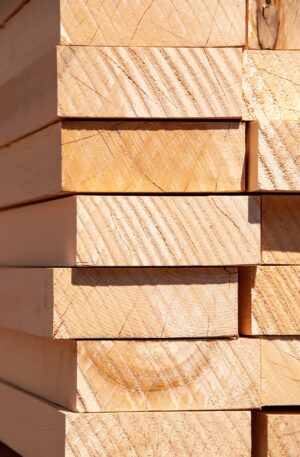
 Wood, a traditional and sustainable structural material, has long been used in construction and furniture due to its availability and mechanical properties. However, natural wood’s strength is often insufficient for advanced engineering applications. Now, researchers from Nanjing University have developed a novel self-densification strategy to create super-strong wood that could replace metals and alloys. The team used a combination of partial delignification and a LiCl/DMAc swelling process to release and reorganize wood fibers. This method allows the fibers to move inward and fill the cell lumen, followed by air-drying to achieve self-densification. Unlike traditional compressed wood, which relies on unidirectional compression, this self-densified wood exhibits uniform shrinkage in the transverse area, maintaining its longitudinal dimension.