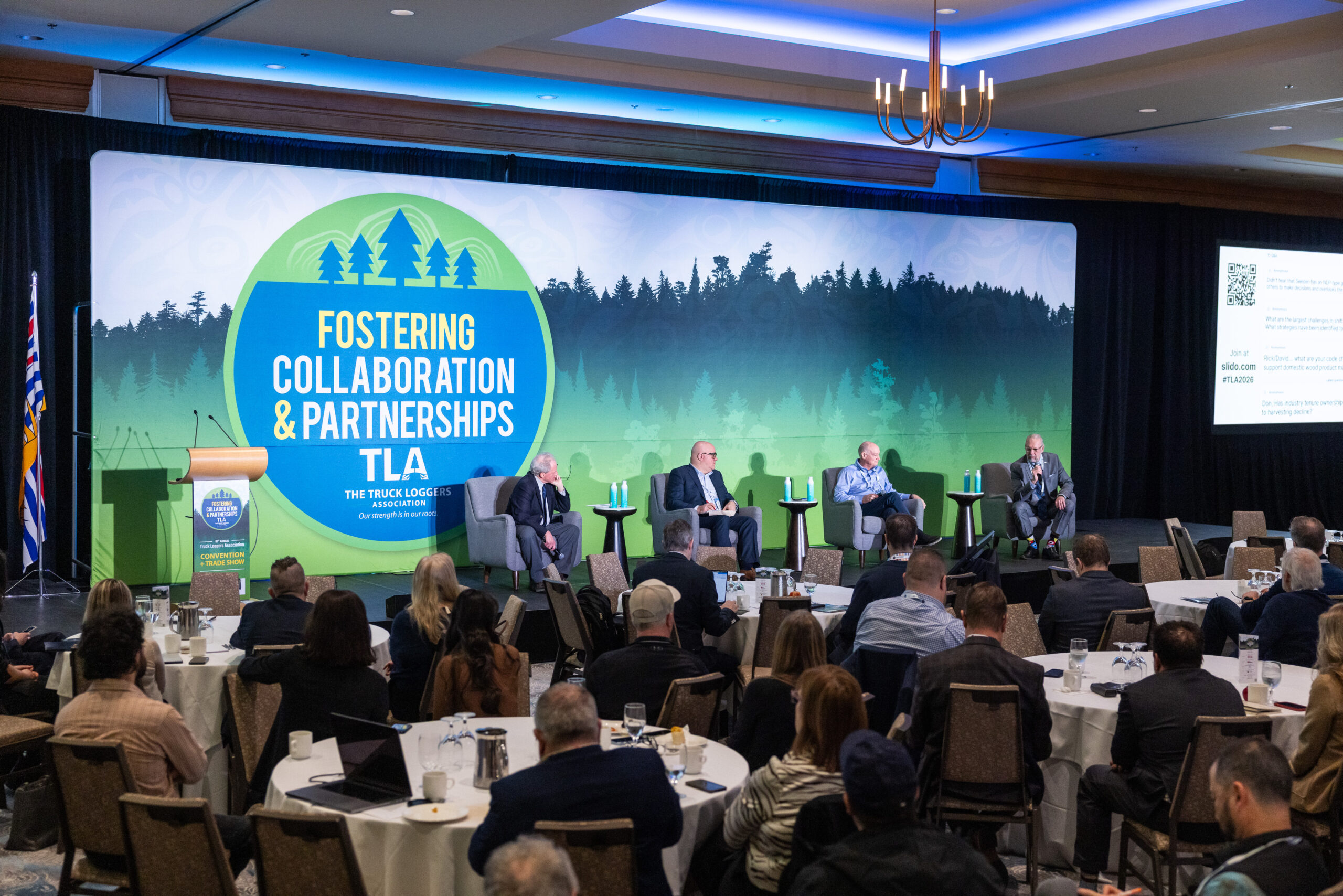
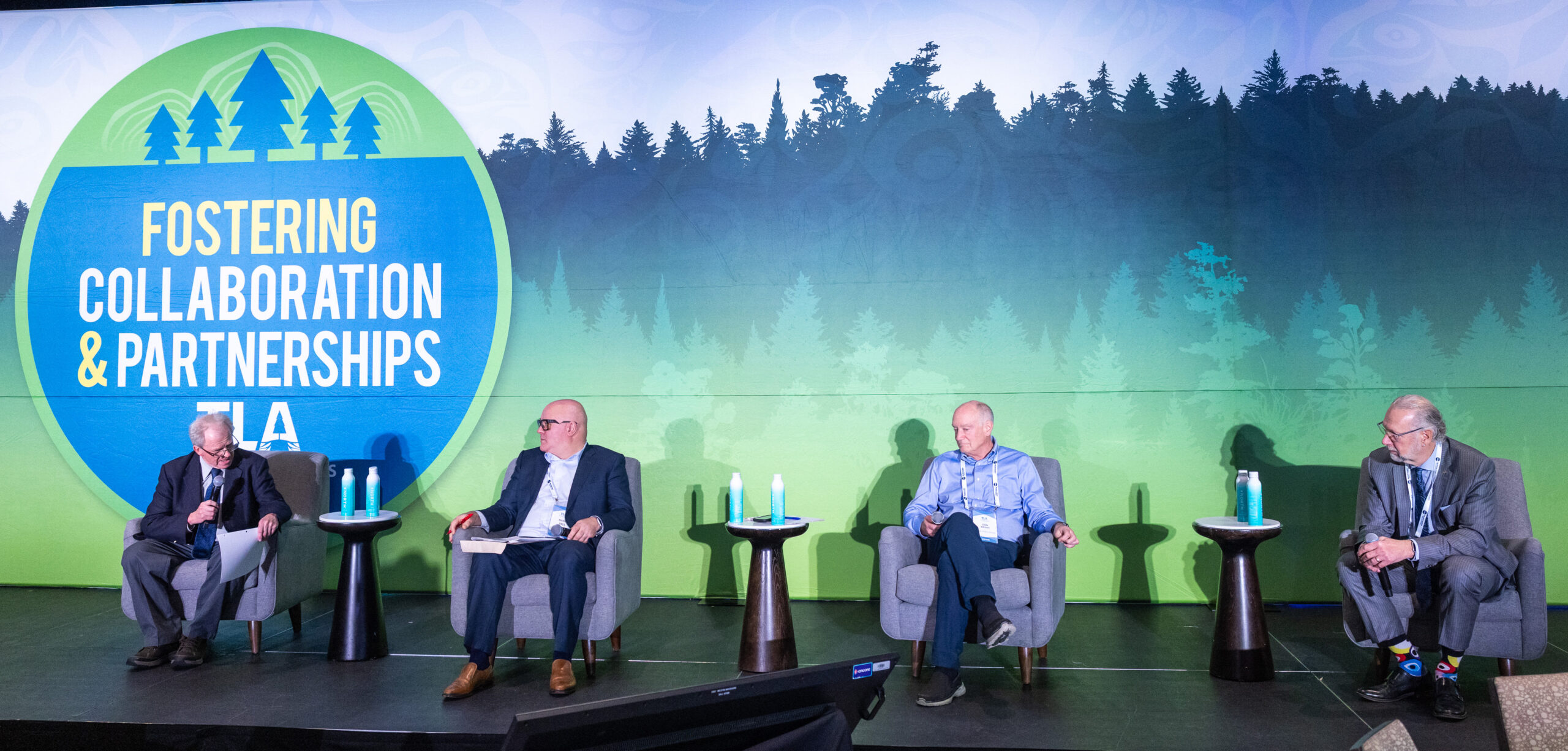
 The Markets & Economy panel opened the technical program at the 81st Annual Truck Loggers Association Convention with a focus on how global trade shifts, domestic construction trends, and policy choices are reshaping the forest sector. Moderated by Vaughn Palmer, the session brought together David Fell, Director of Research and Analysis at Forestry Innovation Investment (FII), Rick Jeffery, President and CEO of the Canadian Wood Council, and Don Wright, Senior Counsel at Global Public Affairs, to examine export markets, domestic demand, and the economic conditions required for the sector to remain competitive.
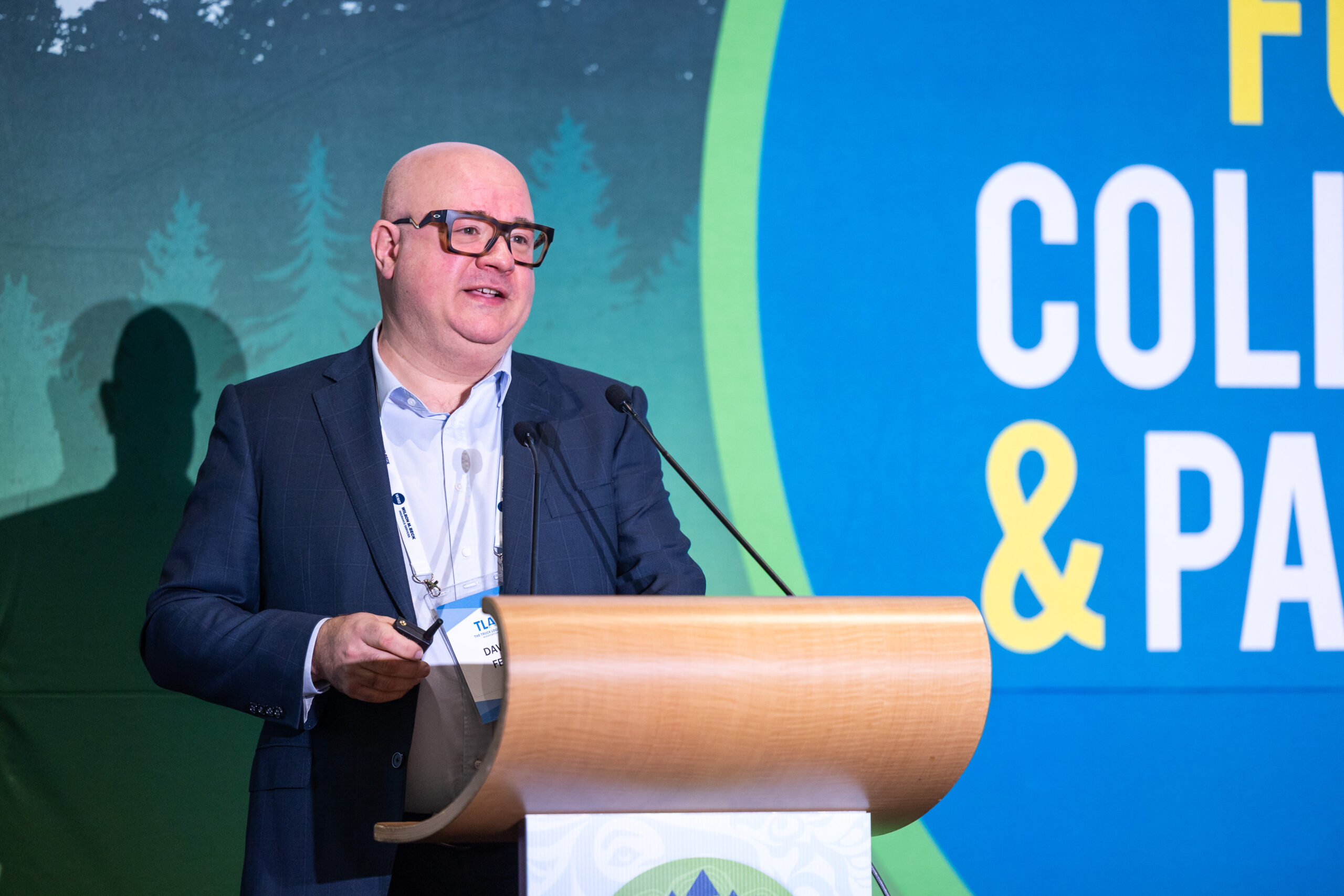 David Fell began with a market-development overview, describing FII as a Crown corporation that supports the forest sector “from mill gate through to end users,” including work on building codes, offshore offices, and research into new applications. Using 2024 data, he said Canada exported about $40 billion in forest products, with BC accounting for roughly $11 billion. Of that, 42% of BC’s forest product exports went offshore, compared with about 14% for the rest of Canada. In 2024, about two-thirds of BC lumber production went to the US, 20% went offshore, and roughly 13% remained in domestic or interprovincial markets. For BC, he said, “by default, … we need diversification.”
Fell emphasized that diversification is not only about volume but also about value. Citing Statistics Canada unit values, he said “unit value matters,” noting that different markets pay very different prices per cubic metre and offer opportunities for different grades and species. He described global lumber trade as a “complex web” and noted that Canada is the world’s largest exporter of softwood lumber, adding that if BC were treated as a country it would rank among the world’s top exporters. He said changing international supply patterns make it essential for BC to be “ready in some of these key import markets to position BC product.”
Fell also addressed domestic diversification. Based on interprovincial trade estimates, he said about seven million cubic metres of lumber move between provinces each year, with BC sending roughly 1.7 million cubic metres, primarily to Ontario and Alberta. He highlighted building codes as a central driver of domestic demand. Code changes allowing five- and six-storey wood-frame buildings created the province’s largest housing category, with approximately 85% wood market share. More recent changes permitting mass timber construction up to 18 storeys were intended to ensure that wood remains viable as cities densify. “We needed to go up with the code,” he said, describing this as essential to protecting wood’s role in urban construction.
 Rick Jeffery followed with a domestic market and construction-focused presentation. He framed the Canadian Wood Council’s mandate as getting “more wood into the built environment in Canada” through codes and standards, market access, technical support, education, and outreach. “Basically our job is to build the road that the industry needs to travel on in the future,” he said, and to ensure that road “is going to the right location.” He identified the strongest opportunities in low-rise residential, mid-rise five- and six-storey buildings, taller structures, educational buildings, and low-rise commercial facilities, noting that residential construction remains the primary driver of wood demand.
Jeffery said Canada’s housing market is increasingly urban and vertical, with 70% of housing now multifamily, a shift he said has “profound implications for our industry.” Based on Council modeling, he said current consumption in targeted segments totals just under one billion board feet annually, but could grow to as much as three billion board feet under more aggressive scenarios. “It’s a big opportunity,” he said, adding that it is “especially significant in light of the antics of US President Trump across the border.”
Capturing that opportunity, Jeffery said, requires changes across the supply chain. While one- to six-storey construction can largely be met with traditional framing lumber, taller buildings require mass timber and engineered products. He described emerging work with the steel industry on timber–steel hybrid systems, noting that steel producers need to decarbonize and that timber offers structural and carbon advantages. “70% of the structural material in those buildings is in the floor,” he said, arguing that timber has a significant role in such designs.
Jeffery said the shift toward factory-built and industrialized construction also raises practical challenges. North American housing, he said, remains a “two-by-four market,” while off-site construction often requires different specifications, consistency, and product forms. He said Canadian producers will need to adapt manufacturing and technology to bridge that gap, pointing to European experience where vertically integrated operations have combined sawmilling with mass timber production and other value-added uses. “Not all 500 sawmills need to change,” he said, “but some of them need to start to look at what they need to do to be able to service both the mass timber market and the industrialized construction market.” Jeffery closed by placing wood within broader climate objectives, noting the scale of future global construction and the sector’s contribution to greenhouse gas emissions. “We have to decarbonize it,” he said, arguing that wood must play a central role.
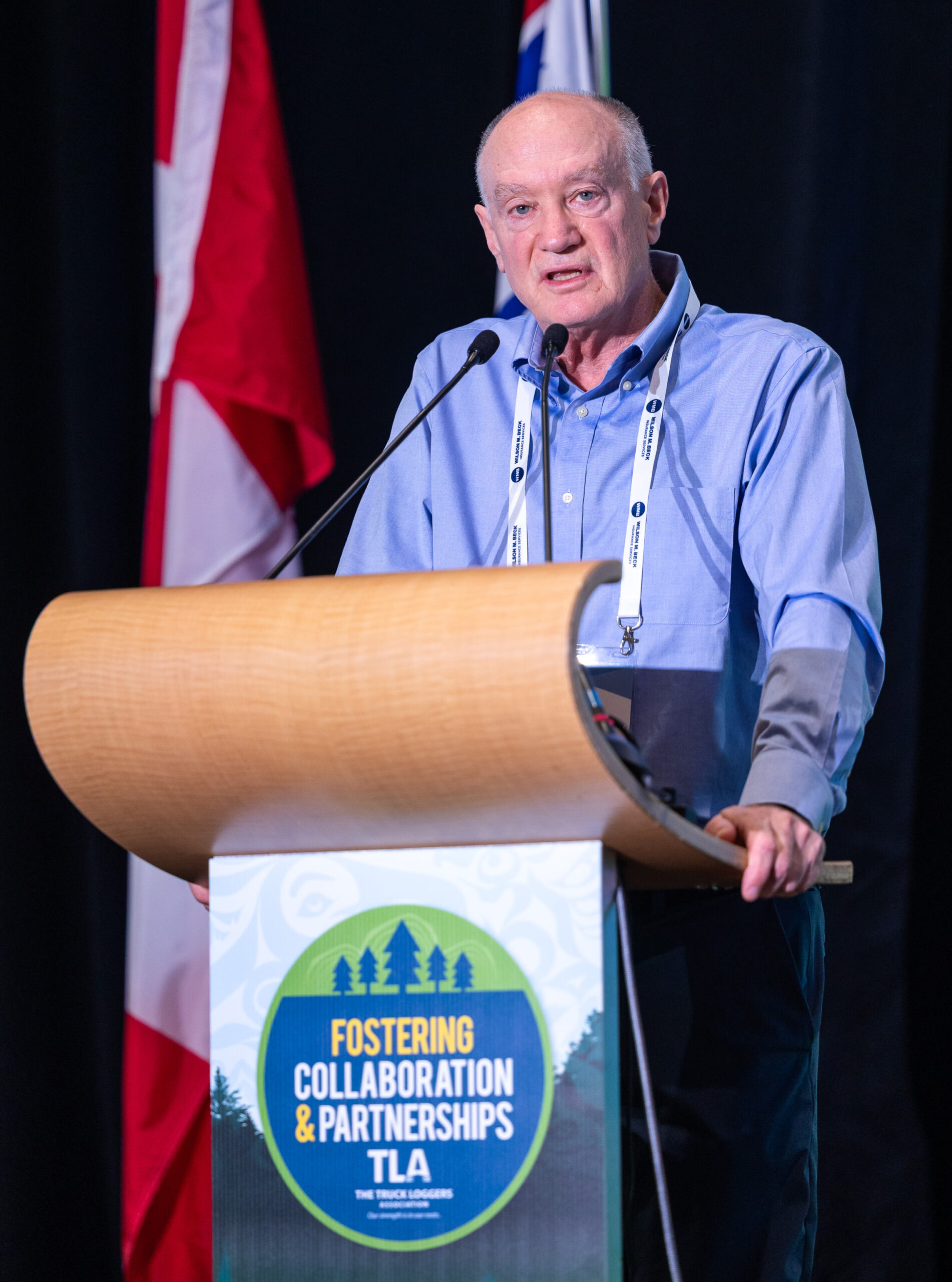 Don Wright then addressed the economic and policy conditions underlying both market diversification and domestic growth. While agreeing that the opportunities described were “real” and “exciting,” he said their success depends on “whether we can make the economics of that work.” He argued that governments often learn economic fundamentals “through pain,” and that the province is now in a period where it must confront cost competitiveness and uncertainty in the forest sector. Wright identified “the big elephant in the room” as “the uncertainty and the cost uncompetitiveness of our fibre supply at this point in time,” calling this “job number one.”
Using historical data, Wright traced the decline in Crown harvest levels over the past decade. After a gradual reduction through the 2010s and a sharp drop following the mountain pine beetle salvage period, he said harvest levels have continued to fall for reasons that are “largely policy driven.” He cited old-growth policies and additional regulatory layers that make it increasingly difficult for the Forest Service to permit volumes. Where BC once harvested about 45 million cubic metres annually, Wright said the current fiscal year projection is about 28 million cubic metres, “and that may be optimistic.”
Wright connected this decline directly to government revenue. He said annual stumpage revenues, which once approached $1.8 to $1.9 billion in peak years, are now forecast at roughly $525 million. Even allowing for unusually high post-pandemic prices, he said the province is collecting “about 50% less revenue than we should be.” He added that stumpage is only part of the fiscal impact: when income taxes, corporate taxes, and sales taxes are included, “total provincial government take… is about four times what that stumpage revenue is.” In his view, this gives government a strong incentive to address fibre supply constraints.
In the moderated discussion that followed, the panelists focused on competitiveness rather than revisiting their presentations. Jeffery said BC’s relatively small domestic market makes scale a challenge for large investments in mass timber and factory-built construction, and that future growth will depend on access to markets along the US West Coast. He emphasized the need for standardization so producers are not required to manufacture components uniquely for each project, arguing that repeatable systems are essential if the sector is to operate at scale. Fell added that, on a per-capita basis, BC has been active in mass timber and is often looked to as a jurisdiction demonstrating what is possible in wood construction.
Asked about immediate actions government could take to improve competitiveness, Wright said there is “not three key immediate actions, there’s one: getting economic sustainable cut to 45 million metres is job number one,” and warned against being distracted by secondary initiatives. Fell said diversification remains essential, not only in how much is produced but in how many markets exist for different products and grades.
Addressing trade tensions with the US, Wright said tariffs on Canadian lumber are “nothing new” and that previous cycles of protectionism had been met through diversification and adaptation. Jeffery and Fell both noted that longer-term demand is tied to housing affordability and construction activity. Jeffery said that without a recovery in residential building, “there’s no market demand,” regardless of tariff levels, while Fell pointed out that housing cycles have rebounded from severe downturns in the past and that underlying demand will return as affordability and interest rates stabilize.
Palmer closed the session by thanking the panelists and noting that several of the issues raised—particularly fibre supply and government policy—would be examined further in subsequent sessions.
Drafted with the assistance of digital tools to streamline the process.