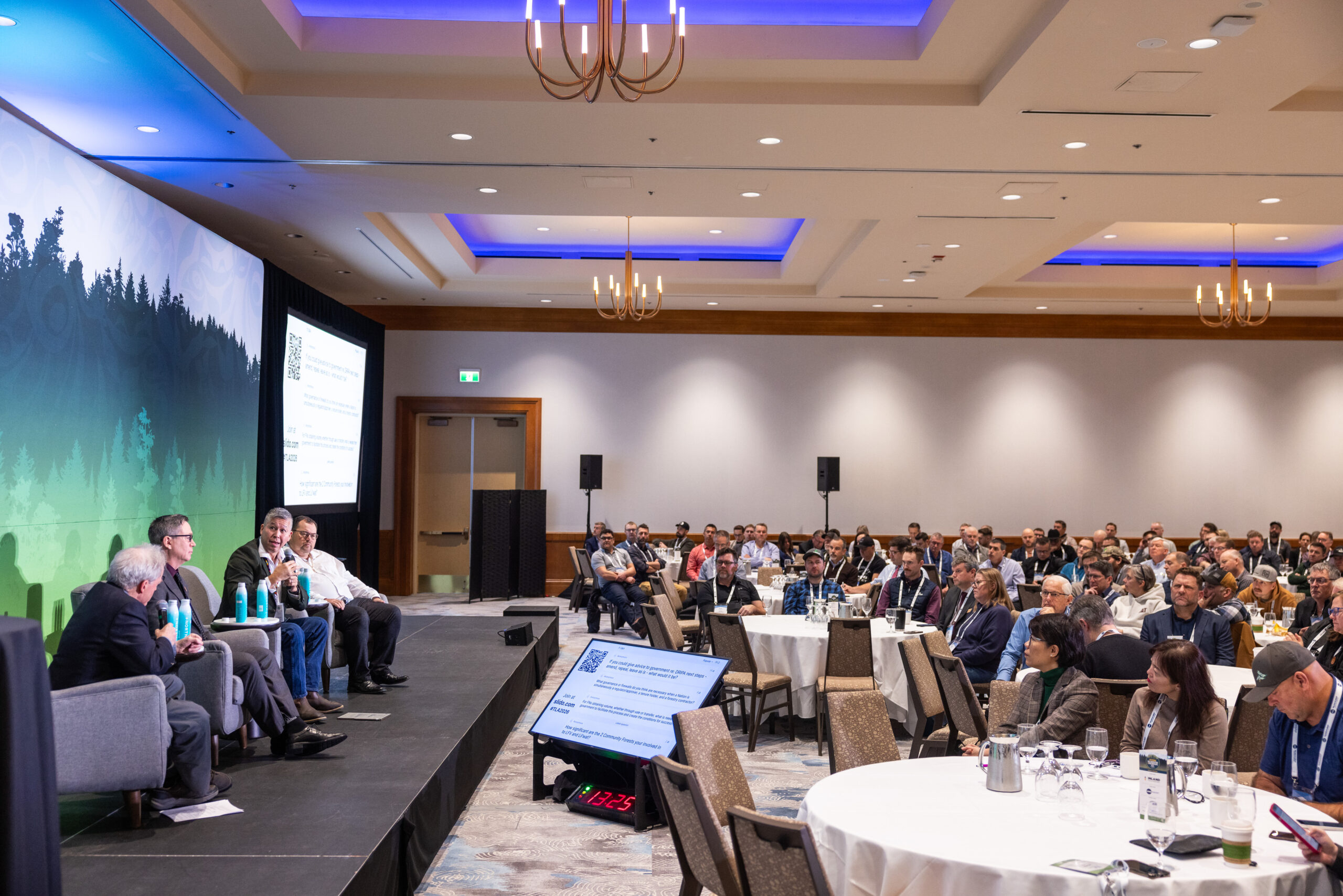
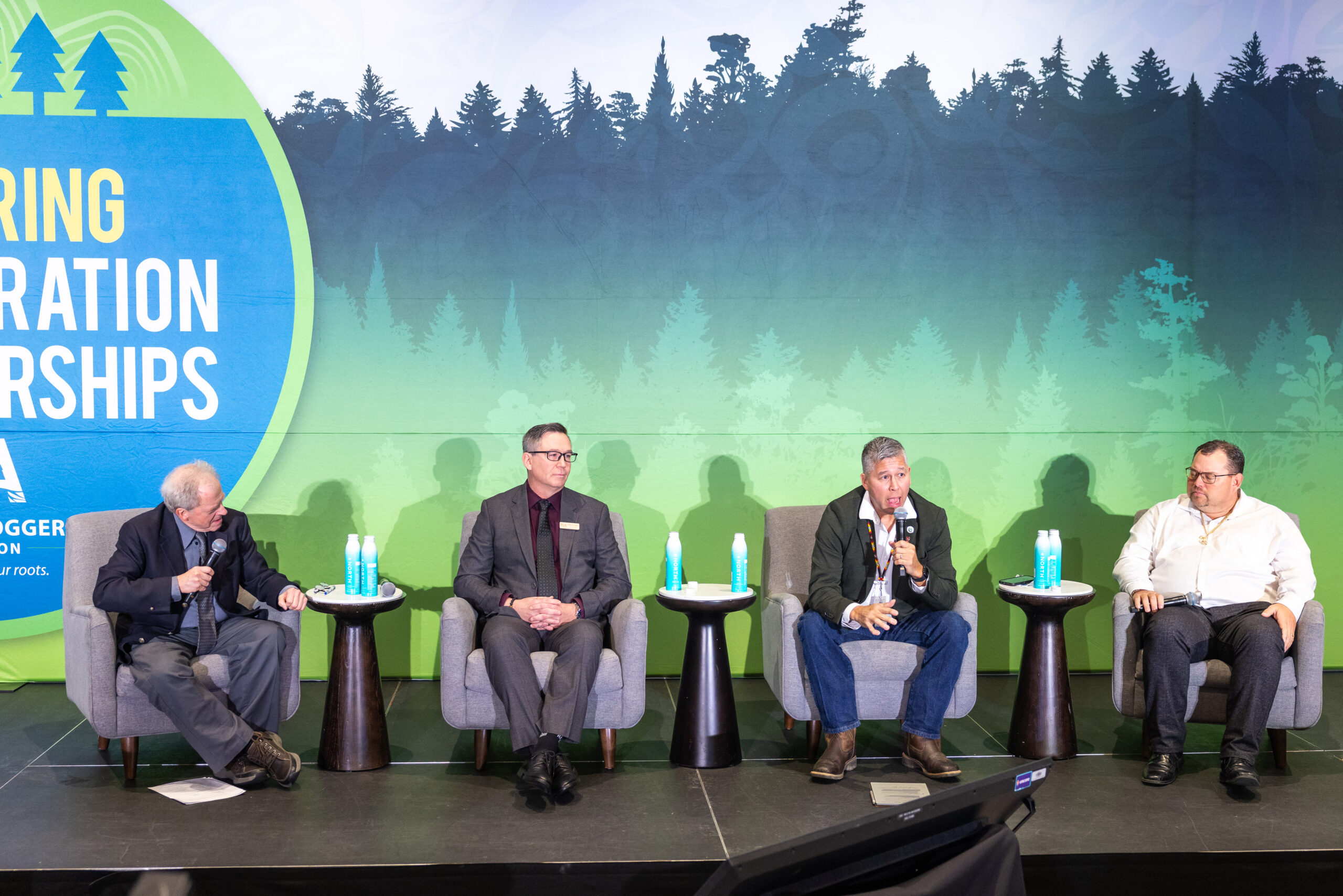
 The first panel of Day 2 at the Truck Loggers Association Convention examined how partnerships between First Nations and industry are evolving across BC, and what conditions are required for those relationships to succeed in practice. Moderated by Vaughn Palmer, the session featured Lennard Joe, CEO of the BC First Nations Forestry Council; Chief Ronnie Chickite of the We Wai Kai Nation; and Klay Tindall, General Manager of Lil’wat Forestry Ventures. The discussion combined strategic context, community-level experience, and operational detail on the practical realities of First Nations–industry partnerships.
Lennard Joe opened by outlining the scale of Indigenous participation in the forest sector. He said British Columbia is home to 204 First Nations, and that First Nations now hold approximately 10.5 million cubic metres of timber under tenure. In practice, he added, more than 12 million cubic metres is being managed through a combination of tenure holdings, partnerships, and shared decision-making with major licensees. He noted the speed of change, explaining that in 2021 less than six million cubic metres was held under First Nations tenure, making recent growth a significant shift in how forestry is governed in the province. At the same time, he acknowledged that the sector is undergoing a broader transition, with tightening timber supply, rising costs, and major companies responding to new economic realities. In that environment, he said, First Nations are increasingly positioned to invest, acquire tenure, and influence how forests are managed on their territories.
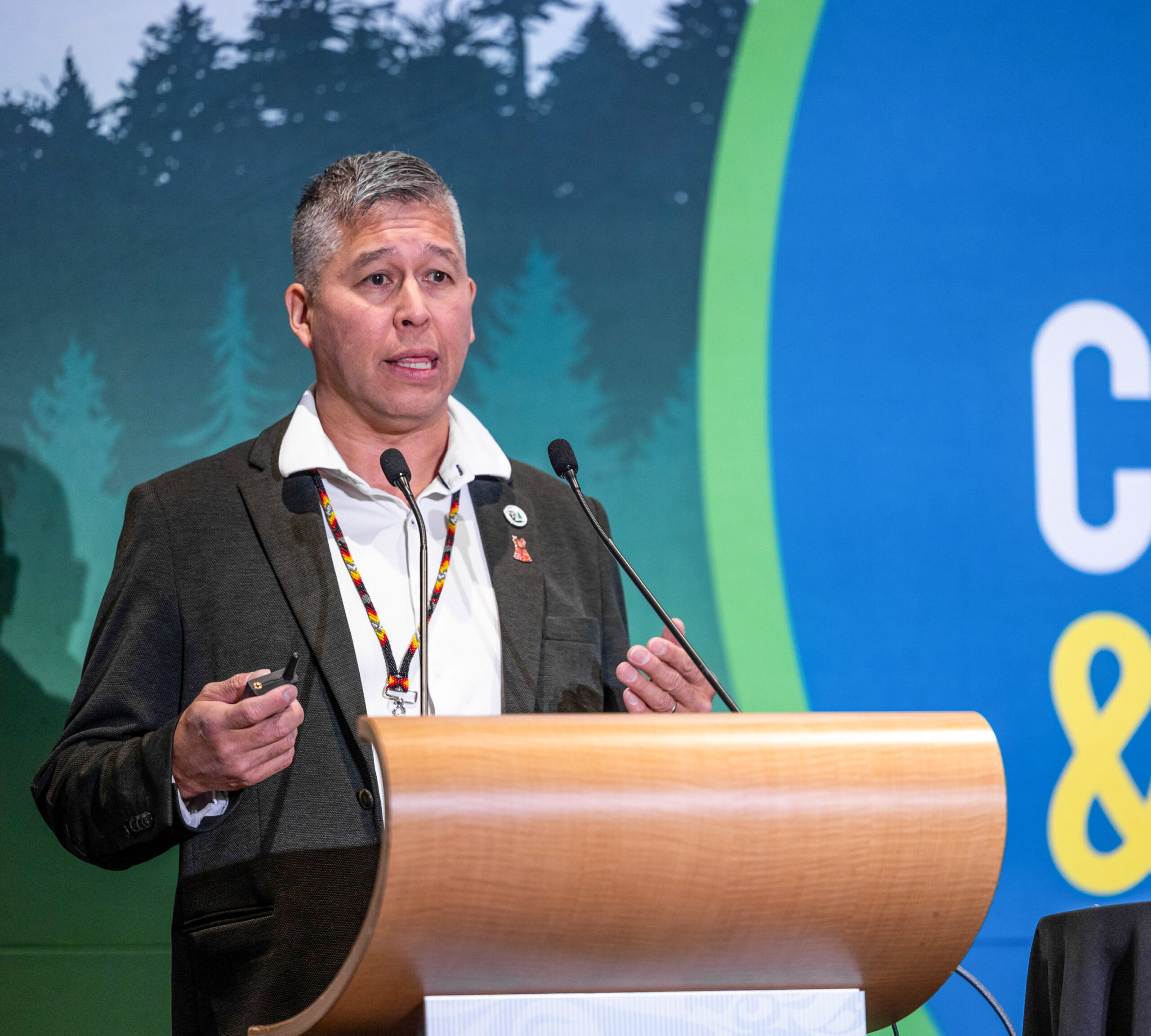 Joe said partnerships work best when the conditions for investment make sense on the ground and when relationships are based on mutual benefit. He added that forestry policy must be operationally feasible and that transformation cannot be driven solely by legislation without regard for how work is actually carried out. Joe also spoke about the responsibilities First Nations carry to the land, describing how knowledge embedded in culture and long-standing stewardship practices shapes how communities approach forest management. That perspective, he said, is now being brought into modern forest governance.
Joe said the BC First Nations Forestry Council has increasingly shifted its focus from working only within Indigenous communities to engaging across the entire forestry sector. Workforce capacity, he noted, is a major concern as the industry ages and faces growing demand for skilled workers, a challenge he said affects the sector as a whole. He said many First Nations now have both the financial capacity and the readiness to invest in forestry and related businesses. Joe described how economic conditions and policy changes have created opportunities for communities to acquire assets, form partnerships, and explore value-added activities, adding that the Forestry Council is increasingly focused on connecting communities with potential investors and partners, particularly in rural areas where relationships are central to business development.
He also pointed to international engagement, saying the focus is not simply on exporting more raw material, but on attracting innovation and new forms of production to BC. He said this reflects a broader move toward diversification and value-added activity rooted in local communities. Looking ahead, he said policy and legislation will need to continue evolving in ways that make operations workable on the ground. He noted that, unlike mobile capital, First Nations cannot relocate, and that their focus is on building lasting economic and environmental foundations for future generations.
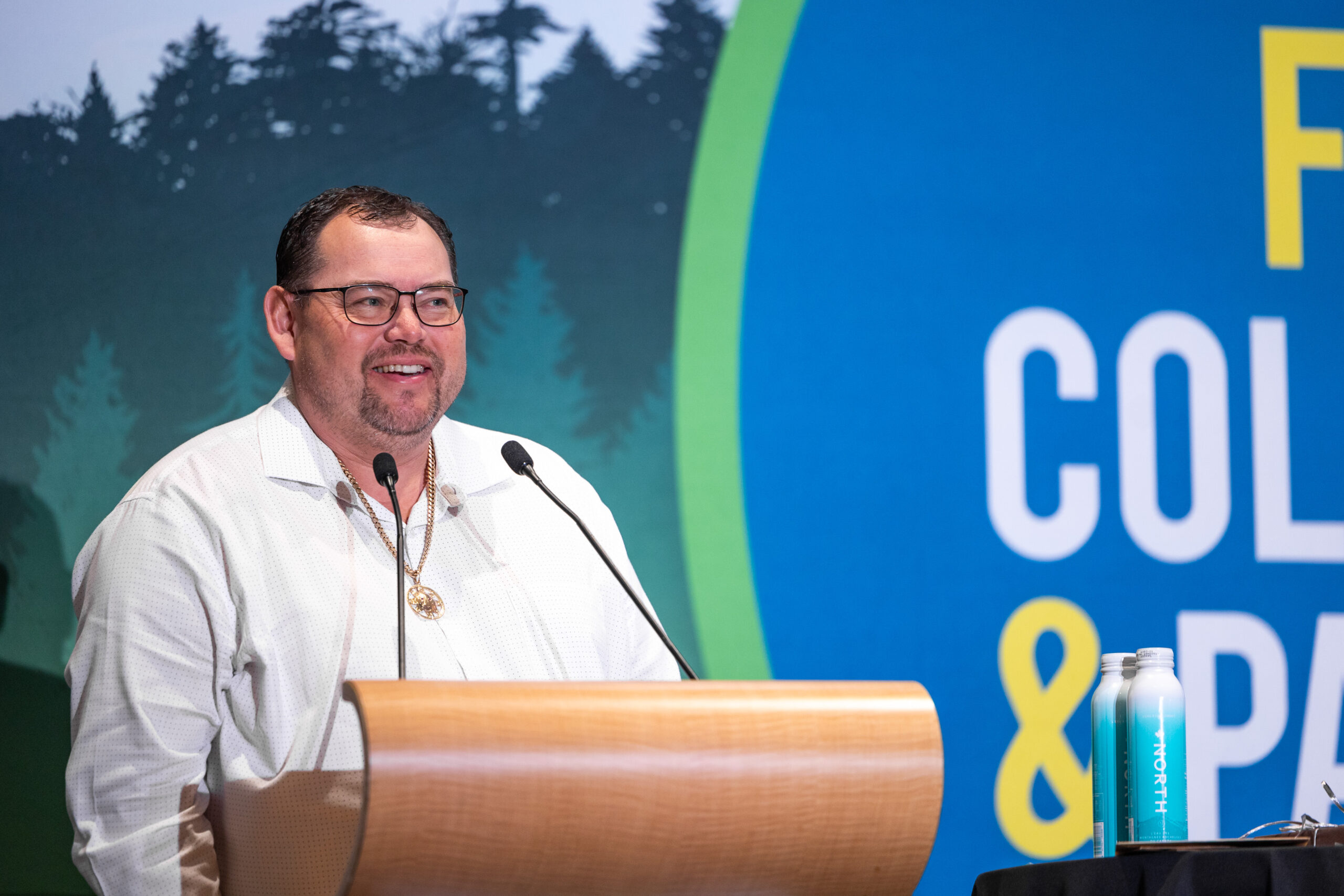 Chief Ronnie Chickite then described how these principles have been applied within the We Wai Kai Nation. He said that when he was first elected chief, the Nation held two woodlots and a small licence totalling about 10,000 cubic metres. Today, through purchases and investment, We Wai Kai controls close to 220,000 cubic metres annually. He credited this growth to leadership within the Nation and a willingness to take calculated risks in order to build a long-term forestry base.
Chickite highlighted the importance of early partnerships in creating that foundation. He said that initial harvesting opportunities provided the entry point for the Nation, allowing it to build experience, credibility, and market access over time. Without those first steps, he suggested, the Nation’s current position would not have been possible. He framed forestry as a long-term investment strategy rather than a short-term revenue source, saying his Nation has already invested approximately $60 million in forestry and related businesses and intends to invest further. For him, forestry is central to community well-being, employment, and regional economic stability. “Forestry feeds my family, my community,” he said, extending that impact to Campbell River, the North Island, and the many workers whose livelihoods depend on the sector.
Chickite also addressed perceptions surrounding Indigenous ownership. He said that when First Nations acquire forestry assets, it is not about displacing workers or shutting down operations, but about maintaining stability and keeping people working. In his view, First Nations participation is about continuity and long-term involvement in the industry. He described how forestry revenues are being reinvested in social priorities, including education, outlining the creation of an education fund supported by forestry income that provides bursaries for students. He said the Nation now contributes roughly one million dollars annually in own-source revenue to post-secondary education, countering assumptions that such funding is solely government-provided. For Chickite, this reinvestment demonstrates how forestry partnerships can generate benefits that extend beyond the forest sector itself.
He also acknowledged the role of government in facilitating access to tenure and private land, describing these steps as important in enabling economic self-sufficiency. His broader message was that partnerships require long-term commitment, shared responsibility, and mutual benefit. He said relationships will not endure if one party consistently carries more of the burden than the other.
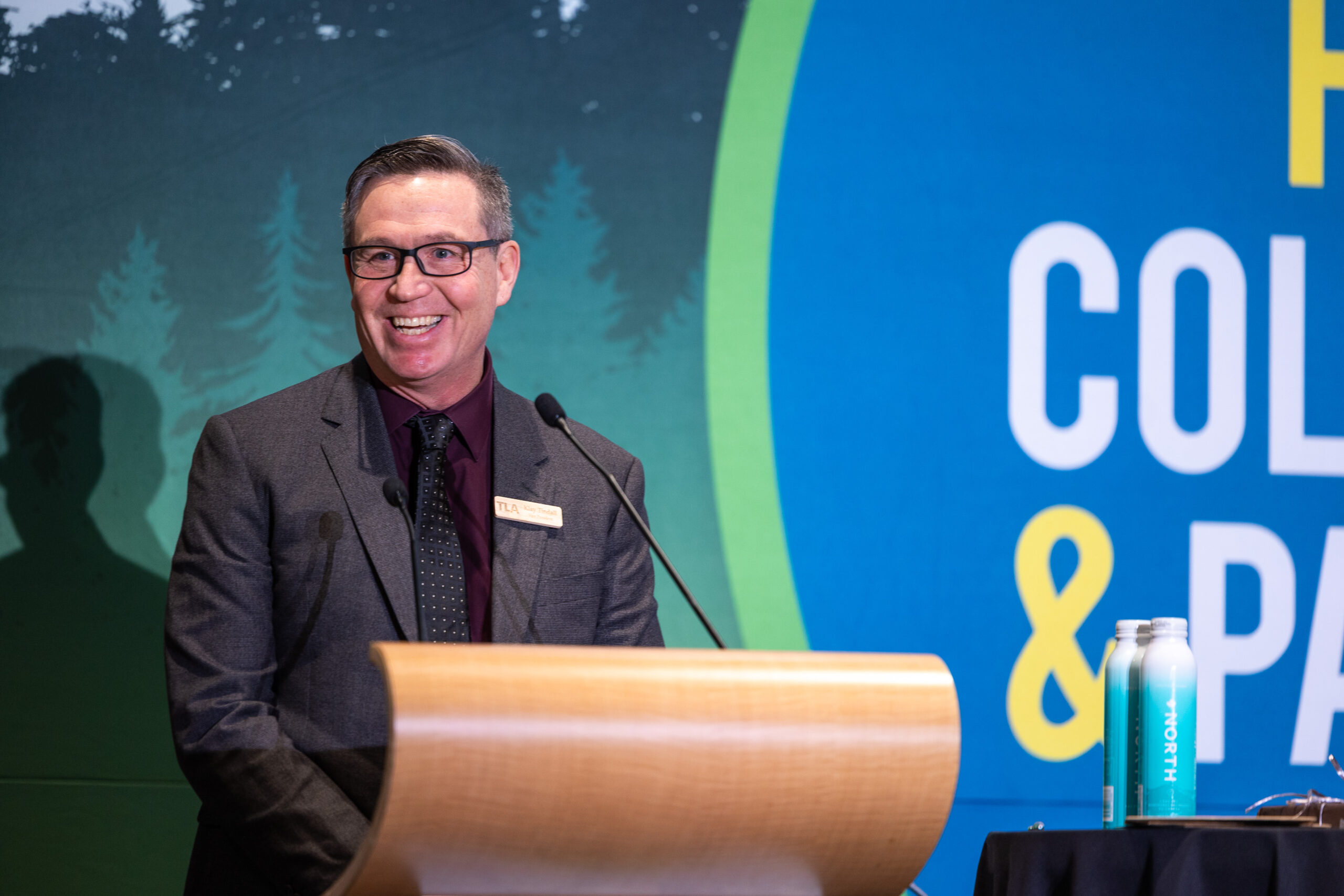 Klay Tindall followed with an operational perspective from Lil’wat Forestry Ventures. He recounted that when he joined the company in 2012, operations were unprofitable, safety standards were inconsistent, and the business lacked the capacity to sustain itself. Partnerships, he said, were essential in reversing that situation. Initially driven by financial necessity, the company gradually stabilized and began to prioritize additional values: employment for community members, stewardship of the land, and long-term capacity building. Tindall said the workforce has grown from fewer than ten employees to more than fifty, with further expansion planned. He described how this growth has been accompanied by a change in how forestry is viewed within the community. Where logging once faced resistance, the company now works to explain its practices, communicate management decisions, and demonstrate that harvesting can be conducted in ways that align with cultural and environmental priorities. Transparency and ongoing engagement, he said, have been critical in building trust.
He outlined how partnerships with government agencies, neighbouring Nations, and research organizations have supported the company’s expansion into areas such as firefighting, cultural burning, training programs, and ecological research. Tindall emphasized that learning from experienced contractors and industry partners was central to developing the operational skills needed to undertake activities such as tree planting, thinning, and fuel management. He also explained how revenue from timber harvesting has been used to fund forest treatments, including fuel reduction and thinning around the Lil’wat community to reduce wildfire risk. He said the company has used timber value to carry out this work while maintaining cultural and ecological standards, instead of relying solely on government funding. He pointed to work in sensitive areas, including spotted owl habitat, as an example of how collaboration with regulators and researchers can integrate conservation objectives with active management.
In the discussion period, one of the few new topic areas raised concerned reconciliation and the Declaration on the Rights of Indigenous Peoples Act (DRIPA). Chief Chickite said his Nation does not support repealing the legislation, arguing that it has created space for First Nations to participate meaningfully in decisions over resources that historically delivered little benefit to Indigenous communities. Tindall echoed concerns about the longstanding outflow of value from rural areas and emphasized the need for approaches that retain economic benefits locally. Joe concluded by calling for greater understanding of DRIPA, saying it is intended to bring all parties into discussions about how laws governing land use are shaped. While acknowledging that the process is challenging, he said it is necessary if forestry governance in BC is to become more durable and inclusive.
Drafted with the assistance of digital tools to streamline the process.