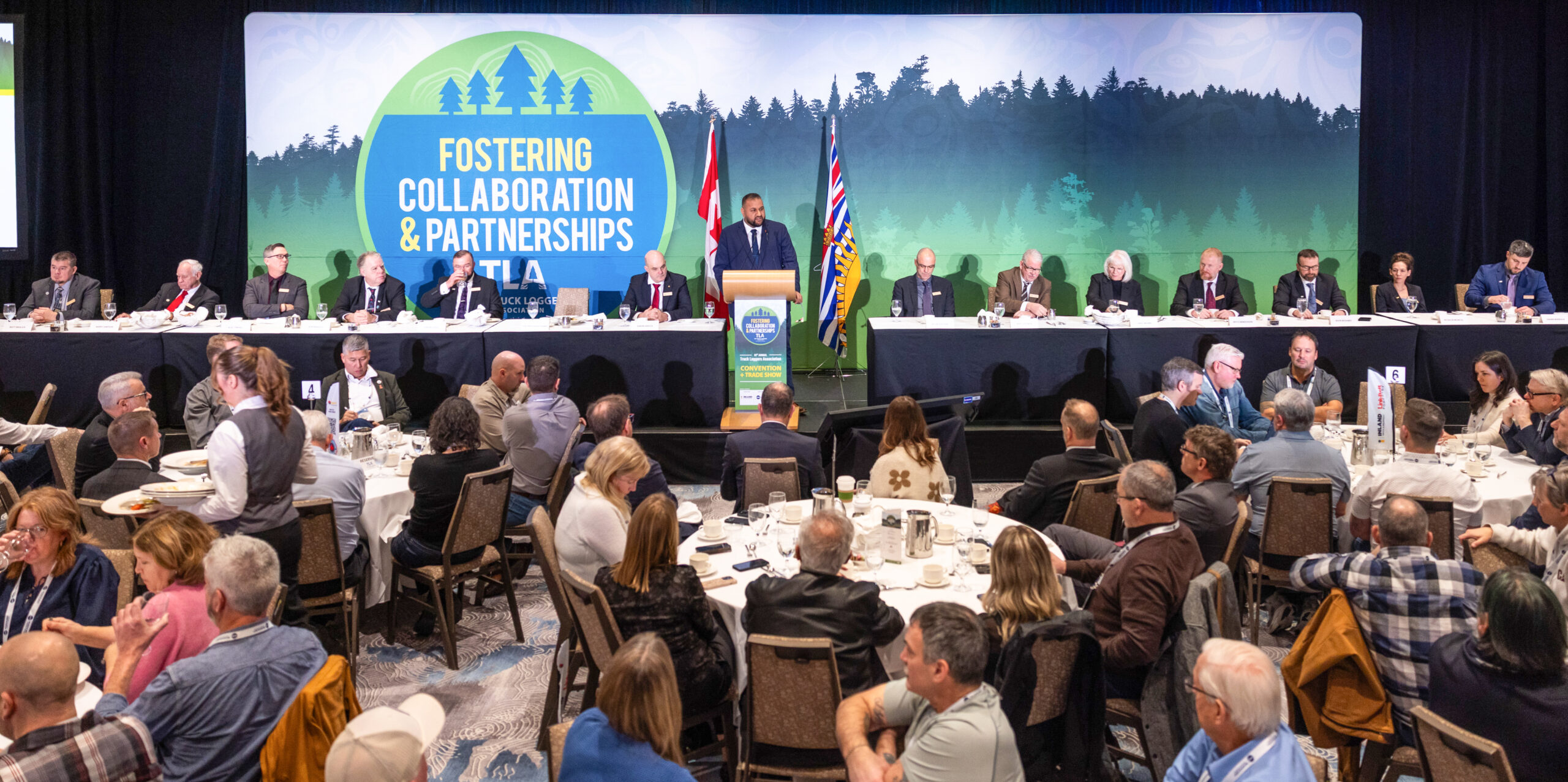
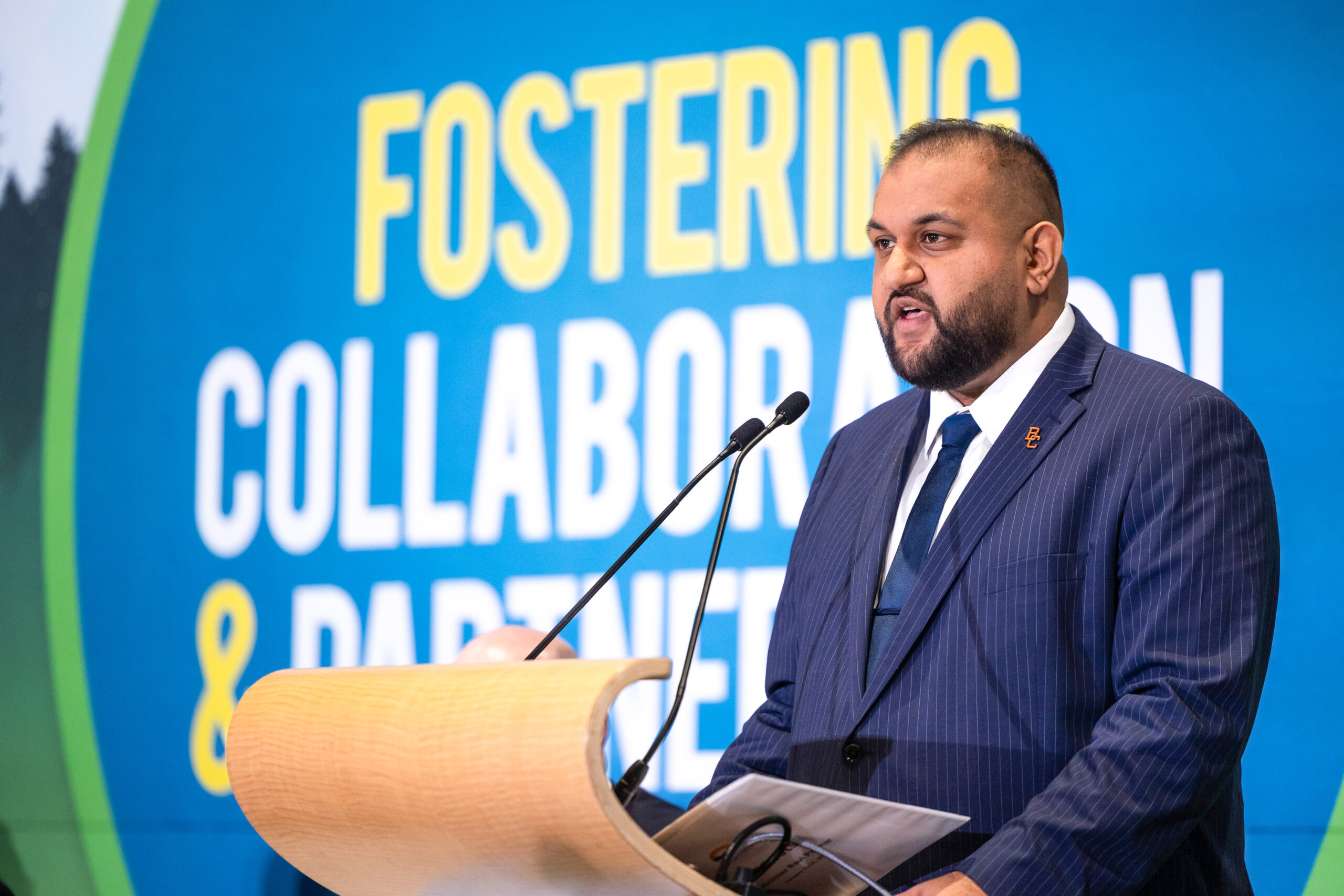
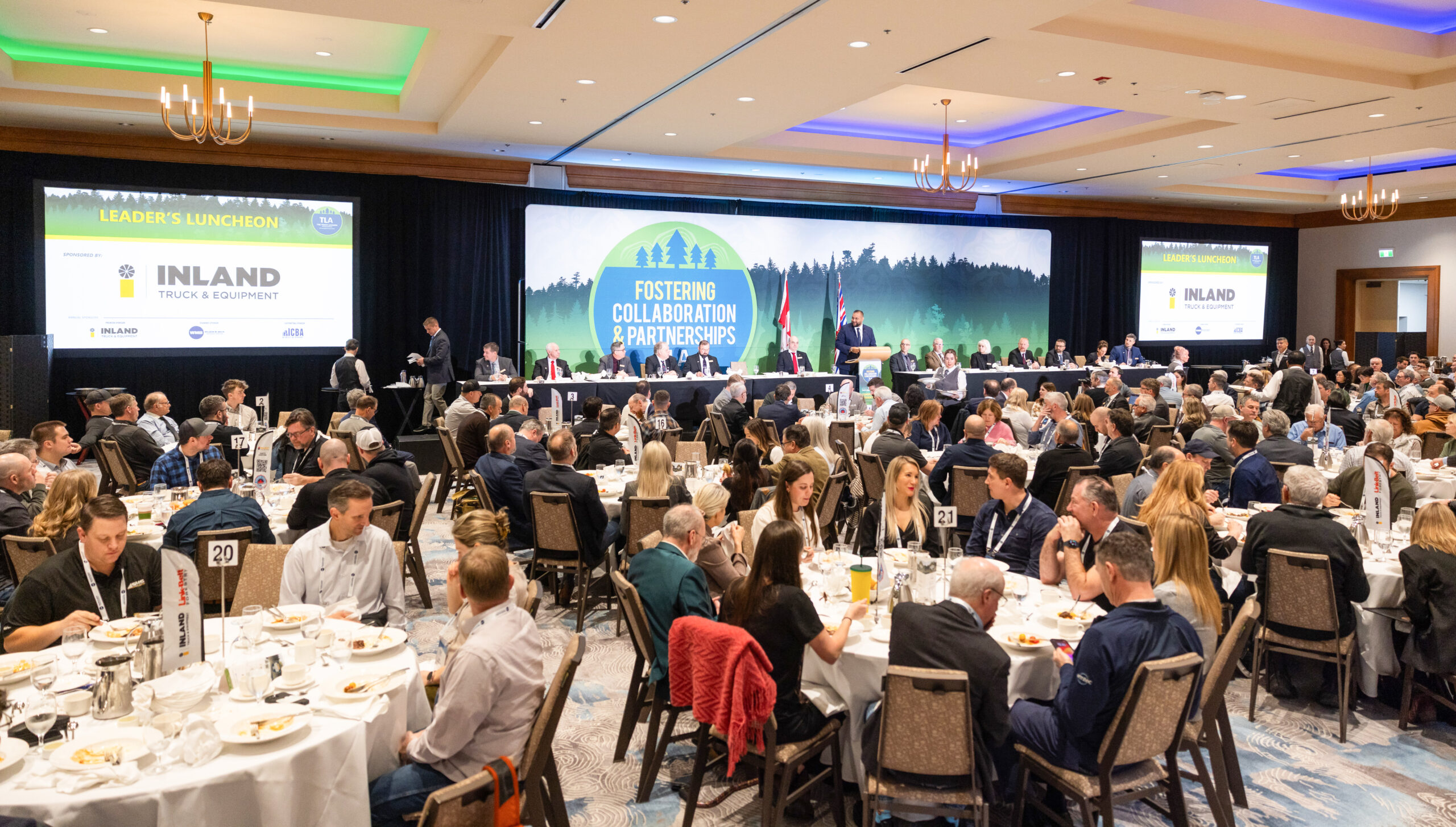
 Forests Minister Ravi Parmar used his Leader’s Luncheon address at the Truck Loggers Association Convention to speak directly to the pressures facing British Columbia’s forest sector and the government’s response. His remarks followed a pre-recorded video message from Premier David Eby, who is currently on a trade mission to India. Eby emphasized the importance of strengthening international trade relationships and promoting BC products in a period of global uncertainty, framing forestry as a sector under strain from market disruption, rising costs, and shifting economic conditions.
Parmar began by thanking TLA members and recognizing the pressures facing contractors and communities across the sector. He said forestry is facing a convergence of challenges, including market volatility, high operating costs, trade uncertainty, wildfire risk, and ongoing structural change. Acknowledging that the past year had not delivered all of the outcomes government had hoped for, he said it was important to speak directly about what has been learned, what is changing, and what remains to be done. Contractors and workers, he told delegates, must remain central to policy decisions, and maintaining a viable operating base in rural and resource-dependent communities is essential if the sector is to recover.
Beginning with wildfire risk, Parmar said recent fire seasons have underscored the need for a more proactive approach that integrates forest management, community protection, and emergency response. In that context, he announced an expansion of the Risk Reduction Equipment Support Trust (REST) program. Under the updated program, the province will increase its contribution toward the cost of eligible equipment from 10% to 25%, applying to new and used equipment as well as to modifications that allow machinery to be used in fuel management, thinning, and other wildfire mitigation activities. The intent, he said, is to help contractors invest in the tools needed to carry out risk-reduction work safely and efficiently, while strengthening the sector’s capacity to respond to wildfire threats. He said the change is part of a broader effort to ensure that wildfire risk reduction is treated as core work rather than an add-on, recognizing that contractors are often asked to undertake this work without adequate support for equipment and sustained activity on the landscape.
 Parmar also addressed the government’s efforts to stabilize timber supply and improve the functioning of the forest management system. He said that restoring confidence in fibre availability remains one of the sector’s most critical challenges, and that policy direction must translate into volumes that can actually be planned, permitted, and delivered. Referring to the Path to 45 initiative, he reiterated that the objective is not simply to set targets, but to identify and remove operational barriers that prevent fibre from moving to market. He described BC Timber Sales as an important tool in this effort, pointing to ongoing work to modernize BCTS so it can better reflect public values, respond to regional conditions, and provide more predictable opportunities for operators, including initiatives such as commercial thinning, pulp-focused sales, reductions in no-bid auctions, and adjustments to contract structures intended to better match contractor capacity.
 He said the government is also moving toward a more integrated, area-based approach to forest management, aimed at improving planning certainty and aligning harvesting, wildfire mitigation, and ecological objectives through forest landscape planning and wildfire resiliency frameworks. Throughout his address, Parmar emphasized the need for balance—between economic activity and environmental responsibility, between short-term pressures and long-term stewardship, and between policy ambition and operational reality. While reaffirming commitments to reconciliation with Indigenous peoples, climate action, and ecosystem protection, he said forestry must also continue to provide jobs, community stability, and economic opportunity. He also pointed to the importance of international markets, noting that overseas demand remains vital for BC’s forest products industry while domestic construction activity remains constrained, and said the province will continue to pursue market development while working to strengthen the competitiveness of BC producers at home.
He closed by emphasizing that while there are no simple solutions to the challenges facing the sector, government is focused on steps that improve conditions for those working in forestry. He cited the REST expansion as one example of how policy can directly support contractors, and said future changes would continue to be guided, he said, by the need to keep forestry both economically viable and environmentally responsible.
Drafted with the assistance of digital tools to streamline the process.