 Rising inflation and interest rates are getting a lot of press lately for good reason, but one specific force hitting all our companies is skyrocketing diesel prices. Commentary suggests the worst is yet to come, especially as refining capacity has been targeted in various war zones. According to a recent Doomberg article, “It is now certain that a full-blown and extended global diesel emergency is unavoidable, and the only questions remaining are those of degree and fallout.” High diesel prices hurt companies from the start of the supply chain (harvesting) through to delivery of the final product. Companies across our coverage universe have called out diesel and freight-based headwinds on earnings calls and in investor presentations… most notably, Smurfit Westrock.
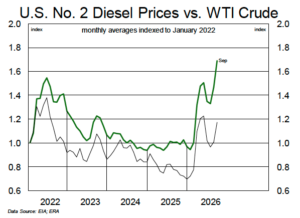 The reality is that US has plenty of diesel, but prices are rising due to actions in the global market. As such, US prices could be capped, and likely reduced, if the Administration halts/reduces diesel exports. That would be beneficial for many US companies/consumers, but would leave Europeans in the lurch. Given the upcoming mid-terms, it isn’t a stretch to see an export reduction, but problems would spread rapidly around the globe as the U.S. is currently the world’s largest diesel exporter. Does the U.S. share the pain or “export” the pain to others? We think the odds are on the latter. Forestry contractors around the globe are pushing for government intervention, ranging from tax relief to additional grants or supports. A swift response is needed.
Other takeaways from September’s ERA Forest Products Monthly include:
- Solid Wood: Lumber markets remain in reasonable balance given the raft of shuts over the past years. Prices are likely to be rangebound though, with a bit of downside risk as duties are set to drop 10%, thus lowering the S-P-F cost floor. OSB prices have nudged up given recent shuts and plywood remains strong with imports held at bay.
- Timber/Log: Log prices remain uneventful in most markets, with the oversupply of pulpwood a pressing issue. Timberland valuations have yet to be seriously impacted by weakening timber cash flows, as other options (carbon, solar, wind, HBU, etc.) add support.
- Pulp: Prices for softwood have finally nudged up in China given multiple closures and continued downtime, but it isn’t away to the races from here with inventory overhangs, possible restarts, etc. Mill inventories jumped more than 500kmt over the past two months, but that was in line with the 10-year average and inventories are below year-ago levels. Various price hikes have been announced and should see some success.
- Paper prices were unchanged for most grades in September, except for newsprint which garnered its full $60 price hike. Cross-border tariffs have been a bit disruptive, but most producers have found workarounds.
- Containerboard producers were largely successful on the September pricing front, with PPI Pulp & Paper Week recognizing a $70 increase for linerboard and $100 for medium. Markets are tight, but more due to supply factors than strong demand. A small amount of new supply is ramping up (e.g., IP’s Riverdale), and there is potential for a new entrant later this year.
- Boxboard: Oversupply has been an issue in the market for more than a year, but capacity closures keep chipping away at the excesses, with recently announced shuts by RYAM and Greif. Operating rates are improving, but not enough to enable broad price hikes. Announced price hikes for URB finally gained traction this month, but other grades have not seen any movement over the past couple of months. Pricing compression across all grades has reached a new low.