
Kevin Mason
Rising inflation and interest rates are getting a lot of press lately for good reason, but one specific force hitting all our companies is skyrocketing diesel prices. Commentary suggests the worst is yet to come, especially as refining capacity has been targeted in various war zones. According to a recent Doomberg article, “It is now certain that a full-blown and extended global diesel emergency is unavoidable, and the only questions remaining are those of degree and fallout.” High diesel prices hurt companies from the start of the supply chain (harvesting) through to delivery of the final product. Companies across our coverage universe have called out diesel and freight-based headwinds on earnings calls and in investor presentations… most notably, Smurfit Westrock.
The reality is that US has plenty of diesel, but prices are rising due to actions in the global market. As such, US prices could be capped, and likely reduced, if the Administration halts/reduces diesel exports. That would be beneficial for many US companies/consumers, but would leave Europeans in the lurch. Given the upcoming mid-terms, it isn’t a stretch to see an export reduction, but problems would spread rapidly around the globe as the U.S. is currently the world’s largest diesel exporter. Does the U.S. share the pain or “export” the pain to others? We think the odds are on the latter. Forestry contractors around the globe are pushing for government intervention, ranging from tax relief to additional grants or supports. A swift response is needed.


 The US hardwood industry is still working through a deep capacity contraction. At the 2026 National Hardwood Lumber Association convention, Hardwood Review said it had identified 151 publicly announced sawmill and yard closures since the start of 2023, while other presentations highlighted a larger role for log exports and NHLA’s longer-term efforts to develop new structural and value-added markets for hardwoods. Highlights include:

 President Trump’s near-global tariff policy is being challenged in federal court — again. A panel of three judges at the US Court of International Trade heard arguments from a group of small businesses and Democratic-led states who say Trump’s sweeping “Section 301” tariffs overstep the law. It’s the third time in less than two years that the courts have been asked to intervene against the president’s attempt to impose sweeping tariffs on the vast majority of U.S. imports. The latest tariffs put 10% or 12.5% rates on goods from 86 countries, covering 99.4% of US imports. The Trump administration said they were imposed in response to the targeted countries failing to effectively enforce bans on the trade of goods produced using forced labor practices. But an attorney for the challengers said at the start of Wednesday’s hearing that a “constellation of factors” show the government’s justification was a “pretext” in pursuit of reviving Trump’s worldwide tariff regime.
 Imported hardwood timber and lumber could be the next wood products to face a US national security tariff, with the Commerce Department’s one-year deadline to report back to the White House on those imports running out at the end of today in Washington. That is according to the proclamation President Donald Trump signed a year ago this week, which requested the update so he could decide whether the phased import duty that Commerce recommended in July last year is warranted. “By October 1, 2026, the Secretary shall provide the President with an update on imports of hardwood timber and lumber, their markets, and the domestic industry,” the proclamation instructs.” …Trump put off the planned increases to 30 and 50 per cent by a year at the end of last year, with the amended proclamation citing “productive negotiations of agreements with multiple countries” on wood products.



 Walmart has settled its case over more than US$80 million in claims against Structurlam, the Canadian mass timber manufacturer it hired to supply its new head office. That is according to the US Bankruptcy Court for the District of Delaware, which approved the settlement with the trust representing Structurlam’s creditors in July and closed the case in August. … According to the trust, Walmart first brought forward deadlines for one building in July 2022, then redesigned six of the eight main buildings a month later. The trust said Walmart also stopped paying for accepted timber and refused further deliveries over a glulam fault … The retailer ended the contract in January 2023, saying Structurlam had failed to deliver fully and on time and had not fixed the problems within the time allowed. … No objections to the settlement were lodged before the court approved it.

 OTTAWA — Exports to the United States surged in August as Canadian businesses rushed to get ahead of looming U.S. tariffs. Statistics Canada said Tuesday the country’s merchandise trade surplus increased to $4.2 billion in August, up from a surplus of $787 million in July. August marked the sixth monthly trade surplus in a row. Total exports increased 2.5 per cent to total $77.9 billion for the month, helped by a 4.7 per cent rise in exports of energy products. Excluding energy products, exports were up 1.8 per cent. Meanwhile, total imports fell by two per cent in August to $73.7 billion, the first decline since January. Exports to the US rose 8.1 per cent in August, while imports dropped 2.5 per cent. That drove a surge in Canada’s trade surplus with the US — widening to $11.2 billion in August. …Katherine Judge, at CIBC, said the increase is therefore probably temporary and will unwind come September.
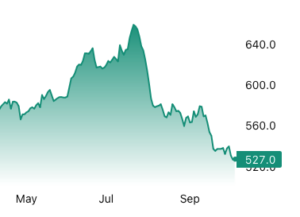 Lumber futures fell to $527 per thousand board feet, reaching their lowest level in two years, as rising borrowing costs weighed on housing demand. Growing concerns over inflationary pressures and government debt have strengthened expectations of higher-for-longer interest rates and fueled a broader sell-off in the bond market, pushing sovereign yields to their highest levels in over two decades. As a result, mortgage rates climbed to 7.3%, their highest level in three years, further straining an already weak housing market. Although lacking any particular economic significance, economists refer to the 7% threshold as a psychological ceiling.
 Capacity utilization at U.S. sawmills and wood preservation plants rose to 76.5% in the second quarter from 70.8% in the previous quarter, according to the Census Bureau. That was the highest since the second quarter of 2025, when it was 77.6%. The Federal Reserve’s industrial production index for sawmills and wood preservation averaged 108.4 in the quarter, up 4.1% from the previous quarter and up 0.7% from a year earlier. Utilization at makers of veneer, plywood and engineered wood products rose to 75.5% from 67.8% in the previous quarter (65.5% a year earlier), while at other wood product manufacturers it rose to 73.3% from 70.1% (67.9% a year earlier). The survey measures actual output as a share of full production capability, so it shows how hard plants are running rather than how much capacity exists. The estimates are subject to revision.
 Mortgage rates increased again this week, with the average 30-year rate hitting 7.4 percent for the first time since November 2023, Freddie Mac reported. The average 30-year mortgage rate rose 12 basis points from last week, when it was 7.28 percent, according to the government-sponsored company. This rate has risen for seven consecutive weeks and has sat above 7 percent for three weeks straight — the first such stretch since April 2024 and May 2024. …Home loan borrowing costs have spiked amid the U.S.’s ongoing war with Iran and a global bond market sell-off, as investors flee the market over persistent inflation and elevated oil prices. The week before the U.S. and Israel attacked Iran, the average 30-year mortgage rate was 142 basis points less. The 10-year U.S. Treasury bond yield similarly rose following the war. …Brent crude oil, the international benchmark, is trading at more than $103 per barrel as of Thursday afternoon.
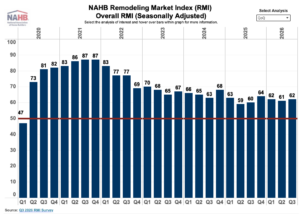 In the third quarter of 2026, the NAHB Remodeling Market Index (RMI) posted a reading of 62, up one point compared to the previous quarter. The RMI has remained within a narrow band between 59 and 70 for the past four years. Remodeler sentiment remains the standout sector within the housing industry, when compared to its single-family and multifamily counterparts. Despite sentiment remaining stable, remodelers report that economic uncertainty is making some potential customers hesitant to move forward with projects. Labor shortages, exacerbated by immigration enforcement and competition from data center construction, are extending the time it takes to complete projects. Nevertheless, remodeling is gaining share in the overall construction market, as it is somewhat less sensitive than new construction to the current elevated interest rates. NAHB’s projection for remodeling activity will remain stable in 2026 and grow slightly in 2027, which is consistent with today’s reading.
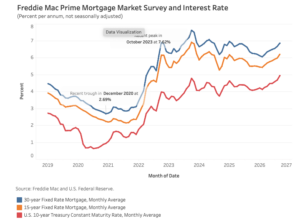 Mortgage rates rose sharply in September as multiple factors applied significant upward pressure on the U.S. treasury yields. According to Freddie Mac, the 30-year fixed-rate mortgage averaged 6.86% in September, up nearly 20 basis points (bps) from August. The recent increase effectively erased the improvement in mortgage rates over the past year, with the 30-year mortgage rate reaching 7.03% by the end of the month. Compared to a year ago, the average rate is higher by 51 bps. The 15-year mortgage rate averaged 6.20% in September, up 22 bps from August and 70 bps from a year ago. The 10-year Treasury yield, a key benchmark for long-term borrowing, jumped 26 bps to an average of 4.94% in September and surpassed 5.00% toward the end of the month. …Broader concerns over elevated oil prices and geopolitical tensions, the U.S. fiscal deficit, and strong competition for capital from AI and hyperscaler investment also contributed to the rise in long-term yields.
 On Monday, President Donald Trump signed an executive order temporarily allowing off-road “dyed” diesel fuel to be used on highways and deferring the applicable federal excise tax for the remainder of the year. The order directs the Secretary of the Treasury to defer payment of the federal excise tax normally imposed when dyed diesel is used on-road. The deferred tax would not accrue interest or penalties, and Treasury is also directed to explore ways to eliminate the obligation to repay those deferred taxes. The Secretary of Transportation is directed to coordinate with states, industry leaders, and labor organizations on access to dyed diesel. …The administration said the temporary measure is intended to reduce fuel costs for farmers, truckers, and other workers affected by restricted global diesel supplies. The full order is available











 The bipartisan 21st Century ROAD to Housing Act — the first major overhaul of housing legislation in more than 30 years — is good news. But the policy, which aims to accelerate housing production across the country, also sets in motion surging demand for one of the oldest and most consequential building materials on Earth: wood. …As cities grapple with the need to increase housing production and decarbonize the built environment, they must take seriously the ecological impact of these material demands. …Since the 1990s, many North American timber operations have received certifications from forestry-standard groups, signaling to eco-conscious developers, architects, and investors that their wood products were responsibly produced. The Forest Stewardship Council (FSC) and the Sustainable Forestry Initiative (SFI) cover the majority of operations in North America. …But SFI policies around clearing primary forests are vague, while the FSC Mix label allows a product to include a majority of wood from non-certified logging operations.




 The roadless rule has flaws. Repealing it entirely could create new ones. …Would more roads help or hurt places such as Mill City? A Trump administration proposal would repeal what’s called the “roadless rule,” which prohibits road building and many types of forest management on 45 million acres of national forest. The regulation could be repealed as soon as next year. Supporters of the administration’s plan argue that these areas should be actively managed to reduce wildfire risks, while many conservationists worry that new roads would hurt forests that are home to many vulnerable wildlife species. The forests also provide drinking water and other environmental benefits. Public comment is open through Oct. 6. …However you feel about the rule, the Forest Service currently lacks the capacity to maintain roads and conduct wildfire mitigation and forest restoration projects at the scale needed. [to access the full story a Washington Post subscription is required]








 A California group said in an Instagram post that it had located the largest redwood tree on Earth following a two-year search. While celebrating the remarkable tree, the post also provides a reminder that awe-inspiring forests are not guaranteed to last, especially as old-growth habitat continues to disappear. In its post, Sacramento Food Forest described an old-growth coastal redwood as having a “base width of 116 feet,” and said it is “over 1,500 years old and 310 feet tall.” It also claimed the tree is wider at the base than “the largest tree in the world, a giant sequoia named General Sherman.” While these precise claims aren’t fully verified, the post included a video showing the tree’s remarkable size. Sacramento Food Forest said larger redwoods once occupied a 2 million-acre coastal band before widespread logging drastically shrank that area.
 For harvesting to be profitable on the scale necessary, we need a competitive market for logs, and our forest products industry was decimated with the earlier cessation of harvesting on federal lands. Today, 25% of our lumber supply, worth about $19.7 billion, is imported from Canada. While we ignored our federal forests, the Canadians have been exhausting their easier pickings. With only difficult sites left, they are cutting back, with more cutbacks planned in the future. In the last decade, lumber production there has decreased by 55%. This is an opportunity that we need to capitalize on. By reestablishing a modest forest products industry, we could create a market for the material we need to thin and harvest. Were we to replace the Canadian lumber with domestically produced lumber, the downstream financial stimulus could add an additional $39.4 billion to our GDP. …Let’s consider some of the possible end products for the thinned and harvested timber.
 Tropical Storm Isaias has formed in the Gulf and is expected to approach the U.S. northern Gulf Coast on Friday after becoming a hurricane, according to the National Hurricane Center. Isaias would be the Atlantic Basin’s first hurricane of the season and is its ninth named storm. El Niño continues to bring a more active season in the Pacific. The storm formed with less than two months remaining in the 2026 hurricane season, which ends Nov. 30. Tropical Storm Isaias, which grew from Tropical Depression Nine on Wednesday,” is expected to pass to the north of Mexico’s Yucatan Peninsula on Thursday before approaching the U.S. Gulf Coast the following day, according to forecasters. It is expected to rapidly strengthen. …The hurricane center warned of “an increasing risk of dangerous wind and storm surge impacts” along parts of the northern Gulf Coast and urged people living in Louisiana, Alabama, Mississippi and northern Florida.
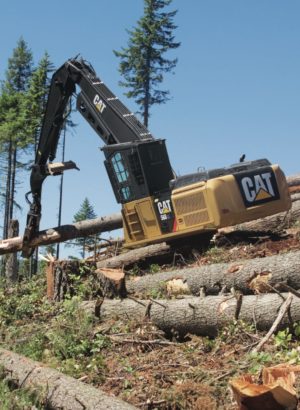 LITTLE ROCK, Arkansas— The timber industry has been vital in Arkansas, contributing more than $7 billion to the state’s GDP. But today, that industry is struggling. …It all has to do with gas prices. …Jeremy Erwin, a 3rd-generation logger running Erwin Resources Services in Fordyce, says “a typical company probably burns a million dollars a year in fuel, and this year, it’s going to hit 2 (million dollars).” …”Our rates probably went up 14-15% on the logging side. …These lifelong loggers are urging Arkansas policy-makers to do something to help stop the bleeding. And as of last week, some relief could be ahead. On September 29th, Arkansas Governor Sarah Huckabee-Sanders signed an executive order that would allow loggers and farmers to use dyed diesel fuel on public highways. This fuel is tax-free and could offer some much-needed assistance.
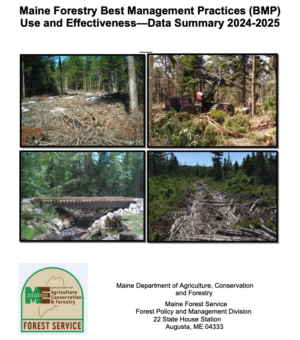 AUGUSTA, Maine — A new Department of Agriculture, Conservation and Forestry Maine Forest Service (MFS) report underscores the effectiveness of environmentally friendly practices during timber harvesting. Released Oct. 1, the “
 In this months newsletter, you’ll find these stories and more:
 WASHINGTON — The Supreme Court kicked off a new term, with the justices wrestling with an attempt by oil companies to throw out lawsuits alleging they should pay damages for the impacts of climate change. Although the case concerns a specific lawsuit the city and county of Boulder, Colorado, brought against Exxon Mobil and Suncor Energy, the ultimate decision could have broad ramifications. …Boulder officials say they face increasing costs because of the impacts of climate change, including efforts to minimize risks from wildfires. …The lawsuit says Exxon and Suncor misled consumers about the impact that greenhouse gases produced by their products would have on the climate. The companies deny the allegations and warn that if the Boulder lawsuit moves forward… energy companies could face crippling damages. They also argue climate change is an international issue that cannot be the subject of litigation in state courts.
 The Supreme Court appeared divided and searching for consensus Monday in a major case involving climate change that could determine whether local governments can sue producers of fossil fuels for potentially billions of dollars in damages over alleged marketing deception and the impacts of global warming. Boulder, Colorado brought the case against Exxon Mobil and Suncor Energy. …A victory for the city would clear the way for its claims — and dozens of similar cases elsewhere — to move forward in state courts but would likely not be the final word in the dispute. “This case involves an unprecedented effort to use state law to regulate global conduct,” argued Kannon Shanmugam, an attorney for the energy companies. “If Boulder’s claims are allowed to go forward, some 90,000 municipalities across the country will have the ability to make national and international energy policy by asking juries to impose catastrophic damages on selected fossil-fuel producers.”
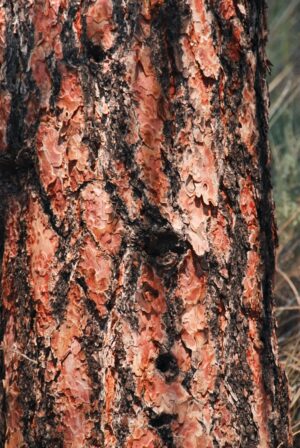 BOULDER, Colorado — To walk deep into the mountain forests at the doorstep of the Rocky Mountains, is to encounter the fragrant majesty of century-old ponderosa pine trees famous for lining ski slopes, National Park trails and residential neighborhoods. Now, those iconic Colorado trees — already under strain from record heat and prolonged drought — are threatened by a rapidly growing outbreak of silent killers: the mountain pine beetle. The mountain pine beetle is the size of a grain of rice but can inflict colossal harm to forests. …More than 700,000 acres in Colorado are affected, officials say. Climate change is blamed for supercharging the emerging outbreak, with no end in sight. …The cost of responding to the pine beetle outbreak, along with the financial impacts from other climate-change influenced environmental threats, are at the heart of a major
  States and cities sued the Trump administration Thursday for repealing rules that limit planet-warming