 With Trump’s 90-day tariff pause set to expire July 9, the US Lumber Coalition renews its attack on Canadian lumber. In other Business news: Tolko and Meadow Lake Tribal Council sign an MOU; BC builders welcome development cost changes; South Carolina turns to biomass to revive its forest economy; and Sweden’s VIDA names Måns Johansson as Vice Chair. Meanwhile: the USDA boosts mass timber capacity; North Carolina researchers develop Styrofoam packaging alternatives; Cincinnati unveils the first mass timber broadcast facility; and Finland’s Spinnova uses spiderweb science to turn wood pulp into textiles.
In Forestry news: FSC supports the EU’s anti-greenwashing directive; FSC Canada releases its annual report; SFI backs the G7 Wildfire Charter; Canada’s signature waterbomber gets a upgrade; BC faces tree canopy shortages; and Michigan trials assisted tree migration. In Wildfire news: the fire near Lytton, BC is being held, but a new fire grows to the north; and crews respond to an “out of control” blaze on Vancouver Island.
Finally, the EU will allow international carbon credits in its binding GHG emissions target.
Kelly McCloskey, Editor
 A fire at
 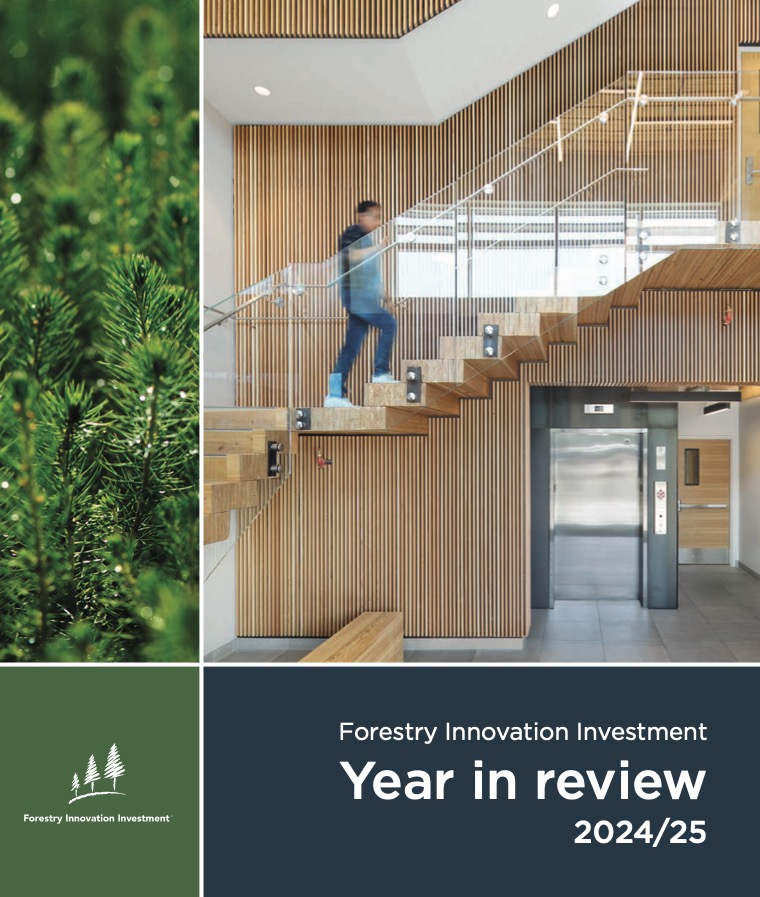 Forestry Innovation Investment (FII) is proud to share our “Year in Review”, a compilation of market development activities completed by FII and our many industry, association, government, academic, and research partners over the past year. Throughout 2024/25, B.C.’s forest sector faced significant headwinds, as difficult industry and market dynamics were compounded by trade threats. Despite these ongoing challenges, the forest sector continues to play a vital role in B.C.’s economy and remains a key global supplier of sustainable forest products and advanced wood building systems. To support a resilient forest economy, FII and its partners are actively working to diversify markets for B.C. forest products both domestically and internationally—a goal that has become increasingly important amid current trade uncertainty. Our commitment to a collaborative delivery approach means we build on the strengths and shared resources that other organizations bring to this important work.
 Domtar (formerly Paper Excellence) has signed a purchase agreement with Cranberry Business Park Ltd. for the sale of the remaining half of its lands at the former Tis’kwat paper mill site in Powell River. “We are looking forward to contributing to the economic future of Powell River and the region,” stated Craig Austin and Thomas Ligocki, from Cranberry Business Park Ltd., in a media release. “With waterfront access and abundant energy sources, this site has so much potential. We are proud to be part of the revitalization of the city’s Historic Townsite, alongside our neighbour at Tis’kwat, the Tla’amin Nation.” “It was a priority for Domtar to find a buyer who would ensure that the lands continue to generate jobs and economic benefit for the broader community well into the future,” stated Carlo Dal Monte, vice-president, Domtar Legacy Assets.
 MACKENZIE — The District of Mackenzie has seen challenges in recent years with a downturn in British Columbia’s forestry industry, but Mayor Joan Atkinson said that diversifying into other industries has made a big impact on her community. … “We suffered a huge loss in taxation from 2024 to 2025 as a result of the closure of two large industrial facilities, but this community has always been resilient,” said Atkinson. …Canfor said it was indefinitely curtailing activity at its Mackenzie sawmill in July 2019. … Paper Excellence permanently shuttered its Mackenzie pulp mill in April 2021. Atkinson noted two factors that have helped the local forestry industry. The first was Forests Minister Ravi Parmar announcing a change in an appraisal system that makes it more economically viable for companies to operate in Northern BC. The second is ownership of nearby timber supply areas by First Nations.
 WASHINGTON — Sen. Mike Lee, R-Utah, said late Saturday that he had dropped his contentious plan to sell millions of acres of public lands from the sweeping domestic policy package that the Senate will soon begin debating. Lee made the announcement on social media after it became clear that the plan faced insurmountable opposition from within his own party. At least four Republican senators from Western states had said they planned to vote for an amendment to strike the proposal from the bill. The plan had also triggered intense pushback from conservative hunters and outdoorsmen across the American West, who had warned that it threatened the lands where they hunted and fished. …Lee said that, because of the strict rules governing the budgetary process … he was “unable to secure clear, enforceable safeguards to guarantee that these lands would be sold only to American families — not to any foreign interests.”
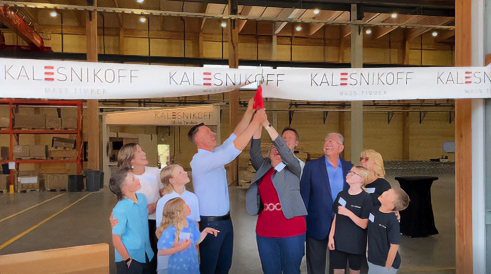 Kalesnikoff Mass Timber recently opened its new 100,000-square-foot mass timber prefabrication and modular facility in Castlegar, B.C., 400 miles east of Vancouver. Starting small just before the Second World War, Kalesnikoff today is a family-owned, fourth-generation company that produces dimensional lumber, glulam beams and columns, glue-laminated timber (GLT) panels, cross laminated timber (CLT) and prefabricated components. The new facility, which is built entirely out of Kalesnikoff’s own mass timber… enables Kalesnikoff to provide new products that can be used for prefabricated walls, flooring, modules and full modular construction. Chief operating officer Chris Kalesnikoff says it’s the first vertically integrated mass timber operation in North America. Kalesnikoff was started by Chris’s great-grandfather and two of his brothers in 1939 as a logging operation. His grandfather and his father (Ken) expanded the sawmill into value-added wood products.



 UK waste wood market processed over 96% of material, annual statistics published this month by the Wood Recyclers’ Association (WRA) showed. The association said that there was “strong demand” for material in 2024. According to the statistics, 4.5 million tonnes of waste wood arose in the UK last year. Of this, 4.33 million tonnes (96%) were sent for reuse, recycling or recovery, the figures showed. The organisation compiled the 2024 figures through its annual survey of members who handle approximately 90% of the market, combining the findings with latest industry data. The figures are somewhat similar to 2023 which saw 97% of the material processed.
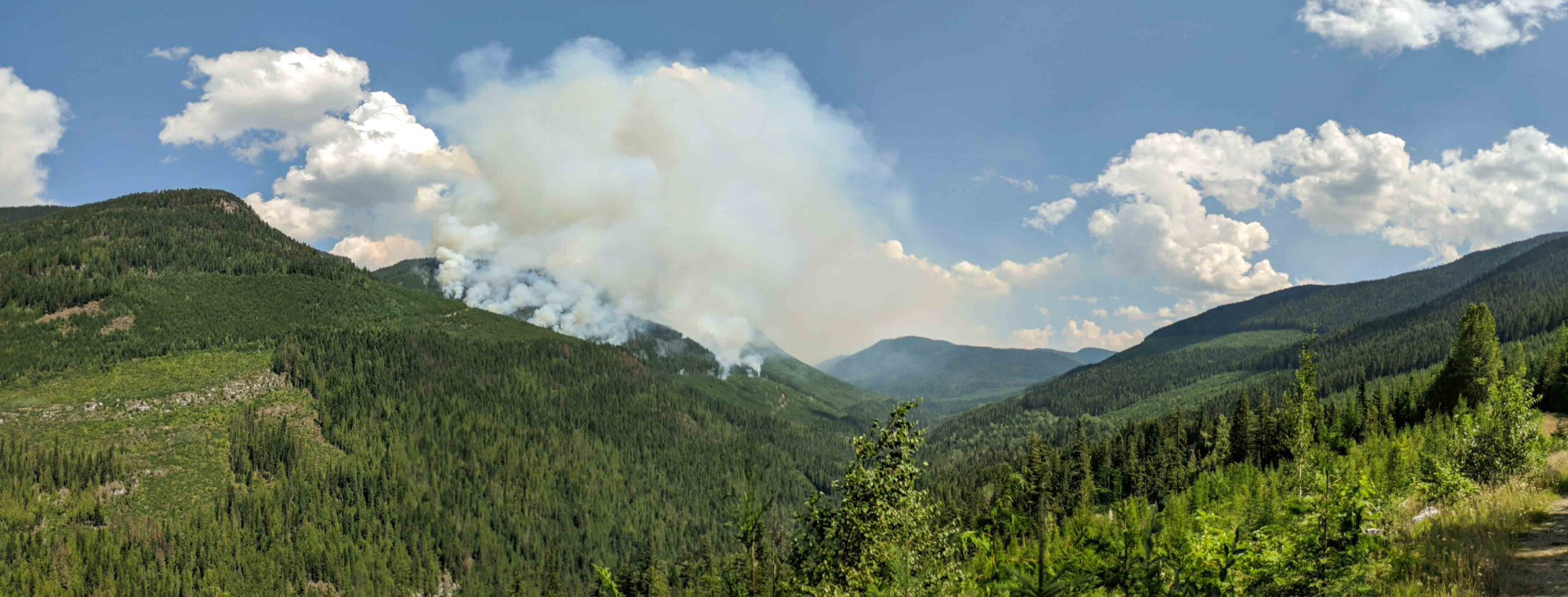 With wildfire season in full swing, an immigration consultant says there is a simple way to end the shortage of qualified people to fight wildfires: Let existing, trained firefighters who are non-residents stay once their work permits expire by letting them choose a path to permanent residency. Jennie McCahill is representing Irish national Jake McGavin, a team leader with a wildfire-fighting contractor called Carmanah Wildfire, which is based in Sidney but has firefighting crews spread all over B.C. …McGavin, who turns 29 in September, is in his third season fighting wildfires in B.C. He’s been lucky to have received a pair of two-year work permits, but the second is soon to run out. …He wants to stay in Canada not only because he’s fallen in love with B.C. …”Unfortunately, Immigration, Refugees and Citizenship Canada does not recognize wildland firefighting as skilled work.”
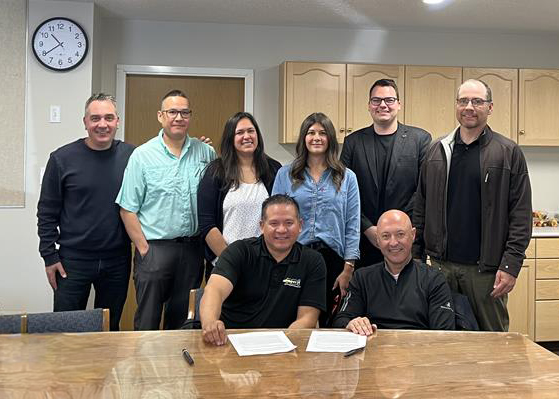
 Llenllenéy’ten (High Bar) First Nation (HBFN) has signed a historic Joint Development Agreement (JDA) with West Fraser Timber Co. Ltd. (West Fraser). The JDA was signed during HBFN’s National Indigenous Peoples Day event in Clinton on June 21. A press release issued by High Bar on June 24 stated that “The landmark agreement highlights HBFN’s commitment to sustainable forest management through partnership with the private sector to achieve mutually beneficial outcomes.” The relationship ensures fibre supply for West Fraser, and opens the door for more diverse fibre product development. At the same time, HBFN notes that the agreement creates a path toward increased resource revenues and decision-making authority for HBFN, which marks a meaningful step toward economic reconciliation. Under the JDA, West Fraser will transfer a portion of its timber harvesting rights to Llenllenéy’ten (High Bar) First Nation.

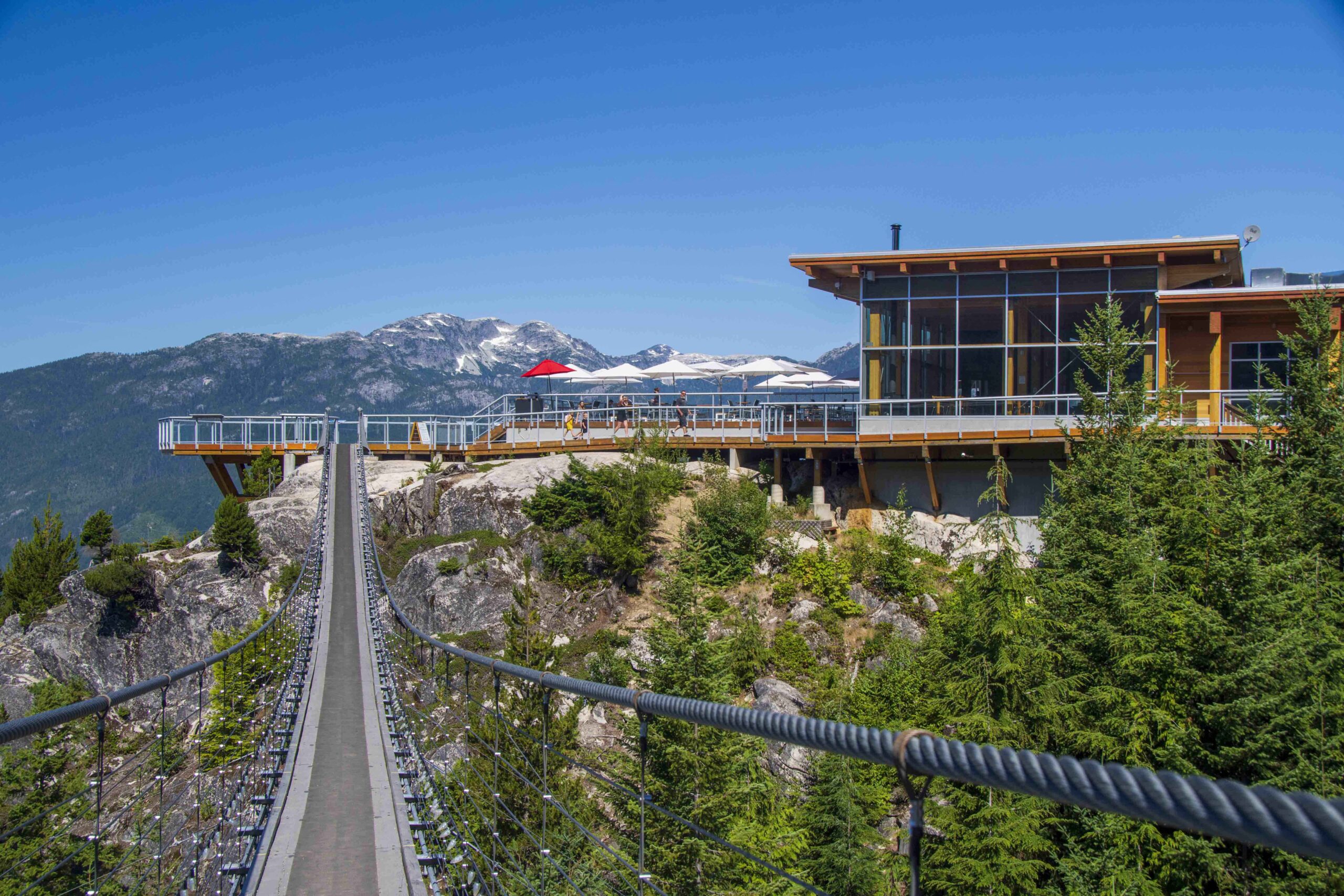 Sḵwx̱wú7mesh Úxwumixw (Squamish Nation) and the Province have signed an agreement to guide forest stewardship in Squamish Nation territory at a ceremony held at the top of the Sea-to-Sky gondola overlooking Átl’ḵa7tsem (Howe Sound). “This agreement will ensure our cultural sites and key environmental areas are protected for future generations. These have been our lands for thousands of years, and the fact they are now back under our direct control provides a greater sense of security for our people, and a strong optimism for our future,” said Sxwíxwtn Wilson Williams, Councillor and elected spokesperson, Sḵwx̱wú7mesh Úxwumixw (Squamish Nation). …The next step will be to complete a ministerial order, which will include consultation with First Nations, and engagement with the public. It aims to establish objectives for the forestry sector to follow in alignment with the agreement and provide the Squamish Nation certainty in sites of high value.
 It’s been hot in southern Ontario [with] apocalyptic news coverage out of Toronto…. “The world is burning,” announces the headline of a parenting advice column in The Globe and Mail. “Should we tell our children?” The author’s children are not told about forest fires… They are not told about the huge, ongoing increase in greenhouse gas emissions in Asia, cancelling out many times over the modest reductions achieved at great cost in North America and Europe. …The answer… is that natural variability is larger than the trend line produced by statistics. It’s true that Canada has seen more communities damaged or destroyed by fire, but that’s largely because there are more communities. …The Second World War was nearing its end, but the war on forest fires was just beginning, with the deployment of heavy equipment as well as aircraft. Saving timber was the goal, and the unintended consequences have piled up ever since.
 The clock is ticking to register and make plans for the 38th Forest Products Machinery & Equipment EXPO from August 6-8 in Nashville, and you do not want to miss it! EXPO is the epicenter of the entire wood products manufacturing sector – held only every other year – with numerous exhibitors showcasing state-of-the-art machinery and specialized services designed for the forest products industry. This event brings together thousands of industry leaders and decision-makers eager to explore cutting-edge products and solutions, spanning advancements in hardwood and softwood log processing, remanufacturing, pallet industries, bioenergy, engineered wood products, and pressure treatment. Seize this unparalleled opportunity to explore new machinery, engage with key decision-makers, reimagine your sawmill operations, and propel your business to new heights.
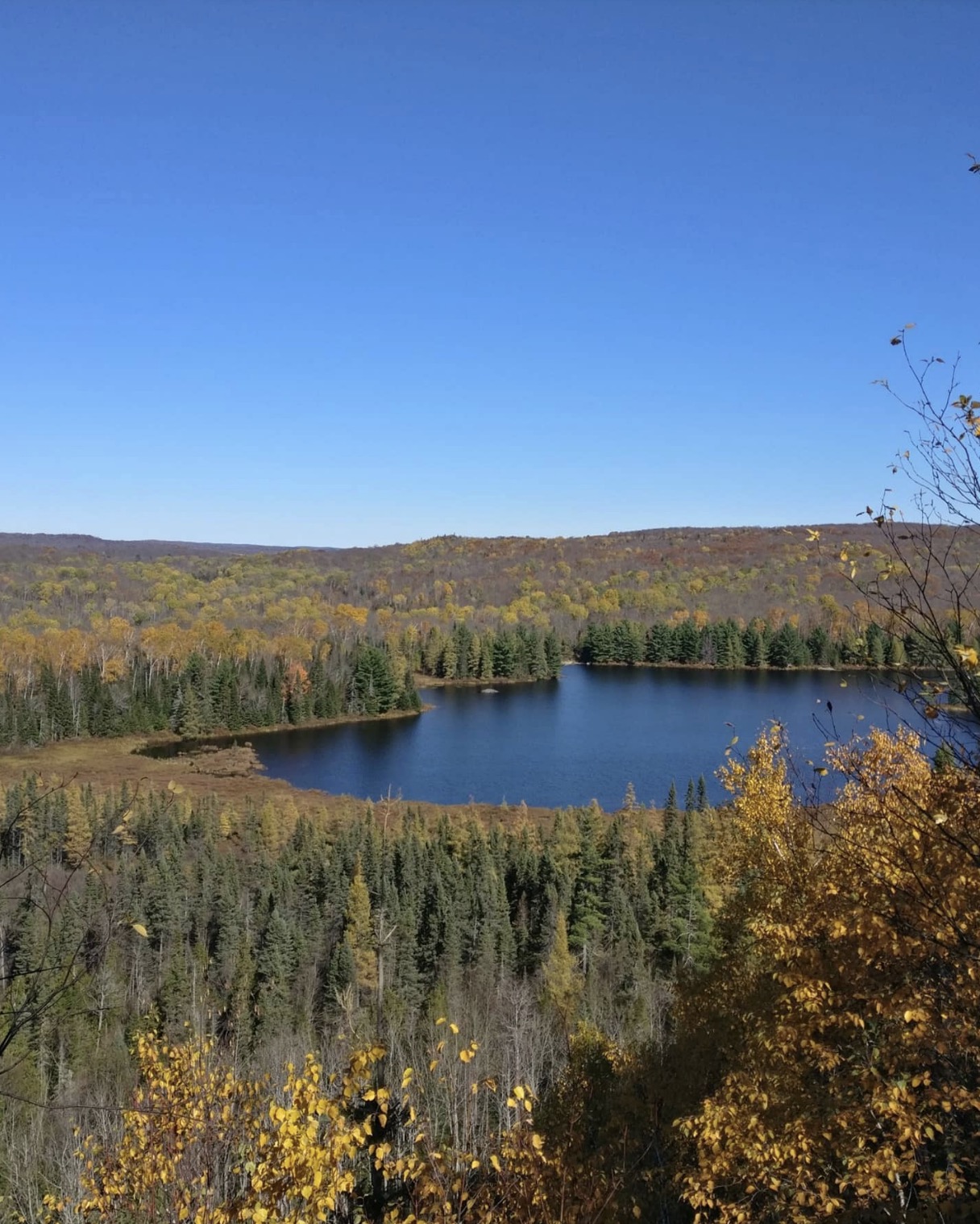 The U.S. Forest Service has proposed lifting the rule that bars roads in designated wilderness areas. The change could open 1.2 million acres of federal land in Arizona to logging. Agriculture Secretary Brooke Rollins proposed canceling the 25-year-old “roadless rule” that created some 58 million acres of wilderness areas throughout the west. Arizona’s forested wilderness areas come to about 1.2 million acres of the 11 million acres of Forest Service land in Arizona. …Environmental groups immediately decried the proposal. They said it would increase the danger of wildfires and destroy wilderness areas essential to wildlife and many forms of recreation. …However, a century of logging, cattle grazing and fire suppression has dramatically increased tree densities across forested Northern Arizona … from about 50 per acre to more like 1,000 per acre in the past century. …The Four Forests Restoration Initiative has tried and mostly failed to ramp up logging on six million acres of non protected forest already criss-crossed with roads.
 A proposal to sell public lands through the U.S. Senate’s budget reconciliation bill died by the sword of parliamentary procedure Monday, though the budgetary battle over public lands is not yet over. The Senate parliamentarian … nixed a provision to sell up to three million acres of Bureau of Land Management and U.S. Forest Service land across 11 states, including Wyoming, finding that it violated a rule limiting budget reconciliation bills to measures that are directly related to federal spending. The provision, which framed the sale as a way to alleviate the housing crisis by opening up more land for development, has roiled Westerners of all political persuasions since it was unveiled June 11. …U.S. Sen. Mike Lee, R-Utah, the architect of the provision, will introduce a new measure removing Forest Service land from the bill and narrowing the amount of BLM land for sale to tracts within 5 miles of population centers.

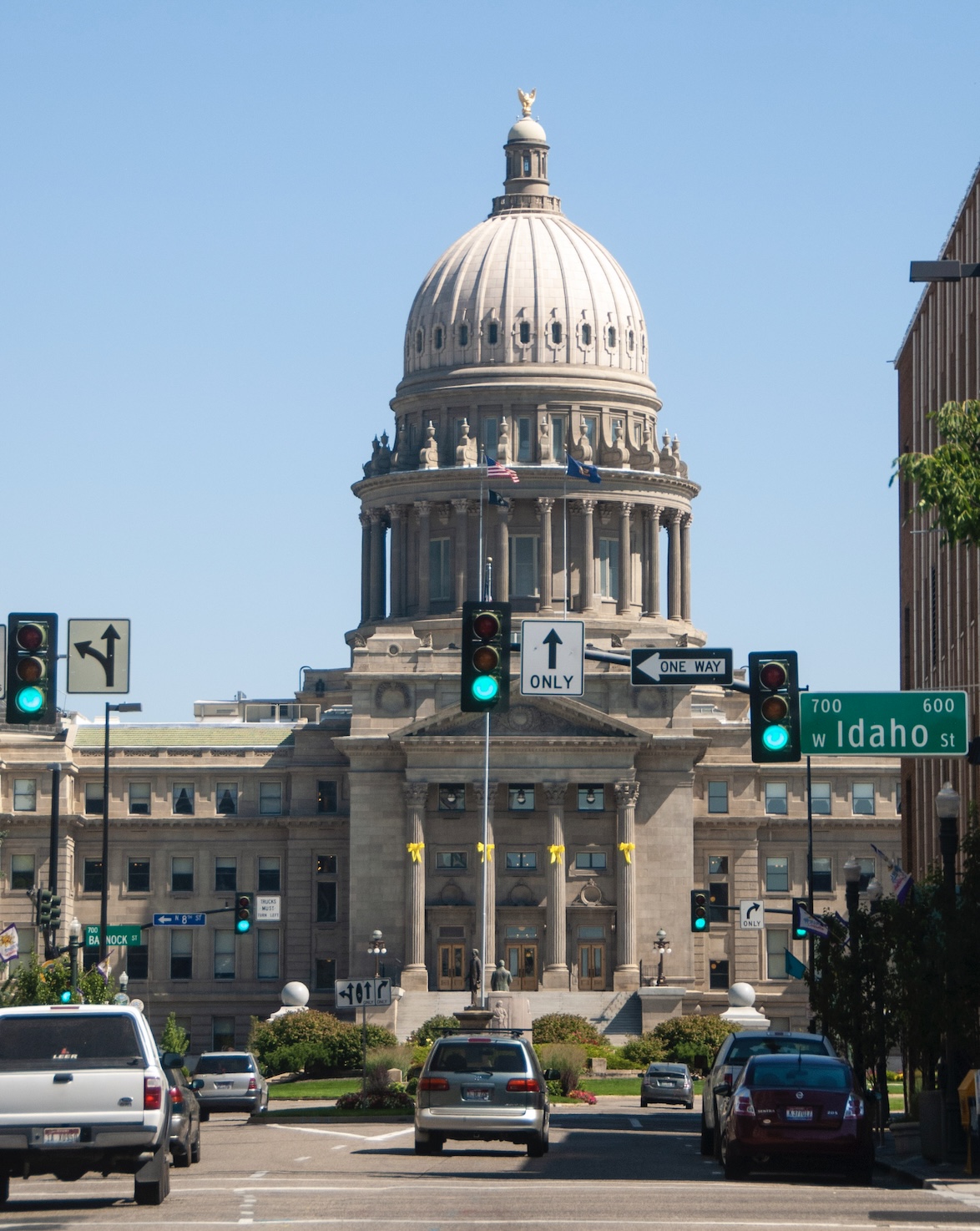 The Idaho roadless rule is not included in the effort by the Trump administration to rescind the national rule. A spokesperson for the U.S. Department of Agriculture said, “the Idaho state-specific roadless rule was part of the Administrative Procedures Act petitions and will not be affected by rescinding the 2001 Roadless Rule.” The rule, a collaboratively written offshoot of the national rule, was spearheaded by then-Gov. Jim Risch in 2006. It is more flexible than the national rule and allows limited logging and road building in some of the state’s roadless forests that are not otherwise protected as wilderness areas. But it also offers more stringent protections to the most remote areas. …Risch’s Idaho-specific roadless rule, implemented in 2008, overrides the national rule and forbids logging and roads on 3.2 million acres of the state’s 9 million acres of inventoried roadless areas. Some logging and roads are allowed, under limited circumstances, on the remaining 6 million acres.
 The Forest Stewardship Council (FSC) reaffirms its support for the Green Claims Directive (GCD) and the Empowering Consumers Directive (ECD) and welcomes the European Commission’s recent decision not to withdraw the GCD proposal. These legislations are critical in the fight against greenwashing and ensuring that consumers have access to accurate, reliable, and verifiable information. FSC, together with ISEAL, has contributed concrete feedback into the GCD and ECD discussions since their onset, with the aim of raising the bar for environmental claims and ensuring the provisions will work in practice. Together, the two proposals offer a powerful framework to ensure that environmental claims and labels placed on the EU market are trustworthy and transparent. Labels rooted in robust, independent certifications like FSC, support companies to enhance accountability and consumer trust.

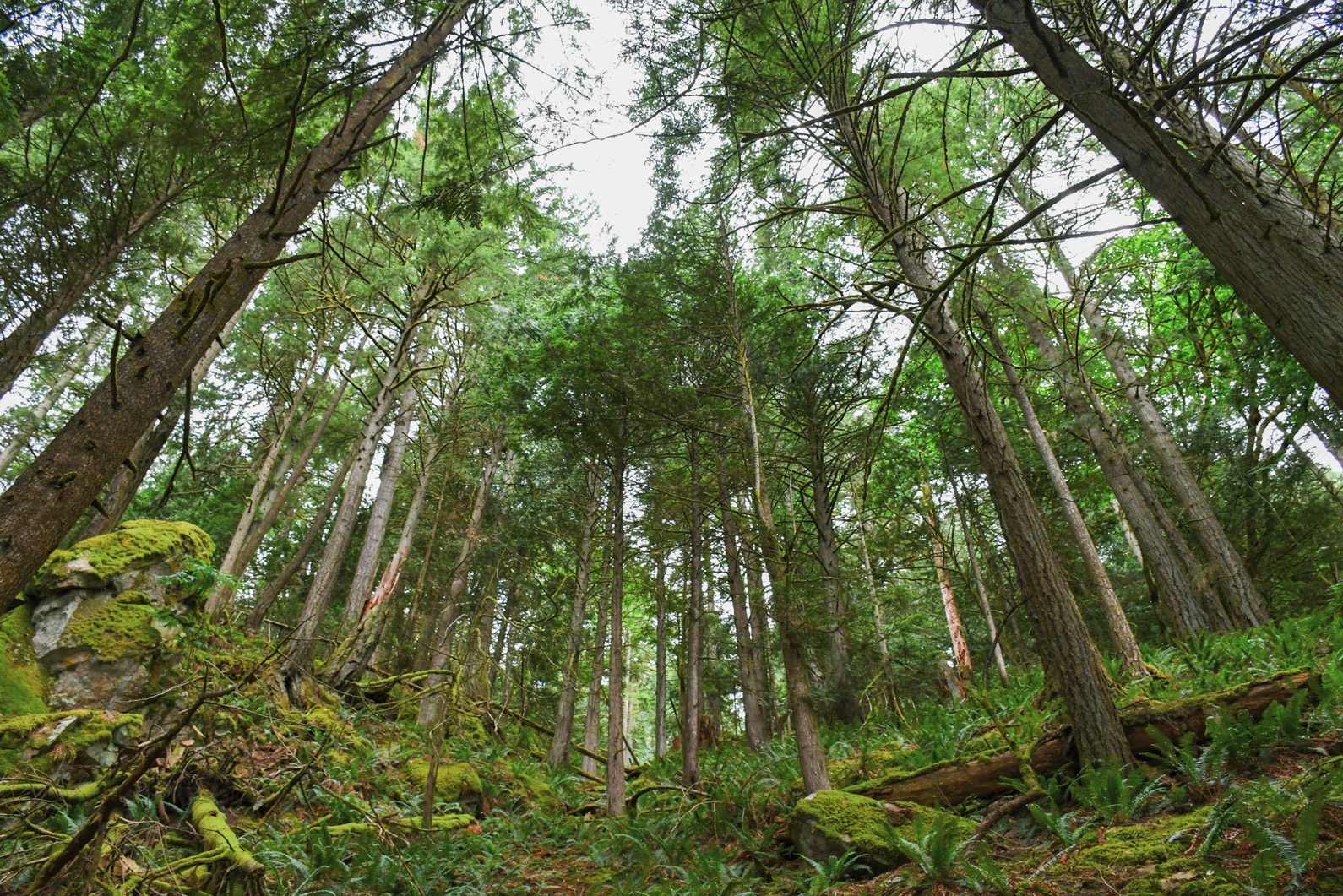 Naturally-regenerating forests are often ignored by policymakers working to curb climate change even though they hold an untapped potential to rapidly absorb planet-warming carbon from the atmosphere, scientists found in a research paper published Tuesday. These so-called secondary forests, which have regenerated themselves after being razed, often for agriculture, can help bring the world closer to the net-zero emissions target needed to slow global warming, the research published in the journal shows. That is because these young forests, which are made of trees between two and four decades old, can remove carbon from the atmosphere up to eight times faster per hectare than forests that were just planted, they found. It comes as companies worldwide are raising millions of dollars to regrow forests from scratch to generate carbon credits they can sell to polluting industries seeking to offset their greenhouse gas emissions.
 Engineered wood manufacturers from across North America were named winners of APA – The Engineered Wood Association’s 2024 Safety and Health Awards — the premier safety award program for North America’s engineered wood products industry. The program promotes and recognizes operational excellence with the goal of reducing injury and illness rates. The Safest Company Award went to three members: Domtar won in the category of three or fewer mills, West Fraser won for companies with four to 10 mills, and LP earned the title for companies with 11 or more member mills. There were two winners in the prestigious Innovation in Safety Award category. Domtar’s Larouche, Quebec, mill won the Equipment-Based Innovation in Safety Award for their submission, “Distancing Handle,” while LP’s Jasper, Texas, mill won the Jack Wagner Process-Based Innovation in Safety Award for their submission, “Safety Champions – Future Leader Development – Safety Projects.”
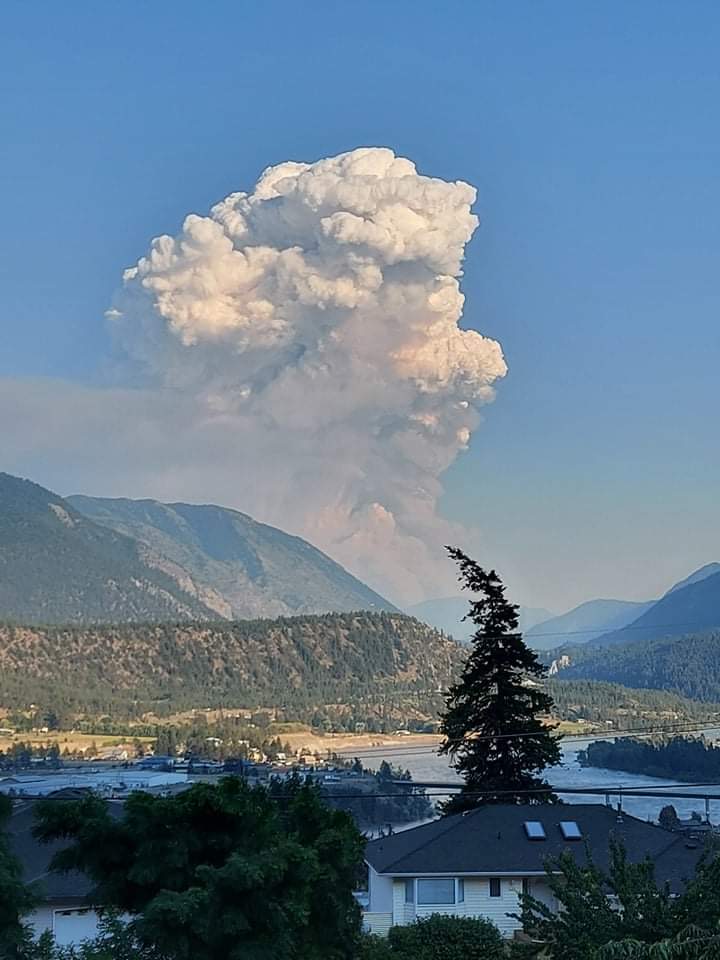 The Thompson-Nicola Regional District has declared a local state of emergency for the Blue Sky Country region due to an encroaching out-of-control wildfire near Lytton, B.C. It has also issued an evacuation order for two properties on Spencer Road South as the blaze poses “immediate danger to life.” The BC Wildfire Service says the Nikaia Creek wildfire is about six hectares in size and is one of more than 70 wildfires burning across the province. It says crews, supported by firefighters from Lytton First Nation, made “good progress” overnight and they are now focused on the north and south flanks of the blaze. The Thompson-Nicola Regional District also issued an evacuation alert Monday night for nine properties in the Harper Lake area near Chase, B.C., due to the rapidly growing Mount Scatchard wildfire.
 ISTANBUL/PARIS/BRUSSELS – Firefighters battled wildfires in Turkey and France on Monday and more than 50,000 people were evacuated as an early summer heatwave hit Europe. Health alerts were issued in France, Spain, Italy, Portugal and Germany. Even the Netherlands, used to a milder climate, issued a warning for high temperatures in the coming days, coupled with high humidity. “Large parts of Western Europe are experiencing extreme heat and heatwave conditions that are normally observed in July or August, rather than June,” said the EU’s Copernicus Climate Change Service. …In Turkey, wildfires raged for a second day in the western province of Izmir, fanned by strong winds, Forestry Minister Ibrahim Yumakli said. More than 50,000 people have been evacuated from five regions, including more than 42,000 in Izmir, Turkey’s AFAD emergency management authority said.