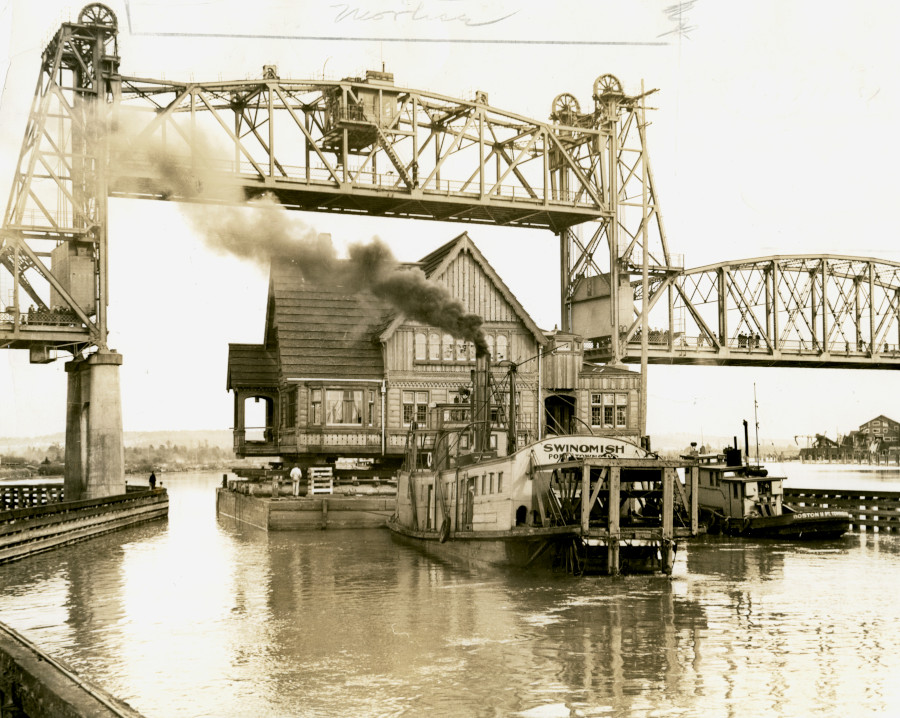
 Meant as a grand showcase for the Weyerhaeuser Lumber Company, the building in our “Then” photo provided an administrative headquarters in 1923 while offering a structural ode to timber itself. Weyerhaeuser’s timber-trade dominance at the time was legendary, rooted in the 1900 “neighborly deal” in which Frederick Weyerhaeuser purchased 900,000 acres of Washington timberland from railroader James J. Hill for $5.4 million. After the purchase, Everett quickly became the manufacturing heart of Weyerhaeuser’s empire, with waterfront mills producing wood products shipped globally. To manage this reach, the company commissioned a headquarters that doubled as architectural persuasion. Designed by the firm Bebb and Gould, its stylized English Gothic structure was built not only to impress but also to move — literally. Architect Carl F. Gould anticipated future evolutions on the waterfront and engineered the building onto four giant crossbeams, making portability a feature, not a bug. The structure was relocated at least three times.