 The Global Supply Chain Pressure Index, which provides a gauge of global supply chain conditions, spiked in April and currently sits at its highest level in almost four years. Several other measures, including the World Bank’s Supply Chain Stress Index are hovering around all-time highs as well. The conflict in the Middle East and resultant spike in energy prices has clearly driven some of the recent increase in supply chain pressure, and the logjam in the Strait of Hormuz, along with some ongoing challenges in the Red Sea, have forced many vessels to take longer routes, adding travel time, increasing fuel costs, and stretching capacity.
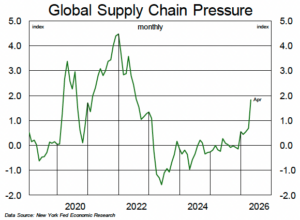 However, the situation in Iran is not the sole driver of recent supply chain pressure: In the US we are seeing an acute shortage of truck drivers following a government crackdown on driver qualifications and after a wave of trucking-firm bankruptcies. As a result, the Federal Reserve Bank of St. Louis’ long-distance trucking price index has recently jumped from a reading of 181 in January to 210 in April (also approaching all-time highs last seen during the pandemic). Similarly, overland freight pricing data from DAT Freight and Analytics shows that flatbed truck rates have surged since the onset of the Iran war—the national average spot rate for flatbed trucks was $2.72 per mile in February and has rocketed to $3.64 by May. DAT’s national load-to-truck ratio (the number of loads posted for every available truck posted on the DAT load board) sat at an eye-watering 72 in April, up from 35 in April 2025 and just 19 in April 2024.
A deal with Iran may be in the works, but as we learned after the COVID pandemic, it can take months (if not years) for supply chains to normalize. Buckle up.
Key forest product pricing observations include:
- Solid Wood: Lumber prices have dropped rapidly for SYP with 2×4 prices down by more than $100 since mid-April. S-P-F has slipped as well but the burden of duties/tariffs, coupled with reduced supply, is limiting downside. The demand outlook is not inspiring, but with sizable capacity reductions over the past few years, any minor uptick in demand could lead to much better pricing. For OSB, the outlook has improved given delayed capacity expansion, but single-family new home construction lags. Plywood has performed the best, but import threats are increasing.
- Timber/Log: Log prices are generally flat to down; there is some hope exports could improve. Timberland markets are seasonally quiet; owners (and buyers) are adjusting to weak cash flows (perhaps a downside risk).
- Pulp markets are mixed: key softwood grades are still oversupplied; hardwood’s momentum is fading; yet fluff pulp prices keep climbing. Continuing hardwood substitution and China’s relentless expansion of its pulping capacity were key topics coming out of Int’l Pulp Week.
- Paper prices are up, or moving up, for every grade save supercalendered (SC) paper; more hikes are coming next month. Cost pressures and current momentum (with some inventory rebuilding from buyers) should ensure general success.
- Containerboard: Producers are forging ahead with another price increase for June, with increases ranging from $50 to $70. Industry demand drivers are mixed and inventories remain too high, but success can be achieved with supply discipline (aided by pushing tons offshore). Market-related downtime and/or another machine/mill closure would help.
- Boxboard: Despite oversupply remaining a key issue in the sector (bleached grades in particular), several producers have announced price hikes for solid bleached sulphate/folding boxboard (SBS/FBB) and coated unbleached kraft (CUK). The gap between coated recycled board (CRB) and bleached grades needs to expand, so this move would be helpful but success won’t come easy given market dynamics (and challenged consumer spending).