Mark Carney
The global trade landscape has fundamentally changed. Canada’s new government will invest in domestic production, develop Canadian expertise, support our companies to retool and reinvest, and help industries pivot to a growing Canadian market and those of new, reliable trading partners around the world. As part of that strategy, the Prime Minister, Carney, announced a series of new measures to help the softwood lumber industry transform to remain competitive. …Canada’s new government will:
- Provide up to $700 million in loan guarantees to address the immediate pressures facing the softwood lumber sector.
- Invest $500 million to supercharge product and market diversification to make the industry more competitive for the long-term.
- Build Canadian by prioritizing Canadian materials in construction and changing federal procurement processes to require companies contracting with the federal government to source Canadian lumber.
- Diversify international markets for Canada’s sustainably sourced forest products.
- Provide $50 million for upskilling, reskilling, and income supports for more than 6,000 affected softwood lumber workers through the Labour Market Development Agreements.
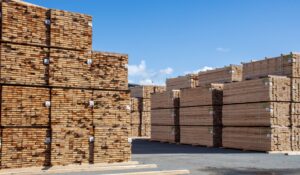 KELOWNA — Prime Minister Mark Carney’s government is preparing financial supports for the forestry sector as the United States ratchets up duties on Canadian softwood lumber. …It comes amid heightened trade tensions with the United States over softwood lumber, a decades-long friction point in the Canada-U.S. trade relationship. The US Commerce Department recently announced it intends to hike anti-dumping duties on Canadian softwood to just over 20%. The prime minister outlined a series of supports at a lumber mill in West Kelowna, B.C., on Tuesday, saying Canada will be its own best customer by relying on more Canadian timber as it works to double the pace of new home building to almost 500,000 homes a year over the next decade.

 President Donald Trump said the US will put a 35% tariff on some imports from Canada, escalating the tensions between two countries that have impaired one of the world’s largest trading relationships. The new rate represents an increase from the 25% tariffs Trump imposed in early March under an emergency law. …But the US administration kept in place an exemption for goods traded under the rules of the US-Mexico-Canada trade agreement. US automakers and other companies with integrated North American supply chains had pushed for that carve-out, which has allowed US importers to continue bringing in the bulk of Mexican and Canadian products without duties. Because of the USMCA exemption, the effective tariff rate on US imports of Canadian goods was around 5%. …Trump signaled that he would be open to further talks with Carney. …Hours before raising Canada’s tariffs, Trump agreed to extend current tariffs on Mexico for 90 days.


 VICTORIA — BC’s minister of jobs and economic growth is urging the federal government to stand firm and “negotiate hard” when trying to find a solution to tariffs imposed by President Trump. …He said he believes Carney and Canada-US Trade Minister Dominic LeBlanc are taking the right approach, “which is keeping their head down… and not getting distracted by the day-to-day swings of the president of the United States.” He said he would also highlight the importance of the softwood lumber industry for BC, which is just as crucial as the auto industry is to Ontario. …Both Eby and Kahlon have repeatedly argued that the long-running softwood lumber dispute with the United States should be part of a larger deal. Brian Menzies, executive director of the Independent Wood Processors Association, said he is “not very optimistic” that a future deal would also resolve the softwood dispute.

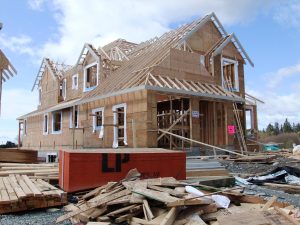 It’s been over a week since the U.S. Commerce Department confirmed that it’s nearly tripling its anti-dumping duties on Canadian lumber imports from 7.66% to 20.56% following its annual review. The response from north of the border has been apoplectic, to say the least. …In the US, several entities are worried about the hiked duties, too. The NAHB continues to sound the alarm that new duties will raise the cost of homebuilding. …”We are also urging the administration to move immediately to enter into negotiations with Canada on a new softwood lumber agreement.” …The US Lumber Coalition continues to be the loudest voice in the room in favor. …”Canada continues its relentless shipments of dumped and subsidized lumber with devastating consequences for mills, workers, and communities.” …The downstream effects of all these trade war machinations remain to be seen, though the cross-border lumber trade has already slowed down considerably.
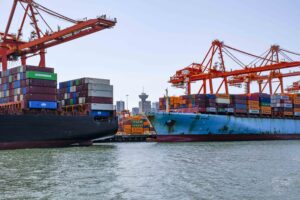 Canada’s merchandise trade deficit widened in June to C$5.9 billion as imports grew faster than exports due to a one-time high-value oil equipment import. The deficit observed in June is the second highest on record after the deficit expanded to its largest in history in April to C$7.6 billion, when the impact of US tariffs first started to weigh. Canada’s exports to the US as a share of total exports shrank to 70% in June from 83% in the same period a year ago while its surplus with the US contracted by a half in the same period, data showed. Total imports were up 1.4% in June to C$67.6 billion from a drop of 1.6% in the prior month, Statistics Canada said. Canada’s total exports grew 0.9% in June to C$61.74 billion following an increase of 2% in May, led primarily by an increase in crude oil exports.
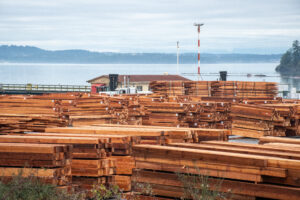 Lumber futures hit their highest price in three years Friday despite a home-building slump and a lackluster remodeling market. Though wood demand is tepid, traders are pricing in dramatically higher duties on lumber imports from Canada. Lumber futures for September delivery hit $695 per thousand board feet Friday, up 39% from a year ago and the highest price since summer 2022, when the price of two-by-fours was tumbling down from its pandemic surge. November futures are trading even higher, around $710. The US raised its antidumping duty Tuesday to nearly 21% from 7.7%… [and] The Commerce Department said it would impose a higher countervailing duty in the coming days. The combined rate is expected to be around 35%. …”We don’t make a tremendous amount of money on distributing lumber,” Builders FirstSource CEO Peter Jacksons told investors. “We’re not eating a 20-point increase in lumber. It’s not possible. So it will be passed through. The market will adapt.” [to access the full story a WSJ subscription is required]
 VANCOUVER, BC —
  NEW YORK, NY -‑ Mercer International reported second quarter 2025. In the second quarter of 2025, net loss was $86.1 million compared to $67.6 million in the same quarter of 2024 and $22.3 million in the first quarter of 2025. Mr. Juan Carlos Bueno, Chief Executive Officer, stated: “Our operating results for the second quarter of 2025 reflect the impacts of ongoing uncertainties in the global trade environment coupled with the resulting weaker dollar. This challenging backdrop contributed to weaker demand for pulp in China during the quarter. …Our lumber sales realizations in both the U.S. and Europe increased in the second quarter of 2025 as a result of lower supply and steady demand.


 The Forest Stewardship Council Canada announces the launch of a public consultation on draft indicators related to Intact Forest Landscapes (IFLs). These indicators form part of our ongoing work to strengthen forest stewardship and protect ecologically and culturally significant forest areas across Canada. IFLs are large, unfragmented areas of natural forest that are free from significant human activity and are critical for biodiversity, carbon storage, and Indigenous cultural values. FSC Canada is committed to ensuring that management activities in IFLs are carefully assessed and responsibly planned. These indicators will guide how FSC-certified forest operations manage intact forest areas… Indigenous Cultural Landscapes (ICLs) are areas that hold significant cultural, ecological, and spiritual value to Indigenous Peoples, reflecting their deep relationships with the land. Due to the need for more in-depth consultation with Indigenous Peoples on the Draft Indicators and Guidance for ICLs, an additional consultation period will be launched shortly.
 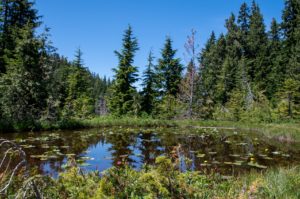 Above average spending on Yukon wildfires is in the forecast due to rising costs of fuel, aircraft, vehicles, food and fire retardant, Yukon wildfire officials told reporters during a July 30 briefing. Officials indicated more spending doesn’t necessarily mean more fires; it relates to higher costs in general. “The cost of fuel is going up. The cost of aircrafts are going up. The cost of vehicles is going up. Fire retardant, which we used over a million litres of, has almost doubled in price in the past several years. Food for catering, for feeding all these crews. Obviously, the cost of food has gone up,” director of Yukon Wildland Fire Management Devin Bailey said at the mid-season briefing. “As everything gets more expensive, we’re going to see more expensive responses during fire season.”
 Gibsons council is renewing its push for stronger watershed protections and clearer oversight of forestry operations, following a staff report on
  …The pressure to balance local benefits and profitability is something community forests must continuously navigate. A


 Years of drought combined with persistent wildfire, some of it burning underground over winter, are causing forests in B.C.’s north east to fall down. Having had the roots and organic soils that had held them up burned away these often green trees now form a dense ground fuel load for future fires. The fallen trees also form a jack-straw of branches and boles that will act as an abatis in the face of fire crews. This has fire specialists and ecologists in the Fort Nelson Fire Zone worried. “With this fuel type, another concern is the multi-year impacts of having this much fuel on the ground,” says Eric Kopetski BCWS Fire Behaviour Analyst. The Fort Nelson Fire Zone has been dealing with drought and fire for years with the Fort Nelson Complex now covering 4 million hectares including 25 fires and 350,000 hectares burned this year. Distance, terrain and fire tenacity already pose challenges to fire crews.

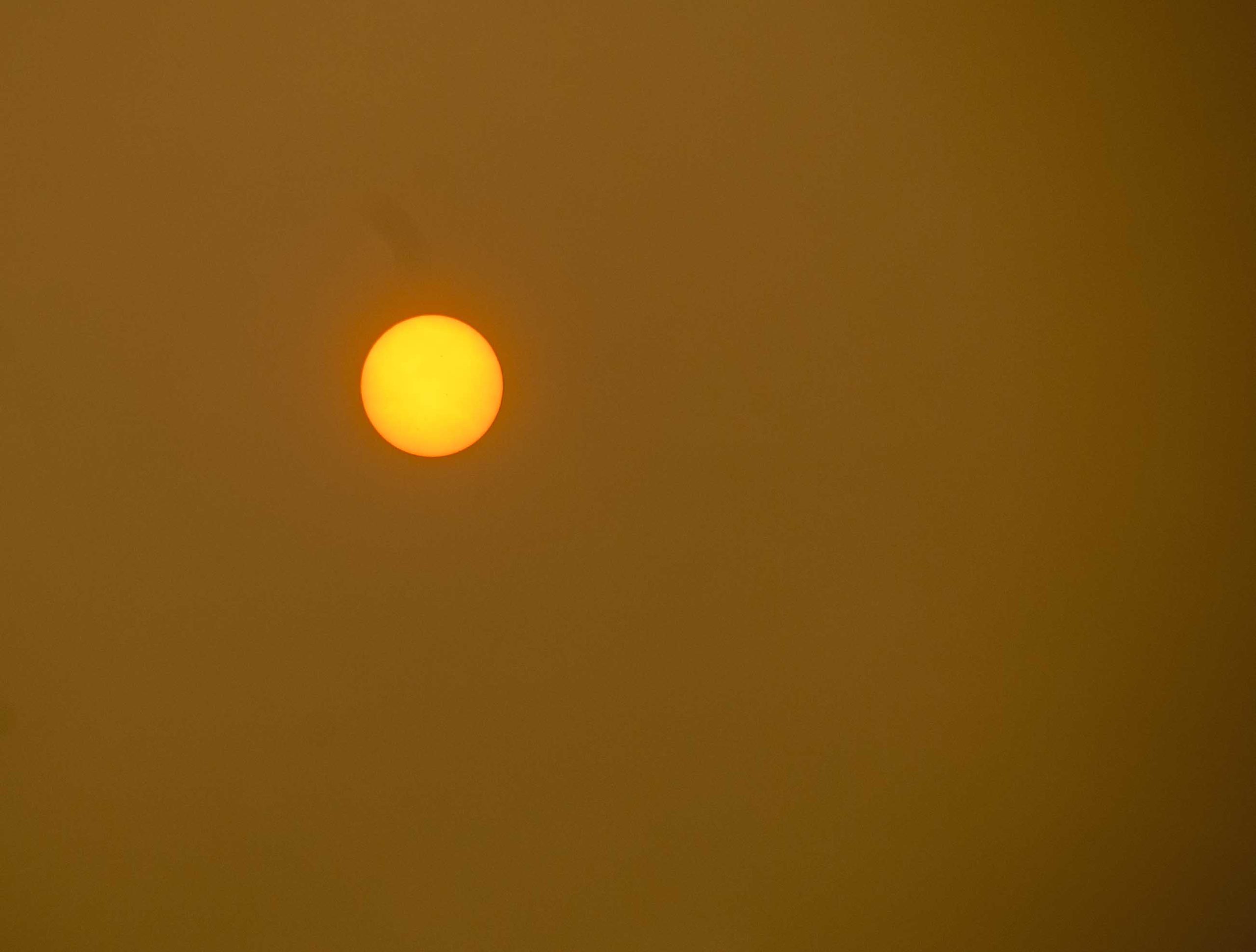 Toronto is among the most polluted cities in the world on Monday morning as the city remains under a special air quality statement for its third consecutive day. Environment Canada said smoke from forest fires is expected to continue to impact much of southern Ontario Monday and may persist into Tuesday before finally easing. “Air quality and visibility due to wildfire smoke can fluctuate over short distances and can vary considerably from hour to hour,” said Environment Canada in a special air quality statement issued Monday morning. …Toronto ranked third in a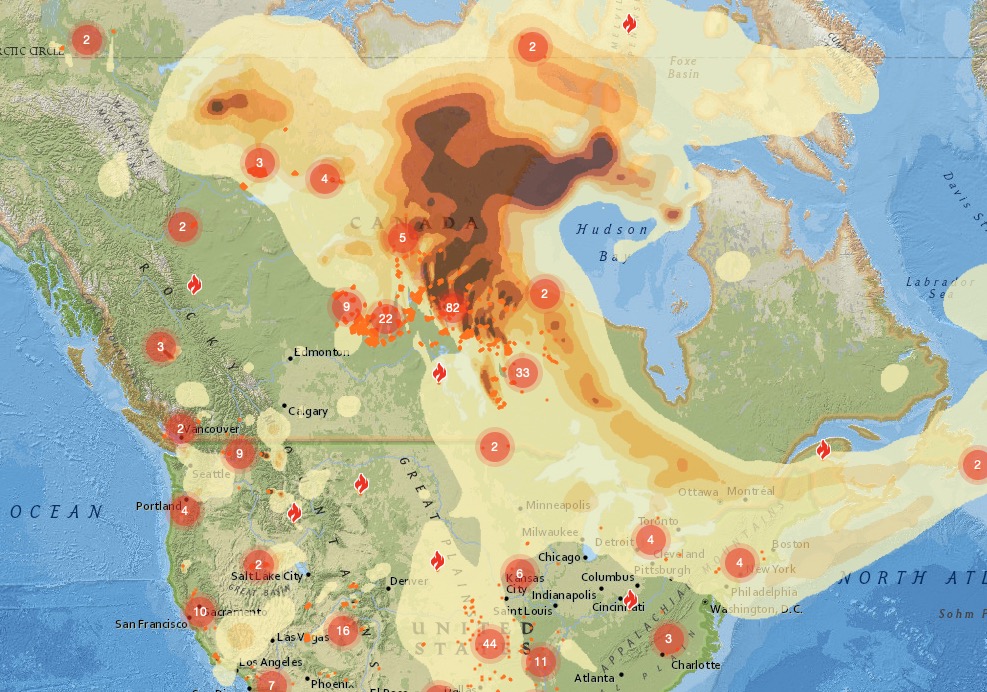

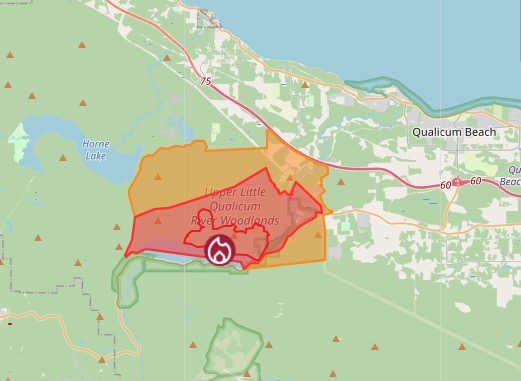 A wildfire on Vancouver Island is threatening Douglas-fir trees in Cathedral Grove, located on the western shoreline of Cameron Lake. The old-growth forest is filled with gigantic 800-year-old trees… The out-of-control Wesley Ridge wildfire was discovered on July 31 and is now 511 hectares in size. The Regional District of Nanaimo issued an evacuation order on August 2, which affected nearly 400 properties in the area around Cameron Lake, about 25 kilometres west of Parksville. …The fire has grown rapidly over the weekend as it looms over Highway 4, which remains open for the time being. Crews are trying to push it back, even using night vision so they can battle the blaze 24 hours a day. Emelie Peacock with the BC Wildfire service says, “we currently have 142 personnel responding to this wildfire, which includes 65 firefighters, 2 followers, and roughly 75 structure protection specialists”. …The fire is suspected to be human-caused … investigation is still in its preliminary stages.