 International political discourse in 2025 has been haunted by the spectre of Donald Trump and his brute force reshaping of global trade relationships to the (perceived) advantage of the US. Canadians have been consumed by the question of when a deal might be struck to end Trump’s egregious tariffs, real and threatened, and what that deal might cost us. …While countries that have struck deals with Trump have largely focused on transactional arrangements that accept a lower tariff, Canada has gone the other direction by seeking to roll security into a broader deal that may prove expensive but without guarantees of market access. …Prime Minister Carney does not appear to be rushing the US negotiations, but the Canadian government response so far leaves much to be desired. …The CUSMA also is up for renegotiation in 2026. …Prime Minister Carney has kept his strategy cloaked from the public.

 The US Court of International Trade threw out a legal challenge from Canadian softwood lumber producers J.D. Irving Ltd. granting a motion-to-dismiss from the Commerce Department. Timothy Reif said in the opinion that J.D. Irving, which had challenged Commerce’s 2022 antidumping administrate review on grounds that the agency erred by assigning a higher cash deposit rate in the order, has its proper venue under a binational panel though the USMCA now reviewing the Commerce order. While the Canadian firm said it was challenging not the Commerce fine order but the instruction for the cash deposit rate. Reif said the challenge entered on the commerce final result and thus should rest before the USMCA panel. [to access the full story, a MLex.com subscription is required]
 President Donald Trump on Friday announced he’s directing his administration to investigate imports of furniture into the United States that will lead to higher tariffs by October. “Within the next 50 days, that Investigation will be completed, and Furniture coming from other Countries into the United States will be Tariffed at a Rate yet to be determined,” Trump wrote. “This will bring the Furniture Business back to North Carolina, South Carolina, Michigan, and States all across the Union,” Trump said. …Already, furniture prices have been increasing over the past few months as Trump hiked tariffs on countries including China and Vietnam, the top two sources of imported furniture. Both countries imported $12 billion worth of furniture and fixtures last year, according to US Commerce Department data. …Furniture stocks, such as Wayfair, William-Sonoma and Restoration Hardware, all tanked in after-hours trading Friday.
 We welcome the recent announcement from the White House regarding the US–EU Framework Agreement on Reciprocal, Fair, and Balanced Trade. Notably, the European Union has committed to addressing U.S. concerns about the EUDR, acknowledging that US commodity production poses negligible risk to global deforestation. This recognition is a positive step toward ensuring Southern Pine lumber producers and exporters are not unfairly burdened by regulations that fail to account for the sustainability and stewardship practices already in place within the American forestry sector. …The EUDR’s stringent traceability requirements (such as geolocation data for every plot of land from which timber is sourced) present serious compliance obstacles for U.S. producers. …Recognizing the broad impact of the EUDR across multiple agricultural sectors, the forest products industry is strategically voicing its objections through official trade and commerce channels.
 The US International Trade Commission determined on August 21 that revoking the existing antidumping duty order and countervailing duty order on wooden cabinets and vanities from China would likely lead to “continuation or recurrence of material injury within a reasonably foreseeable time.” The Kitchen Cabinet Manufacturers Association (KCMA) said that ruling “means that the antidumping and countervailing duty orders will remain in place for at least another five years and continue to provide relief to the US domestic industry from dumped and subsidized merchandise from China.” As a result of the Commission’s affirmative determinations, the existing orders on imports of these products will remain in place. …The action comes under the five-year (sunset) review process required by the Uruguay Round Agreements Act. The Commission’s public report on Wooden Cabinets and Vanities from China will be available by October 3, 2025.





 The United States is the top wood-importing country. Trade issues and tariffs could be a significant factor in determining the path of least resistance for lumber, lumber futures, and wood product prices over the coming weeks and months. …The offseason for lumber demand is on the horizon. The potential for increased price variance due to the uncertainty created by U.S.-Canada trade relations remains high, and the path of least resistance of U.S. short-term interest rates is likely to be lower. Time will tell if longer-term rates follow any Fed Rate cuts over the coming months. Lumber remains a critical construction material, and the current price levels offer a positive risk-reward profile. Accumulating lumber-related assets on a scale-down basis during periods of price weakness over the coming weeks and months could be optimal for 2026, provided the housing market improves and lumber demand rises.
 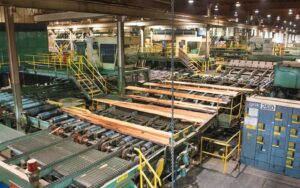 Lumber buyers placed unsuccessful bets on tariffs and interest rates Lumber prices have dropped by more than 14% from a record high in early August. Many home builders, contractors and retailers wagered that higher U.S. tariffs on imports would boost the cost of lumber, while lower interest rates would lift demand for the building material. But those bets have failed to pay off – and lumber prices have tallied a steep decline from a record high reached only three weeks ago. That price decline could lead to a drop in production at a time when home-building and housing demand starts to heat up. The demand component for spring 2025 was a “complete swing and a miss,” said Greg Kuta, at lumber broker Westline Capital Strategies. …On Tuesday, lumber futures for September delivery settled at $595.50 per thousand board feet. …Canadian mills are losing out with lumber prices well under the cost of production,” Kuta said.
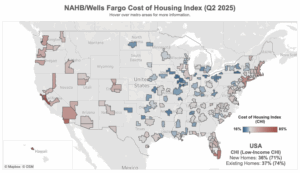 While new homes remain largely unaffordable, builder efforts to improve housing affordability paid dividends in the second quarter of 2025, according to the latest data from the NAHB/Wells Fargo Cost of Housing Index (CHI). The CHI results from the second quarter of 2025 show that a family earning the nation’s median income of $104,200 needed 36% of its income to cover the mortgage payment on a median-priced new home. Low-income families, defined as those earning only 50% of median income, would have to spend 71% of their earnings to pay for the same new home. …The second quarter of 2025 marked the largest historical gap where existing home prices exceeded those of new homes. …The percentage of a family’s income needed to purchase a new home was unchanged at 36% from the first to the second quarter, while the low-income CHI fell from 72% to 71% over the same period.
 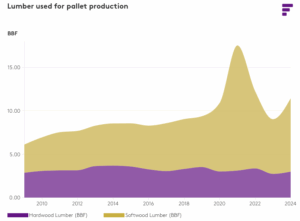 Economic uncertainty has clouded the pallet market outlook, as July’s job report revealed weaker-than-expected job growth. The elimination of the de minimis tariff exemption for low-value shipments is expected to improve pallet demand. Anticipated interest rate cuts will have a knock-on effect on housing affordability, stimulating the construction sector which in turn impacts lumber prices. …As pallet usage has grown, softwood has become the dominant material used in pallet manufacturing due to its abundance and cost-effectiveness. Hardwood mills were hit hard, and many saw closures, after the Chinese property market collapsed as that was its biggest end-use market. This Canadian softwood lumber supply shock does certainly leave the door open for the hardwood pallet to regain some market share. Supply and demand indicators are pointing to higher prices towards the end of 2025 and into 2026.
 This study investigates the economic impact of sawmill entry and exits in Michigan between 2019 and 2023, a period marked by ongoing structural changes in the industry, including the closure of several large mills and the opening of smaller or mid-sized operations. Using observed employment changes… we applied an employment-based multiplier analysis to estimate how net sawmill job losses affected the statewide economy. The results show that while only 273 direct jobs were lost due to net changes from sawmill entry and exit during this period, the broader ripple effects were much larger, approximately 820 jobs and $211 million in output loss. These effects were most pronounced in labor-intensive sectors such as logging and transportation, as well as in downstream sectors like wholesale trade and real estate. The findings highlight the central role of sawmills in regional supply chains and states labor markets, with two-thirds of job losses occurring outside the mills themselves.
.jpg)
 SLB-Funded NYC Mass Timber Studio Expands With Landmark Projects: Building on the success of its first round of projects in 2024, the NYC Mass Timber Studio announced a second cohort of selected projects this month to help catalyze deployment of wood construction throughout New York City. … After supporting successful accelerator programs in Boston, Georgia, and New York City, the SLB is now exploring collaborations with cities in Arizona, California, Colorado, Pennsylvania, Oregon, and Texas.
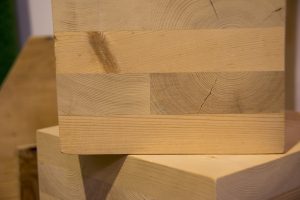 When Millard Dority came out of retirement to oversee the expansion of Jesup Memorial Library, he had one goal: to prove that Maine could produce its own cross-laminated timber. Instead, he uncovered a glaring hole in the state’s forest economy. …But with no CLT factories in Maine, the wood had to be trucked from New England to Illinois for processing, then hauled back to Bar Harbor—a headache in a state blanketed by forests. …The Jesup Library expansion is one of just 27 CLT projects in Maine, using spruce-pine-fir and eastern hemlock from New England. Forestry expert Andy Fast said these underused species are finding new life through CLT, but warned, “Supply chain efficiencies will determine whether it’s a viable product longer term.” Despite interest, Maine has failed to land a CLT manufacturer. LignaTerra Global and SmartLam both announced plans in 2018, only to back out. [to access the full story a Bangor Daily News subscription is required].
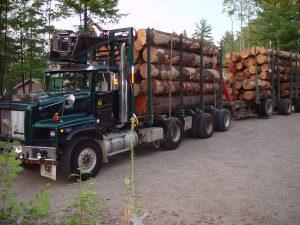 Canada’s forests are burning. …Smoke from these fires has degraded air quality across Canada and the US. The situation has led some US policymakers to publicly blame Canada for failing to manage wildfires and to demand more active forest management. These critiques are hypocritical, given their record of climate change denial. …Yet beyond partisan politics, the US continues to impose tariffs on Canadian lumber, undermining our capacity to invest in stronger forest management. …Eliminating or reducing US tariffs would instantly raise the value of Canada’s standing forest stock, sending a price signal that makes forestry activity viable in regions that are currently too remote or costly to harvest. At the margin, higher returns would unlock investment in better forest management, including areas that are now left untouched because they are uneconomic to service. …Lifting tariffs would be the first step, but it would not be a cure-all.
 Oregon’s forestry sector, once the state’s driving industry, has scaled back dramatically, the result of modernization and reduced harvests since the 1990s. Yet the industry is still adding workers and looking to replace retirees — now with a growing demand for technical expertise. The industry’s employers say they’re struggling to fill the jobs they have. Retirements have thinned the ranks, turnover is high and new workers are hard to recruit. Adding to the trouble, a workforce study found the sector will add 3,400 jobs annually through 2030. In particular, the report found Oregon’s colleges and universities aren’t producing enough forestry graduates to meet demand — suggesting Oregon employers might have to recruit from elsewhere to staff some of the highest-paying jobs in a signature sector. It’s a counterintuitive finding for an industry that’s been cutting further in recent months through the closures of mills and factories. Officials say that’s because there’s more to forestry work than logging.
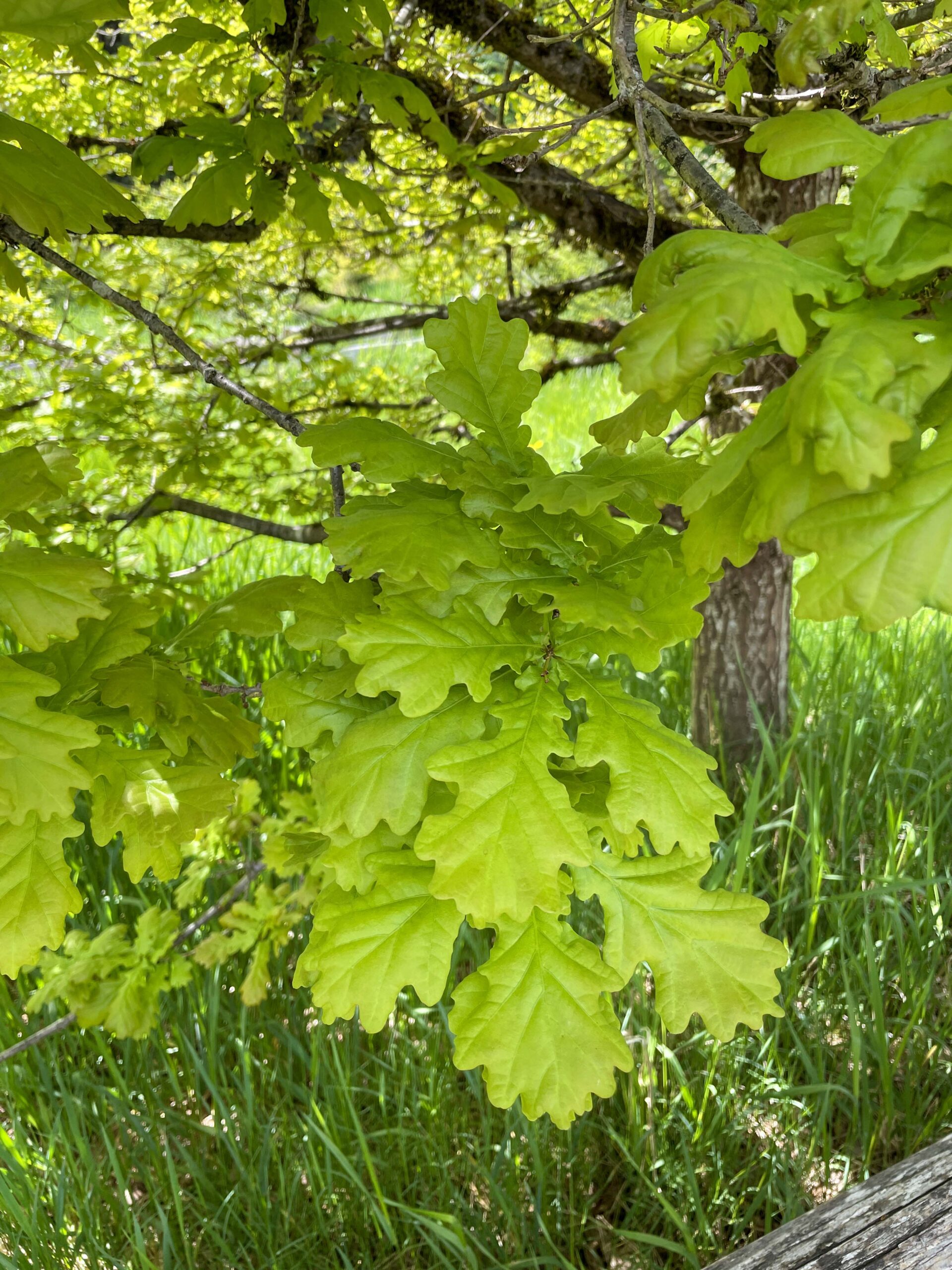 PORTLAND, Oregon — The USDA Forest Service and the Oregon Department of Forestry are investing $750,000 to restore oak habitat and reduce wildfire risk in the southern Willamette Valley. The project will reduce the risk of uncharacteristic wildfire and restore fire-adapted oak ecosystems that are important to wildlife, water quality, and rural communities. Work includes treating 150 acres of hazardous fuels while supporting partner efforts to treat an additional 1,200 acres — for a total of 1,350 acres restored. Landowners will receive assistance to implement oak management activities, including hazardous fuels mitigation, that promote resilient and fire-adapted forests. This investment is part of the Forest Service’s Landscape Scale Restoration (LSR) program, a nationally competitive grant program that supports collaborative, science-based projects across state, tribal, and private forestlands. The Forest Service invested $7 million to fund 19 projects nationwide, including $300,000 to this project in Oregon.
 Wildfires are a natural part of the landscape in much of Central and Eastern Oregon. James “Jim Bob” Collins has seen the damage a wildfire can cause and the effects it has on the land after the smoke clears. His district had worked for months to receive a $21 million grant from the U.S. Department of Agriculture that would have gone to wildfire mitigation in forests and rangelands. But this summer, just as wildfire season was starting, the government walked back on its offer in Wheeler County and across the state. All told $90 million worth of conservation work is on hold across Oregon. That’s left ranchers like Collins and his neighbors, whose land bears the scars of last year’s fires, hoping the rest of this year’s wildfire season is uneventful, as he and the conservation district he serves explore new ways to pay for the work.

 ATLANTA — The U.S. Department of Agriculture’s Forest Service announced it is investing more than $2.1 million in four projects across nine states in the Southern Region to restore state and private forestlands. These investments directly support the agency’s efforts to reduce wildfire risk, increase timber production, and expand rural economies, while providing critical support to landowners across management jurisdictions as they work to promote healthy, productive forests that benefit rural communities. The investments, totaling more than $7 million nationwide, are being delivered as competitive grants through the Landscape Scale Restoration program. Of the total funding, $600,000 will support two projects for federally recognized tribes. …In the Southeast, protecting wildlife habitat and restoring important forest ecosystems such as longleaf pine and oak are important priorities to ensure continued economic productivity of rural working lands.
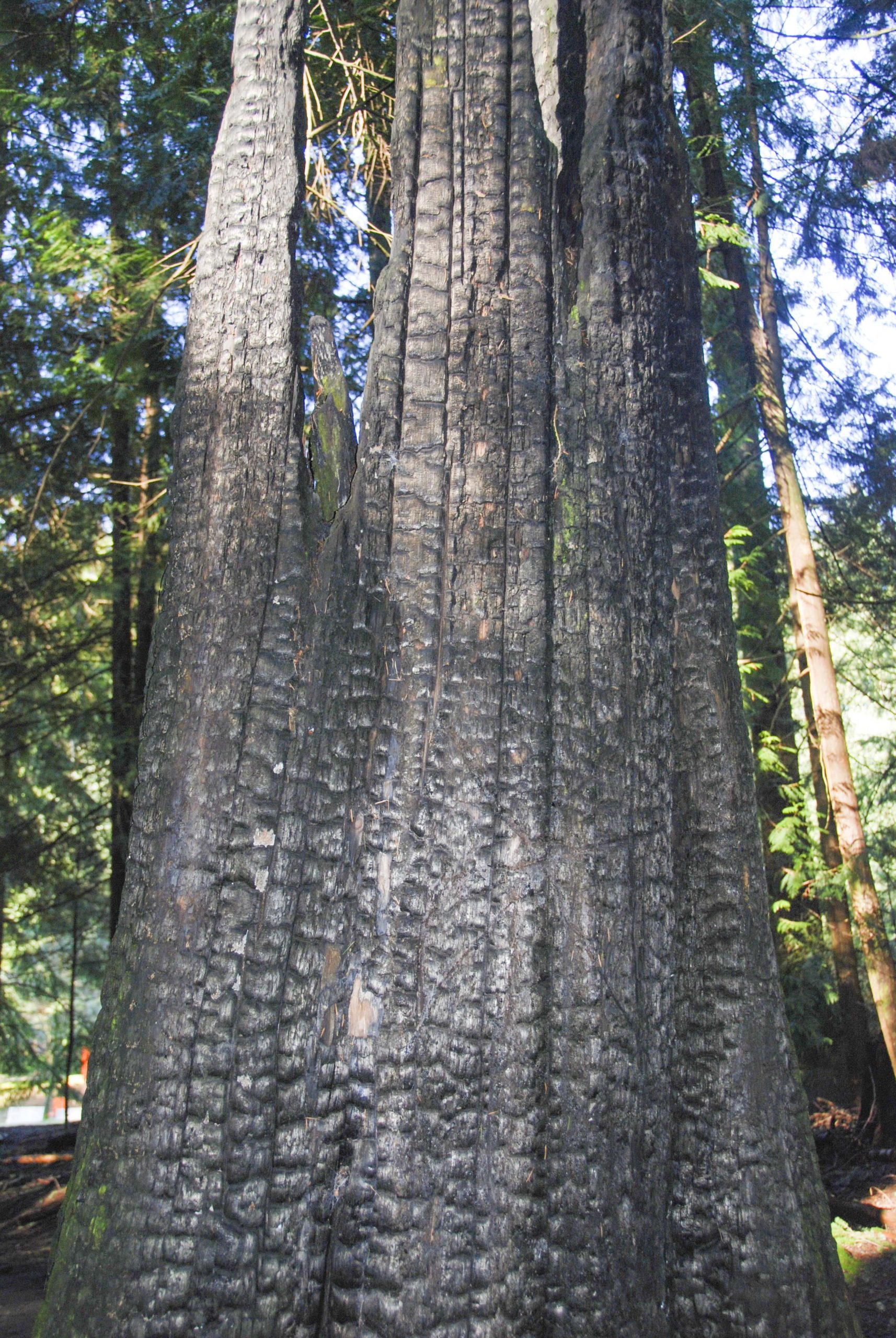 …a University of Delaware professor has found that there is something of value to be learned from what’s left behind in the remnants of a wildfire. The charred debris left in the wake of wildfires … is known as wildfire char. UD’s Pei Chiu, professor of civil, construction and environmental engineering, studies wildfire chars and the ways they just might prove useful in reducing methane, a powerful gas that traps heat in the atmosphere. Methane emissions come from many different sources, ranging from livestock manure to landfills and wastewater treatment plants. This work also informs his research on biochar — man-made chars created from leftover wood chips, rice husks, corn stover and other agricultural biomass — that can be used in soil amendments, stormwater treatment and other applications. Chiu shares five important facts about char — both natural (wildfire char) and manmade (biochar).
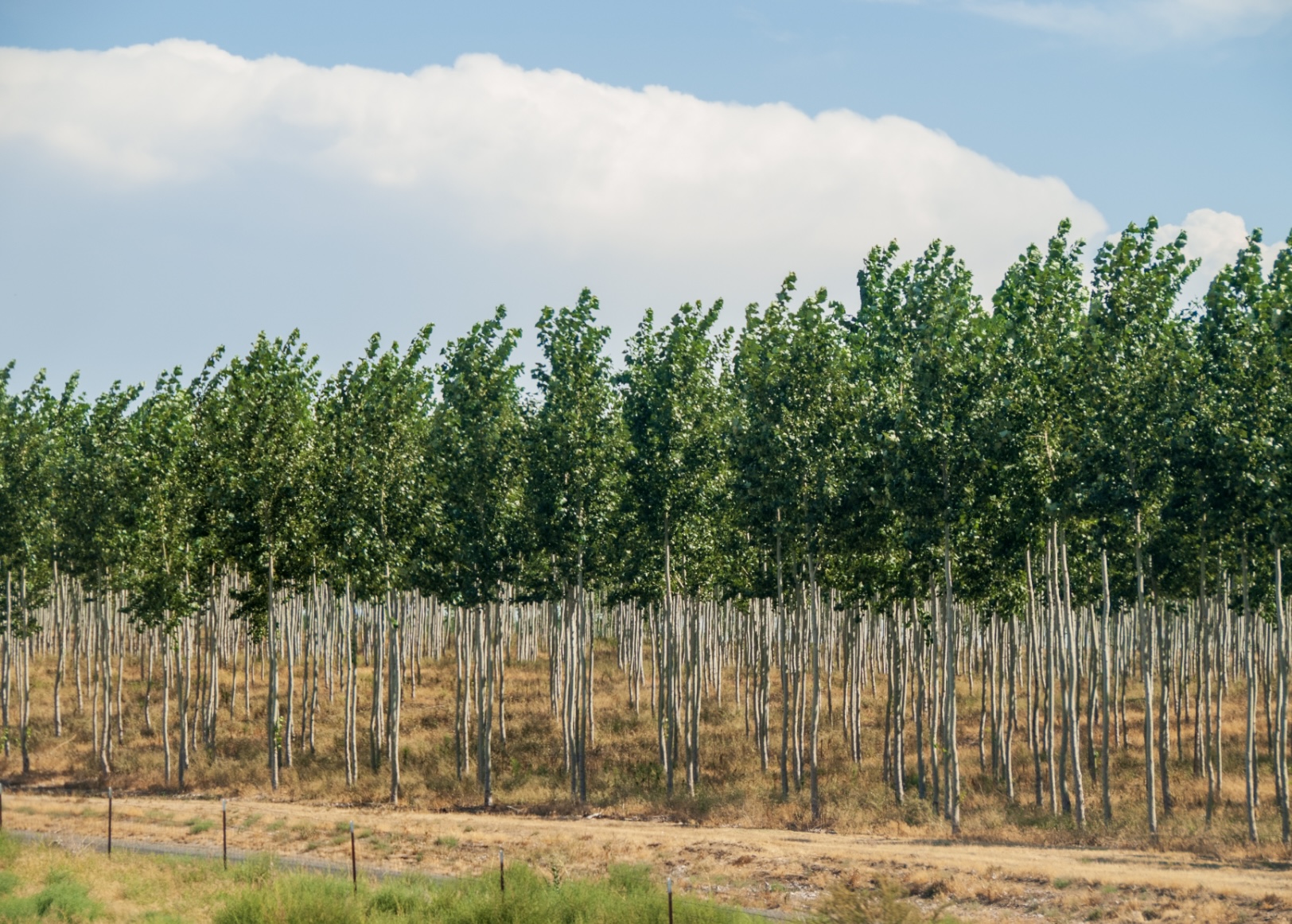 A new study, led by the University of Missouri, has uncovered how poplar trees can naturally adjust a key part of their wood chemistry based on changes in their environment. This discovery … could help create better biofuels and other sustainable products. The study, “Factors underlying a latitudinal gradient in S/G lignin monomer ratio in natural poplar variants,” was published in the journal Proceedings of the National Academy of Sciences. …”Understanding how plants make lignin could help us improve its conversion into high-value biomaterials and improve the competitiveness of U.S. biorefineries,” Jaime Barros-Rios, an assistant professor of plant molecular biology, said. Poplars are used in the paper and pulp industry. Now, they’re being explored as a source of bioenergy—fuels, plastics and other bioproducts. They are useful for scientific research because their genome has been fully mapped.

