 The United States has increased countervailing duties on Canadian softwood lumber [from 6.74% to 14.63%], bringing the total duties on lumber to 35.19%. The decision was announced on Friday by the US Department of Commerce. Although the escalating fees were anticipated, they still drew swift condemnation and words of alarm from industry and political leaders in BC and Ontario, who say it is yet the latest example of unfair treatment of the industry from their largest and most important international partner. “Two words describe Donald Trump’s latest move to increase countervailing duties on Canadian softwood lumber: absurd and reckless,” B.C.’s Forests Minister Ravi Parmar said. “Adding these additional softwood duties … will only worsen an affordability crisis on both sides of the border.”
In response to the increase in countervailing duties:
- Kim Haakstad, Council of Forest Industries: COFI condemns doubling of duties. Urges action to improve business environment for forestry in BC
- Government of Ontario Ministers: Ontario renews calls for removal of duties on softwood lumber exports
- Kurt Niquidet, BC Lumber Trade Council: Urges Canada and the US governments to make resolving the dispute a top economic priority
- Northern Ontario Municipalities: Softwood lumber tariffs ‘deal a serious blow’ to northern forestry sector

 Since Feb. 1, 2025, Canada has been plunged into a major trade war, triggered by U.S. President Donald Trump. …These measures threaten thousands of jobs and destabilize the deeply integrated supply chains between the two countries. This is not the first time Canada has faced such a threat. In 2018, similar tariffs were imposed by the same president but lifted in 2019 with the conclusion of the CUSMA. The difference today is the far greater scale and scope of the trade war. …The USW calls for a robust industrial strategy to reduce Canada’s dependence on U.S. trade. Priority must be given to steel, aluminum, wood and materials manufactured in Canada in all government-funded projects. Public money must be used to support Canadian jobs. The union is also calling for a tax credit to encourage the procurement of Canadian-manufactured goods, as well as the creation of strategic reserves of critical minerals to stabilize demand and secure supply chains.
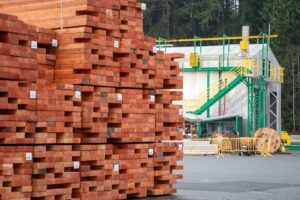 The US lumber industry says new financial support pledged by Canada to domestic forestry companies risks deepening the neighbors’ long-running trade dispute, and may result in yet more import taxes. Last week Prime Minister Mark Carney promised as much as C$1.2 billion in loan guarantees, grants and contributions for Canadian sawmills to pursue product development and market diversification — in response to what he said were unjustified US import taxes. Three days later, US Department of Commerce separately confirmed it would more than double combined anti-dumping and countervailing duties on Canadian softwood lumber. …“We will absolutely be asking Commerce to look at whether companies received a distortive benefit from this package,” said Whitney Rolig, who acts as lead attorney for the US Lumber Coalition. …The Quebec Forest Industry Council said that “even the Department of Commerce has long since ceased to consider loan guarantees as subsidies,” and the aid package also aims to boost domestic demand.

 It will take time to fully understand the implications of a landmark court ruling that appears to place Aboriginal title in British Columbia above standard private property rights. But already, there’s a fierce political debate. The BC Supreme Court ruled that the Cowichan Tribes holds title over federal, city and private land in Richmond that it historically used as a fishing village. This title sits higher in the legal hierarchy than fee simple land rights of other current owners. The ruling could set a precedent that fundamentally changes the security of standard private property in B.C. …Eby’s comments hit at the core of the fallout — that with most of British Columbia identified by First Nations as traditional territory, the court ruling could scare away not only the general public but businesses considering investing in the province. …But Justice Young appeared to set a new precedent by calling Aboriginal title the “senior interest in land vis-a-vis the fee simple titles.”
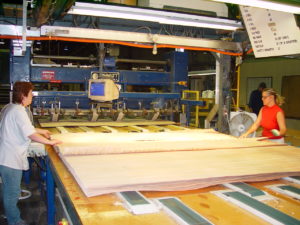 A BC manufacturer that says it’s facing closure is accusing the provincial government of hypocrisy after the premier recently touted a product it had a hand in. BC Veneer Products provided the wood fibre that UBC designers used to fabricate a soccer ball out of innovative “wood leather,” something which Premier Eby promoted while on a June trade mission to Japan. …The problem, Gunia explained, is the company hasn’t been able to secure more logs to keep his plant and its 17 employees working. The forestry company he works with on Vancouver Island has already reached its maximum allowable cut for the year. The operator has another block it can harvest in January, but Gunia says that will be too late. …Gunia said his company’s troubles are particularly galling, given the emphasis the premier and the province have put on promoting value-added wood products.
 For one local lumber mill, the federal government’s announcement of support for the Canadian softwood lumber industry is a step in the right direction. Nick Arkle, CEO at Gorman Brothers Lumber, said in his 50 years of working in the forestry industry, he hasn’t sensed a government that has been this supportive at a federal level. “Both federally and provincially, I’m seeing some major shifts,” Arkle said after Prime Minister Mark Carney visited the Gorman Brothers Lumber mill in West Kelowna to announce the federal government’s strategy to bolster Canada’s softwood lumber industry. …Arkle said Canada also has to figure out how to get along with its neighbours. Gorman Brothers has strong relationships with many customers in the U.S., said Arkle, and those customers can’t figure out why they’ve got this trade action going on because they want Gorman Brothers’ lumber.

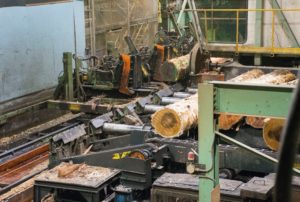 The pieces might be falling into place for Wyoming’s timber industry to make a strong comeback, legislators and land management officials said. The volume of timber being cut in Wyoming might outpace the state’s few remaining sawmills to meet the demand. The increase in demand coincides with tariffs being placed on Canadian lumber. …Long-term success of expanding the Wyoming timber industry hinges on building back the “local timber industry,” instead of trucking logs to mills in other states, Bighorn National Forest Supervisor Andrew Johnson said. Wyoming timber products could include “finger-jointed two-by-four” boards, as well as wooden posts and poles, he said. Johnson made his remarks before the Wyoming Legislature’s Select Federal Natural Resources Committee. He and other land management officials gave optimistic reports as they informed the committee about the outlook for logging and lumber milling in Wyoming, due to recent state and federal policy changes.



 OTTAWA — Canada’s housing crisis may get worse before it starts to show much relief, as new projections say that the number of housing starts will actually decrease this year and next. These new estimates, from both public and private sector housing forecasts, contradict political promises from all levels of government to boost supply of homes across the country. The Canada Mortgage and Housing Corporation (CMHC) forecasts that the total number of housing starts in Canada this year will be about 237,800, down from 245,367 in 2024. CMHC, a Crown corporation that acts as Canada’s national housing agency, also forecasts a drop to no more than 227,734 next year and 220,016 in 2027. Those forecasts are all below the 267,000 annual output for housing starts from 2021-22 and less than half the 480,000 that the CMHC says Canada needs to add each year over the next decade.
 EDMUNDSTON, New Brunswick – Acadian Timber reported financial and operating results for the three months ended June 28, 2025. “During the second quarter, Acadian delivered mixed results,” said Adam Sheparski, CEO. …Acadian generated sales of $17.1 million, compared to $41.2 million in the prior year period. The second quarter of 2024 included $19.7 million in carbon credit sales, while no carbon credit sales occurred in the second quarter of 2025. Acadian generated $0.8 million of Free Cash Flow during the second quarter and declared dividends of $5.2 million or $0.29 per share to our shareholders. …While the second quarter of the year is traditionally our weakest due to seasonal operating conditions, operating activity in Maine was impacted by prolonged wet conditions which significantly delayed the commencement of deliveries in the spring.
 The impact of President Trump’s tariffs on consumer prices is just getting started, according to research by Goldman Sachs Group, adding more uncertainty to a Treasury market that has been gripped by shifting bets on the pace of interest rate cuts. US companies have so far taken the bulk of the hit but the burden will increasingly be passed on to consumers as companies hike prices, economists including Jan Hatzius wrote. Consumers in the US have absorbed an estimated 22% of tariff costs through June, but their share will rise to 67% if the latest tariffs follow the pattern of levies in previous years, they wrote. The net result: faster inflation. The core personal consumer expenditure index, one of the Federal Reserve’s favorite measures of inflation, will hit 3.2% year-on-year in December. They said underlying inflation net of tariffs would be 2.4%. The rate was 2.8% in June.
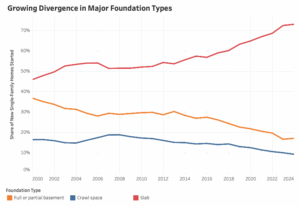 In 2024, 73% of new single-family homes started were built on slab foundations, according to NAHB analysis of the
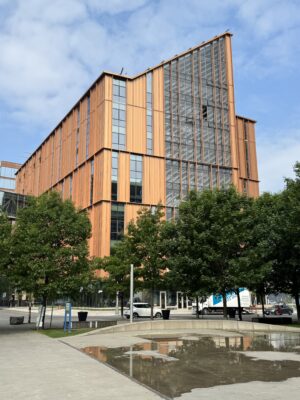 TORONTO — George Brown College’s (GBC) Limberlost Place has helped trigger major changes to Ontario’s building codes and is playing a key role in the province’s strategy to grow its mass timber construction sector, college officials say. The 10-storey academic building—Canada’s first institutional structure made from mass timber and designed to achieve net-zero carbon emissions—has served as a catalyst for the Ontario government’s Advanced Wood Construction Action Plan, unveiled on June 26. The action plan outlines four goals: Promote awareness and use of advanced wood construction; Remove regulatory barriers in codes and standards; Stimulate innovation and investment in advanced manufacturing; and Showcase successful projects to build industry confidence. Limberlost Place embodies all four goals. …By demonstrating the viability and benefits of mass timber at scale, George Brown College has positioned itself—and Ontario—as a leader in sustainable construction and advanced wood manufacturing.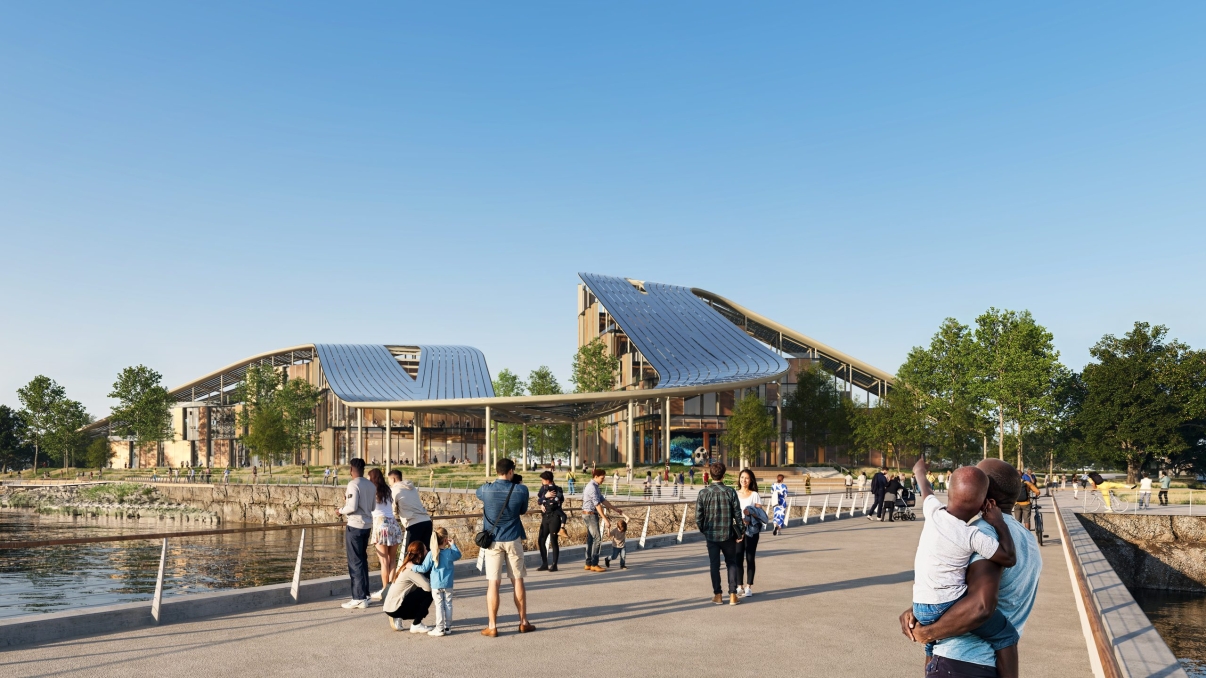
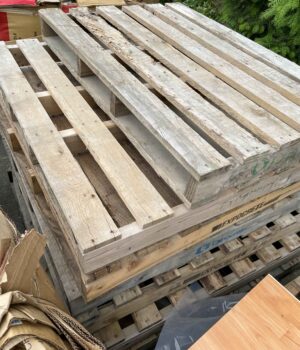 The European Federation of Wooden Pallet and Packaging Manufacturers (FEFPEB) has advised that the EU Deforestation Regulation (EUDR) will not have significant implications for customers using wood pallets and packaging for transport. The organization
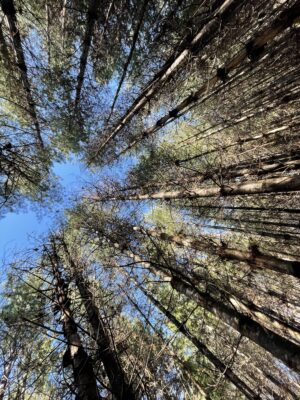
  CALGARY, Alberta — Wildfire season is in full effect across much of Canada, and Canadians are facing significant impacts. …Corey Hogan, Parliamentary Secretary to the Honourable Tim Hodgson, announced $45.7 million in funding for 30 projects across Canada through Natural Resources Canada’s Build and Mobilize Foundational Wildland Fire Knowledge program. These projects are driving research focused on protecting Canadians from the growing threat of wildfires, strengthening wildfire risk assessments and improving mitigation and adaptive forestry practices. We are also helping Indigenous communities access the tools needed to lead on wildfire readiness in their communities and backing Indigenous-led projects that support fire stewardship.
 With wildfires forcing evacuations from Vancouver Island on the Pacific Coast to Newfoundland in the North Atlantic, Canadian officials were mustering additional resources on Thursday to help provinces cope with the blazes and the disruption. Eleanor Olszewski, Canada’s emergency management minister, announced on social media Thursday morning that the armed forces and the Coast Guard would assist the island province of Newfoundland in fighting blazes. Three out-of-control fires forced the evacuation of 900 people in the province on Thursday. Some provinces have moved this week to limit activities like hiking that could spark additional blazes, with forecasts indicating it is unlikely that sufficient rain would fall in regions plagued by out-of-control fires. Canada’s national fire threat level has been at 5, the highest danger rating, since late May. About 7.1 million hectares, or 27,000 square miles, of forest have burned so far this season in the country. [to access the full story a NY Times subscription is required]
 MIRAMICHI, New Brunswick — In response to the increased wildfire risk, some forestry operations in New Brunswick will be restricted over the next couple of days. A release from the province’s Department of Natural Resources says the move is to protect both the forests and people living in the province. On Friday, the natural resources minister said in the release the restrictions will be on both Crown and private lands. “These measures will help protect our forests, animals, natural habitats and our communities, as well as our wildland fire crews,” John Herron said. As of midnight Friday, harvesting, forwarding, skidding, scarification, chipping and all pre-commercial thinning and cleaning are restricted until Tuesday. However, trucking, road construction and maintenance, vegetation management and tree planting are still getting the green light. These restrictions apply to all forested lands in the province, both private and Crown.
 Cole Lindsay, the Oregon Department of Forestry aviation coordinator, said firefighters would typically have to hike into the dark canyon to check for new fires — a time-consuming and potentially dangerous task on a wildfire that had already roared to 23,890 acres in Wheeler County. But technology has advanced. Instead of sending people, Lindsay sent a drone equipped with an infrared camera to sweep across the canyon. “The cameras and sensors are so good that it would have seen something way before the human eye,” Lindsay said. …The Oregon Department of Forestry has 29 pilots. In 2024, ODF and its contractors flew 482 drone missions, 364 of which were for fire purposes. Out of 136 hours of flight time, 98.5 hours were on fire missions. So far in 2025, ODF, excluding its contractors, have flown 41 missions totaling 14 hours. Out of those 14 hours, 7.9 hours were for fire purposes.
 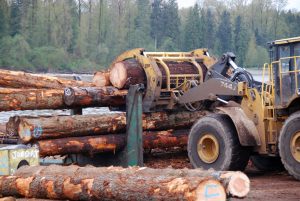 WASHINGTON STATE — Washington’s rural counties and school districts are preparing to start the school year without millions of dollars from a program meant to offset reduced revenue from logging on federal lands. The Secure Rural Schools program expired at the end of 2023 after Congress failed to renew it. Democratic and Republican lawmakers, along with local officials, are pushing US House leadership to bring a bill renewing the program to the floor. The lapsed program helps pay for roads and schools, providing $7 billion in payments to more than 700 counties and 4,400 school districts across 40 states since it was enacted in 2000. …Counties and schools have received logging revenue from the federal government for roads and schools since 1906. Federal law currently mandates that all counties annually receive 25% of the seven-year average of revenue generated by that county’s forests.
 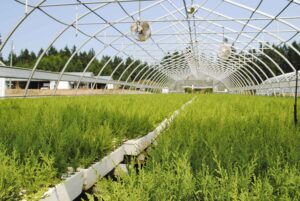 The First Minister has today opened a new £26 million facility to help grow more trees for Scotland’s forests and woodlands. Newton Tree Nursery, near Elgin, will support Forestry and Land Scotland to almost treble their tree production – from seven million to nearly 20 million trees per year by 2029. It will help support the sustainable management of Scotland’s national forests and land and help tackle the climate emergency, while also supporting the rural economy. Seedling operations at the redeveloped tree nursery began in March 2025 and 12 million trees have already been established within the glasshouse. The new nursery is the UK’s largest and most advanced tree-growing glasshouse and sets a new standard for bio secure, sustainable, and high-volume forest nursery production. The facility ensures that an adequate supply of high-quality trees is available to supply the publicly managed forests of Scotland with those forests supporting rural economies, providing flood mitigation, improving biodiversity and sequestering carbon.
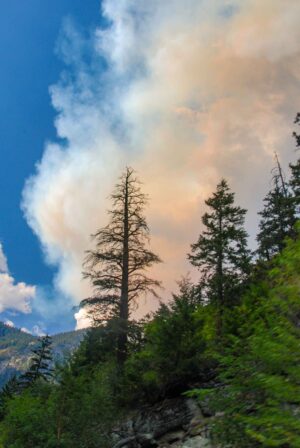
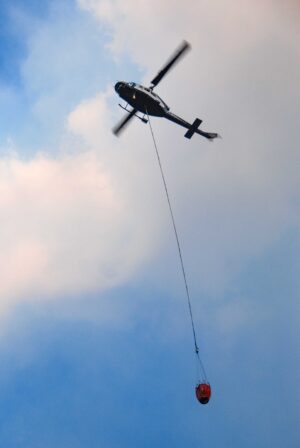
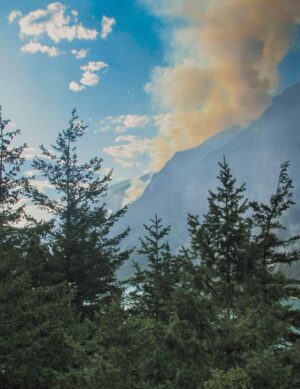 VICTORIA — BC Wildfire Service said an out-of-control wildfire burning on Vancouver Island near Cameron Lake could generate smoke for the “coming weeks, and potentially the coming months.” The warning appears in a video that BCWS posted Sunday as part of a larger update on the Wesley Ridge wildfire. “The public will be seeing smoke at the height of land here on Wesley Ridge for the coming weeks, and potentially, the coming months,” said operations sections chief Beau Michaud while seen standing on a temporary helicopter landing pad fashioned out of logs. But Michaud added that he does not expect the fire to impact Highway 4 connecting communities along the western shore of Vancouver Island with communities on the eastern shore.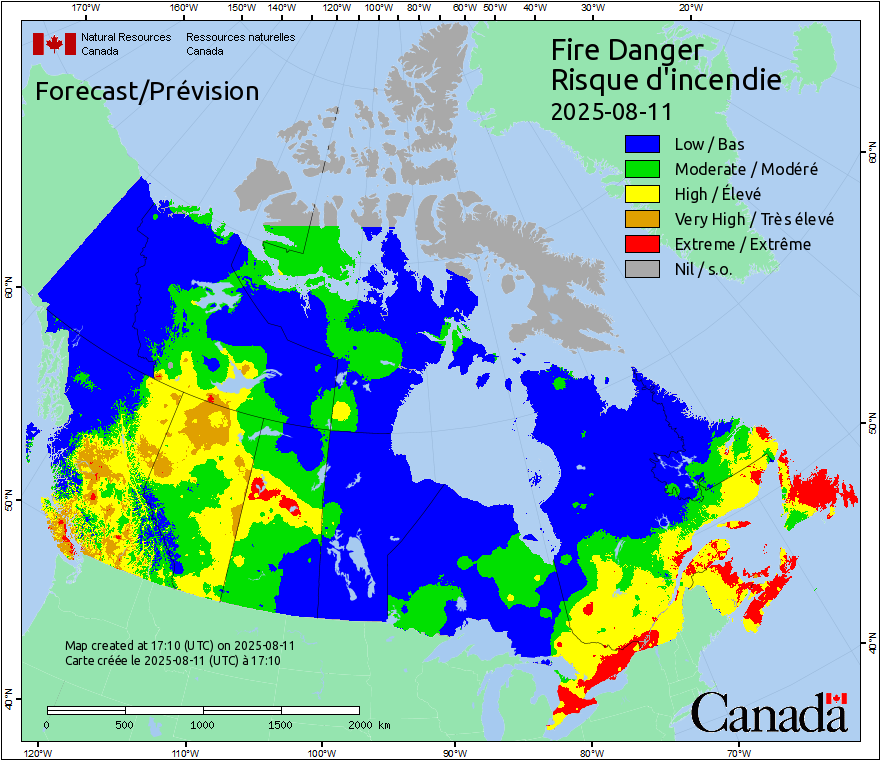
 Fires, storms and the potential for near-record high temperatures across the western US are in the offing for the coming week. The Gifford Fire, about 125 miles northwest of Los Angeles, had burned 113,648 acres and was 21% contained through Saturday, according to Cal Fire. So far, 809 people have been evacuated and the Los Padres National Forest was closed because of the flames. There are 3,935 fire crews and support staff on the scene, and at least seven have been injured, according to a joint statement by Cal Fire, the US Forest Service and several local agencies. The Gifford blaze is the largest of 14 fires across the state. …Large wildfires in Colorado have also caused air quality to drop there, the U.S. National Weather Service said. …Meanwhile, smoke from forest fires in Canada has once again crossed into the US, causing air quality alerts to be posted in Minnesota and parts of Wisconsin.
 At least three people have died in a scorching heatwave that is fuelling dozens of wildfires across parts of southern Europe, forcing thousands of people from their homes. Red heat alerts have been issued in parts of Italy, France, Spain, Portugal and the Balkans, warning of significant risks to health as temperatures push above 40C (104F). Spain’s weather service Aemet said temperatures could reach 44C (111.2F) in Seville and Cordoba, while southern Portugal could also hit 44C. In Spain, an equestrian centre employee died after suffering severe burns in Tres Cantos, near Madrid, where winds over 70km/h (43mph) drove flames near homes, forcing hundreds to flee. In Spain’s north-western region of Castile and Leon, almost 4,000 people were evacuated and more than 30 blazes were reported. Another 2,000 people were evacuated from hotels and homes near the tourist hotspot of Tarifa. …In neighbouring Portugal, firefighters battled three large wildfires.