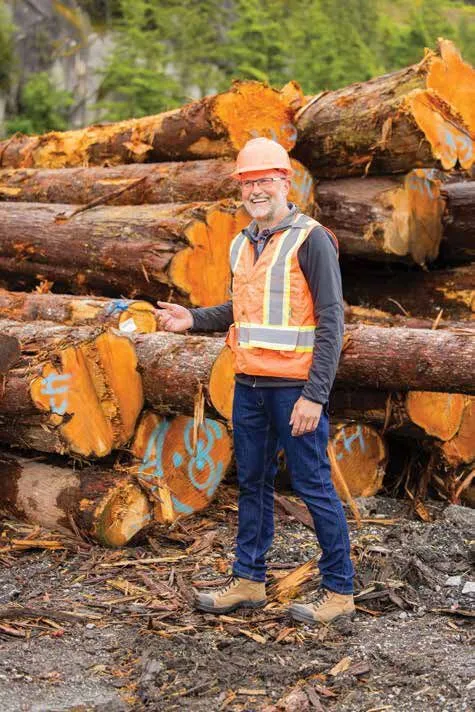
Peter Lister
Growing up in the Courtenay – Campbell River area, Peter Lister understood that forestry, along with other resource industries, was a huge driver of regional prosperity. …Lister led the lumber manufacturing program at Forintek before joining the Forest Engineering Institute of Canada (FERIC) as general manager and national research director. …When FERIC merged with Forintek and Paprican to create FPInnovations, Lister became vice president of the Forest Operations Division with full responsibility for research, membership, and bottom-line financial performance. A year later he took over responsibility for the Wood Products Division of FPInnovations while successfully delivering a wide range of programs focused on expanding markets, developing new technologies, improving processes, worker safety and environmental performance.
…Like so many of his colleagues, Lister spent decades charting the decline of his cherished industry, and now he feels primed to be an effective advocate. “I’m ready to help raise the profile of our sector and to fight for TLA’s members,” he says. “The forest sector is a critical part of BC and we have a great story to tell. Wood is our only renewable and sustainably produced building material and BC has one of the highest percentages of third-party certified, sustainably managed forests. It would be great if everyone in BC knew that.” He continues, “For much of its history, BC has been a global leader in forestry, forest products and forest product equipment. We’ve lost sight of the economic benefits that this has brought to our province and have suffered economically as a Result. …While recognizing that the issues facing the forest sector are many and complex, Lister has many ideas and is keen to engage with industry, associations and government.
Related news by Peter Lister, TLA Executive Director: Why I’m fundamentally optimistic about BC’s forest sector.
 In celebration of Canada Day, the Tree Frog News team is taking a short break on Monday. We’ll return to our lily pad bright and early Wednesday morning with your full dose of forestry news and insight.



 VANCOUVER, British Columbia – Western Forest Products announced today that the sawmill at its Columbia Vista Division, located in Vancouver, Washington, sustained extensive damage in a fire, rendering the mill inoperable. “On behalf of Western, I want to extend my sincere gratitude to the firefighters and first responders who attended the fire at our site,” said Steven Hofer, Western’s President and CEO. “While we are shocked by the damage to the mill, we feel incredibly fortunate that no employees or emergency personnel were injured. We are focused on supporting our team members and completing an incident investigation and assessment.” The Columbia Vista Division produced approximately 53 million board feet of lumber in 2024, with production focused on Douglas Fir specialty products for Japan and U.S. markets.
 KINGSPORT, Tennessee — Domtar’s Kingsport mill received a long-awaited permit last week leading to the start of the anaerobic digester project. The Tennessee Department of Environment and Conservation issued the 142-page permit Wednesday. …“Receiving this permit is an important milestone in our efforts to advance the anaerobic digester project at the Kingsport Mill,” Charlie Floyd, VP of strategic capital projects, said. “This investment underscores Domtar’s commitment to sustainable innovation and environmental stewardship, while supporting good jobs and economic vitality here in Kingsport.” …Start-up of the new wastewater treatment system is expected by the third or fourth quarter of 2026, according to Domtar’s latest timeline. Around 150 contractors are expected to be on site to build the digester and associated equipment, Floyd said. Domtar estimates a $12.8 million economic impact from the project — including labor, hotel and dining within the community.
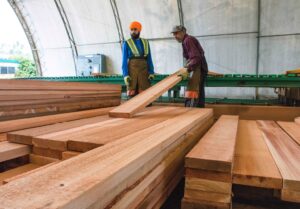 When you think about Indiana’s ag industry, you might not think about hardwoods and lumber, which play a huge role in the state’s economy. Indiana’s hardwood industry has an annual economic impact of over $10 billion to the state’s economy. In fact, Indiana is the number one producer of wooden hardwood and office furniture in the US. Indiana’s hardwood sector also ranks: 2nd in wood kitchen cabinets and countertops, manufactured homes, 3rd in engineered wood products, 4th in pre-fabricated wood buildings, and 5th in upholstered household furniture. Much of the lumber that is harvested and used here in Indiana comes from private woodland owners. “There’s over 4.5 million acres of forest land in Indiana, and of that 85 percent of that is privately owned, so there are a lot of farmers and families who own forest land,” says Tyler Smith, Sales Manager of Cole Hardwood in Logansport.
 VANCOUVER, BC – Canfor announced today its decision to permanently close the Estill and Darlington sawmills in South Carolina, effective August 2025. These closures follow an extended period of persistently weak market conditions and sustained financial losses, which have made continued operations at these facilities no longer viable. “We understand the significant impact this difficult decision will have on our employees,” said Lee Goodloe, President, Canfor Southern Pine. “This outcome is in no way a reflection of the dedication and hard work of our teams. We are committed to supporting our employees through this transition, including providing severance payments and exploring opportunities for redeployment within our other operations where possible.” Approximately 290 employees will be affected by the closures, which will also reduce Canfor’s U.S. lumber production capacity by 350 million board feet annually.
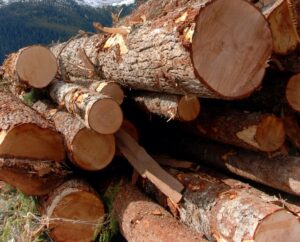 ONTARIO — A northern Ontario forestry company says a train crossing Highway 560 collided Wednesday morning with logs that were spilled by an overturned contractor’s trailer. It happened at the railroad crossing near Interfor’s Gogama Division and resulted in the road being closed between highways 144 and 560A. “There are no injuries or derailment,” Ontario Provincial Police said in a social media post at 8:40 a.m. “A train stop order is in place.” Interfor also confirmed this. …“At Interfor, the safety of our people and the communities where we operate is our highest priority. We are focused on supporting those affected and are actively monitoring the situation.” There is no estimated time of reopening, said OPP Const. Michelle Simard. “The officers are still investigating,” Simard said.

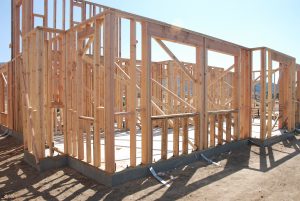 Lumber from Canada? That will be another $534. Major appliances from China? Add a cool $445. New homes in the United States are set to get more expensive thanks to President Donald Trump’s tariff agenda, which is expected to raise the costs of a wide variety of materials that go into building houses. An NBC News analysis of building materials and import data found that the total cost of building a mid-range single-family home could rise by more than $4,000 — an estimate that industry experts who reviewed the analysis called conservative. An April survey from the National Association of Home Builders estimated tariff impacts at $10,900 per home. Neither analysis included labor costs. Robert Dietz, chief economist at the National Association of Home Builders, said the tariffs have an impact beyond their direct cost as they send uncertainty rippling through the supply chain and leave builders unsure how to plan for the future.
 WASHINGTON — Republicans muscled President Donald Trump’s tax and spending cut bill through the House on Thursday, the final step necessary to get the bill to his desk by the GOP’s self-imposed deadline of July 4th. At nearly 900 pages,
 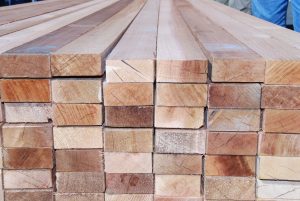 New Zealand has a strong story to tell about free trade, farming and renewable forestry resources. …Given the healthy relationship between the US and New Zealand on the trade front, the temporary relief of tariffs on timber and lumber imported into the US has been welcomed. Though we realise that this tariff exemption could be short lived based on the outcome of the Section 232 investigation aimed at determining the global effects imports of timber, lumber and their derivative products have on the US supply chain. As a small niche supplier of wood products that are needed by the US domestic building market, there is a strong argument for keeping New Zealand timber and lumber imports tariff free to avoid any additional price hikes and further supply chain disruptions. …Like many, we now wait for completion of the section. 232 Investigation.
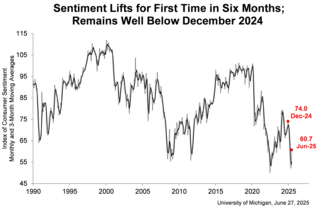

 The US economy contracted in the beginning of the year at a much faster pace than previously reported, after new data factored in much weaker consumer spending. Gross domestic product, the broadest measure of economic output, registered an annualized rate of -0.5% from January through March, the Commerce Department said Thursday in its third and final estimate. That’s worse than the 0.2% decline reported in the second estimate. …The latest estimate showed that consumer spending — the lifeblood of the US economy — was tepid in the beginning of the year. Spending in the first quarter grew at a rate of just 0.5%, down from 1.2% in an earlier estimate. That’s the weakest rate in more than four years. …Economic data released Thursday provides a clearer picture how the US economy has fared in the face of Trump’s policy shifts, which includes fresh figures on new applications for unemployment benefits, and mortgage rates.

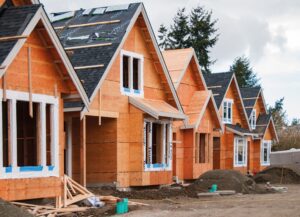 UK — Housing programmes delivered by Homes England resulted in 38,308 new houses starting on site and 36,872 new homes completed between 1 April 2024 and 31 March 2025. This represents an increase in both starts (by 5%) and completions (by 12%) compared to the same period the previous year. 30,087 of new starts on site were for affordable houses — a 0.6% increase on the previous year, and representing 79% of all starts. …Eamonn Boylan, Chief Executive of Homes England, said: ”The statistics demonstrate the importance of programmes like the Affordable Homes Programme (AHP) to enable the delivery of these much-needed homes — and comes hot on the heels of the government committing a further £39 billion in funding to affordable homes over a 10 year period, giving confidence and certainty to the sector.”

 A decade-spanning political battle between housing developers and defenders of California’s preeminent environmental law likely came to an end this afternoon with only a smattering of “no” votes. The forces of housing won. With the passage of a state budget-related housing bill, the California Environmental Quality Act will be a non-issue for a decisive swath of urban residential development in California. In practice, that means most new apartment buildings will no longer face the open threat of environmental litigation. It also means most urban developers will no longer have to study, predict and mitigate the ways that new housing might affect local traffic, air pollution, flora and fauna, noise levels, groundwater quality and objects of historic or archeological significance. And it means that when housing advocates argue that the state isn’t doing enough to build more homes amid crippling rents and stratospheric prices, they won’t — with a few exceptions — have CEQA to blame anymore.
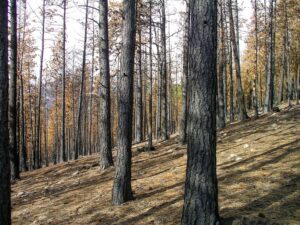 WHITEHORSE, Yukon — Communities in southern Yukon will reduce their wildfire risk after a combined investment of more than $17 million from the federal and Yukon governments. The funding was announced by Dr. Brendan Hanley, Parliamentary Secretary to the Minister of Northern and Arctic Affairs and Member of Parliament for Yukon. …Funding for the Government of Yukon’s Wildland Fire Management branch will decrease fire risk in the communities of Whitehorse, Teslin, and Haines Junction—communities which are part of the northern boreal forest region and prone to aggressive wildfire behaviour. …New treatment will include reducing or managing materials that are flammable or combustible in the wildland-urban interface. These measures follow national standards set out by FireSmart Canada and will increase the wildfire resilience of these three communities.
 Over 7,600 people shared their views on outdoor recreation in a first-ever public survey conducted by Mosaic. “The feedback we received tells us how important Mosaic’s managed forests are to people’s lives,” said Jimmie Hodgson at Mosaic. “It reinforces our responsibility to work toward solutions that reflect what we heard.” Early findings show:
 HELENA, Montana — US Secretary of Agriculture Brooke L. Rollins announced US Forest Service Chief Tom Schultz and Montana Governor Greg Gianforte signed a historic Shared Stewardship Memorandum of Understanding, establishing a new framework between the US Forest Service (USFS) and the State of Montana to advance forest restoration and reduce wildfire risk across the state. Montana’s Shared Stewardship Agreement expands collaborative efforts to accelerate active forest management, safeguard communities, and support sustainable timber production. …“By cutting burdensome, unnecessary red tape and empowering Montana to lead, we’re proving that through real partnership, conservation and economic growth can go hand-in-hand. …The Forest Service and Montana Department of Natural Resources and Conservation (DNRC) will jointly identify and execute large-scale forest management projects, initially focusing on approximately 200,000 acres in northwest Montana.
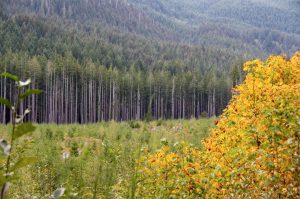 WHITE SULPHUR SPRINGS, Montana — The Helena-Lewis and Clark National Forest has released a final decision for the Bonanza Project, located in the Castle Mountains just east of White Sulphur Springs. Primary management activities planned include timber harvest and prescribed fire. “The project area is highly impacted by the mountain pine beetle and some areas have experienced 90% tree mortality,” said District Ranger Jason Oltrogge. “The timber generated from this project will provide wood products to local companies and prescribed fire will restore forests and reduce wildfire severity.” The Helena-Lewis and Clark National Forest partnered with the Montana Department of Natural Resources and Conservation to plan this project, and the joint effort made this project a reality. …The project includes commercial timber harvest on 1,980 acres and prescribed burning on 918 acres. Project implementation is anticipated to start later this summer.


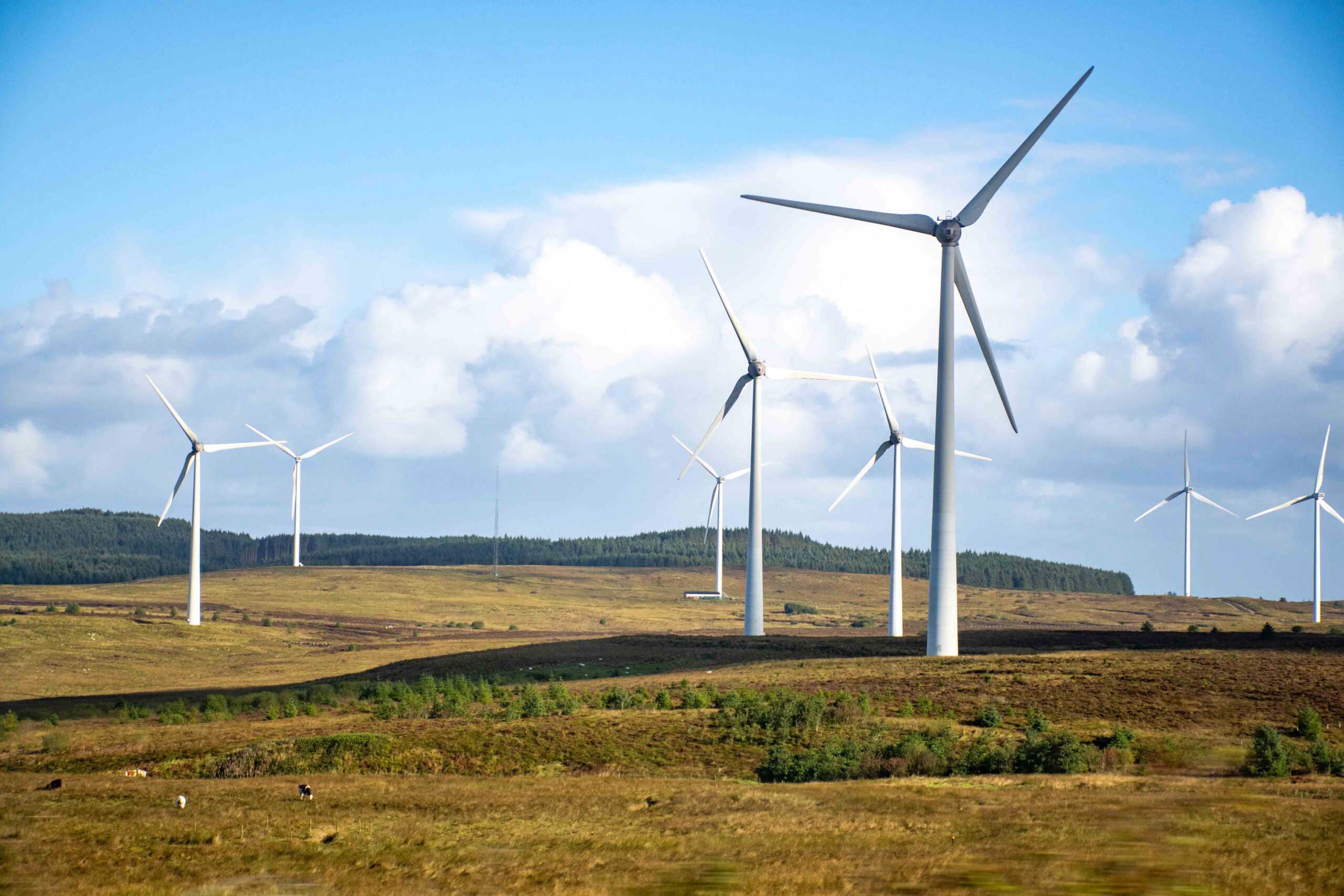 The Trump administration on Monday shut down a federal website that had presented congressionally mandated reports and research on climate change, drawing rebukes from scientists who said it will hinder the nation’s efforts to prepare for worsening droughts, floods and heat waves. The U.S. Global Change Research Program’s website, globalchange.gov, was taken down along with all five versions of the National Climate Assessment report and extensive information on how global warming is affecting the country. “They’re public documents. It’s scientific censorship at its worst,” said Peter Gleick, a California water and climate scientist. …In May, Trump signed an executive order saying that his administration is committed to “restoring a gold standard for science to ensure that federally funded research is transparent, rigorous.” …The president cited an example relating to climate science, saying federal agencies previously used a “worst-case scenario” of warming “based on highly unlikely assumptions.”
 Power plants and industrial facilities that emit carbon dioxide are hopeful that Congress will keep tax credits for capturing the gas and storing it deep underground. The process, called carbon capture and sequestration, is seen by many as an important way to reduce pollution during a transition to renewable energy. But it faces criticism from some conservatives, who say it is expensive and unnecessary, and from environmentalists, who say it has consistently failed to capture as much pollution. …The most commonly used technology allows facilities to capture and store around 60% of their CO2 emissions during the production process. Anything above that rate is much more difficult and expensive, according to the IEA. …Even so, carbon capture is an important tool to reduce CO2 emissions, particularly in heavy industries, said Sangeet Nepal at the Carbon Capture Coalition. “It’s not a substitution for renewables … it’s just a complementary technology”.
  After Georgetown’s International Paper mill shut down at the end of last year, the pressure is on for South Carolina’s forestry industry to find new local markets. The solution may be as simple as burning wood, a type of renewable energy. …South Carolina produces wood pellets but much of the product is shipped abroad. …Some lawmakers hope wood biomass specifically could address two problems the state faces: the forestry industry’s need for new local markets and consumers’ demand for more energy. State lawmakers attempted to address the latter in the South Carolina Energy Security Act. The new law is aimed at generating more energy in the state. …Forestry industry leaders delivered