
Kelly McCloskey

Robert McKellar
When we first reached out to political risk expert Robert McKellar in mid-2024, our goal was to spark a conversation the forest sector wasn’t yet having—about political risk and its growing influence on everything from trade policy to investment decisions. Robert’s op-ed in August, 2024 made the case that political risk is not just something that happens in volatile regions—it is the exposure of businesses to political forces, whether through government policies, trade dynamics, or geopolitical shifts. He identified major political forces impacting the Canadian forest sector—including the growing China-West rivalry and Canada-US trade friction—to help companies assess the relevance of political risk for themselves. In hindsight, his foresights were well placed.
After the election of President Trump and given how quickly the trade situation evolved, we reached out to Robert a few weeks ago to re-examine these dynamics. And given the complexities, we decided on a two-part approach. In Part I, in February 2025, Robert set the stage by looking at Trump’s leadership style and his approach to business, he outlined how forest product companies can assess and manage political risk, and then he focused on the most pressing risk to the sector—tariffs. The other risks—lumber duties, interference in Canadian-owned US-based industries, and the impact of US-China trade tensions on lumber sales—were left for Part II. In that this is a long read, in the “READ MORE document” are the following hyperlinked-titles—should you wish to proceed directly to a given section:
- Recap of Part I
- Is Trump toying with Canada or is there a plan?
- The latest on duties and tariffs
- Are Canadian US-subsidiaries at risk?
- US-China friction and lumber sales
- How to plan and manage for political risk
This isn’t a typical industry commentary. It’s not about what government should do, or where markets might go next. It’s about what companies can do now to better anticipate, adapt to, and, at times, even leverage political disruption. [full disclosure, Robert McKellar is Tree Frog co-editor Sandy McKellar’s brother]


 President Trump’s promised tariffs on softwood lumber risk disrupting the supply chain for something nobody wants to be caught without: toilet paper….While Trump advocates for new tariffs partly to bolster US manufacturing, they may also hit the availability of northern bleached softwood kraft pulp, or NBSK, a key component in making toilet paper and paper towels. NBSK constitutes about 30% of standard U.S. bathroom tissue and half of a typical paper towel, and is currently sourced primarily from Canada, said Brian McClay, chairman of TTOBMA. He added that the U.S. imported about 2 million tons of Canadian NBSK last year, highlighting the longstanding reliance of American paper-goods producers on pulp from their northern neighbour. …“If Canadian pulp mills close because they don’t have the fibre supply, I can’t think of any other option for them — they just can’t switch the recipe around,” he said. The scenario risks reviving painful memories of pandemic-era toilet paper shortages.
 Yesterday, we featured Part II of our in-depth Q&A with political risk expert Robert McKellar, a follow-up to an August
 As a federal election kicks off, the trade war with the US is casting a long shadow over voters’ choices, and whoever forms the next government will have the tall order of trying to draw this conflict to a close. …International trade experts say that will be much easier said than done. The two economies are more integrated than ever before, and President Donald Trump’s chaotic governing style makes it extremely difficult to know how to even begin to unravel this dispute. …Carney met with the country’s premiers and leaders from long-time allies in other countries to chart a short- and long-term response to the tariffs. He has conceded there’s a limit to how much Canada can do to respond. …Russell Williams at Memorial University said because Trump keeps threatening Canada’s existence, a political, rhetorical de-escalation is essential before any compromise on trade can be reached.
 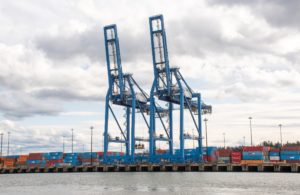 US President Donald Trump’s coming wave of tariffs is poised to be more targeted than the barrage he has threatened, aides and allies said. …The White House is narrowing its approach to take effect on April 2, likely omitting a set of industry-specific tariffs while applying reciprocal levies on a targeted set of nations that account for the bulk of foreign trade with the US. …The White House is still planning to unveil the reciprocal -tariff action on that day, though. …The fate of the sectoral tariffs, as well as tariffs on Canada and Mexico that Trump said were justified by fentanyl, remains uncertain. …The administration is now focusing on applying tariffs to about 15% of nations with persistent trade imbalances with the US… such as Australia, Brazil, Canada, China, the European Union, India, Japan, South Korea, Mexico, Russia, and Vietnam.

 Canada could be on the lower end of Trump’s threatened global tariffs next week, the Star has learned. Nothing, however, is guaranteed until Trump decides ahead of his April 2 deadline and no government officials are taking any assurances for granted, sources said. …Canadian sources with knowledge of discussions between the two countries say White House officials have suggested Trump may impose three escalating levels of tariffs on America’s trading partners, with Canada getting hit on the lower end of the scale. …Despite a recent news report the tiered-approach is not on the table, the sources said it aligns with the government’s understanding of what’s about to hit next week. Flavio Volpe, head of the Canadian Auto Parts Manufacturers Association, said, “I wouldn’t take any comfort from that… it may just be that some other countries have been levied a higher universal tariff”.
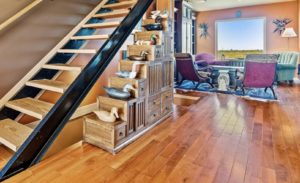 CALIFORNIA — The US Department of Justice (DOJ) announced that it had reached an $8.1 million settlement in a civil False Claims Act case based on alleged customs violations by defendants Evolutions Flooring, a San Francisco-based importer of wood flooring, and its owners Mengya Lin and Jin Qian. …The complaint shows how DOJ and relators may formulate such cases. Evolutions and its owners were accused of knowingly evading customs duties, including antidumping duties, countervailing duties, and section 301 tariffs, on wood flooring manufactured in the People’s Republic of China. Acting at the direction of its owners, Evolutions allegedly mispresented the country of origin of certain flooring imports – declaring them as Malaysia-origin – to avoid the high duties applicable to China-origin products. Evolutions also allegedly falsely declared the true manufacturer of the imported merchandise.


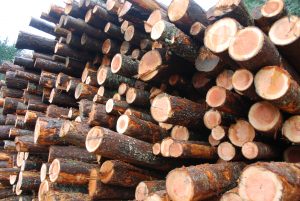 VERMONT — Oliver Pierson, Vermont state’s director of forestry, and Katharine Servidio, mapped out the [tarrif] tangle for the House Committee on Agriculture, Food Resiliency, and Forestry. As sawmill capacity in the U.S. has retracted, New England’s loggers have looked to Canada to process timber felled on this side of the border. …Vermont imported $52 million in sawmill and wood products from Canada in 2024, according to Pierson. …There is a case for bringing more milling back to America, Pierson said, but “it wouldn’t be for a year or two from now when we’d be able to stand up additional processing capacity.” In the short term, Servidio and Pierson said that they expect that U.S. tariffs on lumber imported from Canada and retaliatory Canadian tariffs on Vermont timber will be debilitating for the logging industry in the state.

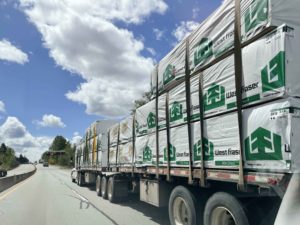 Flatbed trucking rates have surged over the past month as steel and lumber shippers hurry to stockpile inventory amid tariff whiplash threatening to roil their supply chains, experts say. A six-week increase in rates has led to the highest flatbed pricing to start a year since 2017, according to DAT, as freight repositioning combines with a typical seasonal pickup in construction and other industries. “Demand usually picks up in March and April as planti ng, building, construction, machinery imports, and nursery seasons gear up,” said DAT Principal Analyst Dean Croke. “…Last week, the average flatbed spot rate went up 4 cents to $2.13 per mile compared to the previous week. Meanwhile, the load-to-truck ratio for flatbed went up to 46.92 from 41.12 loads per truck.Shippers have pulled forward cargo imports such as machinery, lumber, metals and oversized flatbed freight to mitigate tariff uncertainty.
 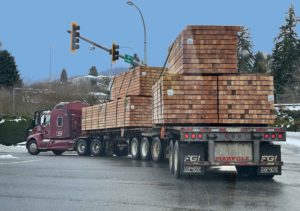 The ongoing trade spat between the U.S. and Canada is impacting BC’s construction sector in ways that could bring short-term gain and long-term pain. At first, there could be an oversupply of lumber if Canadian softwood is taken out of the U.S. equation, resulting in lower costs for B.C. builders and developers, said Padraic Kelly, Vancouver-based director with BTY Group. But costs would later rise significantly, he said. “The medium- and long-term pain would be that if the American market is choked out, mills would close, supply would be constrained and costs would ultimately go up,” Kelly said. The total levy on Canadian softwood lumber going into the U.S. could total between 45% and 55%, taking into account anti-dumping measures introduced by the Biden administration and scheduled to increase this August. Other big-ticket impacts to B.C. construction could be the mechanical and electrical divisions within construction budgets, he said.
 Donald Trump’s trade war is alarming the global markets, sending shares sliding in their worst month in over two years. Stock markets across the Asia-Pacific region are in retreat this morning, as investors fear Trump will announce swingeing new tariffs on Wednesday, which has been dubbed “Liberation Day” by the US president. Japan’s Nikkei has lost 3.9%, down 1,457 points at 35,662 points today, while South Korea’s KOSPI is down 3%, Australia’s S&P/ASX 200 has fallen 1.7%. In China, which has already been hit by Trump tariffs this year. the CSI 300 is 0.9% lower. …Today’s selloff comes after Donald Trump told reporters that the reciprocal tariffs he is set to announce this week will include all nations. …On Friday, core inflation rose by more than expected, while consumer sentiment weakened to its lowest level since 2022.
 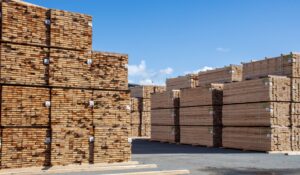 Contractors are bracing for a new wave of tariffs set to take effect April 2, this time on certain material imported from Canada and Mexico — such as steel, aluminum and lumber. Though reports indicate the Trump administration could roll back the ultimate scope of this action, contractors say just the threat of tariffs can have an immediate impact on material costs. That’s why that looming deadline on Canadian and Mexican imports has already sparked concern across the construction industry, particularly around reinforcing and structural steel, curtainwall systems and Canadian lumber, said Steve Stouthamer, executive VP Skanska USA Building. Stouthamer talks about the materials most at risk, tariffs’ impact on budgets and negotiations and steps contractors can take to minimize financial exposure. …The Trump administration has indicated Canadian lumber will be included in the reciprocal tariffs. Lumber has already seen a significant increase, 10% to 15% in cost, in anticipation of this tariff.
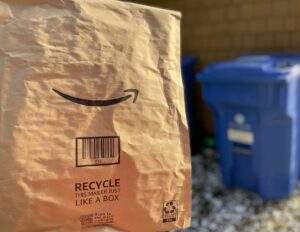 Last week, consumers in four states filed a proposed class action against Amazon, accusing the company of greenwashing by misleading consumers about the sustainability of the company’s Amazon Basics line of paper products. Here are some of the key allegations: Amazon uses a Sustainability Leaf and a Climate Pledge Friendly logo to suggest that Amazon’s supply chain for Amazon Basics paper products uses sustainable forestry practices. …However, because Amazon sources its Amazon Basics paper products from suppliers who clearcut and burn centuries-old forests, Amazon is exaggerating any environmental benefits. …The Forest Stewardship Council (or “FSC”) requires companies to use different FSC logos to depict different levels of commitment to responsible forest management. Despite this, Amazon uses an unqualified Forest Stewardship Council logo. …This Complaint challenges an arguably very sustainably-minded company. We learned this week that Amazon announced the launch of a new carbon credit investment service.
 A Canfor operation in Prince George and three area First Nations have received federal funding to boost innovation in forestry. The $293,500 in local funding is part of more than $20 million the Canadian government is investing in 67 projects province-wide. The funds are part of a broader effort to enhance the competitiveness and resiliency of Canada’s forest industry, which has faced increasing trade barriers, particularly from the US. Among the recipients is Canadian Forest Products, or Canfor, which will receive up to $121,500 for a project aimed at producing innovative, formaldehyde-free and isocyanate-free wood adhesives. The company will explore extracting kraft lignin from black liquor at its Northwood mill in Prince George, converting it into a new, sustainable bioproduct. The project aims to determine the commercial viability of this process, which could open up new revenue streams and reduce reliance on harmful chemicals.
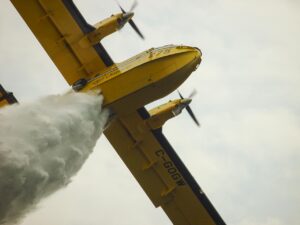 The Province of Ontario says it’s prepared for the fast-approaching 2025 wildland fire season. The new season starts on April 1, and preparations have included filling more than 100 new, permanent positions to help support forest fire fighting operations, said Chris Marchand, fire information officer with Aviation, Forest Fire and Emergency Services (AFFES). …Exactly how busy this season will be remains unknown, Marchand said, as it’s very difficult to predict how intense a fire season will be. …Marchand said the previous winter saw “somewhat normal” snowfall patterns across Ontario. …Marchand noted, however, that the 2024 fire season was slower than usual — 480 fires were reported, down from the 10-year, seasonal average of 700 fires. The Province of Ontario said it partnered with the federal government last year to invest $64 million in the provincial wil
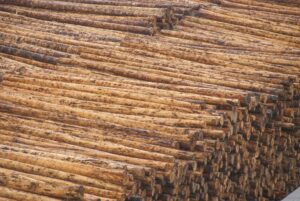 The world is running out of time to halt deforestation. Yet instead of stepping up, the US is dismantling forest protections and undermining global progress – highlighting the dangers of global forest policy that fails to hold the wealthiest, most powerful countries accountable. …But the latest actions by the US highlight just how dangerous and unbalanced this paradigm is. …Under the pretense of national security, Trump’s orders aim to gut environmental safeguards and fast-track industrial clearcutting in some of the US’s most precious and climate-critical forests. …Meanwhile, as Europe strengthens forest accountability, US state officials are pushing to exempt the country from new deforestation protections.. These officials, echoing industry talking points, are urging the EU to exclude US wood products from a law requiring due diligence to prevent imports or exports tied to deforestation or forest degradation. Their argument? That the US doesn’t need oversight.
 NEW YORK — A jury in Georgia has ordered Monsanto parent Bayer to pay nearly $2.1 billion in damages to a man who says the company’s Roundup weed killer caused his cancer. The verdict marks the latest in a long-running series of court battles Monsanto has faced over its Roundup herbicide. The agrochemical giant says it will appeal the verdict. The penalties awarded include $65 million in compensatory damages and $2 billion in punitive damages. That marks one of the largest legal settlements reached in a Roundup-related case to date. …Germany-based Bayer, which acquired Monsanto in 2018, has continued to dispute claims that Roundup causes cancer. But the company has been hit with more than 177,000 lawsuits involving the weedkiller and set aside $16 billion to settle cases. Monsanto said Friday’s verdict “conflicts with the overwhelming weight of scientific evidence and the consensus of regulatory bodies and their scientific assessments worldwide.”
  Prolonged droughts, wildfires and water shortages. Torrential downpours that overwhelm dams and cause catastrophic flooding. Around the globe, rising temperatures stoked by climate change are increasing the odds of both severe drought and heavier precipitation that wreak havoc on people and the environment. Rainfall can disappear for years only to return with a vengeance, as it did in California in 2023, with record-setting rain and snowfall. That led to heavy vegetation growth that provided fuel for the devastating January wildfires in Los Angeles after drought returned. But how can global warming cause both drier and wetter extremes? Here’s what experts say. It’s all about the water cycle. Water constantly moves between the Earth and its atmosphere. But that system — called the hydrological cycle — is speeding up as global temperatures get hotter, primarily due to the burning of fossil fuels like coal and gas.
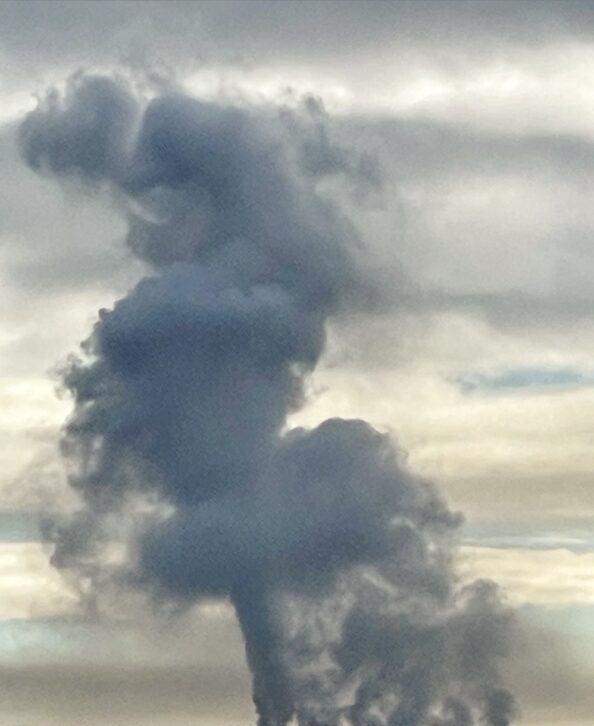 Apologies are in order if anyone blamed it on the dog. The Kruger pulp mill on Mission Flats Road says it is responsible for what some might have noticed was a stronger than usual odour in the air in Kamloops late Friday afternoon. According to Kruger spokesperson Paule Veilleux-Turcotte, the smell was the result of a failure in the mill’s odour control equipment. “The plant halted its operations to repair the equipment, but, despite shutting down, some residual levels of the gases would still have been noticeable within the community,” Veilleux-Turcotte said in an email to Castanet Kamloops. “Despite the equipment issues, operations remained in compliance with the site permit for the duration of the event.” Veilleux-Turcotte said the issue was fixed by about 10 p.m. on Friday night, and, upon confirmation of the repairs, the mill resumed operations. [END]
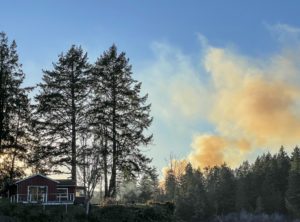 Oregon firefighters arrived Sunday in North Carolina to assist in fighting wildfires that have burned thousands of acres in the western part of the state. The Oregon Department of Forestry sent 26 firefighters and two agency representatives for a two-week rotation in North Carolina. Many of the Oregon firefighters were assigned to the Black Cove Fire. The fire was first reported March 19. The Black Cove Fire in North Carolina’s Polk County has forced evacuations and is one of the largest in the western part of the state. Along with the Deep Woods Fire, burning in the Green River Gorge, a combined 4,621 acres were burning with 0% containment as of Sunday evening, according to the North Carolina Forest Service. …The firefighters were sent under a mutual assistance agreement between Oregon and North Carolina.
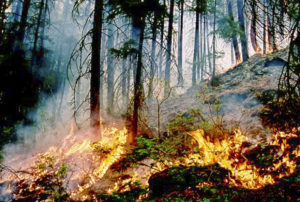 Wildfires forced a mandatory evacuation Sunday in a North Carolina county still recovering from Hurricane Helene, and South Carolina’s governor declared an emergency in response to a growing wildfire in that state. Hundreds of miles north, the New Jersey Forest Fire Service was battling a blaze in the Wharton State Forest. The North Carolina Department of Public Safety announced a mandatory evacuation starting at 8:20 p.m. Saturday for parts of Polk County in western North Carolina about 80 miles west of Charlotte. A shelter had been established in Columbus, North Carolina. …Also this weekend, the New Jersey Forest Fire Service has been battling a wildfire that broke out in the Wharton State Forest on Saturday. The fire had consumed about 2.7 square miles as of early Sunday morning and was about 50% contained, according to an 8 a.m. update.