
Derek Nighbor
The current threat of an additional 25% US tariff facing Canada’s forest sector is an urgent wake-up call to improve our nation’s competitiveness and infrastructure, and to diversify export markets. …Our nation’s natural resources are Canada’s global competitive advantage. In recognition, the federal government has created integrated sector strategies for critical minerals, cement, and electricity. …These natural resource sector strategies are critical to a more secure, more sustainable, and more competitive economy. Forestry is an important part of that economy but has not been part of the underlying strategy.
Forestry needs a National Forest Sector Strategy to: build more homes using Canadian wood products; convert “wood waste” into biofuels for power; open new international opportunities for Canada’s wood products; and cut red tape and regulatory barriers. …FPAC advocates for the reinstatement of full funding for market expansion programs such as Canada Wood, which can open new international opportunities for Canadian forest products. …Finally, environmental and land-use policies must remain science-based and not impose unnecessary restrictions that hurt the creation of jobs, investment, and sustainable forestry operations.
The unjust tariffs threatened by the American administration (in addition to the existing duties on softwood lumber) are a real risk to Canada’s forest sector and the broader economic relationship between the two countries. FPAC supports the federal, provincial and territorial governments in their swift tariff response, including firm countermeasures. However, for the forestry sector’s long-term health, the solution lies in domestic policy. With a robust response, Canada can mitigate the impact and emerge stronger. Expanding domestic wood use, advancing biomass and pulp market opportunities, strengthening trade resilience, and cutting regulatory barriers are critical steps in this journey.
 President Trump’s promised tariffs on softwood lumber risk disrupting the supply chain for something nobody wants to be caught without: toilet paper….While Trump advocates for new tariffs partly to bolster US manufacturing, they may also hit the availability of northern bleached softwood kraft pulp, or NBSK, a key component in making toilet paper and paper towels. NBSK constitutes about 30% of standard U.S. bathroom tissue and half of a typical paper towel, and is currently sourced primarily from Canada, said Brian McClay, chairman of TTOBMA. He added that the U.S. imported about 2 million tons of Canadian NBSK last year, highlighting the longstanding reliance of American paper-goods producers on pulp from their northern neighbour. …“If Canadian pulp mills close because they don’t have the fibre supply, I can’t think of any other option for them — they just can’t switch the recipe around,” he said. The scenario risks reviving painful memories of pandemic-era toilet paper shortages.
 As a federal election kicks off, the trade war with the US is casting a long shadow over voters’ choices, and whoever forms the next government will have the tall order of trying to draw this conflict to a close. …International trade experts say that will be much easier said than done. The two economies are more integrated than ever before, and President Donald Trump’s chaotic governing style makes it extremely difficult to know how to even begin to unravel this dispute. …Carney met with the country’s premiers and leaders from long-time allies in other countries to chart a short- and long-term response to the tariffs. He has conceded there’s a limit to how much Canada can do to respond. …Russell Williams at Memorial University said because Trump keeps threatening Canada’s existence, a political, rhetorical de-escalation is essential before any compromise on trade can be reached.
  Canada could be on the lower end of Trump’s threatened global tariffs next week, the Star has learned. Nothing, however, is guaranteed until Trump decides ahead of his April 2 deadline and no government officials are taking any assurances for granted, sources said. …Canadian sources with knowledge of discussions between the two countries say White House officials have suggested Trump may impose three escalating levels of tariffs on America’s trading partners, with Canada getting hit on the lower end of the scale. …Despite a recent news report the tiered-approach is not on the table, the sources said it aligns with the government’s understanding of what’s about to hit next week. Flavio Volpe, head of the Canadian Auto Parts Manufacturers Association, said, “I wouldn’t take any comfort from that… it may just be that some other countries have been levied a higher universal tariff”.
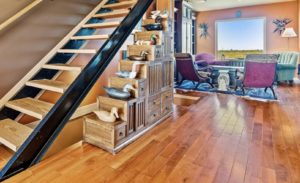 CALIFORNIA — The US Department of Justice (DOJ) announced that it had reached an $8.1 million settlement in a civil False Claims Act case based on alleged customs violations by defendants Evolutions Flooring, a San Francisco-based importer of wood flooring, and its owners Mengya Lin and Jin Qian. …The complaint shows how DOJ and relators may formulate such cases. Evolutions and its owners were accused of knowingly evading customs duties, including antidumping duties, countervailing duties, and section 301 tariffs, on wood flooring manufactured in the People’s Republic of China. Acting at the direction of its owners, Evolutions allegedly mispresented the country of origin of certain flooring imports – declaring them as Malaysia-origin – to avoid the high duties applicable to China-origin products. Evolutions also allegedly falsely declared the true manufacturer of the imported merchandise.
 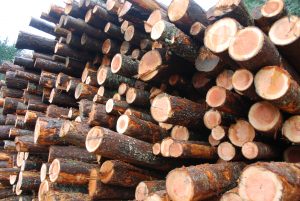 VERMONT — Oliver Pierson, Vermont state’s director of forestry, and Katharine Servidio, mapped out the [tarrif] tangle for the House Committee on Agriculture, Food Resiliency, and Forestry. As sawmill capacity in the U.S. has retracted, New England’s loggers have looked to Canada to process timber felled on this side of the border. …Vermont imported $52 million in sawmill and wood products from Canada in 2024, according to Pierson. …There is a case for bringing more milling back to America, Pierson said, but “it wouldn’t be for a year or two from now when we’d be able to stand up additional processing capacity.” In the short term, Servidio and Pierson said that they expect that U.S. tariffs on lumber imported from Canada and retaliatory Canadian tariffs on Vermont timber will be debilitating for the logging industry in the state.
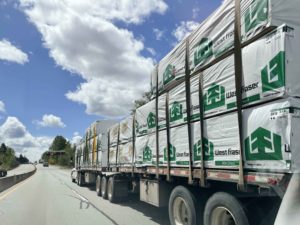 Flatbed trucking rates have surged over the past month as steel and lumber shippers hurry to stockpile inventory amid tariff whiplash threatening to roil their supply chains, experts say. A six-week increase in rates has led to the highest flatbed pricing to start a year since 2017, according to DAT, as freight repositioning combines with a typical seasonal pickup in construction and other industries. “Demand usually picks up in March and April as planti ng, building, construction, machinery imports, and nursery seasons gear up,” said DAT Principal Analyst Dean Croke. “…Last week, the average flatbed spot rate went up 4 cents to $2.13 per mile compared to the previous week. Meanwhile, the load-to-truck ratio for flatbed went up to 46.92 from 41.12 loads per truck.Shippers have pulled forward cargo imports such as machinery, lumber, metals and oversized flatbed freight to mitigate tariff uncertainty.
 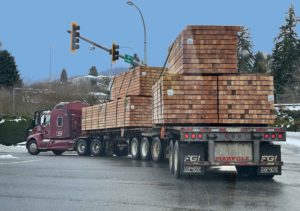 The ongoing trade spat between the U.S. and Canada is impacting BC’s construction sector in ways that could bring short-term gain and long-term pain. At first, there could be an oversupply of lumber if Canadian softwood is taken out of the U.S. equation, resulting in lower costs for B.C. builders and developers, said Padraic Kelly, Vancouver-based director with BTY Group. But costs would later rise significantly, he said. “The medium- and long-term pain would be that if the American market is choked out, mills would close, supply would be constrained and costs would ultimately go up,” Kelly said. The total levy on Canadian softwood lumber going into the U.S. could total between 45% and 55%, taking into account anti-dumping measures introduced by the Biden administration and scheduled to increase this August. Other big-ticket impacts to B.C. construction could be the mechanical and electrical divisions within construction budgets, he said.
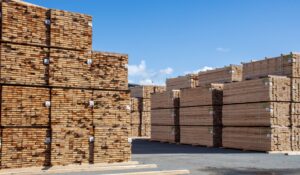 Contractors are bracing for a new wave of tariffs set to take effect April 2, this time on certain material imported from Canada and Mexico — such as steel, aluminum and lumber. Though reports indicate the Trump administration could roll back the ultimate scope of this action, contractors say just the threat of tariffs can have an immediate impact on material costs. That’s why that looming deadline on Canadian and Mexican imports has already sparked concern across the construction industry, particularly around reinforcing and structural steel, curtainwall systems and Canadian lumber, said Steve Stouthamer, executive VP Skanska USA Building. Stouthamer talks about the materials most at risk, tariffs’ impact on budgets and negotiations and steps contractors can take to minimize financial exposure. …The Trump administration has indicated Canadian lumber will be included in the reciprocal tariffs. Lumber has already seen a significant increase, 10% to 15% in cost, in anticipation of this tariff.
 Prolonged droughts, wildfires and water shortages. Torrential downpours that overwhelm dams and cause catastrophic flooding. Around the globe, rising temperatures stoked by climate change are increasing the odds of both severe drought and heavier precipitation that wreak havoc on people and the environment. Rainfall can disappear for years only to return with a vengeance, as it did in California in 2023, with record-setting rain and snowfall. That led to heavy vegetation growth that provided fuel for the devastating January wildfires in Los Angeles after drought returned. But how can global warming cause both drier and wetter extremes? Here’s what experts say. It’s all about the water cycle. Water constantly moves between the Earth and its atmosphere. But that system — called the hydrological cycle — is speeding up as global temperatures get hotter, primarily due to the burning of fossil fuels like coal and gas.
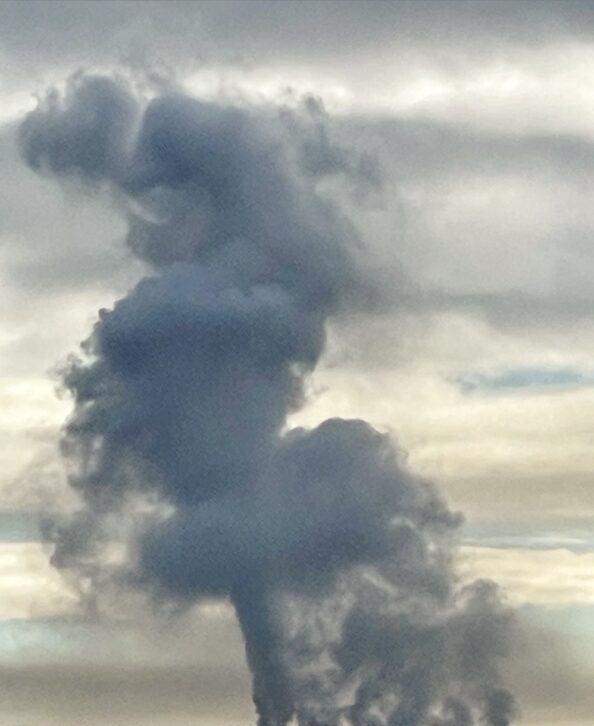 Apologies are in order if anyone blamed it on the dog. The Kruger pulp mill on Mission Flats Road says it is responsible for what some might have noticed was a stronger than usual odour in the air in Kamloops late Friday afternoon. According to Kruger spokesperson Paule Veilleux-Turcotte, the smell was the result of a failure in the mill’s odour control equipment. “The plant halted its operations to repair the equipment, but, despite shutting down, some residual levels of the gases would still have been noticeable within the community,” Veilleux-Turcotte said in an email to Castanet Kamloops. “Despite the equipment issues, operations remained in compliance with the site permit for the duration of the event.” Veilleux-Turcotte said the issue was fixed by about 10 p.m. on Friday night, and, upon confirmation of the repairs, the mill resumed operations. [END]
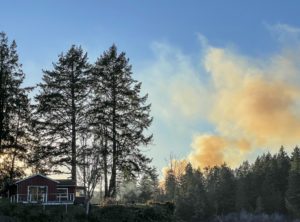 Oregon firefighters arrived Sunday in North Carolina to assist in fighting wildfires that have burned thousands of acres in the western part of the state. The Oregon Department of Forestry sent 26 firefighters and two agency representatives for a two-week rotation in North Carolina. Many of the Oregon firefighters were assigned to the Black Cove Fire. The fire was first reported March 19. The Black Cove Fire in North Carolina’s Polk County has forced evacuations and is one of the largest in the western part of the state. Along with the Deep Woods Fire, burning in the Green River Gorge, a combined 4,621 acres were burning with 0% containment as of Sunday evening, according to the North Carolina Forest Service. …The firefighters were sent under a mutual assistance agreement between Oregon and North Carolina.