 WASHINGTON — A day into Donald Trump’s North American trade war, the U.S. president remained adamant that tariffs would benefit America even as a key member of his team has floated that a compromise could materialize Wednesday. Trump addressed a joint session of Congress Tuesday night by making a case for his massive tariff agenda. …Ottawa introduced immediate 25% retaliatory tariffs. …Following a second day of sharp decline, U.S. Secretary of Commerce Howard Lutnick said… the government was looking to “work something out” in a deal that could be announced on Wednesday. …Lutnick tied the deal to the Canada-U.S.-Mexico agreement, which was negotiated under the first Trump administration to replace the North American Free Trade Agreement. …Trump also ordered 25% tariffs on all steel and aluminum imports into the United States on March 12… m[and he] signed an executive order to implement “reciprocal tariffs” starting April 2. Other tariff targets include automobiles, copper, lumber and agricultural products.
Related coverage in:
- CNBC: Trump says a ‘little disturbance’ from tariffs is OK, as markets reel from trade war fears
- CNN Business: Trump could back off on some tariffs today … again
- The National News Desk: Have past US trade wars worked in our favor?


 US President Trump on Saturday
 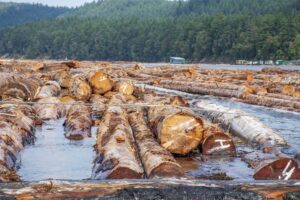 Donald Trump has ordered a probe into dumping in the US lumber market, setting the stage for the industry to join the widening basket of commodities targeted by Washington’s global trade war. The president directed the Department of Commerce to investigate whether imports of lumber and wood products were undermining domestic loggers in a way that posed a risk to US national security, days after ordering a similar review of the copper industry. …Forestry is big business for Canada. In 2022, the sector contributed C$33.4bn to real GDP, or about 1.2%. In the same year Canada’s forest product exports were valued at C$45.6bn, with the majority destined for the US. …Derek Nighbor, FPAC president, said any increase in tariffs on lumber would hurt forest sector employees on both sides of the border. …But Andrew Miller, chair of the US Lumber Coalition, said: “Canada’s unfair trade comes at the direct expense of US companies and workers.”





 Overnight, Jake Power went from reflecting on one of the best months that his Agassiz-based custom sawmill has ever had to staring into a potential recession sparked by U.S. President Donald Trump’s tariffs. Power, along with every other British Columbian, woke up to the reality of a trade war. …“Our business was growing, our customers were doing well,” said Power, CEO of Power Wood. “Now, I think we all expect a North American recession if this continues.” …Premier David Eby declared that “all bets are off” in terms of his response to standing up for the province. …Trade economist Werner Antweiler said he worries the most about B.C.’s forest industry, which was “already struggling (at) the edge of profitability.” …There is another looming danger in a trade war if it results in continuing depreciation of the Canadian dollar versus the U.S. currency, according to economist Bryan Yu.

 Vancouver — The BC Lumber Trade Council (BCLTC) strongly opposes the U.S. Department of Commerce’s preliminary decision to increase anti-dumping duties on Canadian softwood lumber to 20.07%. This unjustified move will negatively impact forestry workers and communities in British Columbia, while further burdening homebuilders, consumers, and the broader construction sector in the United States. “It is deeply disappointing that the U.S. continues to impose these protectionist trade measures” said Kurt Niquidet, President of the BC Lumber Trade Council. “The fact remains that the United States relies on Canadian softwood lumber imports and these duties will harm not only the B.C. forestry industry, but also U.S. consumers, who will bear some of the cost”. Ongoing rebuilding efforts in North Carolina and California, where affordable and reliable lumber is critical to recovery, will be more expensive as a result of this decision.
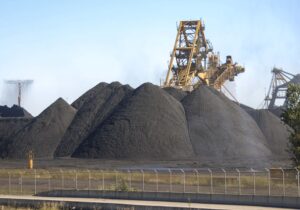 KAMLOOPS — The U.S. Department of Commerce has announced plans to almost triple the anti-dumping duties on Canadian softwood lumber. …“It’s going to be devastating for our industry if we can’t come up with some cost saving methods to be able to not only be more competitive but also trading with our largest partner when it comes to our softwood lumber agreement. …Kamloops-North Thompson MLA and Forest Critic Ward Stamer believes B.C. needs to place a carbon tax on coal as a response. “Our party proposed a carbon tax on U.S. thermal coal through our ports last Monday, and really what we should be doing — whatever they are charging us in duties, we should be charging them back with a carbon tax. …The BC Conservatives asked for an update on their carbon tax proposal during Monday’s question period.

 Landscape to Local: Integrated solutions to wildfire, conservation, community safety and economic development: As wildfires intensify and land use policies evolve, finding solutions requires cooperation across governments, First Nations, local communities, labour and industry. The “Landscape to Local” panel will tackle critical issues, shedding light on real world strategies, innovative practices and community-driven approaches to address the dual challenges of protecting our forests while supporting local economies. Join our distinguished panel of experts: John Kitzhaber, Former Governor of Oregon; Ward Stamer, MLA for Kamloops-North Thompson and BC Conservative Critic for Forests; Klay Tindall, General Manager of Lil’Wat Forestry Ventures; James Whitehead, Engagement Analyst with the Mitigating Wildfire Initiative at SFU’s Wosk Centre for Dialogue; and Moderator Zara Rabinovitch, Vice President of Sustainability & Public Affairs at COFI.
 A key government program designed to help older forestry workers transition into retirement has officially closed after assisting more than 2,200 individuals since its inception in 2019. The Bridging to Retirement Program, launched in response to economic challenges in the forestry sector, has distributed over $92 million in funding, helping affected workers retire early while opening up job opportunities for younger employees, according to the government. The program, which began in October 2019, reached capacity and officially ceased intake on February 26, 2025. Initially funded with $40 million, the program was later expanded to $50 million and renewed in 2021 with a three-year funding commitment. Eligible workers aged 55 and older were provided with financial support of up to $75,000 each, based on their experience and employer contributions. …When first announced in 2019, the provincial government pledged $69 million in forestry support programs to mitigate job losses, strengthen community resilience, and promote economic recovery. …While the program has concluded, new concerns loom over the B.C. forestry sector.

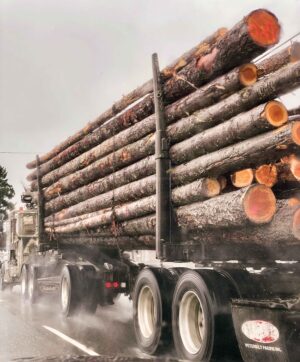 China suspended on Tuesday the soybean import licences of three U.S. firms and halted imports of U.S. logs, stepping up its retaliation for Donald Trump’s decision to impose an extra 10% duty on China. …The suspension of U.S. logs was a direct response to Trump’s move on March 1 to order a trade investigation on imported lumber. Trump had earlier told reporters that he was thinking about imposing a 25% tariff rate on lumber and forest products. “The announcement of import restrictions on U.S lumber and soybeans linked with phytosanitary issues follows a long history of similar measures by Beijing,” said Even Pay, agriculture analyst at Trivium China. …China is one of the world’s largest importers of wood products and the third-largest destination for U.S. forest products. It imported around $850 million worth of logs and other rough wood products from the U.S. in 2024, according to Chinese customs data.


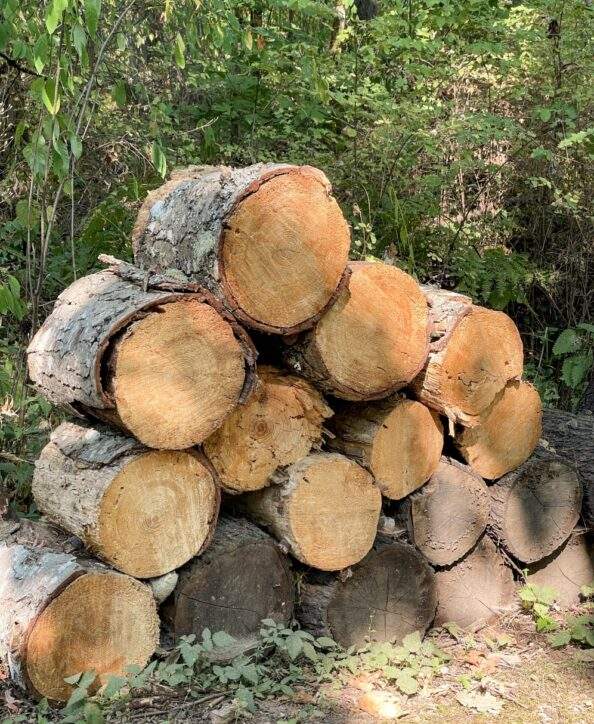 BEIJING – China suspended on Tuesday the soybean import licenses of three U.S. firms and halted imports of U.S. lumber, stepping up retaliatory action after the United States imposed additional tariffs on Chinese goods. Earlier in the day, China also imposed import levies covering $21 billion worth of U.S. agricultural and food products… Customs said it detected ergot and seed coating agent in imported U.S. soybeans while the suspension of U.S. lumber imports was due to the detection of small worms, aspergillus and other pests. …Beijing’s retaliatory measures were in response to U.S. President Donald Trump’s decision to impose an extra 10% duty on China, effective Tuesday, resulting in a cumulative 20% tariff in response to what the White House considers Chinese inaction over drug flows. …The suspension of U.S. lumber was a direct response to Trump’s move on March 1 to order a trade investigation on imported lumber.



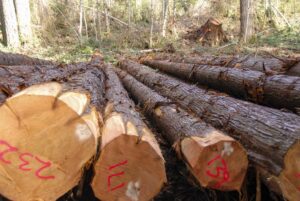 AUGUSTA, Maine — Tariffs on Canadian imports and Ottawa’s retaliation on American goods could sever—or at least strain—the close ties between the forest product industries of Maine and eastern Canada. The state exported $775 million in forest products to Canada in 2023. …Much of the wood Maine sends across the border is in the form of raw logs, according to Dana Doran of Professional Logging Contractors of the Northeast. The timber goes to Canada for processing… and the finished wood products are then frequently re-imported and sold in Maine. …Doran has doubts that these tariff efforts will achieve their intended effect of boosting domestic production. “Most of those Canadian manufacturers have already invested in the United States,” Doran said. …However, others acknowledge that—even if foreign companies benefit—shifting the processing of wood back into the U.S. aligns with the White House’s protectionist aims.
 NEKOOSA, Wisconsin — Partnering with Omya, a producer of essential minerals, the mill built an on-site plant to ensure a reliable source of precipitated calcium carbonate, a key papermaking ingredient. The new PCC plant came online in September 2024, solving several supply challenges. …In 2020, the PCC plant that supplied multiple Wisconsin paper mills, including Domtar’s Rothschild and Nekoosa facilities, closed. …Domtar and Omya researched constructing a four-story PCC plant at the Nekoosa mill. …In July 2022, the companies agreed to build a 27,500 dry-ton-per-year Omya-designed, owned and -operated PCC plant within the Nekoosa mill’s existing footprint. …“By executing this high-ROI, three-year project with a strategic partner, Nekoosa now has an unlimited supply of PCC on-site that allows for flexibility in our papermaking schedules and effective grade development,” says Jason McCauley, Nekoosa mill general manager.