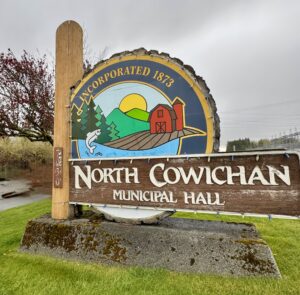
 A North Cowichan Council meeting on April 15 drew industry representatives, union members, and members of the public into an unusually substantive debate on coastal fibre supply and log exports — one that will be remembered as much for the nature of the conversation as for its outcome. What emerged over the course of the evening was a shared goal: a stronger, more productive coastal forest sector that supports workers, families, and communities in the Cowichan Valley. This was not the familiar divide between those who see the forest as a working resource and those who would leave it untouched. It was a debate entirely within the pro-forestry community — about economics, policy, and the best path to keeping mills running and people employed.
The motion itself, brought forward by Councillor Justice, called on the governments of BC and Canada to review and strengthen policies governing raw log exports from forest lands on Vancouver Island, with the goal of improving fibre availability for domestic processing, supporting value-added wood manufacturing, and sustaining forestry employment in coastal communities. It was amended during debate to remove specific reference to private managed forest lands — broadening it to cover Crown and private tenures alike — before being defeated four to three, with Councillors Manhas, Kallio, Finlay, and Hogg opposed.
The backdrop was hard to ignore. The Crofton pulp mill announced its permanent closure in December, and the Chemainus Sawmill has been down for the duration of the year — together representing roughly 500 jobs and significant property tax revenue for the municipality. Mayor Douglas noted that the municipality had already raised fibre supply directly with the Premier and Forest Minister, advocating for faster timber permitting, expanded commercial thinning, and better use of timber damaged by windstorms and wildfires.
Arnold Bercov, speaking on behalf of the Pulp, Paper and Woodworkers of Canada, led the first delegation in support of the motion. He drew on his direct involvement in the employee-led purchase of the Harmac pulp mill out of bankruptcy in 2008, arguing that a secured fibre supply agreement had been the decisive factor in that mill’s survival. He shared a message from the lawyer who represented the union at the time, describing the secured fibre supply agreement as absolutely critical — and noting that without it, Harmac would have faced the same fate as Crofton. Bercov, who spent 47 years at Harmac and rose to lead his national union, put it simply: “Let’s maximize jobs and opportunities for young people. We have the best fibre in the world — let’s stop treating a priceless resource like a 7-11 store.”
Brian Bull, who was approaching his 34th year at the Chemainus Sawmill before it curtailed, framed the motion not as an attack on industry but as a call for conversation. “We’ve lost close to 500 good paying jobs — jobs where you can buy a house, support your family, go on holidays. That’s what we’ve lost in this valley. This motion was about starting a conversation about how we get that back.” He also questioned why more of Mosaic’s open-market log volume isn’t being taken up by mills in the region with available capacity.
The third delegation was from Mosaic Forest Management, represented by Nick Broekhuizen, Vice President Commercial, and Karen Brandt, Senior Vice President Public Affairs and Partnerships. Their arguments were echoed by Megan Hanacek, CEO of the Private Forest Landowners Association of BC, who noted during public input that BC is the only jurisdiction in North America that restricts free-market log sales — requiring domestic mills to be given first right of refusal before any export permit is granted, a protection largely absent in comparable US jurisdictions.
Broekhuizen, a third-generation forest industry worker, walked council through how the system actually works. Every log Mosaic harvests is offered to domestic mills first — by law, at provincially regulated pricing, for two weeks — before any export permit can even be considered. He described one example where 30 domestic customers were served from a single cut block, with only 5% of the volume going to export — and where that 5% was the margin that made the whole operation financially viable. Remove the export option, and the block doesn’t get logged at all. “Mosaic is the largest supplier of open market fibre on the coast. The majority of what we harvest goes to domestic mills — there’s a complex ecosystem of fibre transfer happening that most people don’t see.”
Brandt focused on the structural picture. The coastal sector’s fibre problem, she argued, is rooted in a 50% decline in public land harvest levels over the past decade. The province’s allowable annual cut on coastal Crown land sits around 15 million cubic metres; actual harvest last year came in around 8 million. Private managed forest lands, less than 2% of BC’s total forest base, now supply a third of the coastal fibre basket — up from 23% a decade ago — filling a gap they were never designed to fill and cannot fill indefinitely. Mosaic’s footprint in the valley — $85 million in local supply chain spending and $160 million in wages across the island — underscored that the company is itself part of what the community depends on.
The council debate that followed reflected genuine division, but not along the lines one might expect. Several councillors who voted against the motion did so not because they opposed scrutiny of log export policy, but because they felt it was aimed at the wrong target. Councillor Finlay said the real problem is provincial permitting policy and that fixing it would render the export debate largely moot. Councillor Kallio said he agreed with the motion’s premise but objected to singling out private managed forest lands — a concern that prompted his successful amendment. Both directed their frustration at the province, not at industry.
Brandt, reflecting on the outcome afterward, was measured. “There are no winners here. The wounds in this community are real and a 4-3 vote doesn’t change that. Workers and families on this coast deserve real leadership, and that means industry, government and communities coming together to create the investment climate and hosting conditions that give this coast a real future.”
From this editor’s perspective, what the evening demonstrated most clearly is something the broader policy conversation too rarely reflects: that the forestry community itself — workers, landowners, companies, and local government — is aligned on the urgency of the fibre challenge and increasingly willing to say so publicly and in the same room. The debate over the motion matters less, in some ways, than the fact that the conversation is happening at all. North Cowichan Council deserves credit for creating the conditions for it. The harder work — permitting reform, Crown harvest recovery, the investment environment needed to rebuild coastal manufacturing — requires that same energy directed at the provincial and federal levels, and the turnout and quality of discussion on April 15 suggests there is no shortage of people ready to push for it.