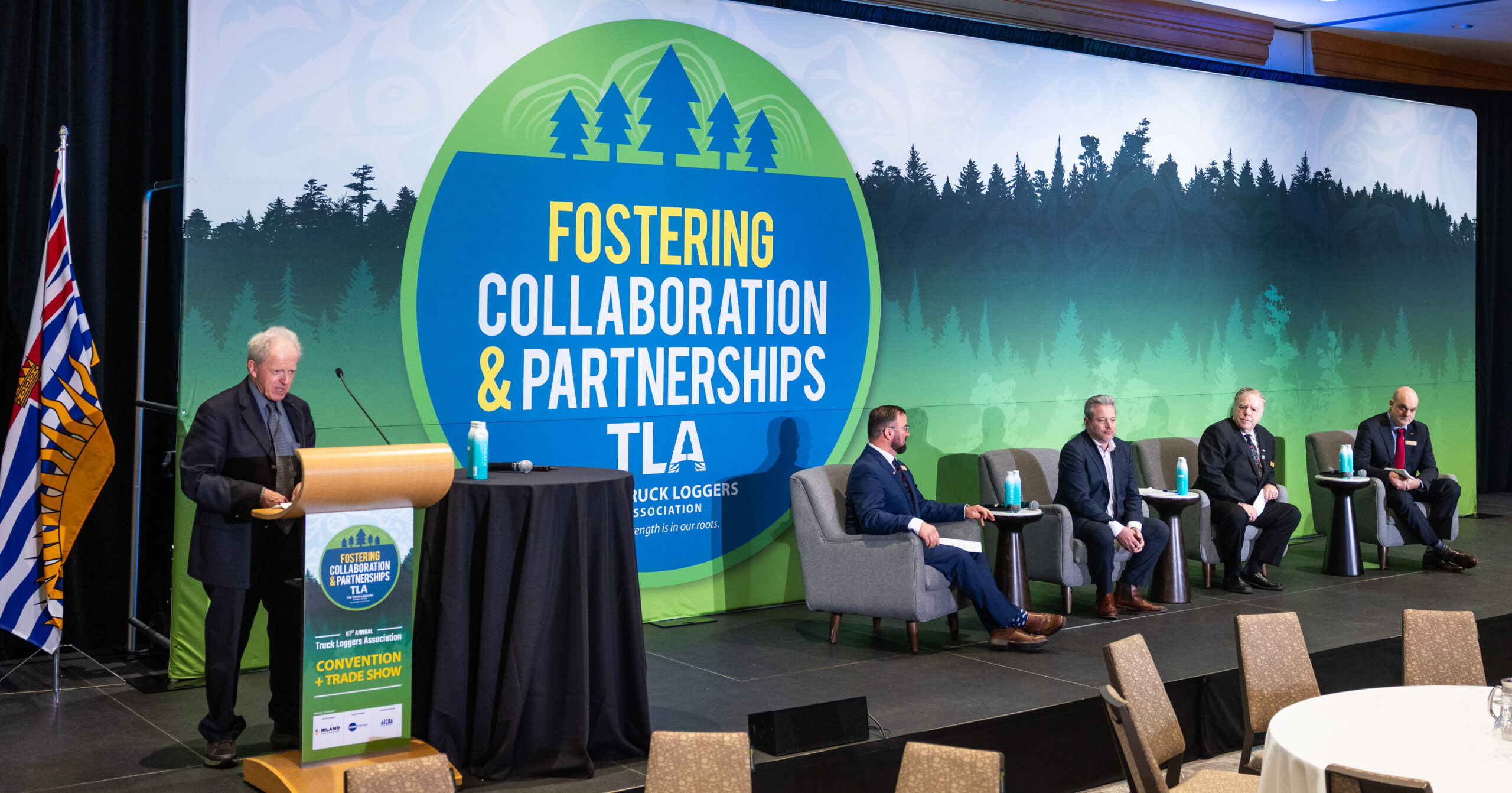
 The final session of the Truck Loggers Association convention took the form of an on-stage conversation with Trevor Halford, Interim Leader of the Conservative Party of British Columbia and current Leader of the Opposition. Moderated by Vaughn Palmer, the discussion featured questions from TLA leadership and selected questions from the floor, focusing on forestry policy, investment certainty, and regulatory conditions in British Columbia. Joining Halford on stage were Dorian Uzzell, President of the Truck Loggers Association and President of Wahkash Contracting; Bob Marquis, TLA Vice President and President of Bob Marquis Contracting; and Aaron Service, TLA Past President and President of Peninsula Logging.
Uzzell opened the conversation by describing the current operating environment for contractors, citing reduced access to fibre, rising costs, and permitting delays that make long-term planning increasingly difficult. He asked Halford how he views the state of the forest sector and the broader investment climate in the province. Halford responded by thanking TLA for the invitation and acknowledging the pressures facing contractors and forestry-dependent communities. He said he was born and raised in Surrey and continues to live there, emphasizing that forestry is not only a rural issue. Halford said thousands of jobs in Surrey and the Lower Mainland depend on forestry activity, linking urban employment directly to work taking place in forests across the province. While noting that he would not claim deep technical expertise in forestry, Halford told the audience he would “fight for you,” adding that forestry has long been foundational to British Columbia’s economy.
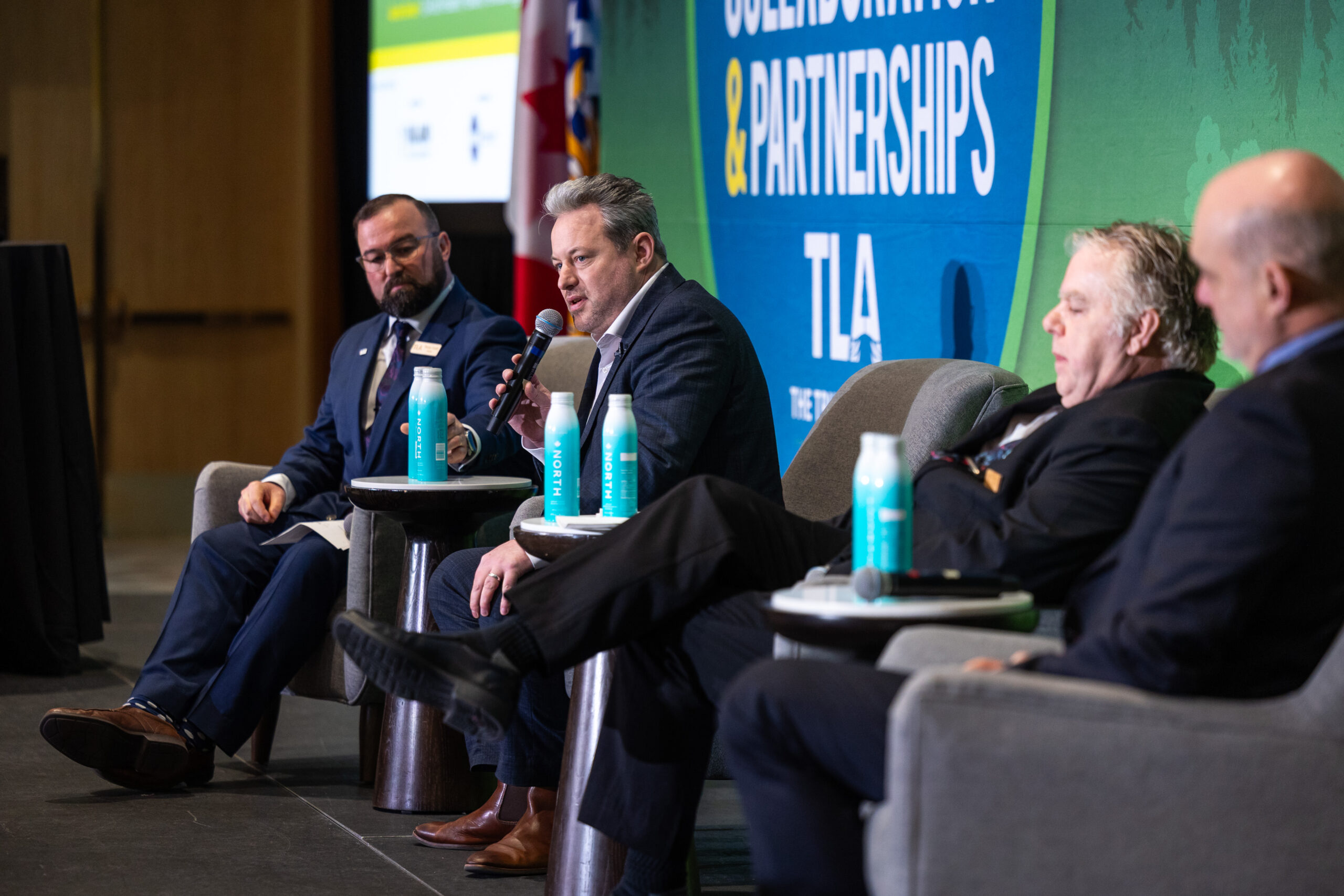 Turning to the investment climate, Halford said BC has become increasingly difficult to do business in, particularly for resource-based industries. He pointed to what he described as excessive bureaucracy, overlapping regulations, and lengthy permitting timelines that discourage investment and delay projects. Halford said he regularly hears from businesses that are prepared to invest but are unable to move forward because approvals take months or years to secure. In his words, “the fibre is there, but it doesn’t matter when the permits aren’t,” and he said the consequences of prolonged delays are often not well understood in urban centres.
Service then raised questions about the Declaration on the Rights of Indigenous Peoples Act (DRIPA), framing the issue by noting that the forest sector has long supported reconciliation and that many contractors work directly with First Nations through tenure arrangements and economic partnerships. He asked Halford to explain why the Conservative Party has taken the position that DRIPA should be repealed rather than amended. Halford said his party has been “very clear” that it supports a full repeal of DRIPA. He framed his position around what he described as uncertainty created by the legislation’s implementation, arguing that unclear rules and shifting expectations make it difficult for businesses and communities to plan. Halford said forestry operated and investment occurred prior to 2019, and he argued that DRIPA has not delivered greater clarity or improved outcomes in recent years. He said his concern is not Indigenous participation in forestry, but what he described as a lack of definition around consent and decision-making timelines. Halford added that he believes reconciliation can and should continue, but said it must not come “at the cost of jobs, the economy, or certainty.”
Uzzell returned to the discussion to raise concerns about fibre supply and the cumulative effects of policy decisions on contractors. He described the sector as being “in crisis,” citing harvest levels below sustainable supply, reduced access to economic fibre, and contractors without work. As a recent example, he pointed to the closure of the Crofton mill and asked Halford for his perspective. Halford described Crofton as a “tragic” case and said the mill contributed more than a billion dollars annually to the provincial economy. He said his understanding is that the mill shut down because of a lack of fibre supply, and he characterized that outcome as a failure of policy and planning. Halford said the closure illustrates the consequences of delays and uncertainty in the system, and questioned how government reached that point and whether sufficient action was taken to prevent it.
Marquis then focused on the practical challenges facing contractors, particularly the ability to plan equipment purchases and workforce needs when access to fibre remains uncertain. He asked how businesses can make long-term commitments under current conditions. Halford responded by emphasizing the importance of stability and predictability for investment. He said businesses cannot make long-term decisions without clear signals about harvest levels, land-use decisions, and permitting timelines. Halford also referenced what he described as rising planning and compliance costs, citing a statistic he said had been shared with him indicating planning costs had increased significantly over time. He argued that rising costs, combined with uncertainty, are eroding competitiveness and discouraging investment, and said government needs to provide a regulatory environment that is reliable and consistent, where rules do not change midstream.
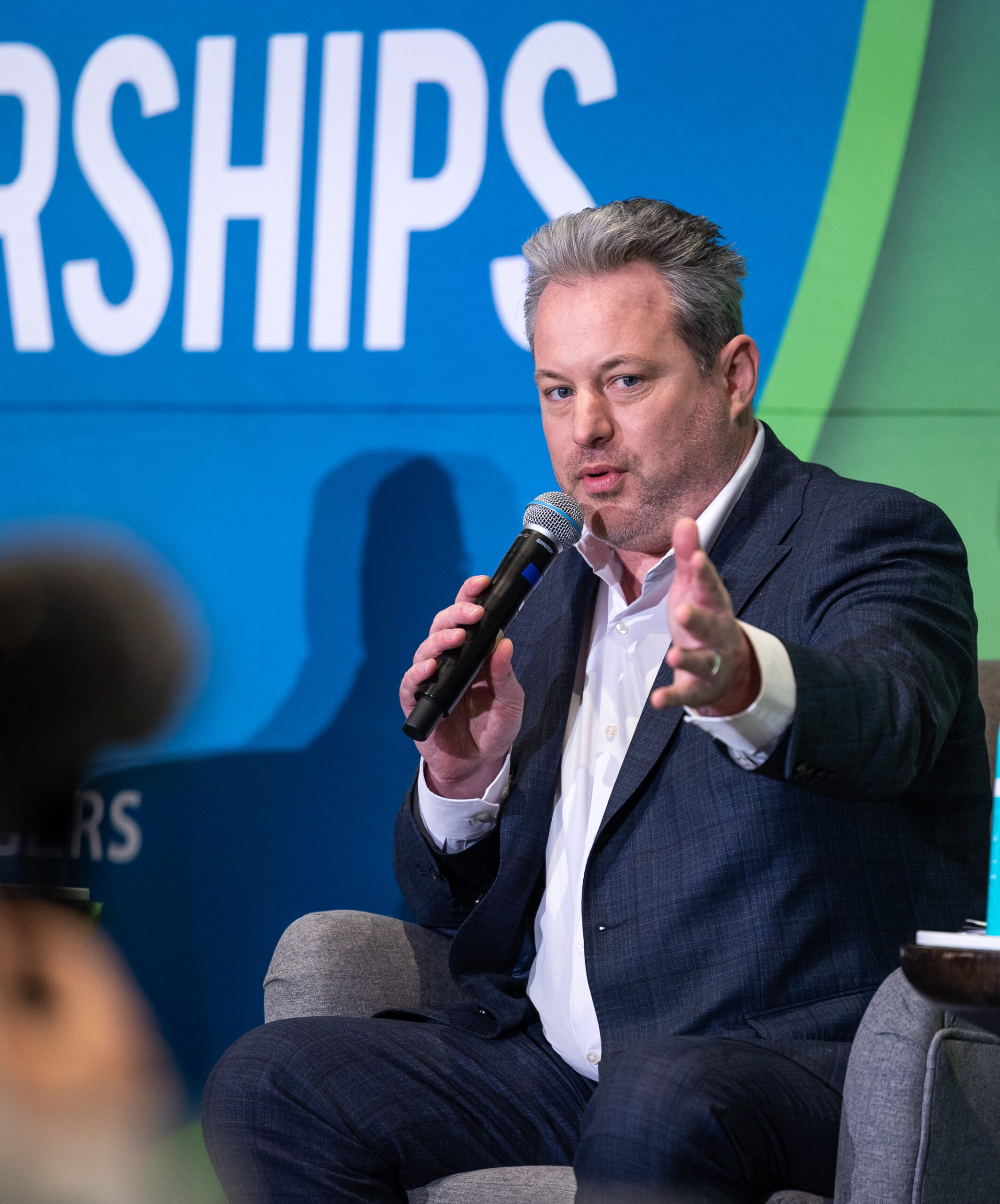 In responding to follow-up questions, Halford repeatedly returned to what he described as the need for government to “get out of the way” and allow people working in the sector to do their jobs. He said forestry and other resource industries underpin public services by generating economic activity, and argued that when mills close and contractors lose work, the effects ripple through communities and government revenues alike.
Selected questions from the floor reinforced earlier themes. In response to a question about why approvals continue to stall despite repeated commitments to streamline processes, Halford said he believes the public service has become overly risk-averse, leading to slow decisions and unclear accountability. Responding to a related question about how that could change, Halford said restoring clear authority, defined timelines, and accountability within government would be a priority for his party, arguing that timely decisions are critical to maintaining confidence and sustaining employment in the forest sector.
Drafted with the assistance of digital tools to streamline the process.