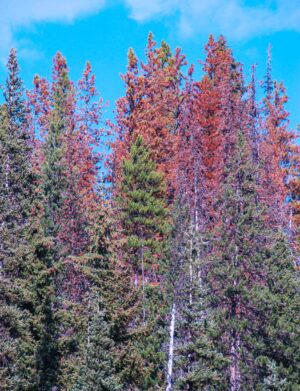
 UNIVERSITY of UTAH — A satellite instrument built to track air pollution has turned out to be a useful early-warning sensor for dying forests. In work covered on 13 September 2026 by Scienmag and published earlier that month by the University of Utah, a Utah-led team reported that solar-induced chlorophyll fluorescence measured by TROPOMI — the Tropospheric Monitoring Instrument aboard Europe’s Copernicus Sentinel-5P — faded in Western U.S. conifer stands roughly two years before USDA Forest Service aerial detection surveys logged bark-beetle mortality in the same places. The study, led by Lewis Kunik and published in Remote Sensing of Environment, is not a forecasting product and does not claim to name the trees that will die. What it does claim is narrower and, for land managers, still consequential: at landscape scale, a physiological signal invisible to the eye and largely invisible to conventional greenness indices shifted first, and it shifted in a way that drought conditions alone did not account for.