VANCOUVER — David Eby appears to be ready to put B.C. on a trade war footing in response to American tariff threats, with an arsenal that includes supporting federal taxes and bans on exports, like critical minerals, and bolstering B.C.’s energy and resource sector to make it more competitive by accelerating permitting for energy and resource projects, and reforming government programs like BC Timber Sales. No industry in Canada understands the negative impact of American duties and tariffs better than the B.C. forestry sector, which has been labouring under American duties on softwood lumber for nearly a decade now. Eby said he would encourage the Canadian government to respond to the tariffs with taxes and bans on key exports.
B.C. forestry companies already pay an average of 14.4% in duties on lumber exports to the U.S., and they could double next year. It’s unclear whether the 25 per cent tariffs Trump has threatened would be additive to existing duties. …Forestry companies in B.C. face an even stiffer tariff of sorts right here at home, in the form of regulatory burdens, including policies that have restricted access to timber, and stumpage charges that can make the available timber uneconomic to cut. …He suggested some relief may be on the way for resource industries in B.C. …One key reform will be to BC Timber Sales. Eby has struck a new task force with the mandate of overhauling it.
BC Timber Sales accounts for about 20% of the timber harvested from Crown lands, and uses auctioning to establish market pricing in order to set the rates (stumpage) charged to forestry companies to harvest timber on Crown lands. Forestry companies have complained that the rates are often too high, not responsive enough to lumber price swings, and can make it uneconomic to harvest timber, even when it is available for harvest. …“The elaborate process that we go through with B.C. Timber Sales in order to appease the Americans on softwood lumber duties has absolutely not done that,” he said. “The tariffs continue, the tariffs. …“Obviously, now, in the context of 25% across-the-board tariffs – we are in a trade war with the United States – that anxiety goes away.”


 At the TLA Conference, the panel “The Future of Innovation” explored technological advancements shaping the forestry sector. Moderated by Vaughn Palmer, the discussion featured Cam Brown of Forsite Consultants, Matt Roberts of Tigercat Industries, and Stéphane Renou of FPInnovations. Cam Brown highlighted LiDAR’s transformative role in forestry, enabling precise forest inventories, wildfire management, and terrain assessments. He emphasized the need for sustained government and industry support to unlock LiDAR’s full potential. Matt Roberts discussed Tigercat’s innovations, including the carboniser machine, which converts waste wood into organic carbon, and challenges like operator shortages with advanced simulators and emerging technologies like remote machine control. Stéphane Renou emphasized aligning innovation with economic realities, critiquing academic-led R&D and advocating for market-driven research.


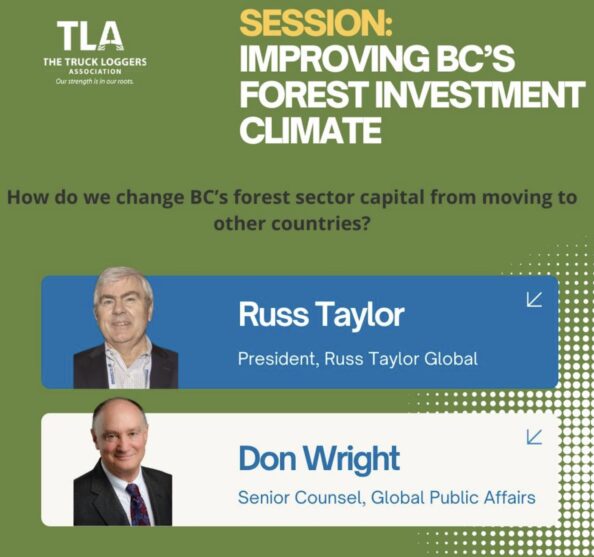 On Day 1 of the Truck Loggers Association 80th Annual Convention, Russ Taylor and Don Wright tackled the pressing question: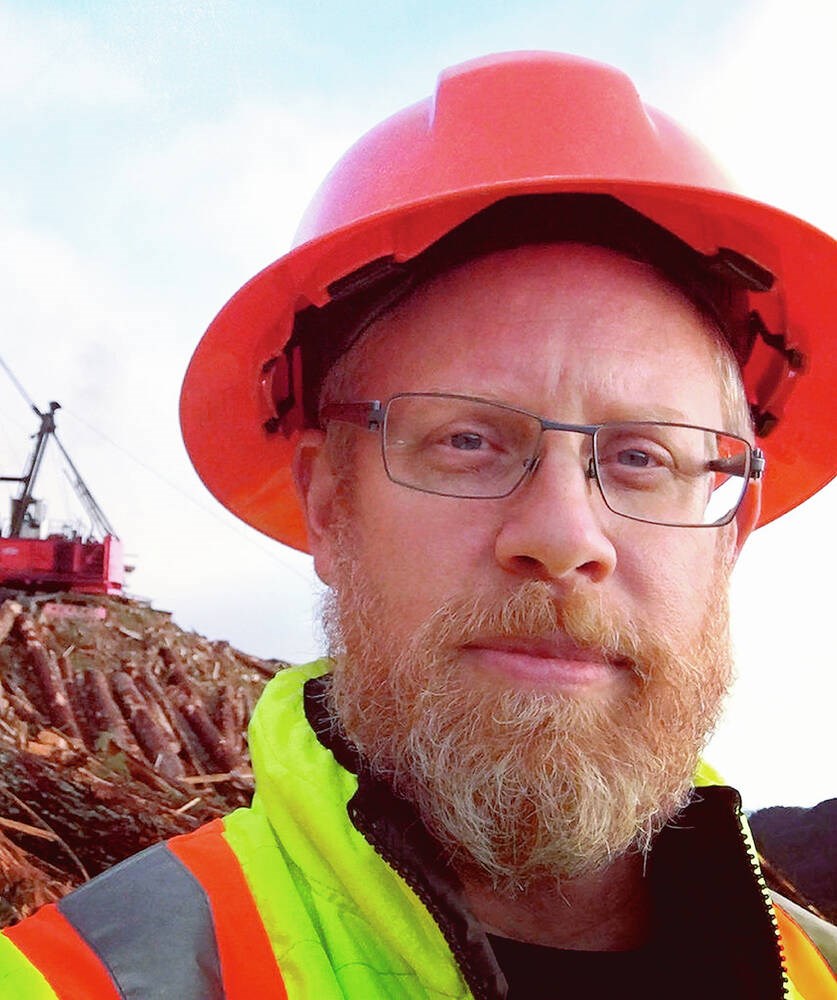
 VANCOUVER, BC – Western Forest Products announced that its hourly employees represented by United Steelworkers Local 1- 1937 have voted to ratify a new collective agreement. The new six-year collective agreement has a retroactive effective date of June 15, 2024, will expire June 14, 2030 and provides for the following general wage increases: Year 1 – 4%, Year 2 though Year 5 – 3%, and Year 6 – greater of 3% or the rate of inflation. The new agreement also includes enhancements to certain benefits and terms of mutual interest for the USW and the Company. …Western’s President and CEO Steven Hofer said: “We are pleased that our USW-represented team members have found it meets their interests and needs. …The BC forest sector is facing many challenges, and we look forward to working together with our union colleagues to build a brighter future for our company.”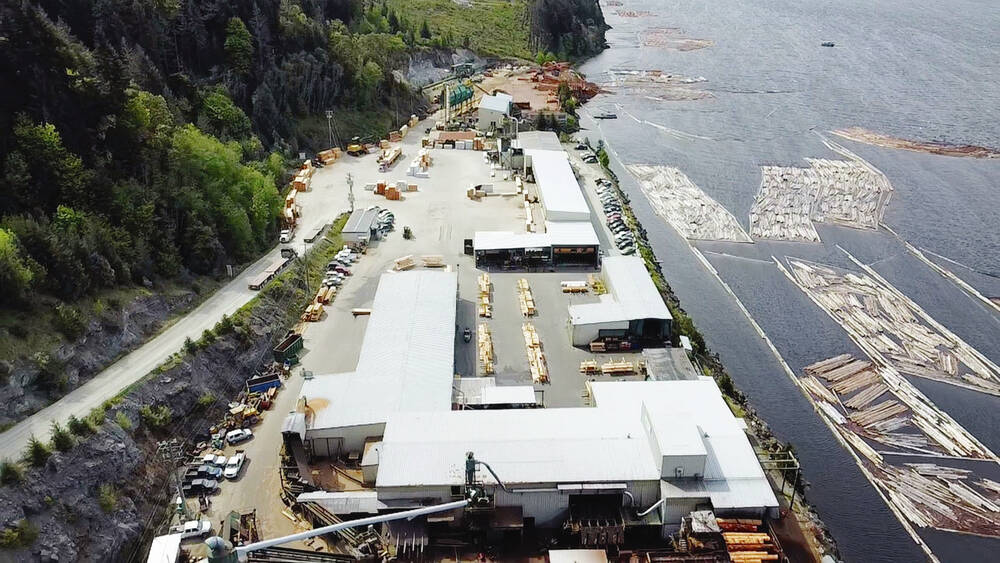



 New support for forest-sector manufacturers throughout the province will create and protect jobs, strengthen local economies and diversify the range of fibre sources used to manufacture high-value, made-in-B.C. forest products. “The BC Manufacturing Jobs Fund is partnering with forestry companies throughout the province to grow and stabilize their operations and get the most out of our fibre supply, while producing more made-in-B.C. engineered wood products,” said Diana Gibson, Minister of Jobs, Economic Development and Innovation. Through the BC Manufacturing Jobs Fund (BCMJF), the Government of B.C. is contributing as much as $5.1 million toward seven forest-sector capital projects and five planning projects in communities throughout the province. Cedarland Forest Products Ltd. in Maple Ridge will receive as much as $1.3 million… Gilbert Smith Forest Products in Barriere will receive as much as $1.1 million…
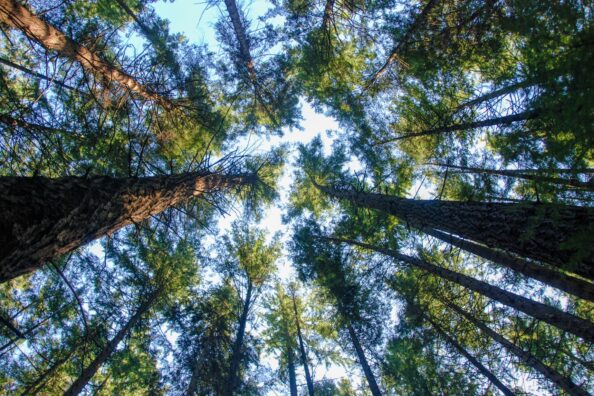 Predictions for 2025 include: Energy output will jump… we’ll stop talking about hybrid work… maybe… the education boom will end… the north will struggle to retain population… we’ll stop ignoring the provincial deficit. …The outlook for f


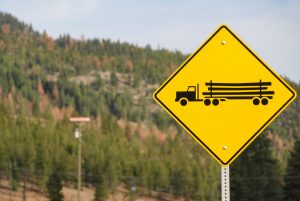 The B.C. government has tasked new Forest Minister Ravi Parmar with reviewing its lead timber agency, B.C. Timber Sales. The Jan. 15 news release announcing the review, and Premier David Eby’s mandate letter to Parmar, both downplay the environment in favour of the business side of forestry… There is no mention of watersheds, biodiversity, wildlife, and climate change in either the news release announcing the review or in the mandate letter, which mentions old growth once in passing. Asked why it is not mentioned in the above six reasons for the BCTS review, or in Eby’s mandate letter, Parmar said, “I’m fully committed to fulfilling my obligations on the old growth action plan. … Biodiversity, taking care of our lands, being good stewards of our land, is critical to me, and it’s going to be a huge part of this review.”
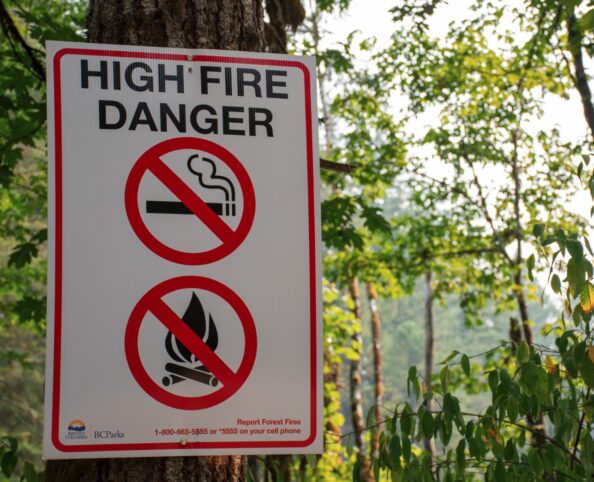 In British Columbia, wood remains the primary framing material, remarks Anthony Marks, who constructs fire resistant modular homes, but the fire resistant modular homes his company constructs are framed with steel. They also use wood sheathing coated with a fire retardant and fibrous cement board products for exterior cladding. …Anabela Bonada, manager and research associate at the University of Waterloo’s Intact Centre on Climate Adaptation says there are solutions at hand to reduce the risk of fire to homes — Canada just hasn’t demanded they be taken yet. …Canada’s National Building Code is geared toward protecting buildings and homes in cities and doesn’t refer to wildfires. …Most Canadian communities are lagging in responding to wildfire threats, Bonada said. …Referring to the National Research Council of Canada’s guide for wildland-urban interface fires, she said programs like

 Colorado wildlife officials say the capture of 15 grey wolves in British Columbia and their release in the U.S. state is complete, an operation they say led to unspecified threats against staff. The operation that began in B.C. on Jan. 10 and wrapped up on Saturday follows Colorado voters’ approval of a 2020 ballot initiative to reintroduce grey wolves to the state, where the animals are listed as endangered. But the program has stirred opposition, and a statement from Colorado Parks and Wildlife on Sunday says its staff have been threatened over the relocations. It says its officers were “watched” and were targeted by threatening phone calls and social media posts. The department says it did not share details while the wolf release was underway due to the “safety risk and security needs of our staff and the animals.” It adds that two of the 10 wolves reintroduced in Colorado in 2023 have been illegally shot.
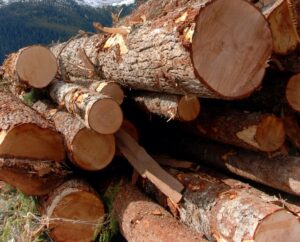 The provincial government is injecting cash into early-stage planning for a potential forestry project by Sḵwx̱wú7mesh Úxwumixw (Squamish Nation) and its economic development arm, Nch’Kay Development Corporation, it was announced last week. With $50,000 from the BC Manufacturing Jobs Fund, the Nation will conduct pre-construction engineering and site assessments to determine the potential for a future capital project… Though details of the project haven’t been finalized, it represents a larger push in the forestry sector to use resources more efficiently, shift away from old-growth timber reliance, and invest in high-value manufacturing. The BC Manufacturing Jobs Fund is partnering with forestry companies throughout the province to grow and stabilize their operations and get the most out of our fibre supply, while producing more made-in-B.C. engineered wood products.


 Rhonda Millikin, an award-winning ecologist who has questioned Whistler’s approach to wildfire mitigation, was issued a cease-and-desist letter last month from Forest Professionals British Columbia (FPBC), which said she is not certified to offer forestry advice. The FPBC said in its Dec. 14 letter that Millikin was unlawfully engaged in the reserved practice of professional forestry by providing advice and recommendations to the RMOW to limit or cease forest fuel-thinning efforts. “On principle, we don’t have an issue with people, whether a member of the public or someone from a different profession, researching or holding opinions or even talking about those opinions,” explained Casey Macaulay, the FPBC’s registrar and director of act compliance, who authored the cease-and-desist letter. “Where it’s an issue is when they start to advocate for a particular practice, and in this case, where that practice is so out of sync with the current science and the current practice of protecting communities from wildfires.”
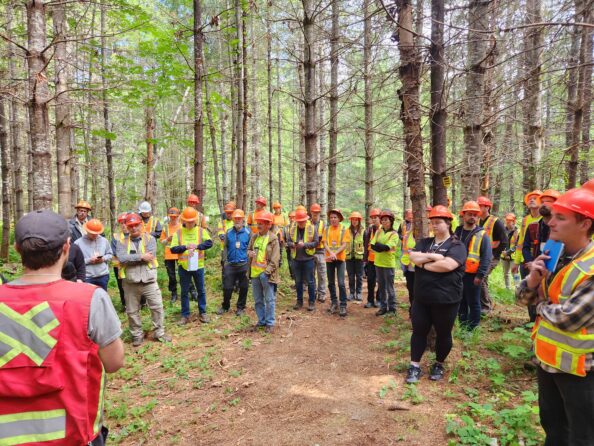 The Coast Silviculture Committee is an ad hoc organization of forest professionals whose prime objective is to disseminate current technical forest management and silvicultural information to all forest practitioners and the public in coastal British Columbia. Its membership includes corporate, government, and self-employed professional foresters and forest technologist, forestry educators, forest land owners, researchers, and tenure managers. Every year the CSC holds two meetings; a short, one or two day, information meeting in winter, and a slightly longer field based technical workshop in early to mid- June; summer meetings are held in a different part of the coast each year. All of the surplus funds from workshops go towards supporting development of silvicultural expertise in students at the post-secondary level through providing of awards. The Winter 2025 workshop is scheduled for February 19 at Vancouver Island University.
  VICTORIA – The Forest Practices Board is identifying opportunities for government to enhance how it manages and enforces range activities. This is following a complaint investigation about cattle grazing practices near Grand Forks. The board investigated concerns raised by the Southern Interior Land Trust (SILT) that two range agreement holders were not following their grazing schedules or maintaining fences as required by law, and that government actions taken in response to their concerns were inadequate. From 2021 until 2023, SILT observed cattle grazing on its private land it had purchased to conserve wildlife habitat. SILT contacted the Ministry of Forests’ range staff to request corrective action, sharing proof of the cattle grazing gathered using game cameras. …“It’s crucial that government record results when it conducts inspections,” said Keith Atkinson, chair, Forest Practices Board. “Documentation helps evaluate the accuracy of complaints, the effectiveness of enforcement efforts and can support corrective measures, if necessary.”
 On April 12-16, more than 700 firefighting professionals, FireSmart experts and Indigenous, municipal and community leaders will gather in Penticton for the 2025 Wildfire Resiliency and Training Summit. There, they’ll share lessons learned from 2024, along with the latest research, technologies, best practices and other information to help regions and communities prepare for the upcoming wildfire season. You’ll want to register fast before this conference sells out! The theme for this year’s Summit is Living with Fire: Building resilience by bringing fire back to the land, strengthening relationships, and investing in collective well-being. The Summit will kick off with two days of training for firefighting professionals, followed by a three-day conference featuring keynote addresses, expert panels, and networking opportunities. Whether you’re a firefighter, community leader, or industry professional, this event is your chance to connect with like-minded individuals, learn from experts, and contribute to a safer, more resilient future for British Columbia.
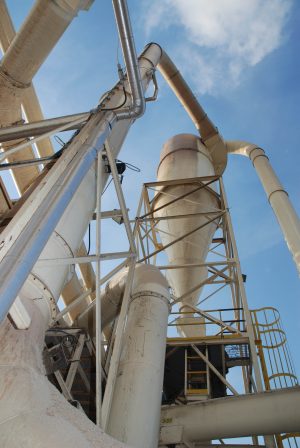 In 2023, Expander Energy Inc., and Rocky Mountain Clean Fuels Inc., announced a project to produce low carbon bio-synthetic diesel fuel by combining pieces of waste wood and synthetic gas using a patented gasification process. Expander Energy CEO Gord Crawford said his company is working on a feasibility study funded by the federal government’s Clean Fuels Fund to determine new locations for future gasification plants that turn forest products into fuel. Northern BC is being considered as a potential plant site. “These plants won’t be located in Vancouver, they’ll be in Prince George, Fort St.. John, places like Fort St. James, rural and remote.”… Northern BC has all the elements needed to support a carbon-neutral project, including fibre supply, renewable energy from the electrical grid and an existing track record of industrial development.
 Here are some highlights from this months Safety News:
 A division of a forestry and construction company with an office in Prince George lost a review of an arbitrator’s decision that awarded fallers $4,000 each for breach of privacy. At issue was the installation of dash cameras in the company’s four-wheel drive pickups in Campbell River… They began installing the dash cameras in February 2023, prompting the United Steelworkers, Local 1-1937 (USW) to file a grievance. They stated the purpose for the rear-facing dash camera included “road conditions not seen by the forward-facing camera” and monitoring “distractions in cab – eating, texting, smoking, horseplay.” USW did not take issue with collection of GPS information or video from the forward-facing cameras while the crew bus was in motion. Its grievance was about the audio and video collected by the rear-facing camera and video by the forward-facing camera while the vehicle was idle.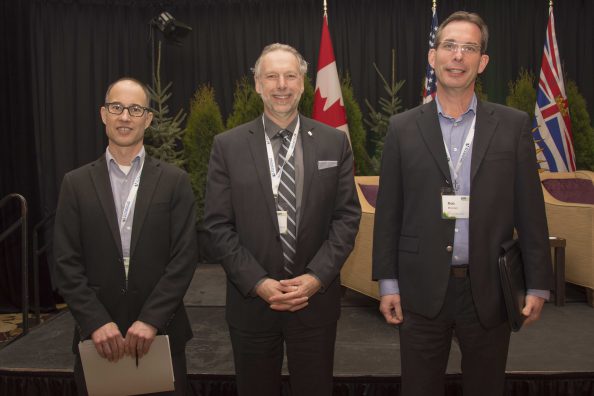
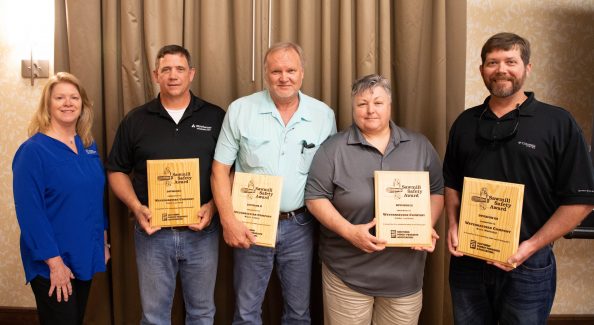

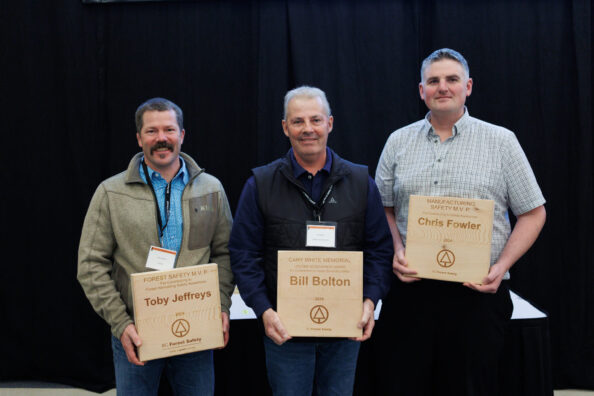 In 2008, BCFSC introduced the Leadership in Safety Awards, celebrating individual safety achievements in forestry. Award recipients are recognized in three categories including safety in harvesting, manufacturing and lifetime achievement. Nominations for leaders in forestry safety can be an individual, crew, team, division, contractor, company, supplier, consultant, trainer, etc. for outstanding safety leadership or achievements. There are three award categories for Leadership Safety. The Cary White Memorial Lifetime Achievement Award is presented to someone who has demonstrated an unwavering commitment to improving safety awareness. The Forest Safety Most Valuable Player recognizes an individual or group that has made a notable contribution to forest industry safety within their operation or company. And finally, the Manufacturing Safety Most Valuable Player recognizes an individual or group that has made a notable contribution to wood products manufacturing safety within their operation or company. Deadline for 2025 nominations is September 23, 2025.
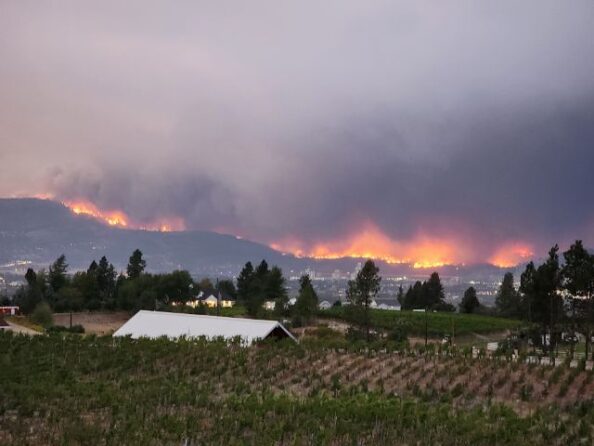 Jason Brolund, the fire chief in West Kelowna, a community devastated by a fast-moving wildfire in 2023 says it’s “haunting” to see similar circumstances playing out in Southern California. Brolund says the images from the Los Angeles area … are so familiar and vivid that some of his firefighters won’t look at them. West Kelowna bore the brunt of the McDougall Creek fire in August 2023, when it descended on neighbourhoods surrounding Okanagan Lake and destroyed or damaged almost 200 properties. In Southern California, flames fanned by high winds have devastated communities, spreading in a manner similar to what West Kelowna encountered in 2023. …”We watch California closely,” Brolund says. “We have for many years. They are considered a bellwether — what they are experiencing now, potentially five to 10 years (from) now, could be something that we see in our region.