 Are you looking to enhance your skills in the lumber and sawmill sector? Onboarding new employees that would benefit from formal education in the field? Are you seeking to provide your employees with essential business skills for professional development? BCIT is currently offering two Associate Certificates to help you: Industrial Wood Processing (IWP) and Business of Sawmilling (BOS). Both programs were developed with industry subject matter experts and informed by industry leaders to support upskilling and professional development for individuals in the lumber and sawmill sector. Each program is 1-year, delivered online and part-time to allow students to balance work and studies. The participants are new or existing employees in the North American lumber sector and are sponsored by their employers.
 New Westminster, BC — The Canadian Mill Services Association (CMSA) is announcing that it has completed a purchase agreement with the BC Council of Forest Industries (COFI) to acquire the COFI Quality Control (QC) operations and to merge them into CMSA. This has involved the transfer of the rights and trademarks to use the COFI grade stamps, and the Interior Lumber Manufacturers’ (ILMA) grade stamps as well as the transfer of the quality control employees from COFI to CMSA. As of December 31, 2024 COFI ceases to offer QC services and the former COFI customers who were using these services are encouraged to join CMSA as active Members. With completion of the merger, CMSA will now provide all the necessary Quality Control Services including Educational Training and Support to its active members. CMSA shall continue to be members of the NLGA, CLSAB and ALSC and will continue to represent its members with the Canadian Wood Council.
 VANCOUVER — Conifex Timber announced that it has amended and restated its existing credit agreement with PenderFund Capital Management Ltd. The restated agreement increases the aggregate principal amount of the secured term loan provided thereunder to up to $41 million, of which $5 million is available immediately, and the remaining $11 million is subject to completion of financial diligence. …“The additional borrowings will be used to fund a build-up in sawlog inventories to support our transition to a two-shift operation at our sawmill complex, effective January 6, 2025,” commented Conifex’s Chairman and CEO, Ken Shields. The decision to move to a two-shift operation was based on a steadily improving backdrop for lumber prices, as evidenced by the 18% improvement in cash prices for Spruce Pine Fir benchmark lumber prices in the fourth quarter of 2024 relative to those in the third quarter of 2024.
  After a dismal 2023 and 2024 in lumber markets in both demand and prices, it can only get better in 2025, right? Well, that depends. …The outlook for 2025 needs to incorporate several variables:
 Are you looking to enhance your skills in the lumber and sawmill sector? Onboarding new employees that would benefit from formal education in the field? Are you seeking to provide your employees with essential business skills for professional development? BCIT is currently offering two Associate Certificates to help you:
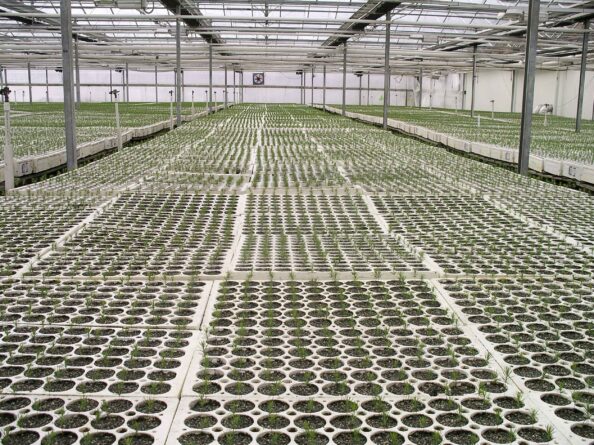 The provincial government expects to plant nearly 50 million fewer trees this year — a 17 per cent drop from last year’s planting season at a time when the province has seen a major spike in wildfire activity. The projections come from presentation slides shown to the industry in September. …the government expects the number of trees planted to sink to 233 million in 2025, 47 million fewer than were planted in 2024. …About half of the anticipated drop in 2025 is due to declines in trees planted by logging companies. Drops are also expected in government programs designed to combat climate change, restore forest carbon stocks, and plant trees in the wake of wildfires, data show. The 2023 wildfires also prevented many replanting projects from occurring that year, and delays due to the time it takes to grow enough seedlings mean replanting won’t take place until 2026 and 2027, according to the ministry spokesperson.
 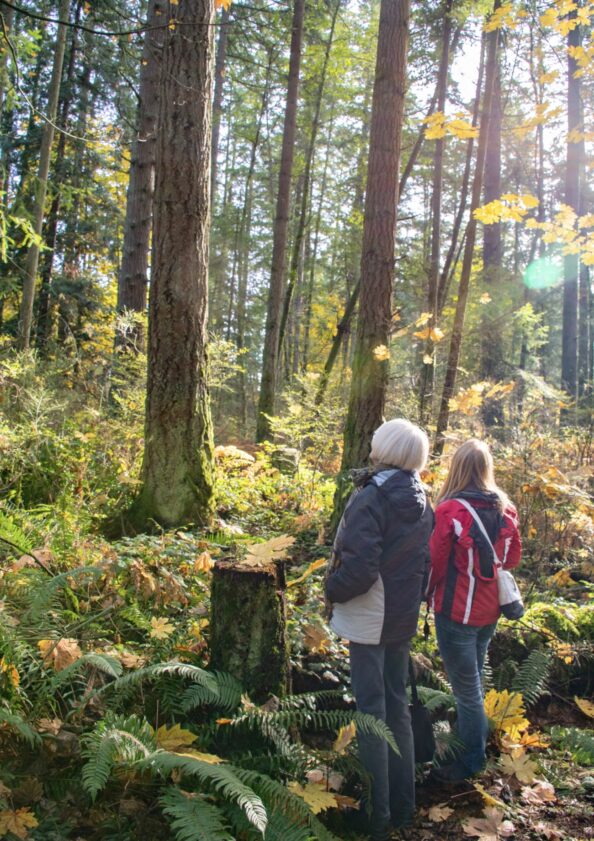 The Kaska Dena people, who for thousands of years have lived on a vast swath of intact wilderness in northern B.C. on the Yukon border… They want to ensure it remains undeveloped… So the Kaska have come up with a plan for the province to protect an area, called the Dene K’éh Kusān — 40,000 square kilometres, an area larger than Vancouver Island, of land and water. …It would also boost B.C.’s pledge to protect 30 per cent of land and 30 per cent of water by 2030, say conservation experts. …With only five years to go, and just about 16 per cent of land protected in B.C. so far, the province must double its efforts if it intends to reach those ambitious targets…Randene Neill, B.C.’s minister of Water, Land and Resource Stewardship said that she’s aware that some areas reported as conservation measures aren’t meeting their originally intended objectives.
  …British Columbia’s forests are … a foundation of the province’s identity and a bedrock of its economy. Both past and present, the industry has been one of the province’s largest employers, providing tens of thousands of well-paying jobs, particularly in rural and Indigenous communities where opportunities can be scarce. These jobs are vital for maintaining economic stability in smaller towns, where forestry often serves as the main driver of local economies. …By managing forests, BC can enhance their role as carbon sinks, reducing greenhouse gas emissions and mitigating climate-driven concerns such as wildfires. …Concurrently, BC’s forestry practices need to keep pace with evolving environmental and social expectations. …Global markets and decision-makers are increasingly demanding environmentally responsible products and wood clearly delivers those needs. However, two things need to happen. First, a clear, cohesive strategy is needed to ensure we do not fall behind international competitors. Secondly, you actually have to cut a tree down.
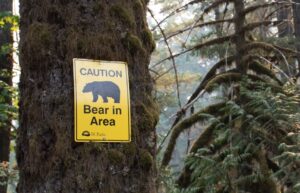 Human recreation on mountain trails is displacing grizzly bears and wolves from their natural habitats, even when the trails are hundreds of metres away, according to a new study from the University of Alberta. The research underscores the need for more effective planning to ensure that recreationists and wildlife can coexist, particularly in the busy Bow River Valley, which has long served as a natural corridor connecting the prairies to the Continental Divide… Though trails that never receive any use from humans have little to no effect on wildlife, only half of grizzlies studied would venture within 300 metres of trails with the highest human use. This effect was more pronounced in wary wolves, whose radius of comfort extended to 600 metres from the busiest trails. “We initially thought bears might use hiking trails as efficient routes when humans weren’t around, but they actually avoid these areas altogether,” says the author.
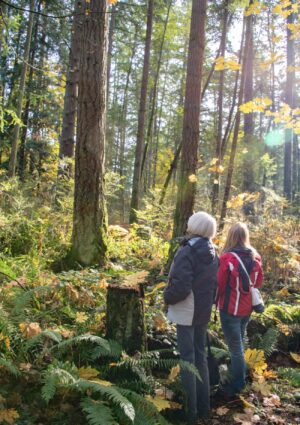 For over 20 years, the BC Community Forest Association (BCCFA) has championed the community forest program, highlighting its ability to foster social, economic, ecological, and cultural resilience. …Community forests are long-term, area-based tenures managed by local communities to reflect local priorities and values. With 61 community forests currently operating across the province, and growing interest in local resource management, the program is gaining broad recognition and support. …According to the December BCCFA Newsletter, the city of Quesnel along with five First Nations, have come to an agreement on the establishment of the Three Rivers Community Forest (TRCF). …Farther south, the BCCFA provided Nakusp and Area Community Forest (NACFOR) with funding through the province’s Economic Recovery Initiative under the Crown Land Wildfire Risk Reduction program. …There were 14 other community forests across the province supported by this initiative.
 A new study indicates that over the past 10 years, the Nanaimo region has gained more winter days above 0 C than anywhere else in Canada. The study comes from Climate Central, a non-profit based in New Jersey… The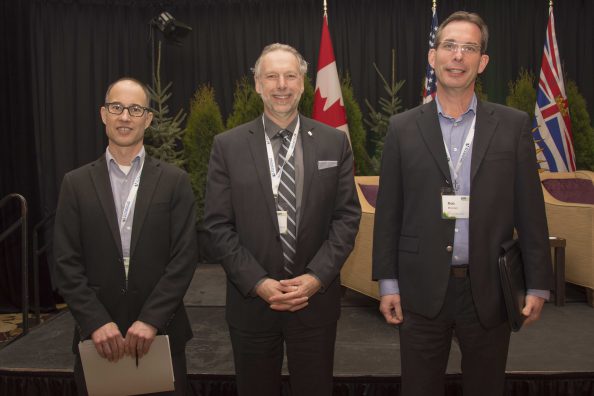
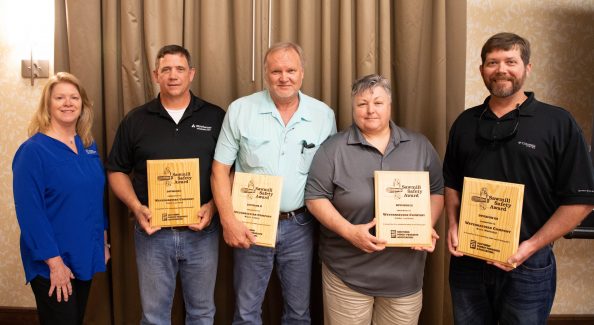

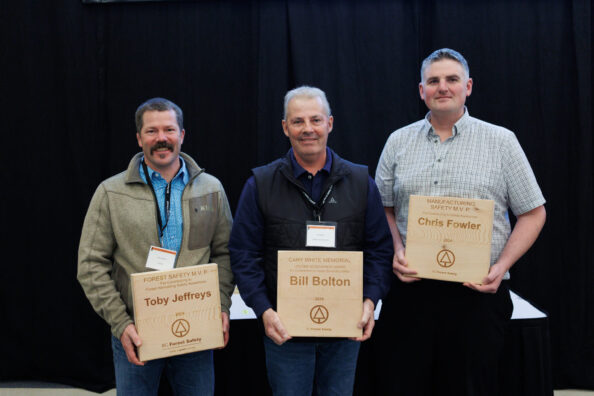 In 2008, BCFSC introduced the Leadership in Safety Awards, celebrating individual safety achievements in forestry. Award recipients are recognized in three categories including safety in harvesting, manufacturing and lifetime achievement. Nominations for leaders in forestry safety can be an individual, crew, team, division, contractor, company, supplier, consultant, trainer, etc. for outstanding safety leadership or achievements. There are three award categories for Leadership Safety. The Cary White Memorial Lifetime Achievement Award is presented to someone who has demonstrated an unwavering commitment to improving safety awareness. The Forest Safety Most Valuable Player recognizes an individual or group that has made a notable contribution to forest industry safety within their operation or company. And finally, the Manufacturing Safety Most Valuable Player recognizes an individual or group that has made a notable contribution to wood products manufacturing safety within their operation or company. Deadline for 2025 nominations is September 23, 2025.
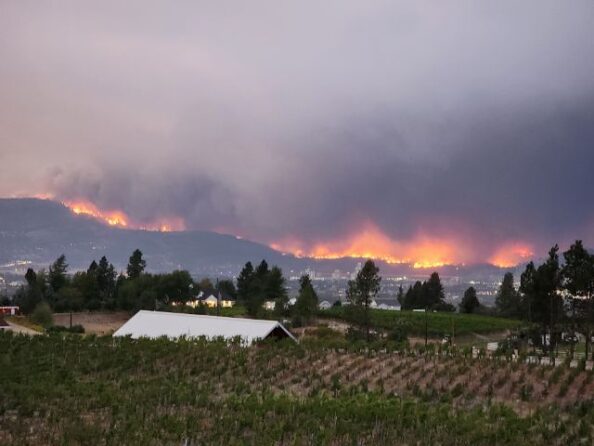 Jason Brolund, the fire chief in West Kelowna, a community devastated by a fast-moving wildfire in 2023 says it’s “haunting” to see similar circumstances playing out in Southern California. Brolund says the images from the Los Angeles area … are so familiar and vivid that some of his firefighters won’t look at them. West Kelowna bore the brunt of the McDougall Creek fire in August 2023, when it descended on neighbourhoods surrounding Okanagan Lake and destroyed or damaged almost 200 properties. In Southern California, flames fanned by high winds have devastated communities, spreading in a manner similar to what West Kelowna encountered in 2023. …”We watch California closely,” Brolund says. “We have for many years. They are considered a bellwether — what they are experiencing now, potentially five to 10 years (from) now, could be something that we see in our region.