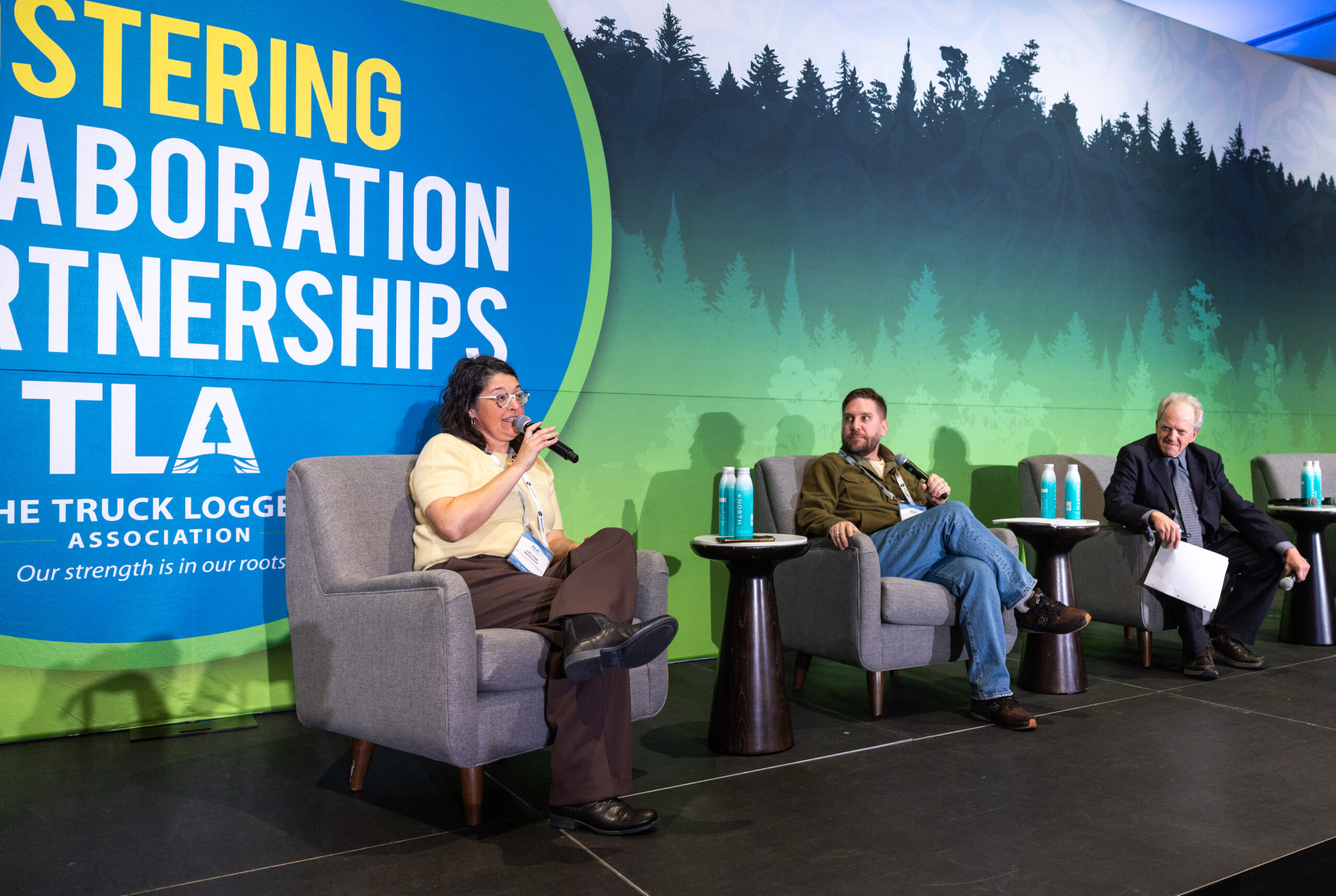
 Day Three of the Truck Loggers Association convention opened with a private screening of BC Is Burning, a documentary produced by professional forester Murray Wilson examining British Columbia’s escalating wildfire crisis and the forest conditions shaping fire behaviour. Introduced by moderator Vaughn Palmer as an “urgent, powerful documentary,” the film explores how fuel buildup, insect damage, drought, and decades of fire suppression have contributed to larger, more intense wildfires, while highlighting a range of forest management approaches being applied in BC and elsewhere, including California. The screening was followed by a Q&A moderated by Palmer with Dr. Carolyn Smyth of Natural Resources Canada, Rob Schweitzer of the Ministry of Forests and BC Wildfire Service, and Jim McGrath of Tk’emlúps te Secwépemc, all of whom also appeared in the film. Discussion focused on fuel mitigation, fire salvage, carbon dynamics, and policy and permitting constraints.
 The
The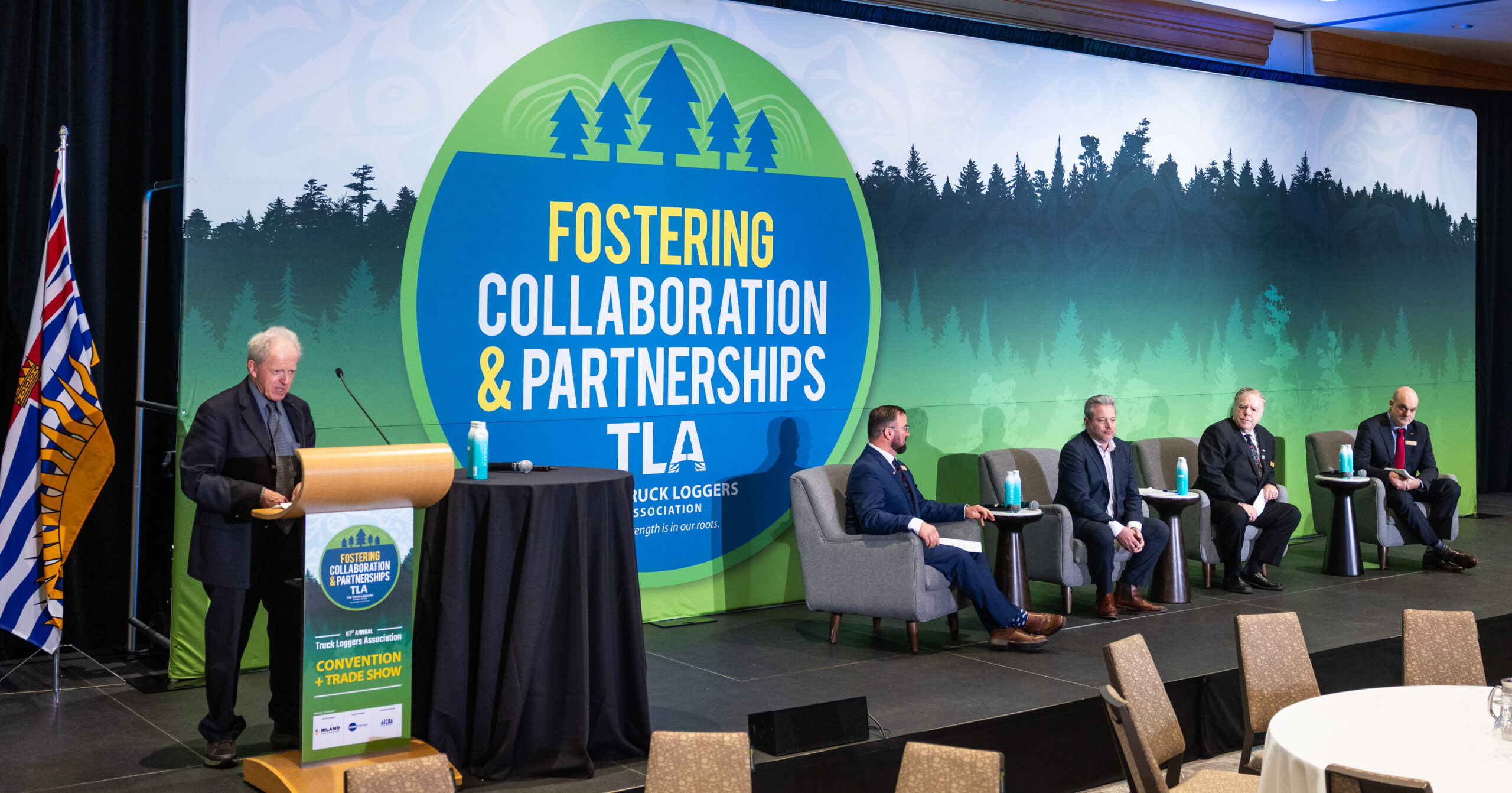 The final session of the Truck Loggers Association convention featured an on-stage conversation with Trevor Halford, Interim Leader of the Conservative Party of BC and current Leader of the Opposition, moderated by Vaughn Palmer. Joined by TLA President Dorian Uzzell, Vice President Bob Marquis, and Past President Aaron Service, the discussion focused on forestry policy, investment certainty, and regulatory conditions affecting contractors and communities. Halford pointed to permitting delays, regulatory complexity, and policy uncertainty as barriers to investment, arguing that businesses are prepared to invest but are being held back by slow approvals. Responding to questions on DRIPA, fibre supply, and the closure of the Crofton mill, Halford framed his party’s call for repeal and his broader critique around the need for clarity, predictability, and timely decision-making. Audience questions reinforced concerns about risk aversion within government and the need for clearer authority and accountability to sustain forestry employment across the province.
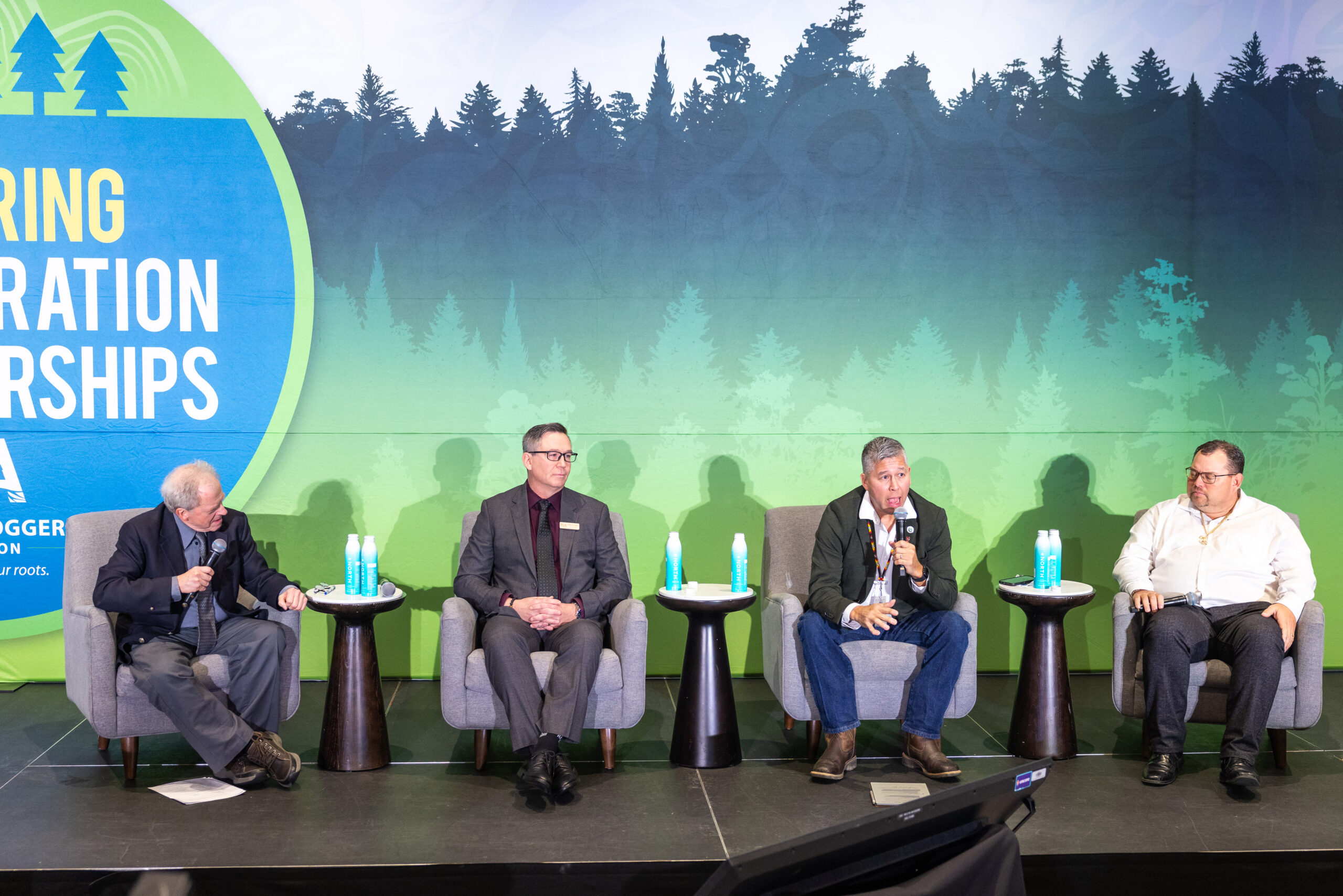 Day 2 of the TLA Convention opened with a panel on First Nations partnerships, examining how collaboration between Indigenous communities and industry is reshaping forestry in BC. Moderated by Vaughn Palmer, the session featured Lennard Joe, CEO of the BC First Nations Forestry Council; Chief Ronnie Chickite of the We Wai Kai Nation; and Klay Tindall, General Manager of Lil’wat Forestry Ventures. Joe outlined the rapid growth of First Nations tenure and investment, emphasizing operational feasibility, workforce capacity, and the need for partnerships grounded in mutual benefit. Chickite described We Wai Kai’s expansion from small licences to controlling nearly 220,000 cubic metres annually, highlighting reinvestment in employment, education, and long-term community stability. Tindall shared how partnerships helped transform Lil’wat Forestry Ventures, supporting capacity building, wildfire risk reduction, and stewardship in sensitive areas. In a discussion touching on DRIPA, the speakers emphasized inclusion, local economic benefit, and the importance of durable, collaborative governance in forestry.
 At the TLA Convention’s Leader’s Luncheon, Forests Minister Ravi Parmar outlined the BC government’s current priorities for the forest sector, following a pre-recorded message from Premier David Eby, who is on a trade mission to India. Speaking from abroad, Eby emphasized strengthening international trade relationships and promoting BC products amid global uncertainty. Parmar said forestry is facing a convergence of challenges, including market volatility, high costs, trade pressures, and wildfire risk. Beginning with wildfire, he announced an expansion of the Risk Reduction Equipment Support Trust (REST) program, increasing provincial cost-sharing from 10% to 25% for eligible equipment and modifications used in fuel management and mitigation work. He also addressed fibre supply and Path to 45, stressing the need to remove operational barriers and improve planning certainty, and pointed to ongoing reforms at BC Timber Sales. Parmar emphasized balancing economic viability, environmental responsibility, and reconciliation, while underscoring the importance of international markets for BC’s forest products.
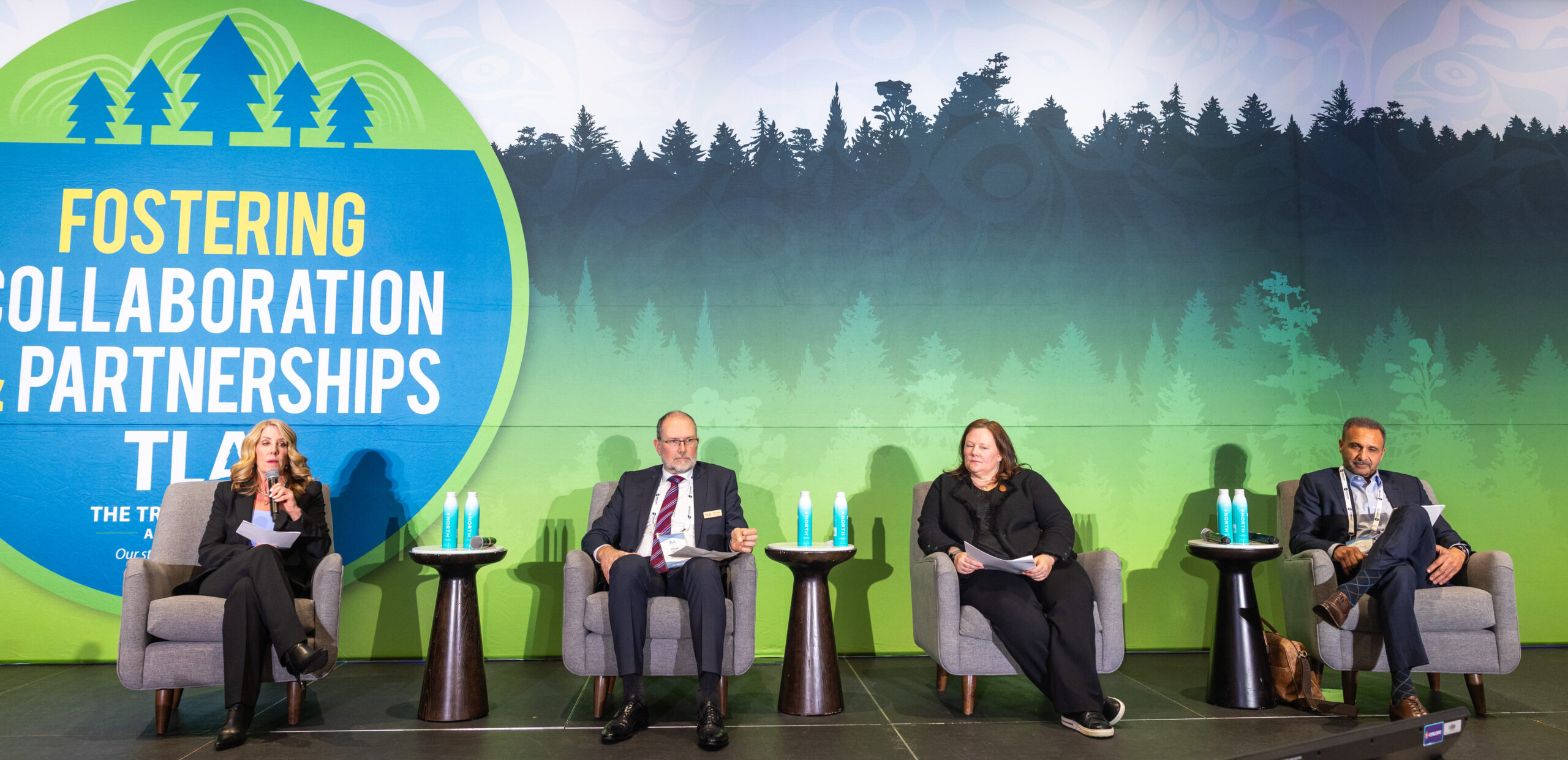 The second “fostering collaboration” panel of Day 2 at the TLA Convention brought together senior leaders from forestry and the broader business community to share organizational perspectives on BC’s economic and forest-sector challenges. Moderated by Vaughn Palmer, the session featured Bridget Anderson, President and CEO of the Greater Vancouver Board of Trade; Peter Lister, Executive Director of the Truck Loggers Association; Kim Haakstad, President and CEO of the BC Council of Forest Industries (COFI); and Joe Nemeth, General Manager of the BC Pulp & Paper Coalition. Anderson addressed the wider provincial economic context, including growth, fiscal pressures, and business conditions. Lister focused on the state of the forest industry, fibre access, costs, and investment certainty. Haakstad examined competitiveness, tenure obligations, employment trends, and economic reconciliation. Nemeth spoke to the pulp and paper sector, highlighting cost structures, fibre availability, and conditions required for future investment.
)

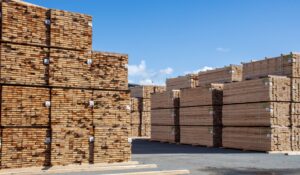 The Nova Scotia government is defending itself after three other provinces levelled accusations that it is being secretive and undermining Canada’s fight against the United States over softwood lumber. Nova Scotia is urging the US Department of Commerce to reject requests from Quebec, Alberta and Ontario for the Atlantic province to provide much greater detail on how it calculates fees charged for harvesting timber. …Nova Scotia asserts that it should not be blamed for its surveys of private timberland owners that could result in higher fees for cutting down trees when compared with other provinces. The US has levied countervailing duties, arguing that other provinces have tree-harvesting fees that are too low when compared with Nova Scotia, which is exempt from US lumber duties. …Lawyers for Quebec, Alberta and Ontario urged the Commerce Department to make inquiries, saying the US should even consider abandoning the private surveys as a benchmark. [to access the full story a Globe & Mail subscription is required]

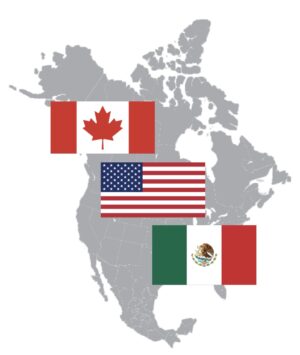 The Canadian and American economies are woven together tightly. So when Donald Trump slapped 25% tariffs on Canadian imports last year, many economists—myself included saw a disaster looming. …The most exposed sectors were those most dependent on US demand: steel, aluminum, autos, energy and lumber. …In our worst-case scenario, we expected it would shrink Canada’s GDP by 2.6 per cent, leading to a moderate recession and shaving nearly $2,000 a year off income for every Canadian. So far, however, that doomsday scenario hasn’t materialized. This was possible because of the Canada-US-Mexico trade agreement. …Avoiding the worst of the tariffs doesn’t mean we’ve won or even survived the trade war. Communities across the country are still hurting. …Regions in Quebec and British Columbia are under strain, with key industrial sectors—steel, aluminum, copper, lumber—are facing additional tariffs under Section 232 authority.

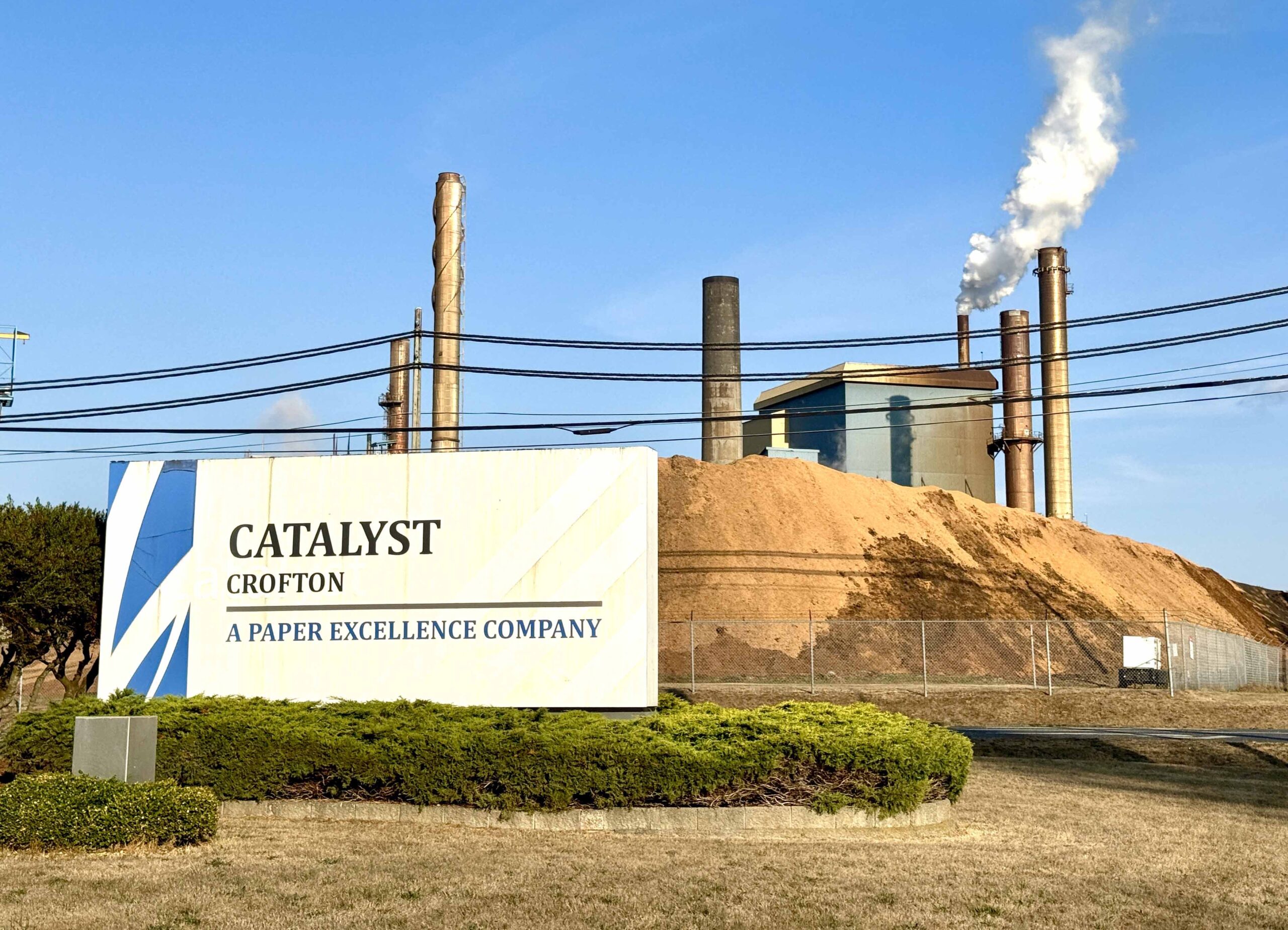 It appears that some investors have been kicking the tires at the soon to be closed Crofton pulp mill. A statement from the Municipality of North Cowichan said Mayor Rob Douglas and senior staff have recently met with several investors interested in potentially acquiring the Crofton mill site for continued forestry-related operations, or alternative industrial uses. “The municipality is facilitating connections between interested parties, Domtar (the mill’s owner), and the provincial government where appropriate, and remains hopeful that any future use of the site will generate employment opportunities and a stable tax base for the community,” the statement said. …North Cowichan provided no further information on who is interested in taking over the mill site.
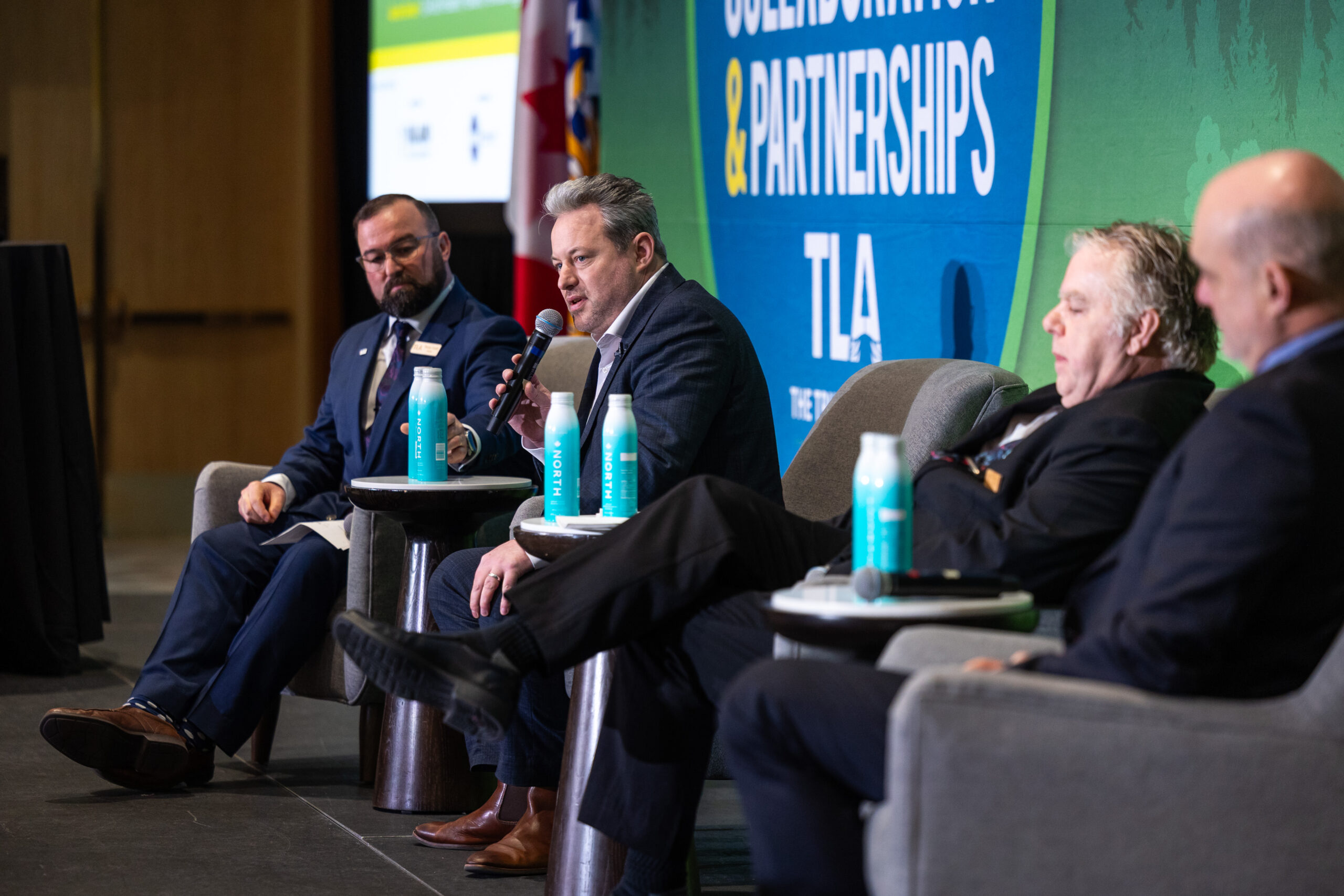 Interim opposition leader Trevor Halford told logging contractors Friday that the province’s forestry downturn is being driven by a system that is “not functioning at the pace this sector requires.” Halford, the interim leader of the B.C. Conservatives spoke at the Truck Loggers Association’s convention in Vancouver. “This crisis is not about forests disappearing. It is not about fibre not existing. It is about permits not moving, decisions not being made, and systems that do not function at the pace this sector requires,” Halford said. Halford opened by citing a Vancouver Sun story that described the B.C. forest industry as “on the edge of collapse,” and quoting TLA executive director Peter Lister, who told the convention he had “never seen it as bad” in more than 35 years in the sector. …Halford said the industry has heard “explanations” from the government, but needs measurable results. “Accountability matters. Transparency matters. Results matter,” he said.
 Facing growing backlash over the unintended consequences of its reconciliation policies, the B.C. NDP government has hit pause on controversial changes to the Heritage Conservation Act…Forests Minister Ravi Parmar announced the move Monday, saying he’d “heard loud and clear” that municipalities, business groups, the real estate sector and …the public needed more time to understand the changes. “It was very clear to me that I was not in a position to bring forward amendments this spring,” he said. …It’s the opposite approach to where the NDP started on the file just four months ago, charging forward with the changes so aggressively that their passage—following secret negotiations with First Nations and non-disclosure agreements slapped on everyone else—seemed like a fait accompli. …The NDP say they are in listening mode now, on the Heritage Conservation Act. The question is whether the government truly understands that changes built without public trust are simply no longer viable.


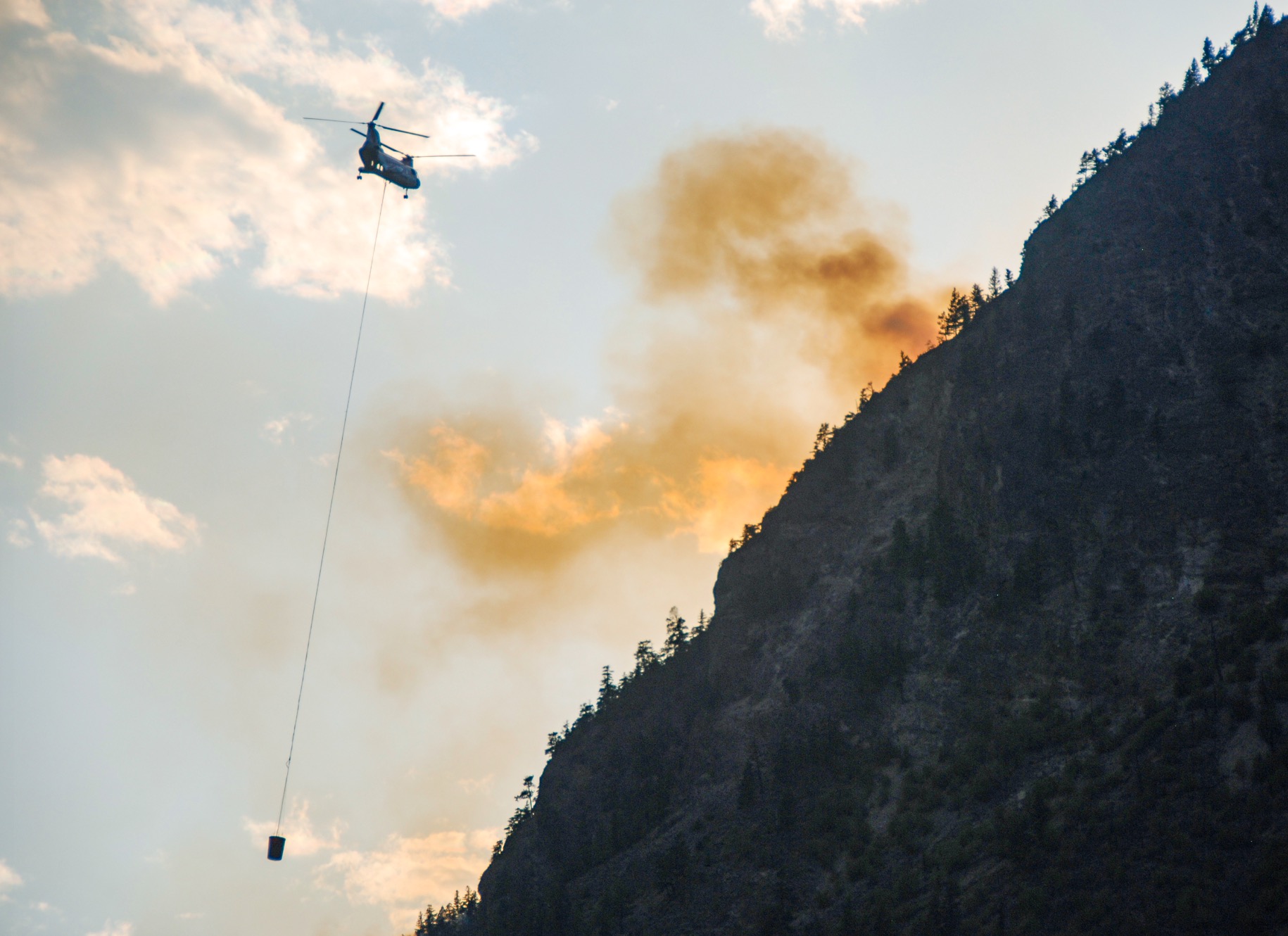
 VANCOUVER ISLAND — About 100 unionized forestry workers on the north Island who’ve been on strike since June have reached a tentative agreement with La-kwa sa muqw Forestry Limited Partnership. The United Steelworkers Local 1-1937 and the LKSM Partnership announced in a joint statement that the agreement is subject to a ratification vote by the union, and no details are being released. “The USW bargaining committee has advised that they will be recommending that its members accept this agreement,” said the joint statement. The deal was reached with the assistance of the BC Labour Relations Board. …LKSM LP is the former Western Forest Products mid-Island forest operation, which remains majority-owned by Western Forest Products. The LKSM partnership is made up of the Tlowitsis, We Wai Kai, Wei Wai Kum and K’ómoks First Nations, all members of the Nanwakolas Council. …The operations cover about 157,000 hectares near Campbell River and Sayward.
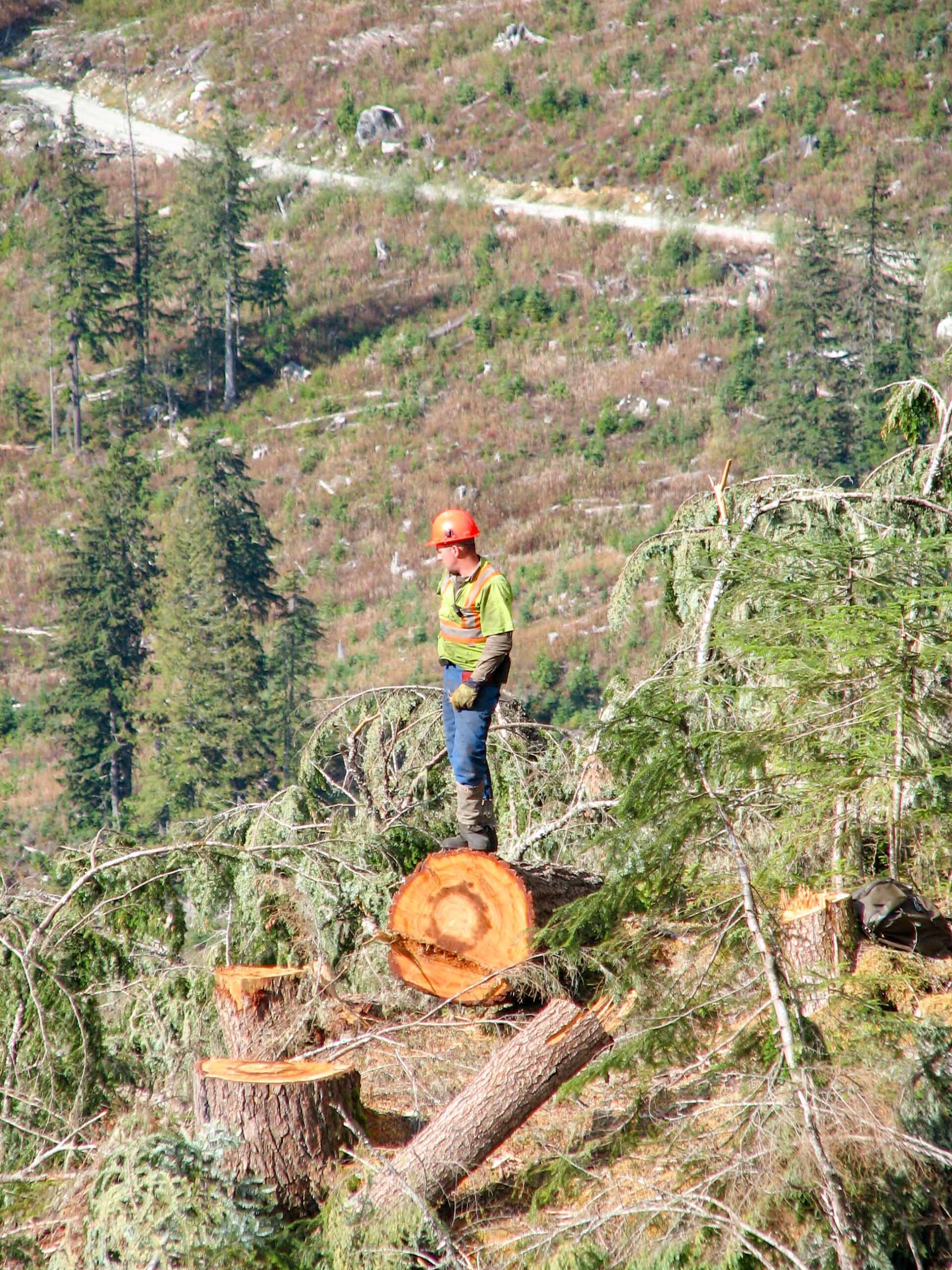 Logging contractor Ron MacFarlane feels fortunate to have work for his eight-person crew, cutting mostly second-growth Douglas fir on a cut block …on B.C.’s Sunshine Coast, while business in his industry is otherwise “flatlined.” “We’re busy until March, and then we’ll see from there,” MacFarlane said at the Truck Loggers Association annual convention. …Difficulties in getting the province to speed up permits to cut more of that timber has put the industry “in a state of crisis,” said Peter Lister, executive director of the Truck Loggers Association. “I’ve never seen it as bad. …it is really on the edge of collapse.” …For forest-management executive John Mohammed, however, Parmar is still missing a connection to short-term actions the industry desperately needs to free up some of the cutting permits companies have sitting on the shelf because they are uneconomic. …Mohammed said Parmar could take the risk of lowering [coastal] stumpage rates … to help economics.
 British Columbia’s Forests Ministry has entered into a memorandum of understanding with China on modern wood construction, a development that the province hopes will bolster the provincial lumber sector as it seeks alternatives to the U.S. market. The five-year, non-binding agreement with the Chinese government also involves the Canadian federal Department of Natural Resources and is among the first reached with Beijing after the arrival of Prime Minister Mark Carney in China this week. On the other side is China’s housing and development ministry, with the memo agreeing on co-operation on the integration of modern wood construction into China’s urban renewal and rural revitalization strategies and exploring “practical approaches” for green developments. University of British Columbia political ecologist and China scholar Juliet Lu said the MOU is “relatively low-hanging fruit” in Carney’s attempt to rebuild trade momentum with Beijing…




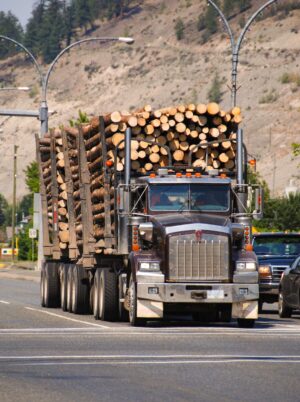 A letter from the Carleton-Victoria Forest Products Marketing Board to New Brunswick’s natural resources minister points to frustration building within the province’s forestry industry. The board’s general manager Kim Jensen, says some prices are the lowest they’ve seen in a decade. Jensen writes that US tariffs have been hard on the entire sector, including mills, but there’s been little support for private producers. “I have already heard from landowners who have changed their mind about having their woodlots cut,” she states. “Is the government’s long-term plan for the private forestry sector to just disappear? Because that is what is happening. Under your watch.” …Natural Resources Minister John Herron acknowledged that prices have declined since October. …But Herron didn’t mention any possible provincial support.” …J.D. Irving said 97% of the company’s lumber is under contract and not impacted by the price changes cited in the letter.

 TORONTO — The review of North America’s free trade agreement will play a large part in determining the trajectory of the Canadian economy, as one strategist says he is optimistic that certain concessions could help achieve a positive outcome. Ashish Dewan, a senior investment strategist at Vanguard, said the Canadian economy is still significantly reliant on US trade despite attempts to diversify its trading partners. He said Canada currently has a “trade advantage,” due to a lower effective tariff rate compared with other nations, sitting around six per cent compared with about 16 to 19 per cent faced by other nations. “What’s really having a negative impact on the Canadian economy are those Section 232 sectoral tariffs,” Dewan said. Tariffs covered by Section 232 of the U.S. Trade Expansion Act of 1962 cover a wide range of products like steel, aluminum and lumber and are generally not exempt under the Canada-U.S.-Mexico Agreement, better known as CUSMA.
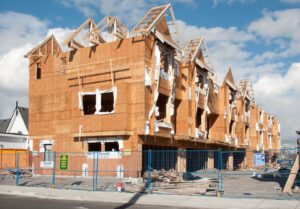 Canada’s six largest CMAs recorded a 3.9% rise in housing starts in 2025, driven by a 58% jump in Montréal and record starts in Calgary and Edmonton, while Toronto fell 31% and Vancouver slipped 3%, CMHC said. CMHC said the metro gains helped lift the national annual total for all areas in Canada to 259,028 housing starts in 2025, up 5.6% from 245,367 in 2024 and ranking as the fifth highest annual total on record. …The year-over-year increase was driven by a second consecutive year of record rental housing starts, which made up just over half of all housing starts in Canada’s urban centres, CMHC said. …Among Canada’s three largest cities, CMHC said all posted year-over-year increases in December. Toronto recorded a 151% increase, driven by higher multi-unit starts. Montréal posted a 123% increase, driven by higher starts across all dwelling types. Vancouver reported a +17% increase, also driven by multi-unit starts.
 Canada’s annual inflation rate ticked up to 2.4% in December compared to the same period last year, when the federal government implemented a GST break that brought some prices down, Statistics Canada said. The temporary tax cut, which began on Dec. 14, 2024, lasted for two months. It reverberated through monthly inflation data for part of 2025 but officially fell out of the year-over-year movement last month, sending price growth accelerating, according to the data agency. December’s rate was a smidge higher than the 2.2% rate seen in November. It was partly offset by a year-over-year decline in gas prices. With energy excluded, inflation rose to 3% in December. …”The main takeaway here is that after a year of some wide divergences, almost all of the main measures of inflation are now very close to [2.5%], in tune with the Bank of Canada’s view on the pace of underlying inflation,” wrote BMO’s Douglas Porter.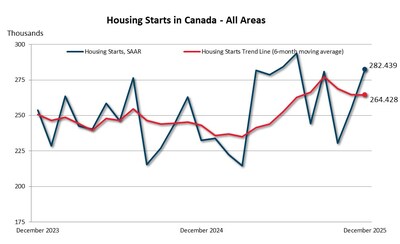
 There are solid reasons to expect near-term strength in the US and Canadian construction markets. In the US, rapid technological progress and supportive federal policies are driving major investments in semiconductor fabrication, AI-related data centers, and energy infrastructure, with growing momentum toward nuclear power. In Canada, federal and provincial governments are promoting “nation-building” projects that emphasize LNG export capacity, port expansions, and new mines for critical minerals required by the digital economy. Both nations recognize that housing supply must rise substantially to meet population needs, signaling a long-term boost in residential construction. Yet, 2025 proved disappointing for overall construction performance, especially in employment. …Housing activity revealed a sharper divide between the two nations. U.S. housing starts in November 2025 dropped to an annualized 1.246 million units, the lowest since the pandemic. Most analysts believe the country needs at least 1.5 million starts per year to meet demand.
  VANCOUVER, BC – Canfor Pulp Products announced the expiration of the go-shop period provided for in the previously announced arrangement agreement dated December 3, 2025 between Canfor Pulp and Canfor Corporation, pursuant to which Canfor Corp will acquire all of Canfor Pulp’s issued and outstanding common shares not already owned by Canfor Corp and its affiliates. Under the terms of the Arrangement Agreement, each shareholder of Canfor Pulp will have the option to receive: 0.0425 of a common share of Canfor Corp per Canfor Pulp Share held, or $0.50 in cash per Canfor Pulp Share held. …During the Go-Shop Period, Canfor Pulp was permitted to actively solicit, evaluate and enter into negotiations with third parties that expressed an interest in acquiring Canfor Pulp. …The Go-Shop Period expired on January 19, 2026. Canfor Pulp did not receive any Acquisition Proposals.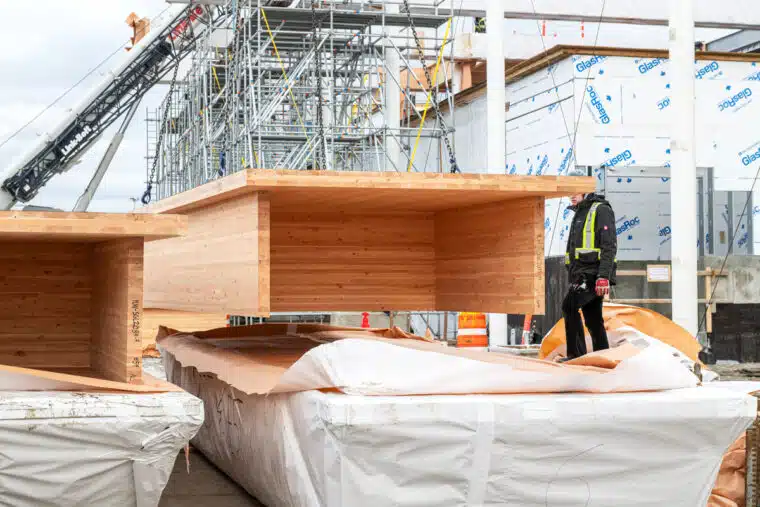



 The federal government is looking for a hub to build modular homes for the Arctic. Prince George, with its forestry infrastructure, industrial base and transportation networks, is being considered as a possible site for that industry. Mayor Simon Yu [said] the city has everything it needs to create a new industry for the region. “We have to seize the moment,” said Yu. “For housing developments up in the Arctic, Prince George will be the centre of action. …This is a key to solve our lumber problem. We’ve got the wood, we’ve got the technology, we have a university here, we have a research program, we have CNC here, we have the workers and we will get this modular home factory going. We need to add value to wood products to create jobs right here and build houses for our overseas markets as well as for Canada.”
 In this naturally:wood newsletter you’ll find the following stories:


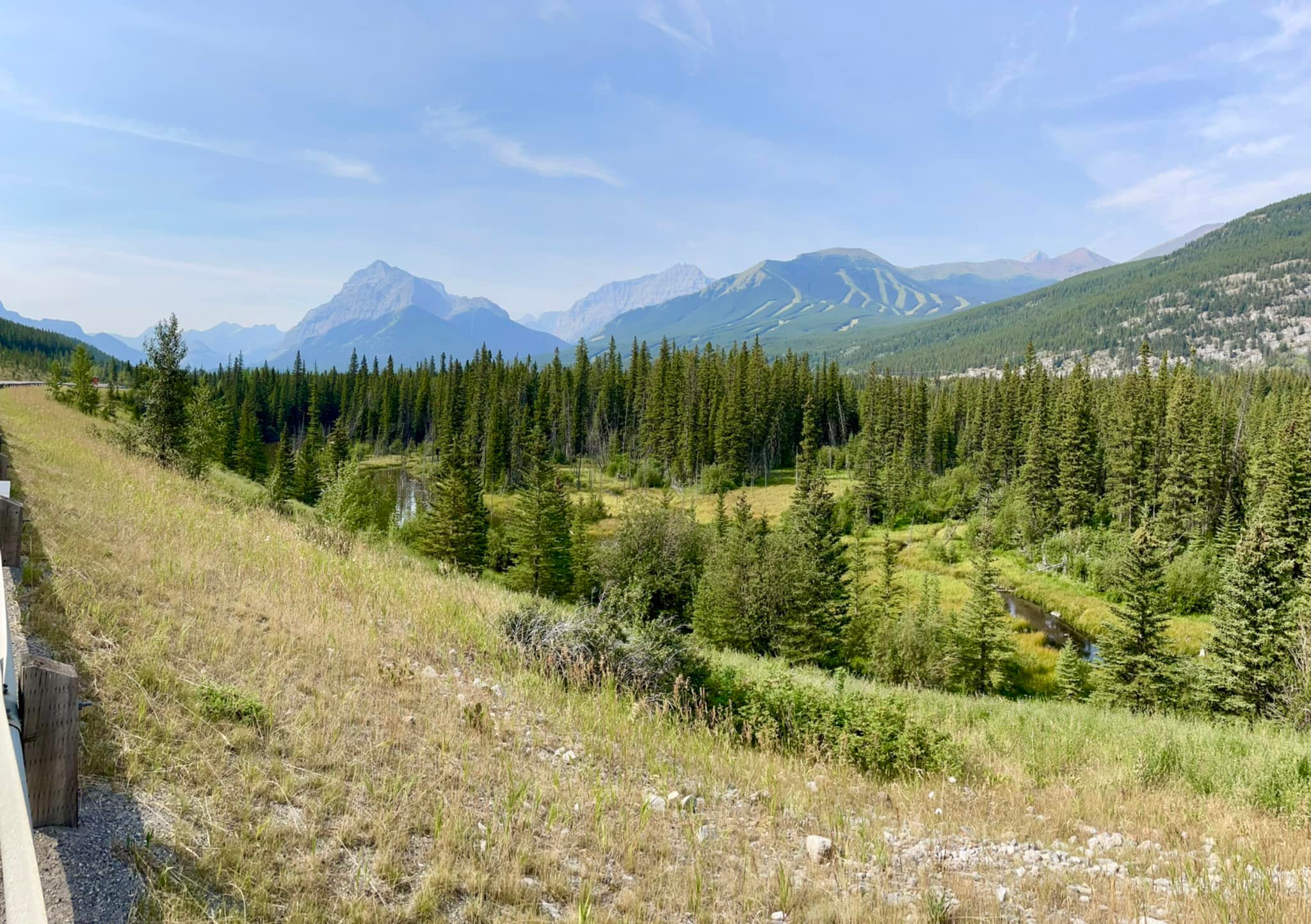 Federal forest managers left vast stretches of beetle-killed pine standing in Jasper National Park, a failure that became a key driver of the catastrophic 2024 wildfire that destroyed roughly a third of the town, according to a Canadian Forest Service report that contradicts cabinet’s climate-change narrative. The analysis says a severe Mountain Pine Beetle infestation peaked about seven years before the fire, leaving behind extensive dead lodgepole pine that dramatically worsened fire behavior. …Blacklock’s Reporter says the Forest Service document, Jasper wildfire complex 2024 fire behaviour documentation, reconstruction and analysis, concludes that dead pine from beetle mortality formed a major part of the fuel load. Tree death altered forest structure, accelerated the drying of surface fuels, and created an abundance of dry, woody material that sharply increased fuel consumption and fire intensity. Internal reports and Access to Information records show Parks Canada was slow for years to remove dead pine through cutting or prescribed burns.
 A broad coalition of forestry workers, community leaders and industry representatives has organized a petition asking the public to support their push for the provincial government to take immediate action to address the current challenges faced by an ailing forest industry. The group has launched a new province-wide platform called Forestry Is a Solution to ask British Columbians to show their support for forestry workers and their families. …The campaign has identified as its top priority that the provincial government expedite permits and project approvals to speed up access to economic fibre. It also seeks to improve the competitiveness of BC’s forest industry by reducing administrative barriers and regulatory burdens. The coalition says it’s time to fix BC Timber Sales and its policies to ensure a reliable and competitive supply of logs for mills and secondary manufacturing.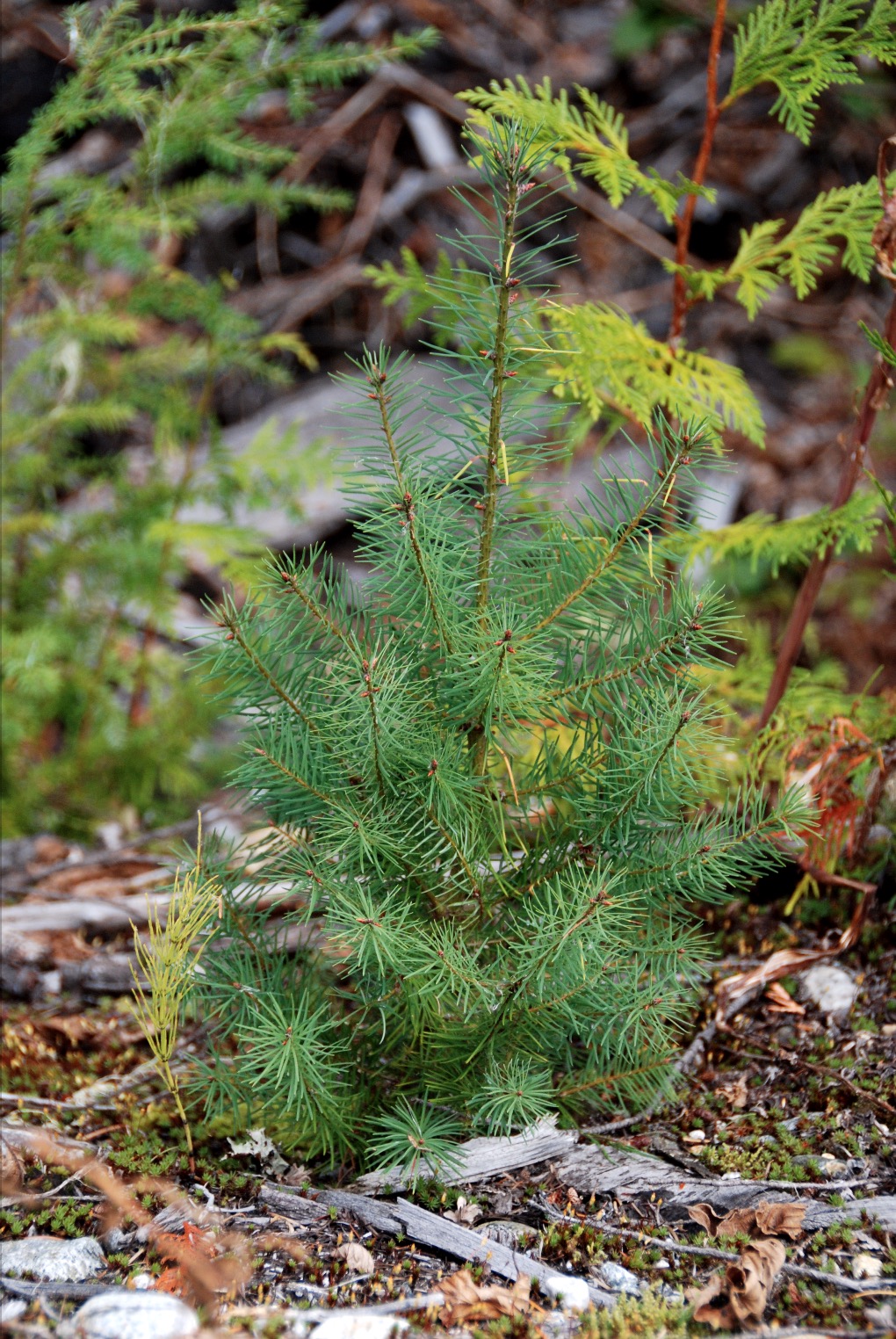

 STRATHCONA COUNTY, AB – Project Forest has partnered with Keyera and Strathcona County to establish the Keyera Legacy Forest. This forest restoration initiative is focused on restoring wildfire-impacted land and supporting community biodiversity in Alberta’s industrial Heartland. Located in Strathcona County, northeast of Fort Saskatchewan, the project will restore over 95 acres of ecologically degraded land. Strathcona County will use a Conservation Easement to ensure permanence and create a “green island” within Alberta’s Industrial Heartland. …The Keyera Legacy Forest is a unique example demonstrating how restoration and industry can coexist, delivering long-term community and ecological benefits. This is a rare, once-in-a-lifetime opportunity to responsibly restore designated industrial land. This project represents a voluntary commitment by Keyera to invest in long-term environmental stewardship, guided by values rather than obligation.
 Government is postponing the introduction of proposed amendments to the Heritage Conservation Act that had originally been anticipated for spring 2026. This decision reflects the need to continue engagement to gather and incorporate additional feedback from industry, local governments and First Nations. Input received to date has confirmed the importance of streamlining the permitting for major projects on Crown land and private residential projects, ensuring quicker community rebuilds following a disaster, and better protecting heritage and significant First Nations cultural sites. The Ministry of Forests will continue to engage with industry, project proponents, First Nations, local governments and other interested parties. Specifically, the Province will be inviting industry partners to a cross-sector meeting in the coming weeks to discuss the permitting process, and will continue to welcome feedback as the work progresses.
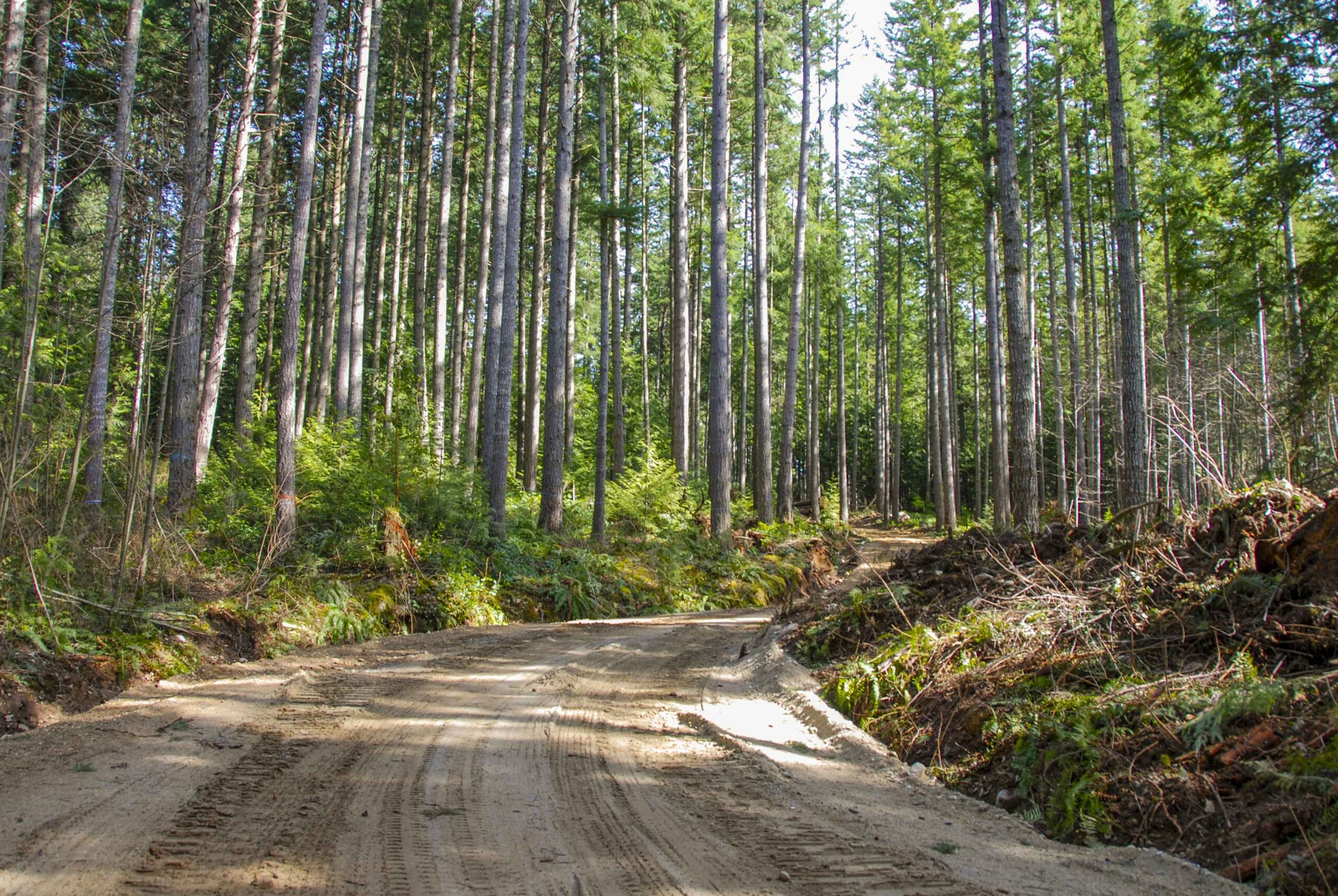
 “British Columbia has the forests, the workers, and the expertise to lead the world, yet the sector currently faces significant headwinds from global competition, challenging operating conditions, and damaging U.S. trade actions,” the coalition stated. “This campaign is about homegrown solutions that use our resources to solve our most urgent challenges—from building affordable housing to reducing wildfire risks in our backyard”. The initiative centers on a new digital hub,
 We are thrilled to introduce you to our new brand as we aim to inspire a new generation of leaders in Alberta’s forest sector! We’re here to flip perceptions: forestry is about more than just trees — it’s about futures. Our forest industry already aligns with young Albertans’ values; they just don’t know it yet. Our new brand enthusiastically explores the breadth of opportunities in forestry and celebrates the people, the environmental leadership, and the innovation that make Alberta’s forest sector a great place for young people to grow. The new iconography takes the two bold Ws from “Work Wild” to form a tree — symbolizing growth, sustainability, and connection. We are bringing Work Wild into a new era. Work Wild was built on research informed by youth values, career interests, and motivations from over 10 years ago. It was time for a change.
 In this Woodlots Weekly you’ll find:

 For generations, caribou have sustained Cree families, their culture and their way of life. Now, that relationship is at a critical moment, as the Leaf River herd population continues to decline. The Cree Nation Government (CNG) have issued a territory-wide call to pause caribou hunting, urging Cree not to harvest across Eeyou Istchee, the traditional territory of the Cree of northern Quebec. “We’re going to have a hard time blaming somebody else for this issue because it is only First Nations that are hunting right now. We need to step up and be proactive,” said Paul John Murdoch, who is the grand chief of Eeyou Istchee. This decision was based on consultation from land users and study results from the Quebec government, said Murdoch. Leaf River herd consisted of approximately 136,000 caribou in 2025, down from 175,000 in 2024, according to wildlife studies. In 2000, the herd’s population was 600,000. That’s more than a 75 per cent decline in 25 years.
 NDP MPP Lise Vaugeois (Thunder Bay – Superior North) and MPP Guy Bourgouin (Mushkegowuk – James Bay) released the following joint statement following reports of the indefinite shutdown of the Ignace sawmill, leaving another group of forestry workers without jobs, and further eroding the fabric of our Northern Ontario communities. “Communities like Ear Falls, and now Ignace, deserve better than uncertainty and silence.” said Vaugeois. “The government must work directly with the company, and the company must work in good faith with the government and the union, to find solutions that protect workers, families, and good forestry jobs. Mills across the province are shrinking or shutting down; workers are being laid off at alarming rates, and infrastructure isn’t being replaced. Neglect is not a plan, and New Democrats urge collaboration between the government and the company as a responsible path forward for Ignace and northern Ontario.”
 OTTAWA, ON
 PRINCE GEORGE, BC — On the anniversary of the Babine Forest Products mill explosion, the United Steelworkers union is remembering the two workers killed and the more than 20 others injured in the 2012 tragedy, while welcoming long-overdue reforms to BC’s combustible dust safety regulations. Fourteen years ago, two workers went to work at the Babine sawmill near Burns Lake, BC, and did not return home after a powerful explosion caused by combustible wood dust. The disaster remains one of the deadliest industrial workplace tragedies in the province’s history. …At its November 2025 meeting, WorkSafeBC’s Board of Directors approved significant amendments to Part 6 of the Occupational Health and Safety Regulation to modernize how combustible dust hazards are regulated in BC. …The new requirements include mandatory combustion risk assessments, written combustible dust management programs, stronger controls on ignition sources and dust accumulation, and enhanced training and worker consultation. The amendments will come into force on Jan. 4, 2027.
Deposits $10.6 Billion CAD + Interest 2.6 Billion + FX Gain 0.5 Billion = Total $13.7 Billion
Canadian softwood lumber exporters are currently paying a combined duty deposit rate of 45.16% on lumber imported into the United States.