Canada urgently requires a bold, cohesive economic strategy to navigate an increasingly volatile global landscape. For decades, the country has functioned much like a resource-rich colony, exporting raw materials while lagging in value-added innovation and technological leadership. …Canada must shift from its historically risk-averse, fragmented investment model to a targeted, mission-oriented approach that concentrates on sectors where it holds inherent advantages: agriculture, forestry, energy and critical minerals. These sectors form a synergistic ecosystem. …Canada should prioritize innovative solutions, including next-generation mass timber products for sustainable construction – addressing the housing crisis while reducing emissions – and drone-assisted reforestation. The 2025 Woodrise Congress highlighted climate-resilient building – an area where Canadian advancements in cross-laminated timber position the sector for global leadership. By shifting from raw exports to value-added products, such as advanced wood products and low-emission heavy machinery, Canada can create jobs, cut emissions and export intellectual property, avoiding hype-driven distractions such as uneconomical hydrogen pursuits…
 Canada aims to establish duty-free access for up to 95 per cent of its exports to Indonesia over the next eight to 12 months, International Trade Minister Maninder Sidhu said, after signing a trade agreement. The Comprehensive Economic Partnership Agreement is Canada’s first in the economically crucial Indo-Pacific region since
  As the trade war sparked by Donald Trump’s tariffs rages on, Canada’s lumber industry is pushing back on U.S. claims that a $1.2 billion aid package announced last month amounts to an unfair subsidy for Canadian softwood. …The aid package includes $500 million in funding to help Canadian lumber producers diversify away from dependency on the American market, and $700 million in loan guarantees to help producers restructure. …The American argument is undercut, however, by the fact that export aid and loan guarantees are both used by various levels of government to support the US‘s own lumber industry, said Niquidet, president of the BC Lumber Trade Council. “There are a lot of tax incentives.” …The measures taken by Prime Minister Carney are in response to unjustified and illegal trade practices being advanced by the United States,” said Ian Dunn, CEO of the Ontario Forest Industry Association. [to access the full story a Toronto Star subscription is required]
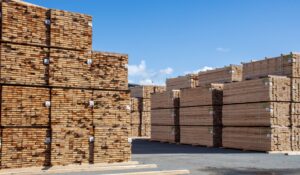 OTTAWA — Canada has dropped two legal challenges of United States duties on Canadian softwood lumber. …The Wall Street Journal first reported this week that Canada dropped long-standing appeals earlier this month of two U.S. anti-dumping reviews dating back to the previous decade. The US undertakes administrative reviews each year to set the level of duties. Canada has regularly challenged those orders. Global Affairs Canada spokeswoman Dina Destin said that the decision to drop the two appeals was made “in close consultation with Canadian industry, provinces and key partners, and it reflects a strategic choice to maximize long-term interests and prospects for a negotiated resolution with the United States.” She said Canada still believes U.S. anti-dumping duties on softwood lumber are unfair and Ottawa is still pursuing six other legal challenges on the matter.

.jpg)

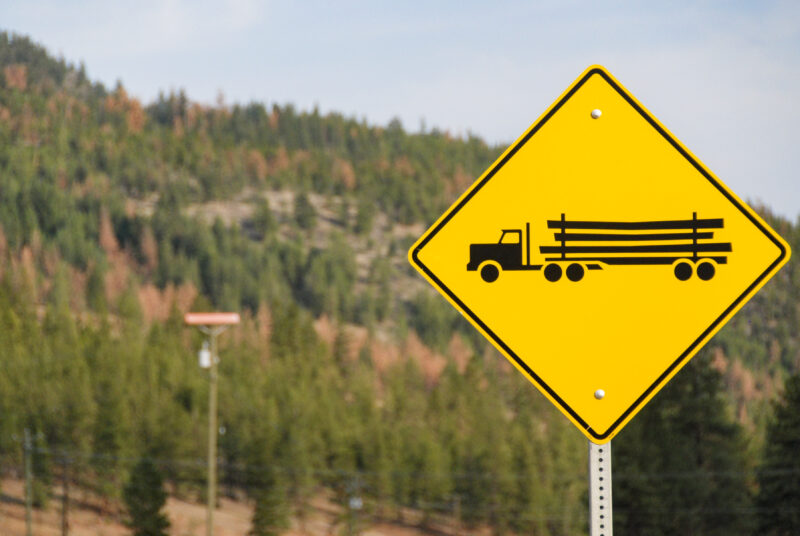 VICTORIA — Forests Minister Ravi Parmar this week announced major reforms to B.C. Timber Sales, hoping to reverse a two-thirds decline in sales volumes under the NDP. …Parmar said the government will broaden the agency’s mandate to focus on providing wood to support manufacturing, delivering jobs to communities and building partnerships with First Nations. The changes are prompted by a review conducted earlier this year by former B.C. Liberal cabinet minister George Abbott, Vanderhoof councillor Brian Frenkel and First Nations representative Lennard Joe. …Parmar didn’t understate the urgency of delivering logs to all the right places … that day’s Merritt Herald announced Aspen Planer mill was closing for “an indefinite period.” …The company doesn’t lack for wood supply on paper. …For all Parmar’s and Eby’s enthusiasm for boosting the annual harvest, they have not made believers of the Ministry of Finance in their own government.
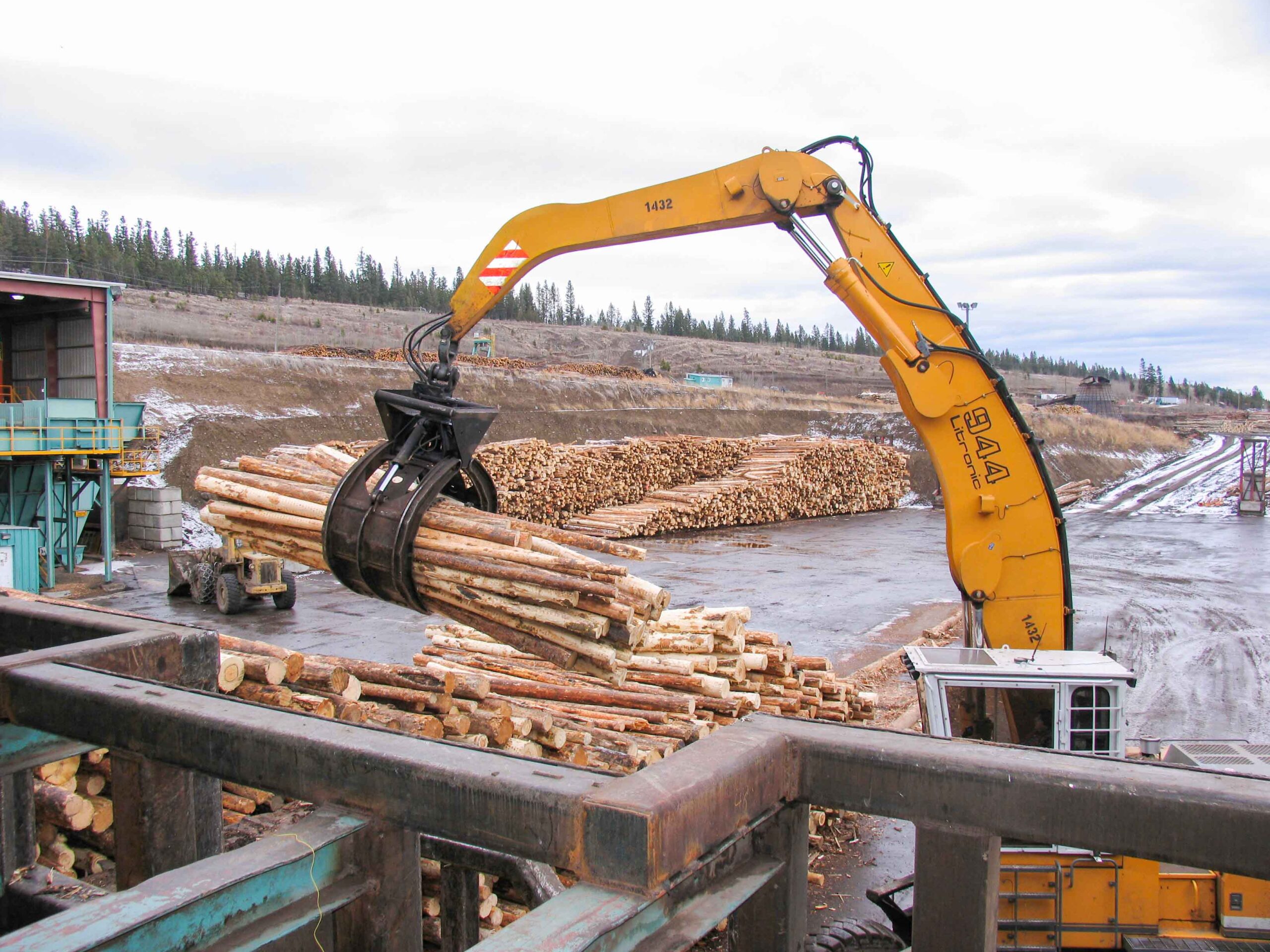 The B.C. Government says it’s going to expand the scope of BC Timber Sales. The organization manages 20 per cent of the province’s allowable annual cut for Crown/public timber and the auction of public timber. The government released a review of BC Timber Sales on Tuesday… A Chemainus mill is among two Western Forest Products mills in the Cowichan Valley facing lengthy curtailments, impacting more than 200 workers. …At the Paulcan Jemico mills in Chemainus, there are 50 people working despite tough times for the industry. The owner says profit margins are razor-thin while regulations are always increasing. “We’re making it to the point where no one wants to do business because there is so much uncertainty in what goes on in this industry,” said Paul Beltgens, owner of Paulcan Jemico Industries. Beltgens says unless conditions improve, there’s very little reason to invest in his company’s operations for the future.
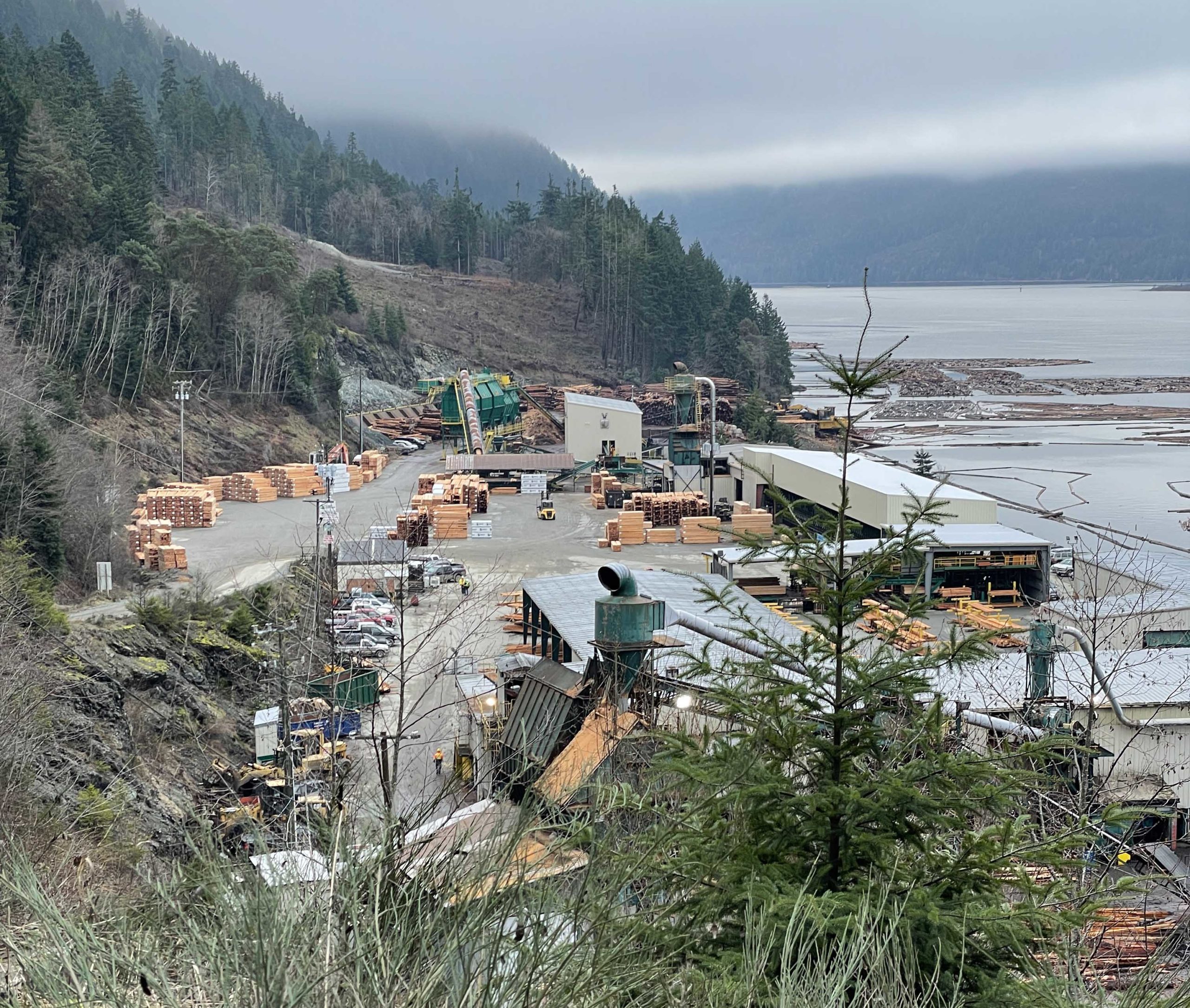 The new owners of the Coulson Manufacturing Mill (formerly operated by the San Group) say they are anxious to get the mill back up and running after purchasing the Port Alberni facility in a court-approved sale in June of this year. The mill will act as a stand-alone operation named Coulson Sawmills and will be managed by Jovan and Ajit Gill, but are connected at arms length with Fraserview Cedar on the Lower Mainland. “This is the next generation of Gills that have bought this and their plan is to go up there and get their own relationship,” says Fraserview Chief Executive Officer Gary Gill. Plans are to get the operation going near the beginning of November but the company’s first priority is to build up a long-term log deck so that the mill can run continuously with a healthy supply of logs. That’s a problem that Gary Gill says is facing other mills as well.
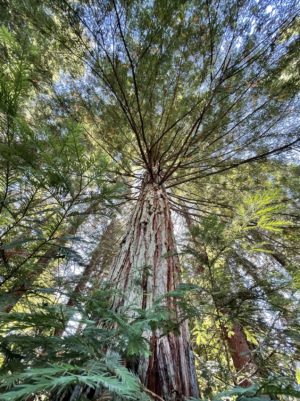 CAMPBELL RIVER — Several mayors from across BC have united to advocate for resource development by creating the Alliance of Resource Communities, with Campbell River’s mayor at the helm. “It’s time for an alliance of community leaders from all corners of the province to come together and strongly advocate for a secure and brighter economic future through the responsible development of our abundant natural resources,” said Mayor Kermit Dahl at the Get it Done conference on Sept. 22, which was hosted by Resource Works. “While it’s encouraging that the federal and provincial governments are becoming more vocal in support of major projects, thousands of people in my community who rely on natural resource industries face an uncertain future,” said Dahl, referring to Prime Minister Mark Carney’s pledge to fast-track nation-building projects and the recent announcement of five major infrastructure projects.
 British Columbia’s forestry industry is “under pressure from all sides,” prompting the provincial government to bring in changes to expand the role of BC Timber Sales, including allowing some communities to manage their own forest resources. Forests Minister Ravi Parmar says attacks from US President Trump, “increasingly intense” wildfires and climate change all put extra pressure on the industry. A review of the work done by BC Timber Sales, an organization that manages 20% of Crown timber, has generated 54 recommendations in a plan to help support a thriving forest economy. One of the key recommendations includes expanding three community forests in Vanderhoof, Fraser Lake and Fort St. James. …Parmar said he wants the changes implemented as quickly as possible, but a number of them will require legislative change to move forward. Parmar said the B.C. forestry sector is also looking to expand into other foreign markets.
 MERRITT, BC — Aspen Planers has halted operations at its Merritt sawmill and planer facility for an undetermined period, citing what it calls a lack of available logs and rising costs that have made continued production unsustainable. “Simply put, our mill lacks logs,” said regional manager Surinder Momrath. “Our Lillooet veneer plant has also curtailed operations for the same reason. These two closures are linked given that we source logs from both our Merritt and Lillooet forest licenses – and the saw logs are processed in Merritt while the plywood ‘peeler’ logs are processed in Lillooet.” The company pointed to an inability to obtain cutting permits under its AAC. Aspen Planers’ licenses provide for 490,000 cubic metres, but over the past two and a half years the company has only harvested 29% of that amount. …He says the shortage stems from provincial policy decisions, including Indigenous co-governance under DRIPA and old growth initiatives.
 “The BC Council of Forest Industries (COFI)… is encouraged to see recognition of the urgency to ‘increase performance, move more fibre, and better serve the current client base, including the primary sector.’ To create the stability, certainty, and predictability needed, we urge government to prioritize and fast track the Task Force’s recommendations that focus on increasing wood flow to manufacturers across the province. While BCTS has consistently underperformed in its core function of delivering wood supply to the market, the government is choosing to expand its mandate and propose additional volumes be allocated to BCTS. …COFI is pleased to see harvest targets in Recommendation 17, however, the proposal to increase the BCTS volumes by only 1 million m³ per year is not ambitious enough to meet the government’s Major Project commitment to reach a 45 million m³ harvest.
 The union representing thousands of forest-industry workers on the coast is calling for a united effort to address a growing crisis in the sector. Brian Butler, president of United Steelworkers Local 1-1937, says government, industry, First Nations and the union need a plan to resolve the issues that remain under the province’s control. He said members of the union, which represents 5,500 workers on the coast, are being hit hard with layoffs, most of which are either due to market conditions or lack of available logs. “Right now, as we see it, stakeholders work independently in their own silos, rather than collectively,” he said. On Monday, Western Forest Products, which supports about 3,300 jobs on the coast, announced that curtailments at its Chemainus sawmill will be extended until the end of the year. …Butler said there are plenty more examples of trouble in the sector around the Island.
 Western Forest Products announced planned temporary operating curtailments at its BC sawmills during the fourth quarter of 2025. These planned curtailments, combined with temporary curtailments taken in Q3 of 2025, will collectively reduce lumber production by ~50 million board feet in the second half of 2025, amounting to ~6% of the Company’s annual lumber capacity. The curtailments are in response to persistently weak market conditions, further impacted by increases in US lumber duties. In addition, certain factors relating to the operating environment, including a lack of available economic log supply, ongoing harvesting permitting delays and the strike by the United Steelworkers Local 1-1937 at our La-kwa sa muqw Forestry Limited Partnership are also contributing factors. The temporary curtailments will be taken through a combination of reduced operating hours, an extended holiday break and reconfigured shifting schedules. The Chemainus sawmill, which was curtailed for the third quarter of 2025, will remain temporarily curtailed for the fourth quarter.
 Ontario’s Associate Minister of Forestry and Forest Products announced over $5 million in funding today for Interfor Sault Ste. Marie at the company’s mill on Peoples Road.
  Canada’s GDP managed to grow for the first time in four months in July, even as the economic impacts of American tariffs began settling in, according to Statistics Canada. On Friday, the agency reported that the gross domestic product increased by 0.2% in July compared with the month prior. In addition, Statistics Canada gave a preliminary estimate for August’s reading to show that the economy was “essentially unchanged in the month.” July’s figure was slightly higher than the 0.1% increase most analysts polled were expecting. …“Canada’s economy is tracking very soft growth in Q3. While not a recession, it’s still an economy that’s bumbling along,” said Derek Holt at the Bank of Nova Scotia. “The combined effect leaves us tracking growth of only about 0.7 per cent at a seasonally adjusted and annualized rate in Q3 — that’s hardly much of any rebound from Q2.”
 BURNABY, BC — Interfor announced that it has entered into an agreement with a syndicate of underwriters led by RBC Capital Markets and Scotiabank, under which the Underwriters have agreed to purchase, on a bought deal basis, 12,437,800 common shares of the Company at a price of $10.05 per Common Share for gross proceeds of $125 million. The Company has agreed to grant the Underwriters an over-allotment option to purchase up to an additional 15% of the Common Shares. …The Company intends to use the net proceeds of the Offering to pay down existing indebtedness and for general corporate purposes. …Proceeds of the Offering are expected to further enhance Interfor’s flexibility to navigate near-term market volatility. The Offering is scheduled to close on or about October 1, 2025.

 Four new buildings in B.C. are each receiving $500,000 — totalling $2 million — to demonstrate and showcase the benefits of mass-timber construction. “Mass timber represents a transformative, locally sourced solution that’s generating significant employment opportunities, spurring cutting-edge innovation, and revitalizing rural economies across British Columbia,” said Ravi Kahlon, Minister of Jobs and Economic Growth. …The four projects were announced at the 2025 International Woodrise Congress. …Delivered through the Province’s Crown corporation Forestry Innovation Investment. The four projects are:
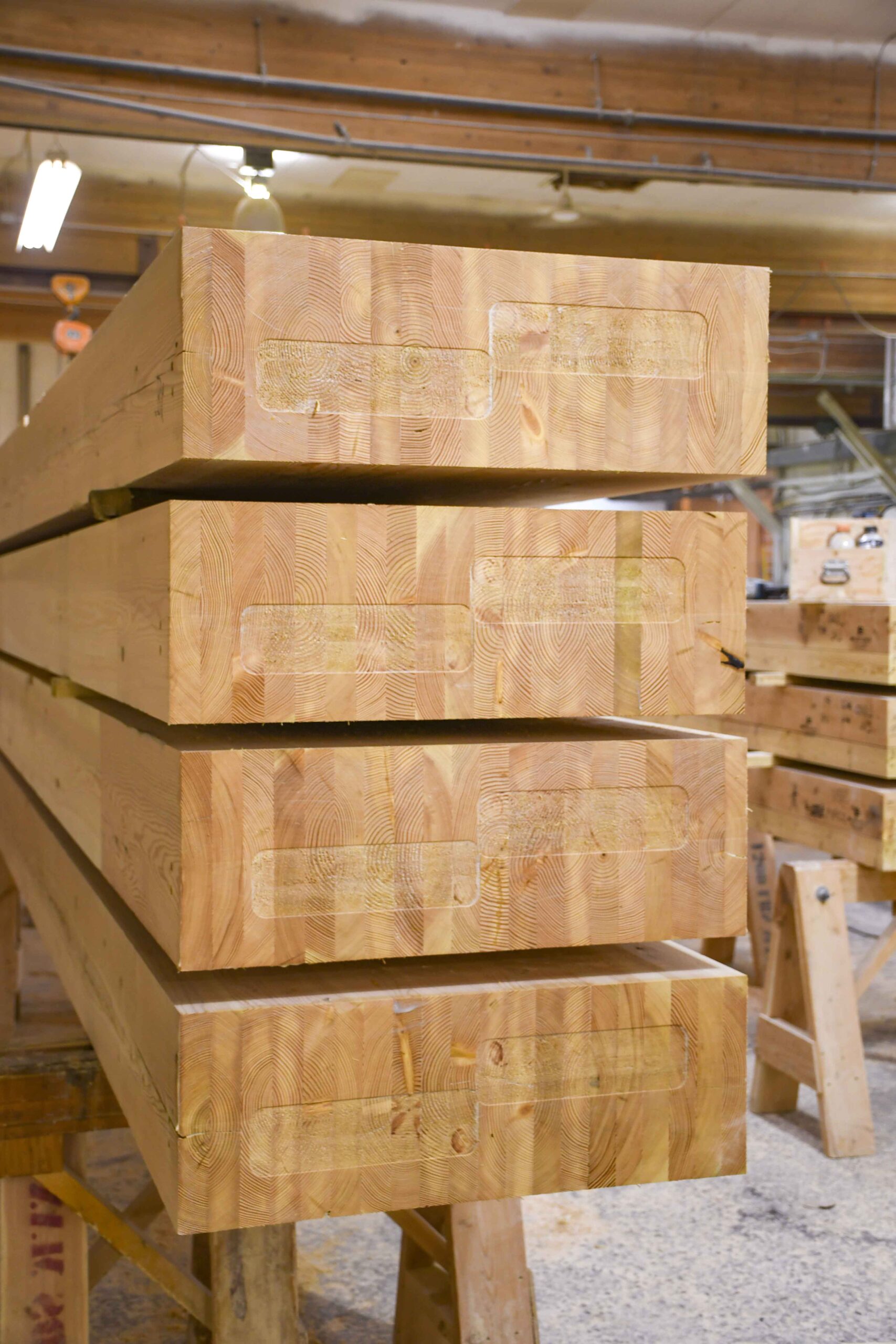 A proposed 18-storey residential tower on St. Paul Street in downtown Kelowna will be constructed using mass timber, according to applications recently submitted to city planners. The city announced earlier this year that it was partnering with non-profit developer Housing Okanagan Foundation on the project for middle-income earners. Now a development permit and variance applications have been submitted for the property at 1428 St. Paul St. “If completed today, it would be the tallest mass timber residential building in Canada,” according to the application from project architect Lang Wilson Practice in Architecture Culture. “The use of mass timber also offers significant reductions in embodied carbon emissions. “This design aligns with the provincial and federal housing objectives while also incubating a building construction methodology that creates local manufacturing jobs.” Above the three-storey podium will be 15 residential floors and a rooftop terrace for all tenants.




 In many places, moose, bear, wolves and other wildlife can simply walk between the two nations. There are barriers — roads, development and a lack of protected habitat on either side — but for more than a century, relatively relaxed border policy and a shared sense of purpose saw conservationists in both countries working together to overcome them. Now, US President Trump has ratcheted up the challenges to cross-border conservation. …Many of Trump’s actions have explicit implications for cross-border conservation — in North America and globally. …Canadian conservation organizations have reported losing co-funding as a result of Trump’s cuts to foreign aid. As his administration has stretched staffing thin and proposed deep budget cuts at the US National Park Service, it ended funding many found crucial to habitat conservation work across the border. Trump has also withdrawn from the Green Climate Fund and the Paris Agreement.
 OTTAWA, ON – Today, the Honourable Tim Hodgson, Minister of Energy and Natural Resources, announced over $1.44 million in funding for 10 projects under Natural Resources Canada’s Global Forest Leadership Program, delivered through the International Model Forest Network. This funding will help restore damaged ecosystems, support agroforestry and sustainable local businesses, empower Indigenous and local communities — especially women and youth — and improve global forest management and restoration. Healthy forests around the world contribute to carbon sequestration and climate resilience, benefitting Canadians and the global community. As a leader in sustainable forest management, Canada plays a key role in advancing sustainable forestry worldwide, and the federal government remains committed to sharing its expertise, fostering collaboration and helping restore, manage and conserve forests around the world to protect biodiversity and help tackle climate change and environmental damage.
 GATINEAU
 The Interior Department says it’s on track to meet a federal goal to increase logging on federal lands, even as timber industry analysts warn low prices, scarce sawmills, and litigation will likely threaten progress. Interior’s Bureau of Land Management has increased timber sales by 4.6% so far in fiscal 2025 over all of fiscal 2024. Interior spokeswoman Alyse Sharpe said. …Trump’s logging goals face fierce headwinds, however, as depressed lumber prices, a worker shortage in the timber industry, and an overriding sense of uncertainty about the future of logging are chilling timber industry interest in actually cutting down the trees sold in federal sales, said Mindy Crandall, at Oregon State University. “The Forest Service can put the timber up for sale, but someone has to want it,” Crandall said. But Trump’s logging policies are likely to have limited reach across the US in part because federal lands make up only a small part of the timber supply, and tariffs are unlikely to crush the demand for Canadian lumber.

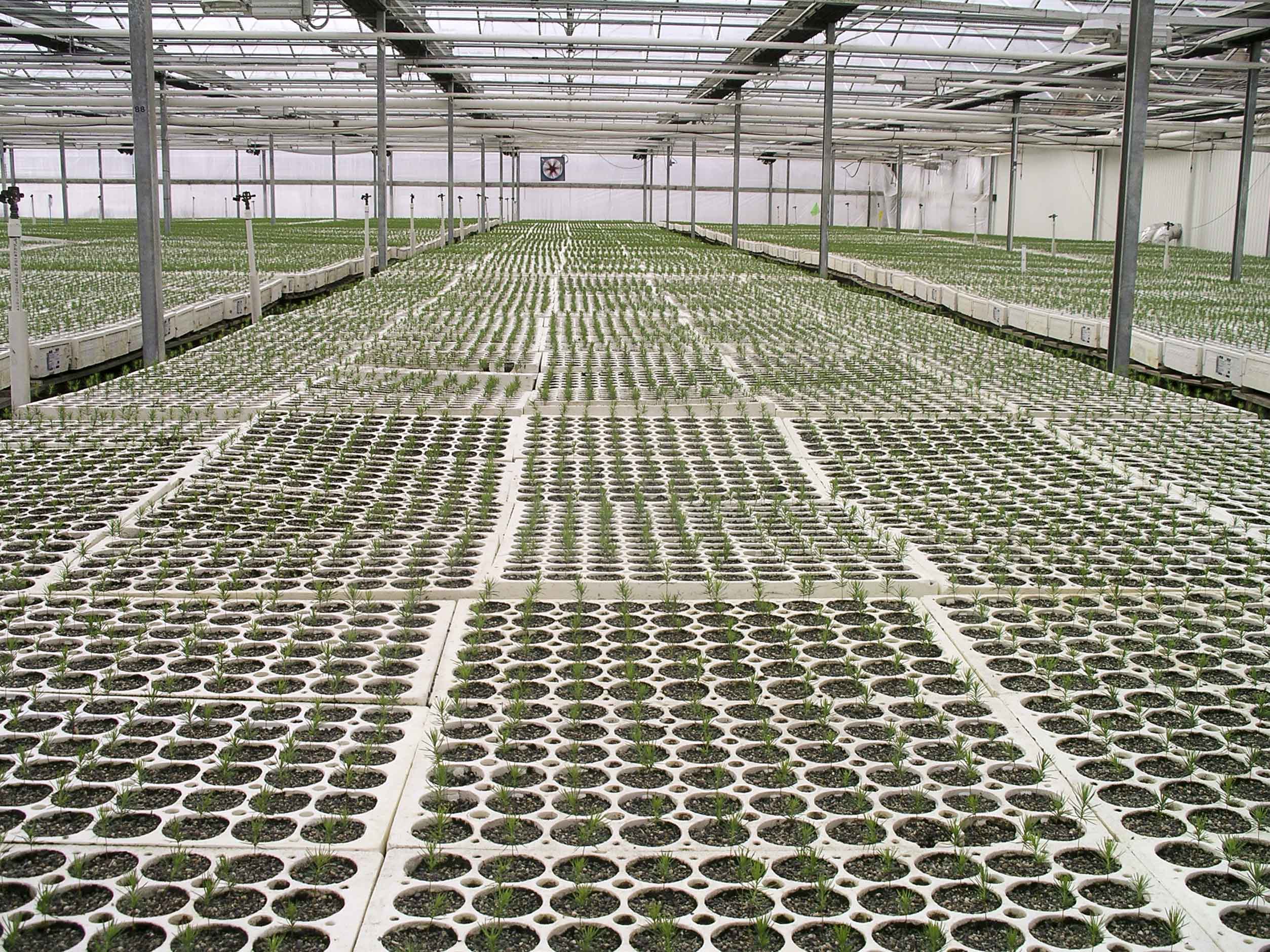 Through its 2 Billion Trees (2BT) program, the federal government has planted more than 228 million trees since 2021. With Canada enduring some of its worst wildfire seasons since it began, should the government expedite and increase its co-ordinated, replanting efforts? Canada’s 2 Billion Trees (2BT) program has achieved more than 11 per cent of its goal of planting, as the name suggests, two billion trees over a 10-year period. …The government also announced the program has agreements in place to plant one billion trees, approximately, since it kick-started the initiative in 2021. As of June 2025, Canada has signed or is negotiating tree-planting agreements with 11 provinces and territories, 58 Indigenous partners, 30 municipalities and 88 non-governmental organizations. …Restoring tree cover is an important strategy for carbon removal and addressing the climate crisis. So, with the intense wildfire seasons Canada has been experiencing in recent years, does the country require a more expedited process to keep its forests thriving?

 TORONTO — World Wildlife Fund Canada’s

 In a career that has spanned nearly 40 years in the forestry industry, Michael McKay says he’s never had to face a situation like the one he’s staring at now. “This is probably one of the biggest, I mean with this fire and the current state of the industry, to have it all come together at once, it’s definitely about as tough as it’s been,” McKay said. The president of Franklin Forest Products is facing a perfect storm of problems but is pivoting as best he can to weather through it. The latest issue was the Mount Underwood Fire which started Aug. 11 and ended up destroying half of the company’s powerline despite his employees trying to save it. …The blaze interrupted the implementation of a new Gang Mill plant that would have added more staff to the company’s roster of 35 employees. …”It’s been four years and wood’s not coming out, there’s just no wood coming out of the bush and all we are is a bunch of too many squirrels chasing too few nuts,” McKay said.


 Less wildfire damage throughout the province and improved access to the great outdoors feature prominently in Danielle Smith’s renewed vision for Alberta. The premier issued new marching orders last week to Forestry and Parks Minister Todd Loewen, directing him to expand efforts to prevent wildfires and reduce their effects. One bullet point is that the minister seek a wildfire agreement with the federal government. Loewen said wildfire fighting and prevention are “incredibly important to Albertans.” So is more access to public lands in a sustainable way. “Those two things encompass a lot of what’s in the mandate letter, and I think they really resonate well with Albertans,” said Loewen, the member for Central Peace-Notley in the province’s northwest. He was one of four ministers to receive new mandate letters on Sept. 17.
 [Recent] articles in the Campbell River Mirror during Forestry Week, “Celebrating the role of First Nations in the forestry economy,” and “Mayor calls for urgent action to support forest industry,” deserve some context and reply from someone like myself who is directly in the crosshairs as a forest industry worker. …I work for La-kwa sa muqw Forestry Ltd., a majority-owned Western Forest Products company. And, as a union member, I am on strike. However, I am expressing my opinion only. …The article on the First Nations’ role in forestry is positive and forward-looking to a point. … On the face of it, you would think that the the Nanwakolas Council and Western Forest Products agreement was a win/win. …It glosses over the fact that Western is now using that partnership to try to gain major concessions from the union regarding the mid-island forest operations being a union shop.

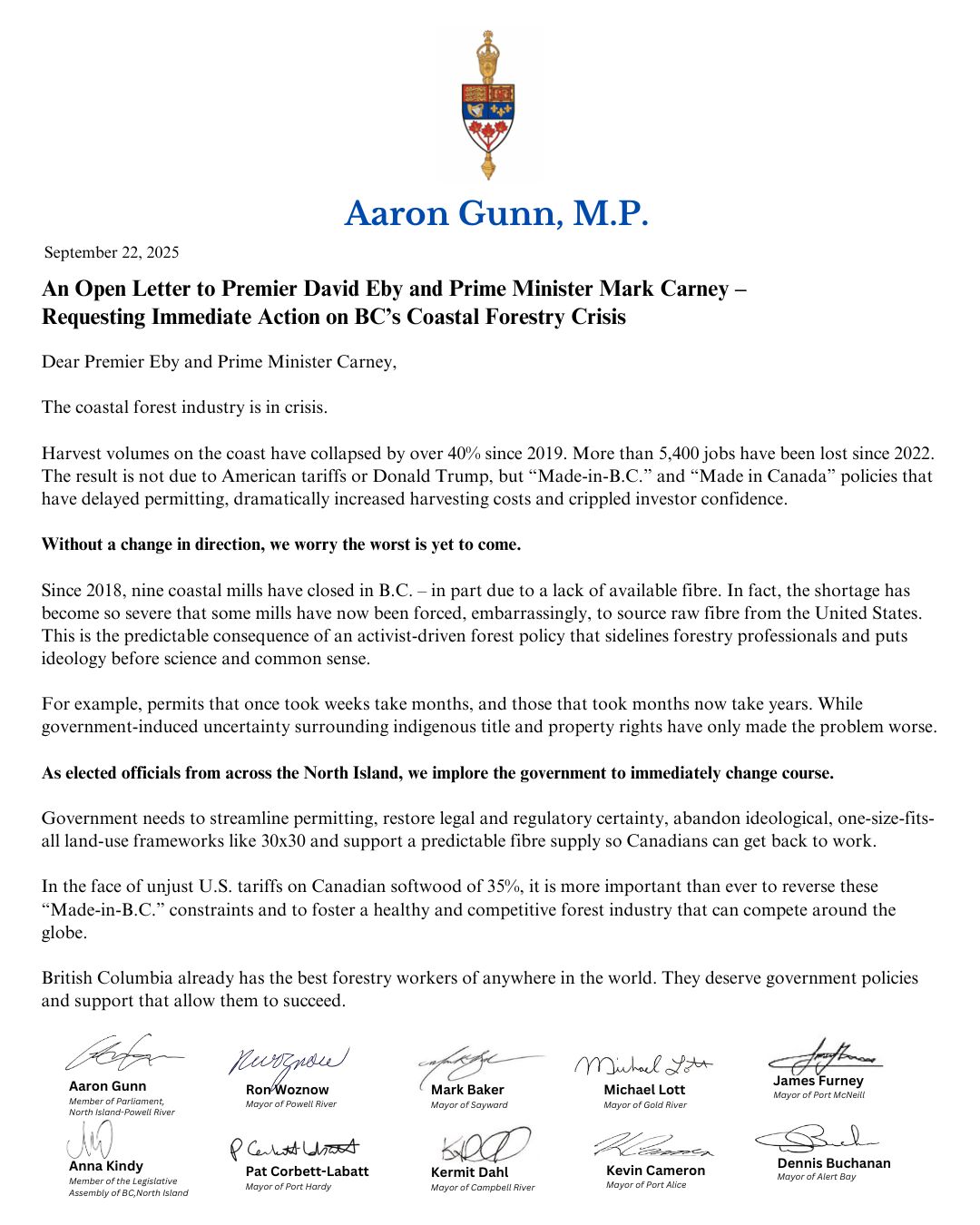

 Today on the back steps of the Legislature building, MP Aaron Gunn, MLA Anna Kindy along with five North Island Mayors are calling on Ottawa and BC to remove the red tape when it comes to cutting permits in the province. North Island- Powell River MP Aaron Gunn sent an open letter today to both Premier David Eby and Prime Minister Mark Carney telling North Vancouver Island and the province is in a forestry crisis. “Harvest volumes have collapsed in half and more than 5,400 jobs have been lost. It’s the result of made in BC, made in Canada policies that have delayed permitting, dramatically increased harvesting costs and crippled investors confidence,” said Gunn. The Mayor of Powell River Ron Woznow was at the press conference with Gunn, echoing his concerns. …BC Forests Minister Ravi Parmar reacted briefly… adding that more details on a ‘refreshed BC timber sales’ will be released Tuesday.
 Mosaic Forest Management says it has heard Vancouver Islanders loud and clear when it comes to accessing private forest lands,

 Fall issue of WorkSafe Magazine
 REVELSTOKE, BC — A BC forestry worker was fatally injured while on the job last week, an industry safety group said Tuesday. “A skidder operator was fatally injured when their skidder rolled down a steep slope in an area north of Revelstoke,” the BC Forest Safety Council said of the Sept. 16 incident. “WorkSafeBC and the Coroners Service are currently investigating this incident.” It’s the fifth harvesting fatality in 2025 and BC Forestry said details are still to be determined. Contributing factors to the incident are not available during an ongoing investigation. The BC Forest Safety Council said they have several safety points to be considered as the process unfolds. Those include a thorough assessment before work begins to prepare operators for steep slope logging operations. …Maintain safety buffers by not operating on the steepest possible slopes. This helps operators recover when surprised by an unexpected event.