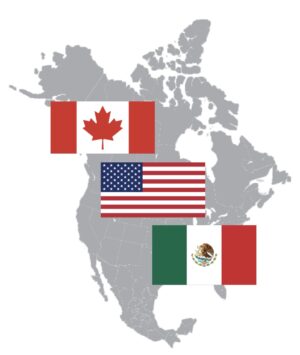
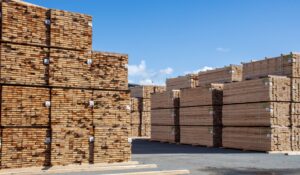
 Prime Minister Mark Carney said Canada probably won’t reach a near-term deal with the United States to lower tariffs on sectors such as steel and aluminum, and negotiations are likely to be rolled into next year’s review of the US-Mexico-Canada Agreement. Canada and the US were close to a pact on metals tariffs, but President Donald Trump then terminated talks in October. …“My judgment is that that is now going to roll into the broader CUSMA negotiation, so we’re unlikely, given the time horizons coming together, to have a sectoral agreement,” Carney said on Thursday. “Although if the United States wants to come back on that in those areas, we’re always ready there — we’re very ready.” …Canada is “very ready on forest products to strike an agreement,” the prime minister added. The U.S. has placed roughly 45% duties and taxes on imports of Canadian softwood lumber, to the frustration of US homebuilders.
 Canada and the U.S. will launch formal discussions to review their free trade agreement in mid-January, the office of Canadian Prime Minister Mark Carney said. The prime minister confirmed to provincial leaders that Dominic LeBlanc, the country’s point person for US-Canada trade relations, “will meet with U.S. counterparts in mid-January to launch formal discussions”. …Carney met with the leaders of Canada’s provinces on Thursday to give them an update on trade talks. Canada is one of the most trade-dependent countries in the world, and more than 75% of Canada’s exports go to the country’s southern neighbor. But most exports to the US are currently exempted by USMCA. …Canada is the top export destination for 36 US states. Nearly $3.6 billion Canadian worth of goods and services cross the border each day. About 60% of US crude oil imports are from Canada, as are 85% of US electricity imports.
 The trade war launched by Donald Trump continues to intensify, striking Canadian workers. In addition to the 50% tariffs on steel and aluminum imposed earlier this year and the duties on non-CUSMA-compliant automobiles and parts, Washington added a 50% tariff on copper in July. More recently, a new 10% duty on softwood lumber was introduced, on top of the existing countervailing and anti-dumping duties. …Thanks to the mobilization and constant pressure of the United Steelworkers, several long-standing union demands have finally been adopted in Ottawa. …The federal government announced that it will now require the use of Canadian-made products in publicly funded projects and has announced new investments to strengthen Canada’s industrial capacity and the resilience of our supply chains. …Canada must go further and adopt a strong industrial strategy to reduce our dependence on the U.S. market, protect jobs, and ensure that we never again find ourselves in such a vulnerable position.
  The Court of International Trade on Dec. 18 again
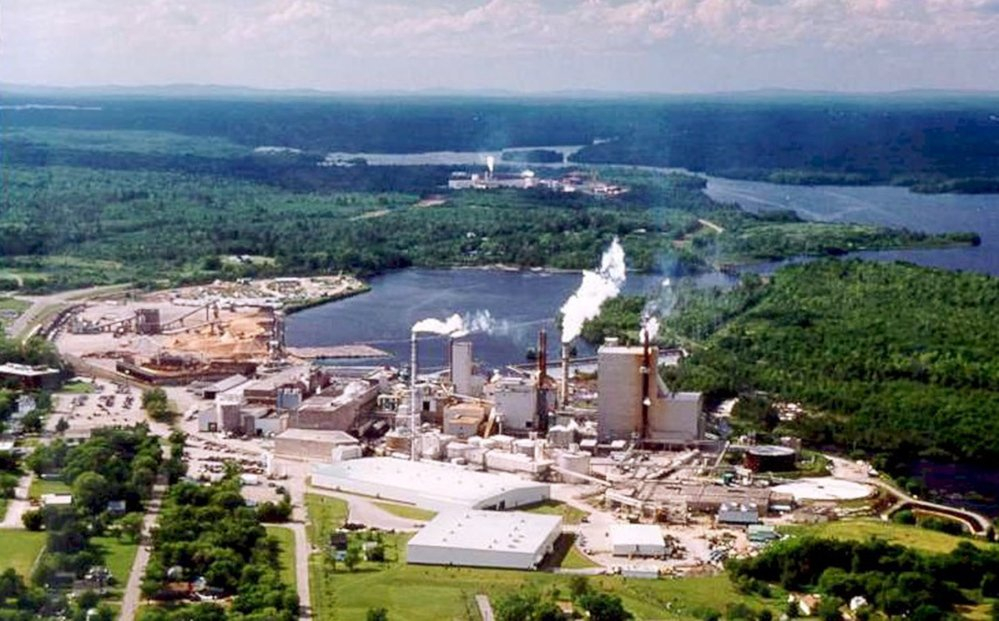
  Maine timber companies are in line to receive substantial incentives to manage forests and grow healthier, more valuable trees. A $32 million award to the New England Forestry Foundation was recently finalized by the US Department of Agriculture. The funding package, through the Advancing Markets for Producers initiative, replaces similar funding provided under the “climate smart commodities” program. While there are some adjustments to the program, it achieves the same purpose, according to the foundation Deputy Director Andi Colnes. The grant will largely subsidize commercial and pre-commercial thinning, Colnes said. It will also provide funding to expand market opportunities, particularly for mass timber construction, she added. …According to Colnes, the program is able to cover about 50,000 acres of New England forests, mostly commercial timberland in Maine. The foundation said 23 commercial, conservation and public forest owners are already enrolled in the project.
 NORTH CAROLINA — After reviewing public comments, the

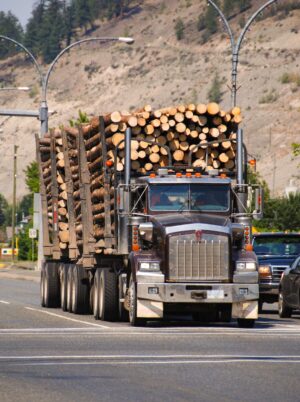
 President Trump’s tariff and trade policies dominated the world’s political discourse through 2025. …The good news is that the BC economy has been fairly resilient through 2025. …BC trade resilience can also be attributed to a broader export commodity mix, dominated by forestry, agricultural and seafood products, as well as mining and oil and gas. …Forest products were tagged with a sectoral tariff of 10 per cent in October 2025, on top of new anti-dumping and countervailing tariffs on softwood lumber. …This has put tremendous pressure on an industry. …It’s difficult to disentangle the impact of tariffs from overall adverse trends in the BC forest industry, many mill closures and curtailments in recent years. BC forestry exports are among the most exposed to the US market, with about 75% of forestry exports headed south. Exports of softwood lumber were down 26% in August 2025 compared to August 2024. Pulp and paper exports were also down 9% on a year-to-date basis compared to 2024.
 The
The 


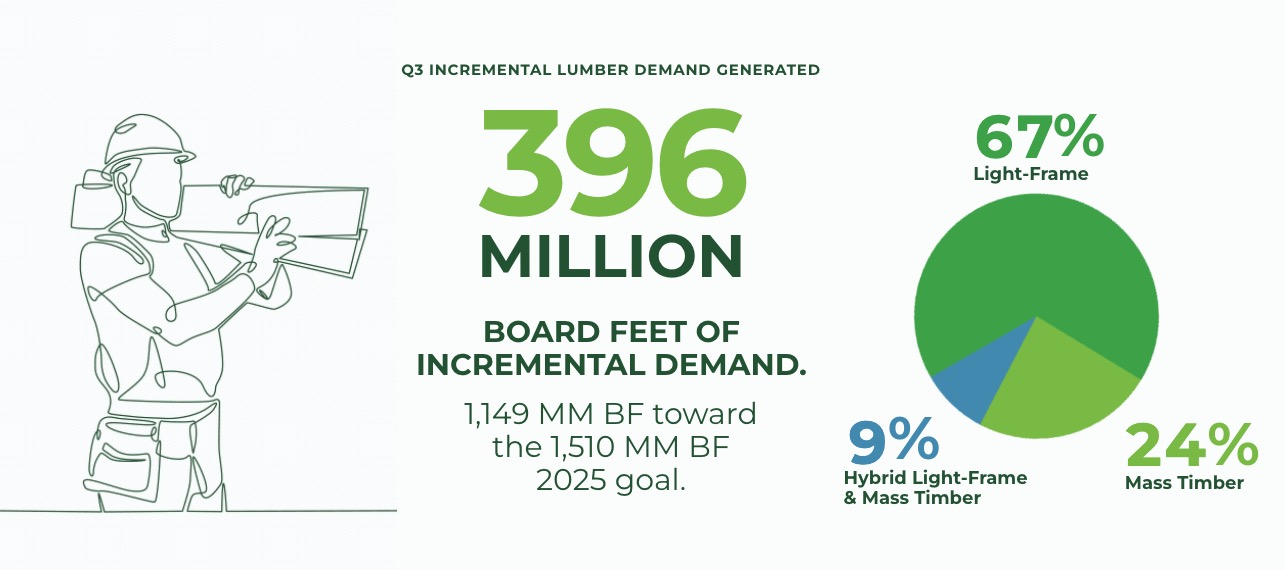 The Softwood Lumber Board has released its Q3 2025 Report, highlighting significant progress tied to its new strategic plan. This quarter, SLB-funded programs advanced a coordinated strategy centered on high-opportunity sectors—1-8 story multifamily, commercial, K-12 education, and the fast-growing industrial segment—while accelerating project conversions, strengthening building code support, scaling post-secondary education, and expanding outreach in key cities.
 Mark Latino is the CEO of Lee Display, a Fairfield, California-based company… that still makes artificial Christmas trees, producing around 10,000 each year. Tariffs shone a twinkling light this year on fake Christmas trees — and the extent to which America depends on other countries for its plastic fir trees. Prices for fake trees rose 10% to 15% this year due to the new import taxes, according to the American Christmas Tree Association, a trade group. Tree sellers cut their orders and paid higher tariffs for the stock they brought in. Despite those issues, tree companies say they aren’t likely to shift large-scale production back to the US after decades in Asia. Fake trees are labor-intensive and require holiday lights and other components the US doesn’t make. …About 80% of the US residents who put up a Christmas tree this year planned to use a fake one. …That percentage has been unchanged for at least 15 years.

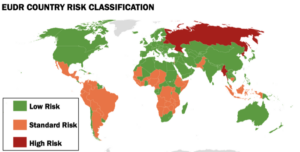 The EU Deforestation Rule has already caused supply chain hurdles for American farmers, ranchers and foresters, and the rule has not even begun being enforced. EU farmers themselves have raised concerns over their compliance requirements and received additional flexibilities, and member governments are still navigating how to implement the complex auditing system. With these logistical challenges clear even to EU officials, the European Commission has voted to once again delay the rule’s implementation until 2026 and 2027 for large and small businesses, respectively. However, as long as the rule stands as currently drafted, agricultural supply chains will be strained from the looming enforcement deadline. Overall, the EU fails to recognize the long-standing position of American farmers and ranchers as global leaders in agricultural production with environmental stewardship. A rule that was originally targeted to penalize bad actors in the global marketplace has now hindered some of the most productive producers in the world.
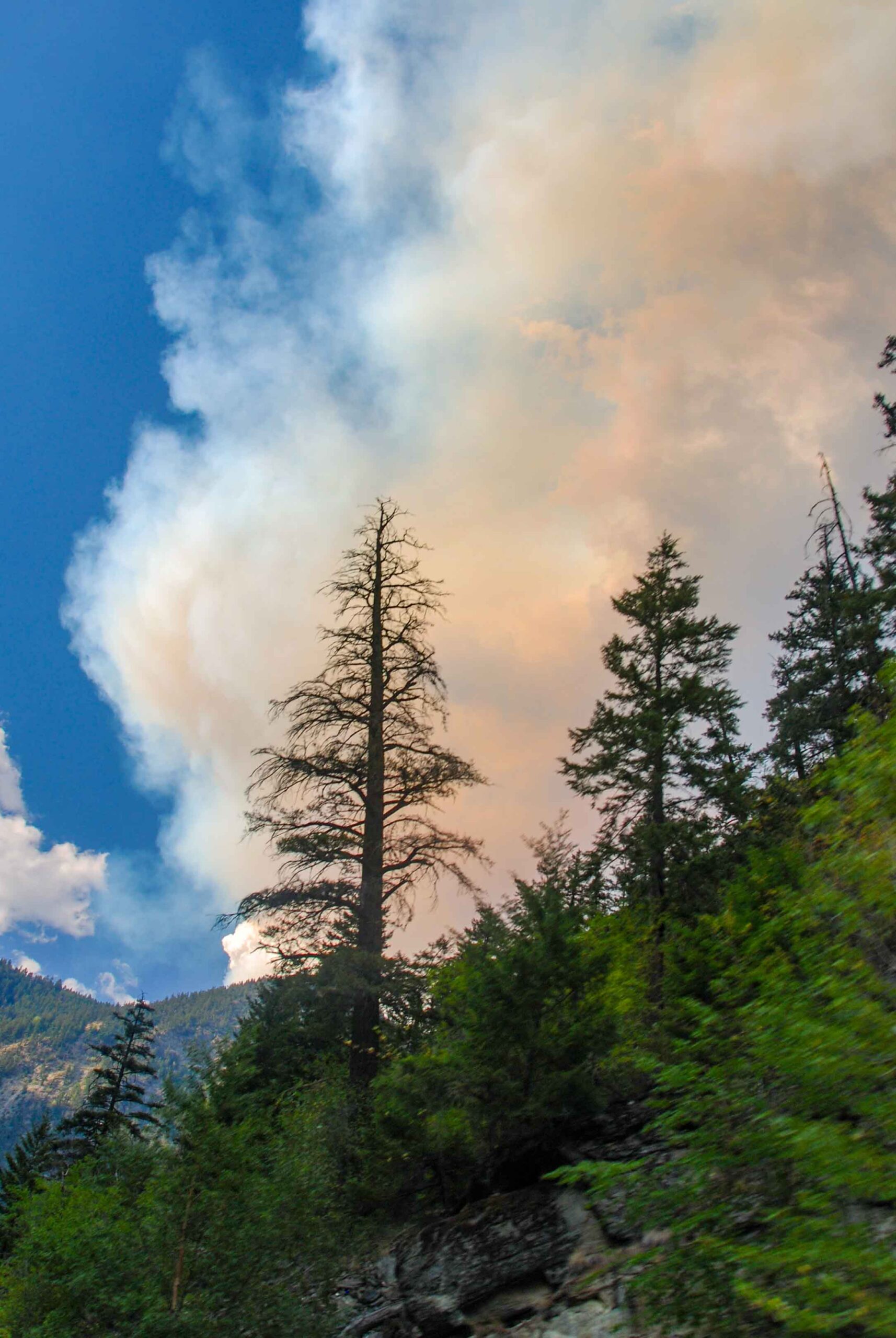 One of the most profound shifts in how the United States manages wildland fire is underway. Federal wildland fire forces are spread across several agencies, closely collaborating but each tackling prevention and protection somewhat differently. Now, the Trump administration is creating an entirely new “U.S. Wildland Fire Service” to combine as much of that under one headquarters roof as it can. A firefighter with decades of federal and local experience says he has been tapped to head that agency, news that heartened much of the wildfire community when it broke just over a week ago. …But the muddled rollout of these plans—along with widespread layoffs at agencies that fight wildfires and a crackdown on efforts to combat the climate change that’s fueling the flames—have sowed concerns that this is not the right administration to carry out such a significant transformation.
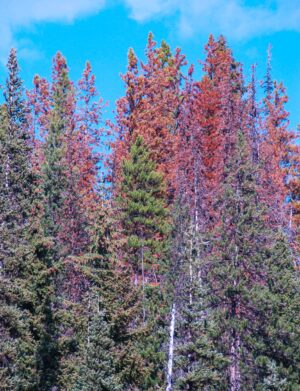 DENVER — Vast swaths of the ponderosa pine forests that blanket Colorado’s Front Range mountains could turn rust-colored and die over the next five years as pine beetles begin to spread aggressively, new federal forecasts show. Aerial surveys conducted by the U.S. Forest Service over the last year found evidence of rapidly spreading beetle infestations along the mountains and foothills that stretch from southern Larimer County to southern El Paso County, including the western flank of metro Denver. Already, pockets of dead trees are visible from Interstate 70 and U.S. 285. The rapid uptick in beetle-killed trees near the state’s largest cities and major highways prompted state leaders to form a task force this month to grapple with the outbreak. Gov. Jared Polis
 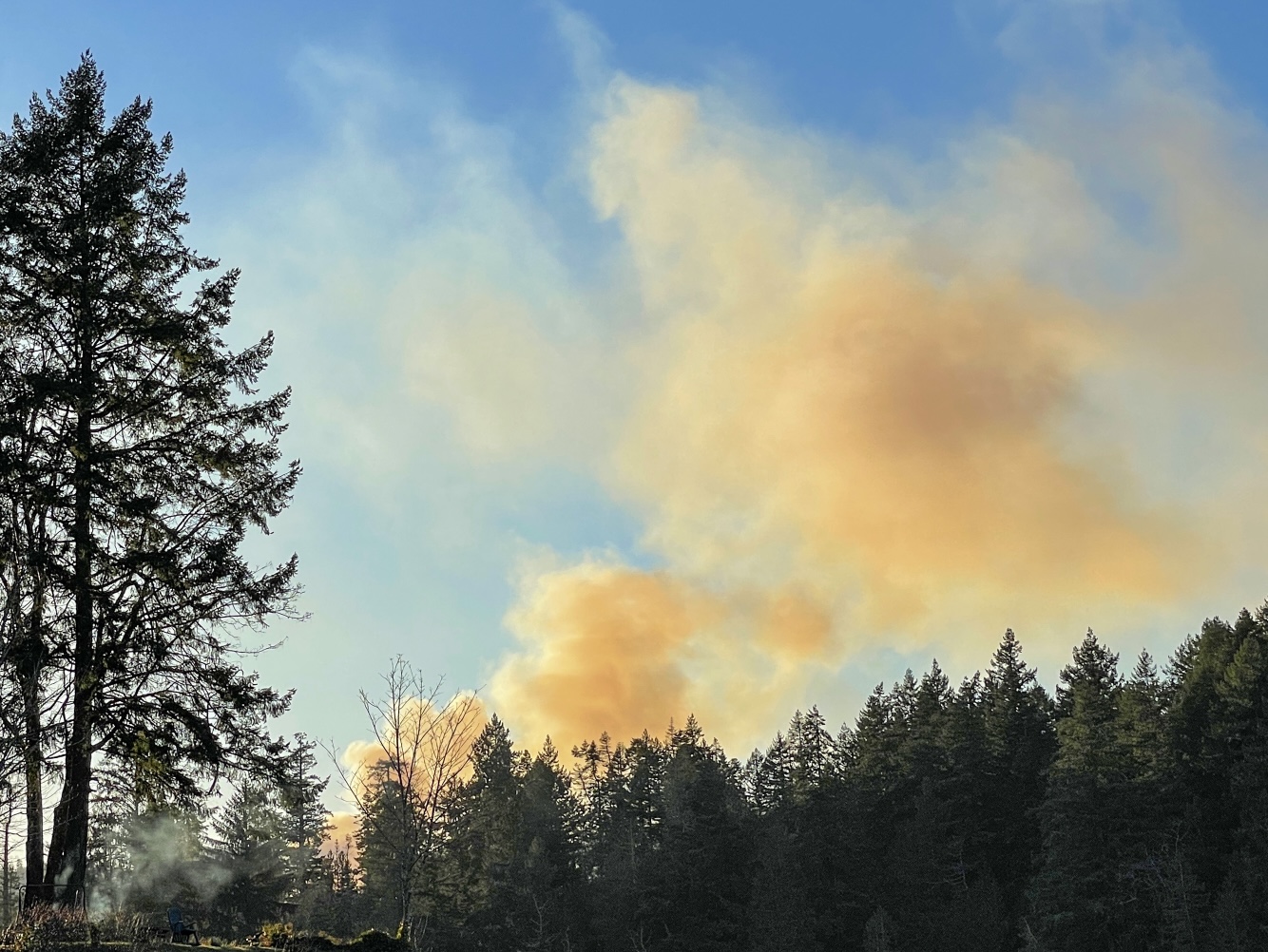 Wildfires are not always purely destructive. In many forests, fire can clear out built up dead material, return nutrients to the soil, and help ecosystems reset. For more than 100 years, the United States has spent billions of dollars on fire suppression to protect people, homes, and sensitive environments. But putting out too many fires can also prevent landscapes from getting the burns they need, allowing extra fuel to accumulate and raising the risk of larger fires later. New research … reports that nearly 38 million hectares of land in the western United States are historically behind on burning. The researchers describe these areas as being in a “fire deficit.” …”Conditions are getting so warm and dry that it’s causing huge amounts of fire compared to the historical record,” said Winslow Hansen, director of the Western Fire and Forest Resilience Collaborative and scientist at Cary Institute of Ecosystem Studies.
 Cutting red tape and streamlining project work have been marching orders for the U.S. Forest Service throughout the first year of the second Trump administration. Last week, a federal court ruling on a Greater Yellowstone landscape project showed how far those directives can backfire. …Initially proposed in 2020, it received a decision notice in 2023. Opponents referred to it by its acronym, SPLAT, and promptly sued to block it. In his December 11 opinion, U.S. District Judge Donald Molloy wrote that South Plateau failed to meet requirements of the National Environmental Policy Act, National Forest Management Act and Endangered Species Act. But he added the “primary challenge concerns the project’s conditions-based management approach.” Molloy generally agreed with the plaintiffs’ concern. “This approach,” he said, “conflates a promise of future statutory compliance with actual compliance.”




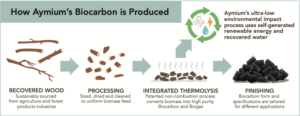 Weyerhaeuser, America’s largest private landowner, said it has launched a venture to turn runty trees and sawdust from its fleet of mills into a replacement for metallurgical coal used in steel making. The forest-products company said it expects production to begin in 2027 at a facility being built next to its sawmill in McComb, Mississippi—the first of several biocarbon plants planned by Weyerhaeuser and partner Aymium. It is the latest effort to find a market for the trees too small or otherwise unsuitable for making lumber. Such wood has typically been sent to pulp and paper mills, but U.S. wood-pulp consumption capacity has plunged due to waning paper demand. …Stockfish said he envisions the venture with Aymium operating as many as 10 or 11 biocarbon production facilities across Weyerhaeuser’s U.S. properties. …Aymium CEO James Mennell said the company’s process works with all species of wood as well as agricultural residues. [to access the full story a WSJ subscription is required]