 Canada’s government has moved quickly to protect and strengthen the sectors most affected by U.S. tariffs – introducing new measures to help workers gain new skills, support businesses as they modernise and diversify, and boost domestic demand for Canadian goods. Building on previously announced measures to help transform the Canadian steel and softwood lumber industries, the following new initiatives were announced:
- Further limit foreign steel imports
- Make it easier to build with Canadian steel and Canadian lumber
- Canada will work with railway companies to cut freight rates for transporting Canadian steel and lumber interprovincially by 50%.
- To maximise the use of Canadian softwood lumber in housing, Build Canada Homes will prioritise shovel-ready, multi-year projects.
- Canada will implement our Buy Canadian Policy later this year, which requires that all contracts worth over $25 million prioritise Canadian materials – including steel and lumber.
- Increase protections for Canadian steel and lumber workers and businesses
- Canada will earmark more than $100 million to provide support in all sectors with an active Work-Sharing agreement.
- Canada will provide an additional $500 million to the BDC Softwood Lumber Guarantee Program.
- For softwood lumber firms facing liquidity pressures, Canada will earmark $500 million under the Large Enterprise Tariff Loan facility.
- Canada will launch a Canadian Forest Sector Transformation Task Force.



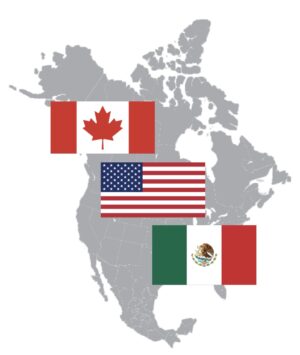 US President Trump could decide next year to withdraw from the Canada-United States-Mexico trade agreement (CUSMA), Politico reported on Thursday, citing U.S. Trade Representative Jamieson Greer. “The president’s view is he only wants deals that are a good deal. The reason why we built a review period into CUSMA was in case we needed to revise it, review it or exit it,” Greer told Politico’s White House bureau chief Dasha Burns in a podcast episode that airs Friday. Greer also raised the idea of negotiating separately with Canada and Mexico and dividing the agreement into two parts in the podcast, adding that he spoke with Trump about that possibility just this week. …Trump on Wednesday said that the CUSMA agreement – which faces an upcoming review- will either be left to expire or another deal will be worked out.
 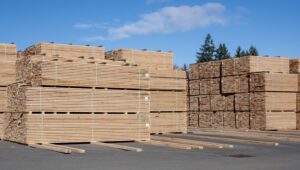 The federal government has rejected an industry request for payouts to softwood producers in Canada on the hook for US duties, fearing that direct intervention would further irritate the US. Canadian softwood producers have paid more than $10-billion since 2017 in accumulated duties, which are cash deposits held in trust by the US that collect interest. The producers expect the US to refund a portion of the duties if and when the two countries resolve the trade dispute. In the meantime, the industry has suggested that the Canadian government make payouts to reflect the present value of anticipated refunds. The two sources said Ottawa would have received any future refunds in exchange for injecting much-needed liquidity into the struggling industry. Ottawa rejected the idea because of fears that such payouts would be viewed as subsidies and become a serious irritant during the wider US trade war, according to a senior government official. [to access the full story a Globe & Mail subscription is required]
 The United Steelworkers union (USW) welcomes the federal government’s new measures to support Canada’s steel and softwood lumber sectors, calling them a meaningful step forward in the face of US tariffs and global market instability. The package includes tighter import controls, a 25% surtax on steel derivatives, strengthened border enforcement, expanded liquidity supports for softwood producers, a top-up to the Work-Sharing program, lower interprovincial freight costs, and new domestic-content requirements for federal projects. …Marty Warren, USW National Director… underscored that the Work-Sharing top-up will help workers stay on the job during temporary downturns and also pointed to the importance of strengthening procurement rules. On softwood lumber, the union welcomes the government’s efforts… “But let’s be honest, forestry towns cannot rebuild on temporary fixes. A long-term resolution to the softwood lumber dispute with the United States is essential. Without it, workers and communities remain vulnerable to decisions they cannot control.”

 Help is on the way for Canadian steel producers and those in softwood lumber affected by the ongoing trade dispute with the United States. Multiple senior government sources confirmed that Prime Minister Mark Carney will announce measures on Wednesday to protect the steel industry, which has been hit with 50 per cent tariffs by the Trump administration. The measures include cutting limits to the amount of steel that can be imported into the country from nations that do not have a free trade agreement with Canada. …The Carney government will also increase the total money available to struggling softwood lumber companies to $1.2 billion. It’s a $500-million increase from the previously announced Softwood Lumber Development Program, which gives companies access to government-backed loans. …Trade talks between the two countries have been put on pause for the last month.

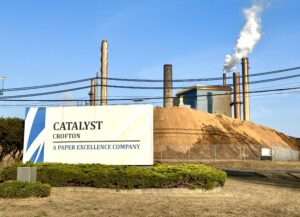 When Domtar announced it would be shuttering a Vancouver Island pulp mill and laying off 350 workers, it came as little surprise to those who knew the company was losing millions of dollars despite cost-cutting measures by management and staff. What’s not widely known is that the company had been buying and transporting American pulp to the Cowichan Valley facility to keep it running after struggling to find enough material in Canada. “It’s cheaper and it’s more readily available and dependable, in terms of its supply,” said Domtar’s senior director of public affairs, Chris Stoicheff. “That should give an indication to British Columbians of where we’re at.” …The forestry sector has been urging the government to reform permitting and approvals processes and reduce red tape in order to make them more economically viable. Stoicheff says the opposite has been true, with companies going from weeks-long waits for harvesting permits to year-long waits.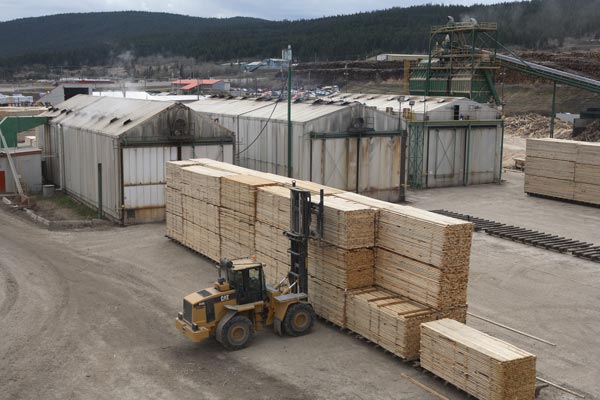
 MACKENZIE, BC — Forestry company Conifex Timber announced that it will temporarily curtail operations at its Mackenzie, BC sawmill for a planned four-week period commencing December 15, 2025. The curtailment is being implemented in response to, among other things, continued weakness in North American lumber markets. The curtailments will begin on December 15, for a planned four-week duration, Conifex said, adding that it is expected to reduce production by roughly 13 million board feet. The North American timber industry has gone through several curtailments in response to US President Trump’s decision to implement tariffs. …The company said it does not anticipate any challenges in securing sawlogs to maintain capacity operations in the future, once market conditions permit a return to full operations. It also expects to see gradual recovery in demand in the second half of 2026.



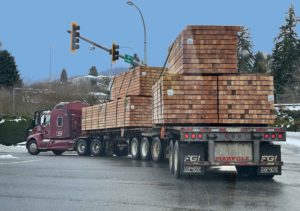 Ottawa threw the beleaguered softwood lumber industry a bone. …The new measures include $500 million in new loan guarantees for softwood lumber companies. “Loans are only good if i can sell my prioduct and pay for those loans,” said Brian Menzies, at the Independent Wood Processors Association of BC. “At 45%, I can t sell my product into the United States.” Other steps announced include cutting freight rates. …The measures are window dressing – say some – when compared to the impact of the steel industry supports. “I’m afraid we’ve come to the point that ‘Sophies choice’ is happening and softwood lumber is the child who’s going to be left behind,” said Menzies. It’s a concern shared at Leslie Forest Products, in Delta where James Sanghera said the measures won’t make a difference. “Most of the wood we’re sending down to the States is going on truck.”


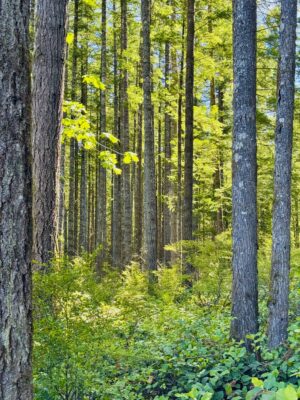 MANCHESTER, Tennessee – Several US sawmills are struggling to stay open after industry leaders said years of trade uncertainty have drained export markets and tightened margins. The Hardwood Federation estimates at least one sawmill is going out of business every week. Additionally, the National Hardwood Lumber Association (NHLA) reported that more than 4% of U.S. sawmills have been lost due to closures and consolidations. The equipment from those sawmills ends up in a growing pile of auction fliers on Johnny Evans’ desk at the Evans Lumber in Manchester, Tennessee. However, Evans is desperate to save his sawmill from being auctioned off due to ongoing trade talks. …Evans said a lot of this goes back to trade tensions that began in 2018, during the first Trump administration. That’s when some countries, like China, stopped buying American hardwood in retaliation to President Donald Trump’s tariff policies.

 KINCHELOE, Michigan — A unique manufacturing facility opened in September along a CN line in Kincheloe, Michigan. Located in the Chippewa County Industrial Park in Michigan’s upper peninsula, the $7.3 million, 20,000-square foot facility serves as a transportation and logistics hub for wood and lumber dealer Maple Transport. The facility features a rail spur and is situated near Interstate 75. The new manufacturing hub will support Michigan’s $20 billion forest products industry and serve other new or expanding businesses, Maple Transport officials say. Project funding included $5.8 million from the U.S. Economic Development Administration, $1.25 million in matching dollars from the Michigan Economic Development Corp., and contributions from the Chippewa County Economic Development Corp. and a Strategic Site Readiness Program grant. Construction began in spring 2024 on the manufacturing facility, which Maple Transport will use to ship wood products, CN officials said in an email. The facility will be served by both CN and trucks.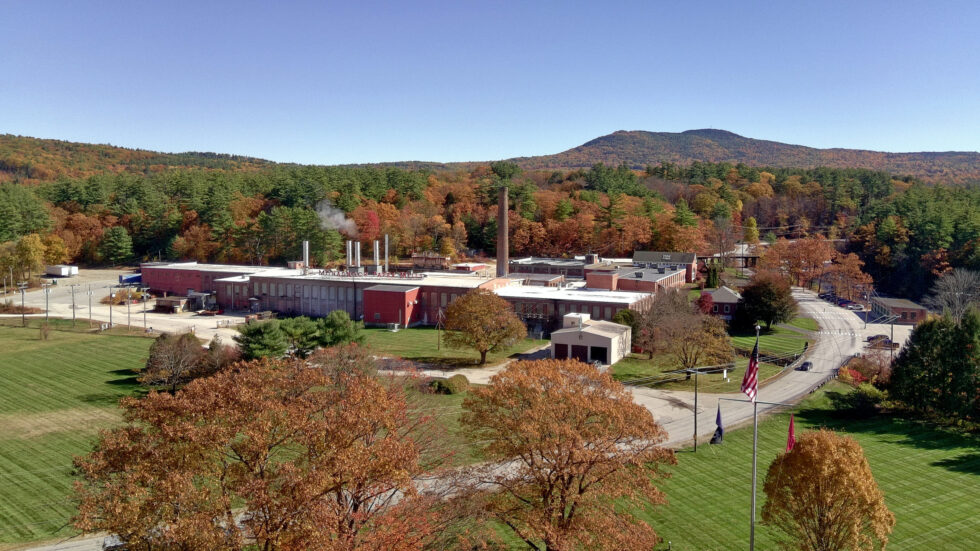
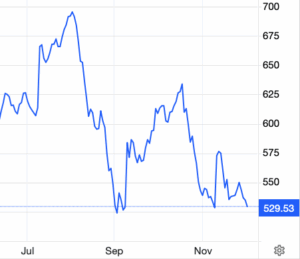 Lumber futures fell toward $530 per thousand board feet, down nearly 10% from November’s peak, as the market contends with pronounced oversupply and lingering weak demand. Mills and distributors continue to carry elevated inventories, a hangover from early 2025 when buyers front-loaded purchases in anticipation of tariffs, leaving the market with a persistent supply overhang. At the same time, US housing starts and building permits remain below last year’s levels, reflecting a prolonged construction slowdown as easing borrowing costs have yet to materialize in higher new building activity and limit near-term consumption of framing lumber. Demand from renovation and new homebuilding also remains subdued, with housing-related wood products consumption estimated to have declined in 2024 and only a modest recovery expected in 2025.
  Prime Minister Carney announced measures to help protect and strengthen the sectors most affected by U.S. tariffs. …The focus of the liquidity initiatives are to reduce bankruptcy or closure risk for leveraged or high-cost lumber mills through initiatives such as the BDC Softwood Lumber Guarantee Program… and enhancing EI worksharing and training grants. The demand support initiatives include working with railway companies to cut freight rates, prioritizing shovel-ready, multiyear projects that use Canadian wood products and creating demand for Canadian Wood products. The structural initiatives include a “forestry concierge” at Natural Resources Canada to help mills navigate loans and programs as well as an industry-led transformation task force to expand, diversify and identify opportunities and support affected communities. …The measures will help the sector but the bigger picture is really about duties and a supply/demand balance that has traditionally been difficult to obtain given this industry’s capital intensity. [to access the full story a Globe & Mail subscription is required]



 Sweden’s Green Business Index declined in the fourth quarter of 2025 as forestry and crop farming weakened, according to data from the Federation of Swedish Farmers. The total index fell to 100.7 from 106.5 in the previous quarter, marking a broad slowdown across several agricultural industries. The forestry subindex recorded the largest fall, dropping by 19 points to 97.6, its lowest level since spring 2020. The decline reflects weaker export demand, lower prices for sawn wood and pulp, and a soft U.S. dollar that reduced export revenues. New tariffs on Swedish wood products to the United States and a slower global economy further limited profitability. LRF reports that sawmills and pulp producers have experienced tightening margins, while forest owners face lower returns and are reducing harvesting activity.
  Japan’s housing starts rose 3.2% year-on-year in October 2025, defying market expectations of a 5.2% decline and reversing a 7.3% fall in September. It was the first annual increase since March, driven by rebounds in rented units (4.2% vs -8.2%), built-for-sale homes (14.8% vs -8.3%), and prefabricated housing (9.2% vs -0.4%). However, weakness persisted in owned homes (-8.2% vs -5.6%), while issued units slumped sharply (-36.3% vs 53.7%) and two-by-four homes also turned negative (-3.8% vs 2.1%). [END]
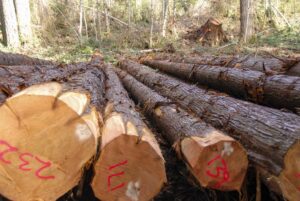
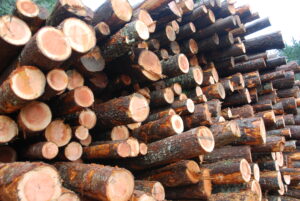 MOSCOW — Russia’s forestry sector could face a deep contraction next year as sanctions tighten, interest rates remain high and the ruble stays strong, Deputy Industry and Trade Minister Mikhail Yurin said Thursday. Addressing a Federation Council committee, Yurin said the industry has entered a “downward trend,” with the worst-case scenario pointing to a 20-30% drop in output in 2026. The ministry expects already falling production to continue declining into 2027 if geopolitical conditions worsen, Interfax quoted Yurin as saying. According to the Economic Development Ministry, wood-processing is among the weakest performers in Russia’s industrial landscape. Output fell 4.3% in the third quarter and the slump accelerated to 7.8% in October. …He said Russian timber exports have fallen by more than 20% since before the war, from $12.5 billion in 2021 to to $9.8 billion. Logging volumes are expected to hit a four-year low of 182 million cubic meters this year.



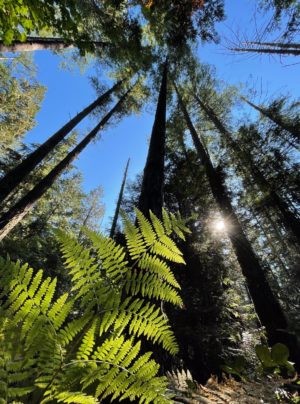 A BC Resource Sector Coalition says current federal and provincial policymaking has become unpredictable enough to justify an immediate pause on all implementation and action under Declaration on the Rights of Indigenous Peoples Act (DRIPA). …“We write to you on behalf of thousands of British Columbians whose livelihoods, communities, and futures are tied to the natural resource sector. Today, those livelihoods are at risk,” the letter begins. “A series of federal and provincial policy decisions have destabilized the industries that sustain our province and are eroding the economic foundations of British Columbia.” …The coalition is composed of a cross-industry membership spanning land and marine activity: BCCA, Geoduck Underwater Harvesters Association, ICBA, Deep Sea Trawlers Association of BC, Guide Outfitters Association of British Columbia, Pacific Prawn Fishermen’s Association, North West Loggers Association, and the Council of Marine Carriers.

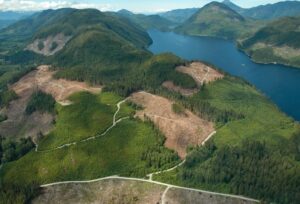 Retired federal wildlife surveyor Erich Reeder… has seen centuries-old forests targeted for destruction as President Donald Trump’s administration accelerates logging on federal lands nationwide. Earlier this year, loggers cleared out most of the forest in Galagher Canyon, part of a federal timber sale an hour south of Eugene, Oregon. …“The Trump administration is ordering the last of our publicly-owned mature and old-growth forests to be cut off and sold,” Reeder, 59, said. …Legal and political battles are heating up between Trump, who is eager to bolster the timber industry as part of his effort to create thousands of jobs and reduce the risk of wildfire, and environmentalists who are keen to protect ancient forests and the endangered wildlife that depend on them. …At least 27 court battles over federal logging and endangered species are unfolding from California to Washington, DC. Seven cases are challenging logging in eastern states.
 The Washington Forest Protection Association (WFPA) announced last week that it would file litigation against Washington state. The lawsuit will challenge a new buffer rule by the Washington State Forest Practices Board. The new rule expands the required no-cut buffers around non-fish-bearing streams in the state, requiring forestland owners to leave more trees uncut. WFPA states that it believes the new rule is a result of the Washington state Department of Ecology “misinterpreting” a federal water temperature standard. The statement added that the financial cost of implementing the rule is so large that it “justifies a judicial review.” The group also painted the creation of the new rule as a break from the state’s tradition of collaboration with other stakeholders. …“The rule overreaches the law, ignores on-the-ground realities, adds costly and unnecessary regulations, and offers little to no benefit for salmon recovery.”
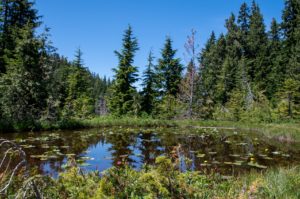 As the US Forest Service considers the future management of the Tongass National Forest, I hope that Alaska’s congressional delegation will listen to what Southeast Alaskans already know: Wild salmon are one of the Tongass’ most valuable resources. If we leave the trees standing and protect the habitat that fish need, the Tongass will continue to generate billions of dollars in natural dividends, in turn supporting thousands of fishing jobs and providing millions of pounds of nutritious seafood year after year. …For decades, Southeast Alaska’s communities and fishermen have fought industrial logging in the Tongass. …The harmful impacts of industrial logging on Southeast Alaska’s salmon watersheds and our natural dividends are not hypothetical. Protecting the Tongass is the most cost-effective way to improve ecosystem productivity and ensure the well-being for all who call Southeast home.
  TROY, Montana — Vincent Logging, a family-owned logging company in Libby is working with Hecla Mining Company to manage its forested lands for wildlife habitat. It’s a 15-hundred acre research project to determine which management techniques provide the best habitat for endangered species. …It’s forest land in the Bull Lake area on Hecla Mining property near Troy. “We’re going to create grizzly bear habitat or enhance existing habitat for the bear,” he said. “Doing so, will enhance habitat for all the other critters that are living in here or that might live in here. We’re also studying it for success or failure at the same time.” Chas said thinning small diameter trees opens the area to create more plants that grizzlies like to eat. Larger diameter trees and thickets are left untouched to create a safe haven for the bears.
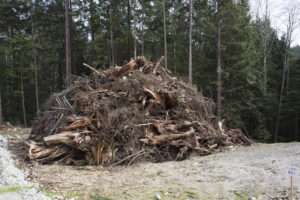 ARIZONA — For the first time in months, Forest Service timber managers last week attended a Natural Resources Working Group meeting on the continuing effort to restore Northern Arizona forests and protect communities including Payson, Show Low, Pinetop and Pine. Local officials and logging operators said they are still searching for ways to handle millions of tons of low-value brush, slash and small trees that crowd the region’s overgrown ponderosa pine forests. The group, formed through the Eastern Arizona Counties Organization, meets regularly with industry representatives and Forest Service staff. …The Four Forest Restoration Initiative (4FRI) completed about 18,000 acres of thinning in the past year. Mass layoffs and the shutdown limited collaboration and fieldwork. …Pascal Berlioux, executive director of the Eastern Arizona Counties Organization, said a major problem was reduced production at the Lignetics plant in Show Low, which normally buys large amounts of biomass for wood-pellet manufacturing.
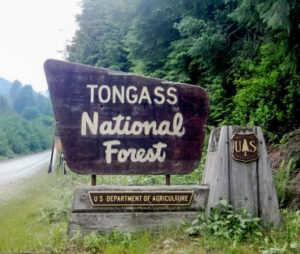 It was no surprise that everyone on the timber panel at this month’s Alaska Resource Development Council conference had the same message: The industry needs a larger supply of trees to cut. And a steady, bankable supply, said Joe Young, of Tok, who started Young’s Timber in Alaska’s Interior more than 30 years ago. …The Nov. 13 industry panel at the annual conference held in Anchorage also talked about demand for their product and the challenges in meeting that demand. Juneau attorney Jim Clark, said the Trump administration’s move to rescind the Roadless Rule, which has been around since 2001, could help open areas of the Tongass National Forest to logging. …The lack of timber sales, financial pressures and opposition from conservation groups have knocked down Alaska timber industry jobs from almost 4,000 in 1990 to about 700 in 2015 and just 360 in 2024, according to Alaska Department of Labor statistics.
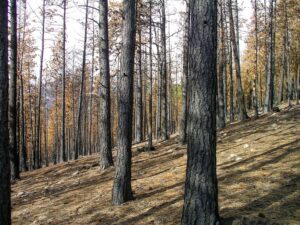 As the American West warms due to climate change, wildfires are increasingly burning in higher-elevation mountains, charring the watersheds where the region’s vital snowpack accumulates. A new study has found that in the immediate aftermath of fires across the region, the snowpack disappears earlier in burned areas. This change can threaten forest health and affect the downstream farms, cities and species that rely on the snowpack for their water, according to other research. Scientists who study the effects of wildfires on the snowpack and streamflows are finding that the story is complex and nuanced. The impacts can vary greatly across the West’s diverse ecosystems and topography. Plus, each wildfire burns differently, so the severity of the blaze is another critical factor. …Published in the Sept. 17 issue of
 The European Parliament has approved measures to simplify the EU Deforestation Regulation adopted in 2023, which aims to ensure that products sold in the EU are not sourced from deforested land, according to the European Parliament. The new position grants companies an additional year to comply with the regulation. Large operators and traders must apply the obligations from 30 December 2026, and micro and small enterprises from 30 June 2027. The extension is designed to support a smooth transition and allow upgrades to the IT system used for electronic due diligence statements. Parliament agreed that the responsibility for submitting due diligence statements should rest with businesses that first place products on the EU market, not with later traders. Micro and small primary operators will now be required to file only a single simplified declaration instead of full due diligence reports.
 TORONTO — Environmental experts are calling out the City of Toronto for not including a what they say is a key climate tool in its five-year climate action plan. The Toronto Environmental Alliance is highlighting the lack of building emission performance standards (BEPS) in the plan. BEPS are regulations that set emission limits for new and existing buildings. How-Sen Chong, TEA’s climate campaigner, such standards are one of the most significant policy tools as they would help the city cut emissions more efficiently. …Bryan Purcell, at the Atmospheric Fund, said, “Buildings are the largest source of GHG emissions in Toronto, accounting for over half of the emissions,” he said. “Reducing emissions from buildings is absolutely key to reaching the city’s climate targets.” …Chong “we’re hoping city council recognizes how important this is because so much of the city’s emissions are coming from the building sector,” he said.
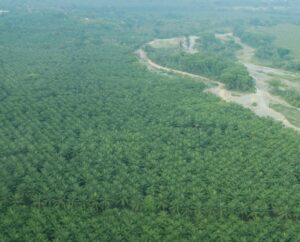 As he officially opened COP30, Brazil’s president, Lula Inacio da Silva said “the world will finally be able to say that it truly knows the reality of the Amazon”. …Last year the biggest cause of forest loss in the Amazon was fires, which were ignited to clear land for agricultural expansion or illegal mining. Despite a pledge made at COP26 in Glasgow in 2021 to halt and reverse deforestation by 2030, another 8.1 million hectares of forest were lost globally last year. Lula called for a consensus on a roadmap to deliver on the Glasgow deforestation promise. …But while more than 90 countries supported a deforestation roadmap, opposition from the likes of Saudi Arabia, Russia and India meant deforestation failed to make it to the final agreement, and COP president Andre Correa do Lago said Brazil would continue to work on developing one over the next year, to present at COP 31 in Turkey.
 BRUSSELS — The European Commission has unveiled a new plan to end the dominance of planet-heating fossil fuels in Europe’s economy — and replace them with trees. The
  Africa’s forests have turned from a carbon sink into a carbon source, according to research that underscores the need for urgent action to save the world’s great natural climate stabilisers. The alarming shift, which has happened since 2010, means all of the planet’s three main rainforest regions – the South American Amazon, south-east Asia and Africa – are now part of the problem. Human activity is the primary cause of the problem. Farmers are clearing more land for food production. Infrastructure projects and mining are exacerbating the loss of vegetation and global heating – caused by the burning of gas, oil and coal – thereby degrading the resilience of ecosystems. …The worst affected were the tropical moist broadleaf forests in Democratic Republic of Congo, Madagascar and parts of west Africa. The study,

 A new
A new  The
The