The Forest Products Association of Canada (FPAC) released a new national research report, titled Canada’s Forest Economy: An Analysis of the National Supply Chain and Community Investment Impact, which underscores the forest sector’s vital contributions to Canada’s economy, rural development, and urban sustainability. Produced with the expertise of iTOTEM Analytics and in partnership with BC Council of Forest Industries (COFI) – the report highlights how 19 leading forest products companies in Canada are sustaining a network of 30,000 vendors spanning approximately 1,595 municipalities nationwide.
Together, these partnerships generated $14.9 billion in supply chain expenditures in 2022 alone, demonstrating a compound annual growth rate of 9.5% since 2020. In alignment with the First Nations Major Projects Coalition Conference Valuing Reconciliation in Global Markets happening this week, the forestry sector is deeply invested in partnering with Indigenous communities across the country and learning more on how reconciliation strengthens both commercial success & project sustainability.
“The forest products sector touches every corner of Canada,” said FPAC President and CEO Derek Nighbor. …Beyond supply chain expenditures, the study also revealed that between 2020 and 2022, the forest sector made $39.2 million in community investments – supporting over 2,000 organizations across 380 communities with funding for health, education, public amenities, and Indigenous initiatives. “As our sector continues to evolve, this research helps shine a light on the outsized and interconnected role that Canada’s forest sector, along with our commitment to growing the economy and building strong partnerships across rural and urban communities alike, plays in Canada’s national economy,” added Nighbor.


 President Trump’s shifting trade policies are creating uncertainty for the Canadian forestry industry. Sean McLaren, CEO of West Fraser Timber, says the potential inflationary effects of tariffs could weigh on future demand. “Looking forward, we see considerable macroeconomic uncertainty, particularly stemming from the US’s evolving tariff policies”. He said the company is planning for multiple scenarios. …RBC’s Matthew McKellar said that the outlook for the paper and forest products industry is highly uncertain when it comes to demand. “All of this uncertainty is bad for business,” said Derek Nighbor, CEO of Forest Products Association of Canada. Nighbor added that any impact on Canadian lumber companies will also affect pulp and paper: “We’ve got all of these downstream industries that depend on those inputs.” …McKellar noted that companies like West Fraser, Interfor and Canfor are geographically diverse, meaning potential softening of demand could be the bigger concern.



 WASHINGTON, DC — The American Kitchen Cabinet Alliance (AKCA) recently submitted formal comments as part of the Section 232 investigation on Timber, Lumber and Derivatives (including cabinets). Unfairly traded cabinet imports many of them sold at prices that are often over 60% below that of the domestic market are flooding into the US. …“American cabinet manufacturing plants cannot compete with foreign countries flooding the market with unfairly traded cabinets which has resulted in an estimated $6.5 billion in lost revenue to the domestic industry over the last five years,” remarked Perry Miller, President of Kountry Wood Products. “Foreign imports primarily from Cambodia, Malaysia, Mexico, Thailand, Vietnam that are heavily subsidized are destroying American cabinet jobs. …“The domestic cabinet industry is on the brink of collapse. “We are asking for a Section 232 tariff of at least 60%, to level the playing field and stop the cheating as we seek to protect over 250,000 American jobs.”
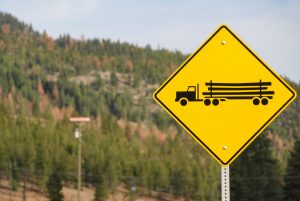 WASHINGTON – The US Commerce Department said on Wednesday it is opening a probe into national security impacts of imports of medium-duty and heavy-duty trucks and related parts into the United States. The “Section 232” investigation could form the basis of grounds to impose new tariffs on work trucks, buses, vans and other larger vehicles. Tariffs would hurt Mexico, as it is the largest exporter of trucks to the US. …Canada and Japan are also large exporters of larger trucks to the US. The Commerce Department is seeking public comment by mid-May on the extent to which domestic production of trucks and truck parts can meet domestic demand. …It also wants comments on the impacts on prices “due to foreign unfair trade practices and state-sponsored overproduction”. …Higher tariffs on commercial vehicles could put pressure on transportation costs.
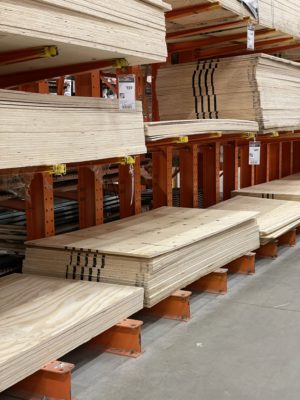 BINGEN, Washington — A plywood mill in the southern Washington city of Bingen will close next month and lay off all 81 workers, the plant’s operator said Thursday. The SDS facility has been operating — with occasional stoppages — since 1949. It uses older equipment, according to Wilkins, Kaiser & Olsen, which was part of a consortium of firms that acquired the mill in 2021. “Regrettably, the long-term challenges and the magnitude of the required investment render continued operation unsustainable,” the mill’s operators said. An adjacent stud mill, planer mill and marine facility will continue operating. Bingen is a small city just across the Columbia River from Hood River. WKO and an affiliated business, Mt. Hood Forest Products, are adding 60 full-time positions to increase their output by 35%. The firms said they will consider hiring some of the laid-off workers.
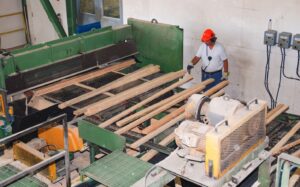 SALEM, Oregon — The Oregon Senate on Monday passed a bill to establish a lumber-grading pilot training pilot program. “This bill opens the door for small sawmill operators to participate in local housing solutions,” said Sen. Todd Nash, R-Enterprise, the bill’s sponsor. “Forty years ago, Eastern Oregon had 69 mills. Today, only seven remain. This is a practical step to support rural economies and increase housing options using locally sourced materials.” Senate Bill 1061, otherwise known as the Oregon Forests to Homes Act, would operate through Oregon State University’s Extension Service, in partnership with the Department of Consumer and Business Services. …Once certified as a grader, a mill owner could sell his lumber directly to a builder. Certified small sawmill operators will be able to sell lumber directly to homeowners or their agents for use in single-family homes or duplexes.



 NEW YORK, NY — Mercer International reported first quarter 2025 Operating EBITDA of $47.1 million, a decrease from $63.6 million in the same quarter of 2024 and $99.2 million in the fourth quarter of 2024. In the first quarter of 2025, net loss was $22.3 million compared to $16.7 million in the first quarter of 2024 and net income of $16.7 million in the fourth quarter of 2024. Mr. Juan Carlos Bueno, Chief Executive Officer, stated: “There was continued strength in pulp markets and an improving lumber pricing environment in the first quarter of 2025. However, our operating results in the quarter were negatively impacted by annual planned maintenance downtime at our Celgar mill and the impact of the weaker dollar against the euro.
 Statistics Canada says the Canadian economy shrunk in the month of February, but declines might not last long, as early signs for March point to moderate GDP growth. The agency says real gross domestic product decreased 0.2% in February. This follows previous growth in the month of January of 0.4% overall. While goods-producing industries pulled the economy up in January, Statistics Canada says it saw a decline of 0.6% overall for February. …Statistics Canada says 12 of the country’s 20 industrial sectors saw declines in February. But the manufacturing sector bucked the trend — that industry saw a 0.6% rise in February. …Advanced information from Statistics Canada indicates that real GDP increased by 0.1 per cent last month. The agency says the annualized growth rate for the first quarter of 2025 based on the March flash estimate is 1.5 per cent.
 Risks are high that the global economy will slip into recession this year, according to a majority of economists in a Reuters poll, in which scores said US President Donald Trump’s tariffs have damaged business sentiment. Just three months ago, the same group of economists covering nearly 50 economies had expected the global economy to grow at a strong, steady clip. …While Trump has suspended the heaviest tariffs imposed on almost all trading partners for a few months, a 10% blanket duty remains, as well as a 145% tariff on China, the United States’ largest trading partner. …Showing unusual unanimity… three-quarters of economists cut their 2025 global growth forecast, bringing the median to 2.7% from 3.0% in a January poll. …China and Russia were forecast to grow 4.5% and 1.7% respectively, outperforming the US. However, growth forecasts for Mexico and Canada were downgraded from January by some of the largest margins, to 0.2% and 1.2%.
 Gross domestic product (GDP) contracted in the first quarter by 0.3%, with imported goods being a large contributor to the decline as the suppliers prepared for President Trump’s tariff proposals once he took office. NAHB estimates this should even out in the second quarter. Other economic data of note are inflation, which is still elevated but creeping downward, and the unemployment rate, which remains low but may edge up among economic uncertainty. …NAHB Chief Economist Robert Dietz hasn’t hit the panic button yet. And I still think that we don’t know what President Trump’s economy really is yet. It’s been policy by sledgehammer, and now they’re going to start putting the pieces back together.” NAHB Senior Officers and staff continue to actively engage with lawmakers on this and other policies, including a special BUILD-PAC Capital Club event this week featuring an interview with Sen. Tim Sheehy.
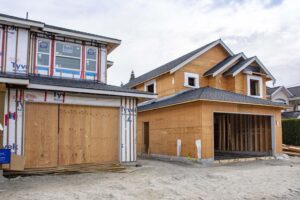 Tuesday marked the 100th day of President Trump’s second term in office and there are signs of stress and jitters in the US construction industry, with rising prices, falling confidence, and a sharp uptick in abandoned projects. “Lumber and metals prices shot up in March, while contractors’ inboxes are bulging with ‘Dear Valued Customer’ letters announcing further increases for many products,” said Ken Simonson, chief economist at AGC. “Rapid-fire changes in tariffs threaten to drive prices higher for many essential construction goods,” he added. The price of materials and services used in nonresidential construction rose 0.4% in March, the third monthly increase in a row, AGC said. It was the first time since September 2023 that input prices had risen for three consecutive months, and comes after more than a year of stable or falling prices, Simonson said. …Within the 0.4% hike, lumber and plywood rose 2.7%.
 To kick off National Home Remodeling Month in May, which promotes the benefits of hiring a professional remodeler, the National Association of Home Builders (NAHB) has highlighted
 The US economy contracted in the first three months of 2025 on an import surge at the start of President Trump’s second term in office as he wages a potentially costly trade war. Gross domestic product fell at a 0.3% annualized pace, according to a Commerce Department report adjusted for seasonal factors and inflation. This was the first quarter of negative growth since Q1 of 2022. Economists had been looking for a gain of 0.4% after GDP rose by 2.4% in the fourth quarter of 2024. However, over the past day or so some Wall Street economists changed their outlook to negative growth, largely because of an unexpected rise in imports as companies and consumers sought to get ahead of the Trump tariffs implemented in early April. …The more telling number for the future of the expansion was consumer spending, and it grew, but at a relatively weak pace,” said Robert Frick.

 The clock is ticking on trade deals that the US will need to strike with many nations, most notably China, to avoid what Trump’s Treasury Secretary has described as an “unsustainable” tariffs war. But in the U.S. farming sector, the damage has already been done and the economic crisis already begun. US agriculture exporters say the global backlash to President Trump’s tariffs is punishing them, especially a decline in Chinese buying of US farm products, leading to cancelled export orders and layoffs. Peter Friedmann, of the Agriculture Transportation Coalition …says “massive” financial losses are already being shared by its members. …A wood pulp and paperboard exporter reported to the trade group the immediate cancellation or hold of 6,400 metric tons in a warehouse and a hold of 15 railcars sitting in what is known in the supply chain as “demurrage,” when fees are charged for delayed movement of goods.



 UK — Housing starts in the UK have lagged behind completions for the sixth successive quarter, including to the latest official data. Around 32,000 homes were started in the last quarter of 2024, compared to just over 49,000 completed during the same period, according to the Office for National Statistics. The number of starts is down from 37,000 in the preceding quarter and well below the average of 42,000 homes which have been started per quarter since the ONS resumed gathering the data after the pandemic in April 2022. Completions have remained more stable, rising in the last quarter of 2024 from 41,500 in the third quarter, with an average of just over 49,000 completions a year since the pandemic. Pocket Living chief executive Paul Rickard said: “By any measure these are a disappointing set of figures and continue to highlight the massive challenge the government has.”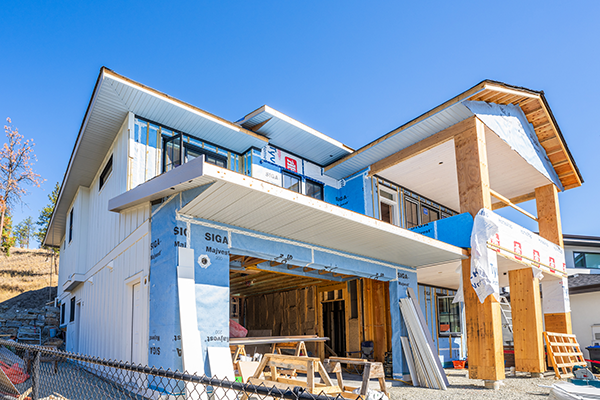


 May is Invasive Species Action Month and 33 organizations throughout BC will be able to continue their work fighting invasive plants, due in part to a funding boost. …Ravi Parmar, Minister of Forests said “No one person, group, agency or government can effectively control invasive plant species alone, and collaboration is critical to everyone’s success. The work these groups do is crucial in our fight to ensure BC’s environments remain healthy and vibrant.” …Nearly $3 million will go toward groups, such as regional invasive species committees, local governments, environmental groups, researchers and the Invasive Species Council of BC, to continue collaboration and support of invasive plant programs and management actions. …Gail Wallin, executive director, Invasive Species Council of British Columbia said, “Invasive plants are estimated to cost us over $2 billion in losses annually.”


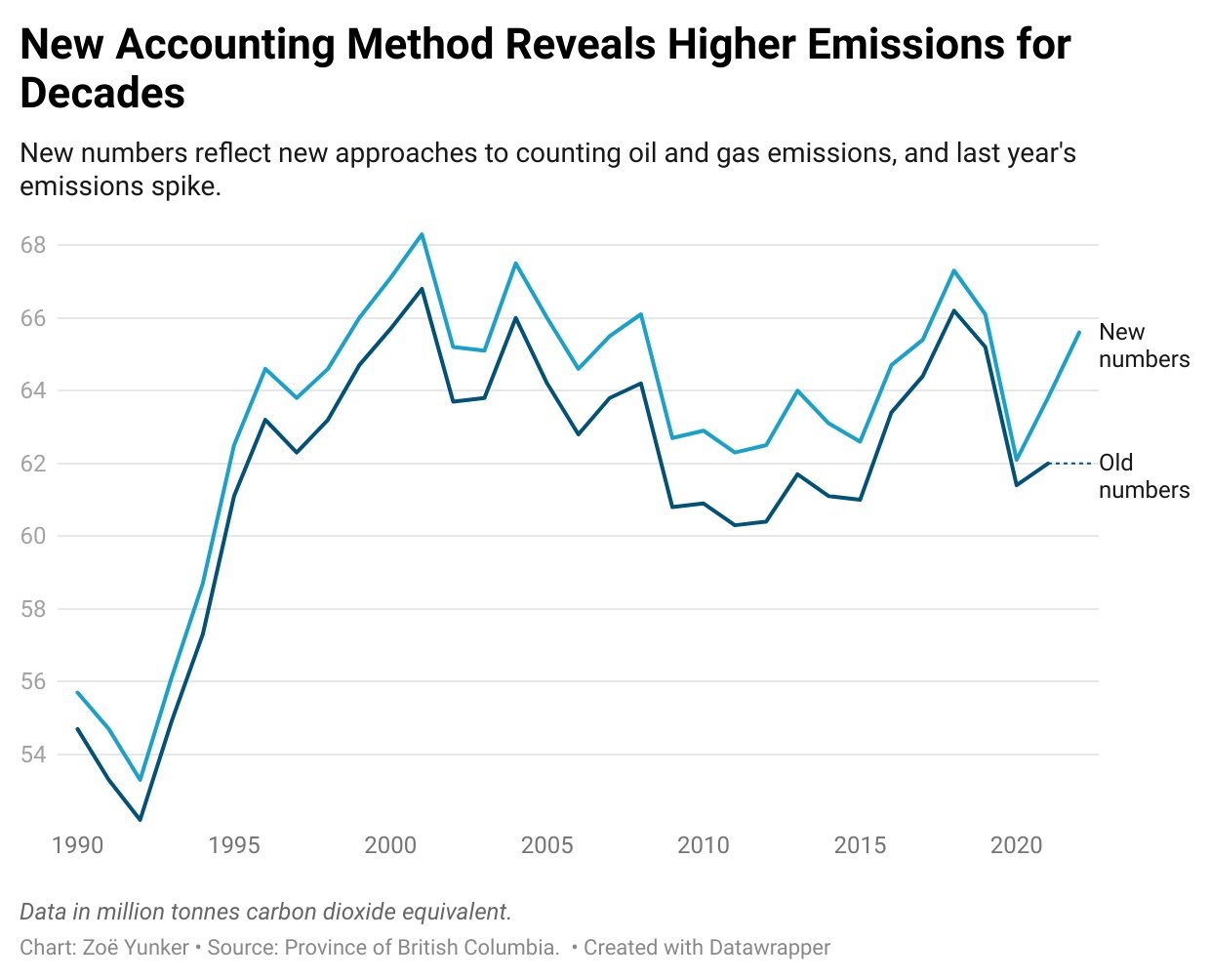
 The BC government says it will only meet half of its 2030 target to lower greenhouse gas emissions. In an annual
 The Sustainable Biomass Program (SPB) published its Annual Review 2024, capturing a year of growth, strategic progress, and continued delivery as the biomass certification scheme of choice. With 2024 marking the second year of its current three-year strategy, SBP has consolidated its position in a rapidly evolving sustainability landscape, while laying firm foundations for the years ahead. “2024 outcomes reflect a busy and productive year for SBP. We saw significant growth in certified biomass volumes and certificate holder numbers, but equally important we took proactive steps to define our contribution to global challenges, from carbon and climate to regulatory compliance and sustainability governance. With growth comes an increased responsibility to ensure that assurance and oversight of compliance are rigorously maintained,”stated Carsten Huljus, CEO of SBP.
 Firefighters from Fort St. John and the B.C. Wildfire Service were battling a blaze that prompted evacuations late Thursday, the city said. The fire is in the Fish Creek Community Forest on the northern outskirts of the city. …The wildfire service website indicates the out-of-control blaze was discovered Thursday and spanned an estimated 0.56 square kilometres — about four times the size of Granville Island in Vancouver — as of 7:32 p.m. The suspected cause of the fire is human activity. The fire is one of nearly two dozen active across BC on Thursday, as the provincial government warned that a combination of warm, dry conditions and strong winds would raise the fire risk in southern parts of B.C. It’s one of two blazes classified as burning out of control, the other being a 1.85-square-kilometre blaze that began as two separate fires about 30 kilometres southwest of Dawson Creek, which is south of Fort St. John.
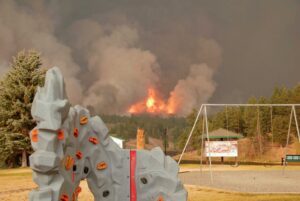 A New Jersey teenager is being charged with arson following a