 Canada’s ambassador to the US says Canada is ready to buy more from the US, but will retaliate if tariffs are imposed. In related news: former prime minister Harper has a problem with Trump’s rhetoric; Premier Eby says BC is prepared; and team Trump considers gradual tariff hikes. In other Business news: recent innovations in pulp and paper; Tolko appoints Rhys Thompson VP Sales, Marketing & Logistics; and the University of New Brunswick’s John Kershaw is honoured.
In Forestry news: Parks Canada and Alberta work to reduce wildfire risk; BC announces wildfire resiliency summit; why it matters that Oregon lost its Chief Forester; Washington state protects private forest land; and Shell and Microsoft are big buyers of carbon credits. In Wildfire news: high winds return and threaten California; why some houses burn while others survive; and the pros and cons of saltwater and chemical fire retardants.
Finally, nominations are open for BC Forest Safety Council Awards, and the TLA Convention kicks-off tomorrow.
Kelly McCloskey, Editor, Tree Frog News


 GATINEAU, QUE. — An agreement has been reached between the Competition Bureau and Rona Inc. in relation to concerns about the company’s proposed acquisition of

 New Westminster, BC — The Canadian Mill Services Association (CMSA) is announcing that it has completed a purchase agreement with the BC Council of Forest Industries (COFI) to acquire the COFI Quality Control (QC) operations and to merge them into CMSA. This has involved the transfer of the rights and trademarks to use the COFI grade stamps, and the Interior Lumber Manufacturers’ (ILMA) grade stamps as well as the transfer of the quality control employees from COFI to CMSA. As of December 31, 2024 COFI ceases to offer QC services and the former COFI customers who were using these services are encouraged to join CMSA as active Members. With completion of the merger, CMSA will now provide all the necessary Quality Control Services including Educational Training and Support to its active members. CMSA shall continue to be members of the NLGA, CLSAB and ALSC and will continue to represent its members with the Canadian Wood Council.
 After a dismal 2023 and 2024 in lumber markets in both demand and prices, it can only get better in 2025, right? Well, that depends. …The outlook for 2025 needs to incorporate several variables:
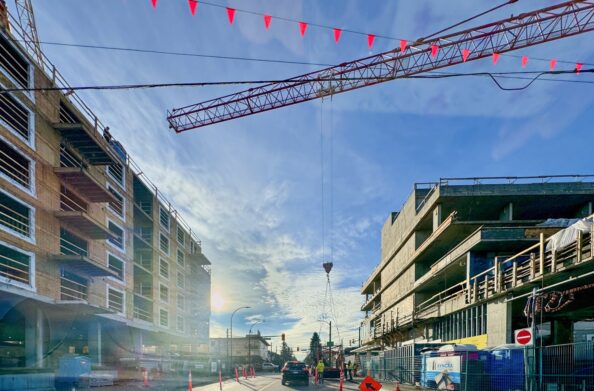 It would be easy to quote the price per square foot for concrete home construction vis-à-vis the price per square foot for the same size wooden house. But direct comparisons like that fail to capture the complexity and nuance of these choices. That is because the building and maintenance costs are woven together with the sustainability, durability and longevity of the materials involved in the construction process. …In this article, we will explore these respective approaches, with special attention to cost, sustainability, maintenance, durability and time to build. The U.S. Department of Housing calculates that for the construction of a 2,500-square-foot house, the price difference between concrete and wood would be around $7,000. …At first glance, timber frame construction should easily be the most sustainable. After all, we are dealing with a natural, renewable product. However, there are several parts to the comparative puzzle.
 Are you looking to enhance your skills in the lumber and sawmill sector? Onboarding new employees that would benefit from formal education in the field? Are you seeking to provide your employees with essential business skills for professional development? BCIT is currently offering two Associate Certificates to help you: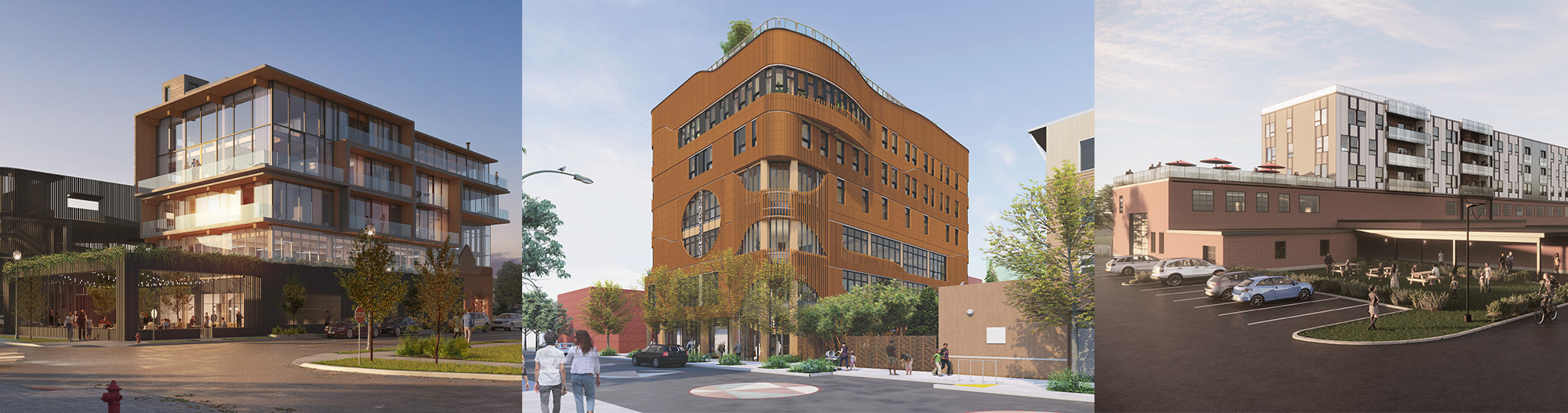

 On April 12-16, more than 700 firefighting professionals, FireSmart experts and Indigenous, municipal and community leaders will gather in Penticton for the 2025 Wildfire Resiliency and Training Summit. There, they’ll share lessons learned from 2024, along with the latest research, technologies, best practices and other information to help regions and communities prepare for the upcoming wildfire season. You’ll want to register fast before this conference sells out! The theme for this year’s Summit is Living with Fire: Building resilience by bringing fire back to the land, strengthening relationships, and investing in collective well-being. The Summit will kick off with two days of training for firefighting professionals, followed by a three-day conference featuring keynote addresses, expert panels, and networking opportunities. Whether you’re a firefighter, community leader, or industry professional, this event is your chance to connect with like-minded individuals, learn from experts, and contribute to a safer, more resilient future for British Columbia.
 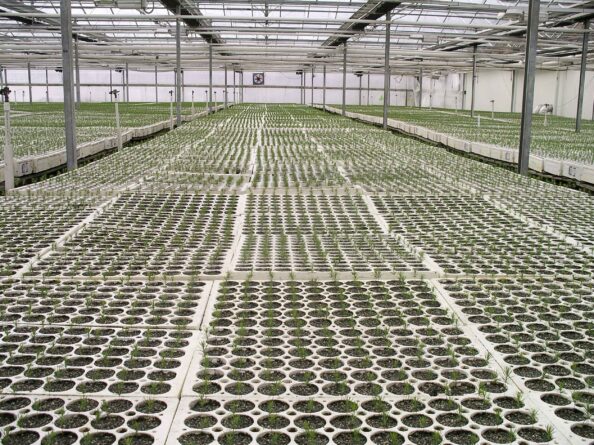 The provincial government expects to plant nearly 50 million fewer trees this year — a 17 per cent drop from last year’s planting season at a time when the province has seen a major spike in wildfire activity. The projections come from presentation slides shown to the industry in September. …the government expects the number of trees planted to sink to 233 million in 2025, 47 million fewer than were planted in 2024. …About half of the anticipated drop in 2025 is due to declines in trees planted by logging companies. Drops are also expected in government programs designed to combat climate change, restore forest carbon stocks, and plant trees in the wake of wildfires, data show. The 2023 wildfires also prevented many replanting projects from occurring that year, and delays due to the time it takes to grow enough seedlings mean replanting won’t take place until 2026 and 2027, according to the ministry spokesperson.
 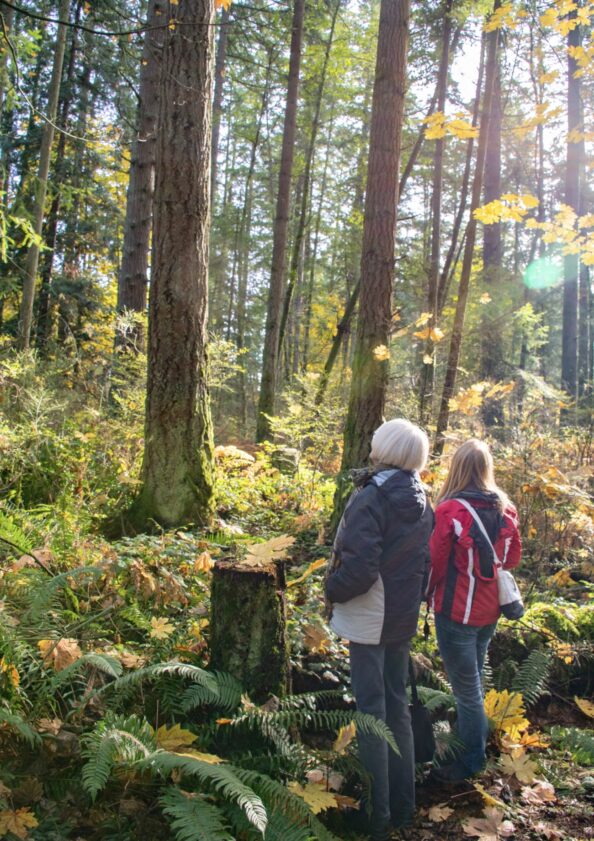 The Kaska Dena people, who for thousands of years have lived on a vast swath of intact wilderness in northern B.C. on the Yukon border… They want to ensure it remains undeveloped… So the Kaska have come up with a plan for the province to protect an area, called the Dene K’éh Kusān — 40,000 square kilometres, an area larger than Vancouver Island, of land and water. …It would also boost B.C.’s pledge to protect 30 per cent of land and 30 per cent of water by 2030, say conservation experts. …With only five years to go, and just about 16 per cent of land protected in B.C. so far, the province must double its efforts if it intends to reach those ambitious targets…Randene Neill, B.C.’s minister of Water, Land and Resource Stewardship said that she’s aware that some areas reported as conservation measures aren’t meeting their originally intended objectives.
  …British Columbia’s forests are … a foundation of the province’s identity and a bedrock of its economy. Both past and present, the industry has been one of the province’s largest employers, providing tens of thousands of well-paying jobs, particularly in rural and Indigenous communities where opportunities can be scarce. These jobs are vital for maintaining economic stability in smaller towns, where forestry often serves as the main driver of local economies. …By managing forests, BC can enhance their role as carbon sinks, reducing greenhouse gas emissions and mitigating climate-driven concerns such as wildfires. …Concurrently, BC’s forestry practices need to keep pace with evolving environmental and social expectations. …Global markets and decision-makers are increasingly demanding environmentally responsible products and wood clearly delivers those needs. However, two things need to happen. First, a clear, cohesive strategy is needed to ensure we do not fall behind international competitors. Secondly, you actually have to cut a tree down.
 As wildfires continue to burn out of control across Los Angeles, questions have turned to why and how California authorities allowed the perfect conditions — extremely dry, uncleared forests, hillsides and brush — to proliferate during an already dangerous fire season made worse by a Santa Ana wind event that hits the area with relative frequency. Well before those dangerous conditions sparked the massive blazes… this week, the region was already a tinderbox due, in part, to a lack of prescribed fires. …The reason California hasn’t conducted more controlled burnings comes down to existing environmental laws in the U.S. that have posed bureaucratic obstacles to prescribed fires. It often takes years for proposals to go through reviews before any controlled burning can take place. …Lawmakers have introduced legislation that would allow for more controlled burning, but because no laws have been passed, environmental red tape has continued to present challenges to proactive fire management.
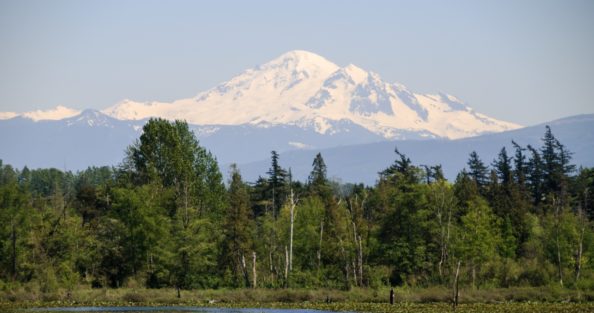 PORT ANGELES — The committee of commissioners representing five encumbered counties, including Clallam and Jefferson, have arrived at a recommendation for how timber revenue from replacement lands should be distributed between the counties. The ratio agreed upon by the committee, known as the impact share method, will distribute funds based on how many encumbered acres each county has when compared to the total number of acres encumbered between the five counties. The Washington State Association of Counties (WSAC) will vote on the recommendation at its Feb. 5 meeting, Clallam County Commissioner Mark Ozias said. Encumbered counties are those which have substantial portions of their state trust land set aside for protection of endangered species such as marbled murrelets and northern spotted owls.

 Global deforestation rates have declined, but forests remain under significant pressure. Rising demands for forest products and climate-related challenges have led to calls for better conservation measures. The European Union had 160 million hectares of forest in 2022, covering 39 per cent of its land, an increase of 8.3 million hectares since 2000. The largest forest areas are in Sweden, Finland, and Spain. According to the European Environment Agency (EEA), the EU’s average forest connectivity, a crucial indicator for supporting biodiversity, was 80.6 per cent in 2021, a slight decline of 0.8 per cent compared to 2018. Larger forest areas, such as those in Slovenia, Romania, Finland, and Sweden, contribute significantly to higher connectivity, while smaller fragmented forests rely on forest strips to maintain connectivity. …Initiatives such as the Nature Restoration regulation, forest and biodiversity strategies for 2030, and a pledge to plant three billion trees by 2030, aim to enhance connectivity.
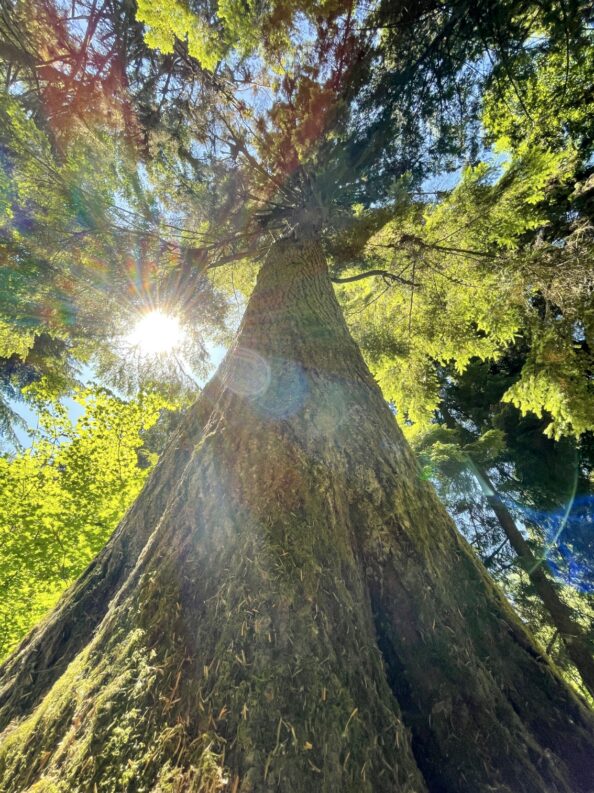 A new study indicates that over the past 10 years, the Nanaimo region has gained more winter days above 0 C than anywhere else in Canada. The study comes from Climate Central, a non-profit based in New Jersey… The
 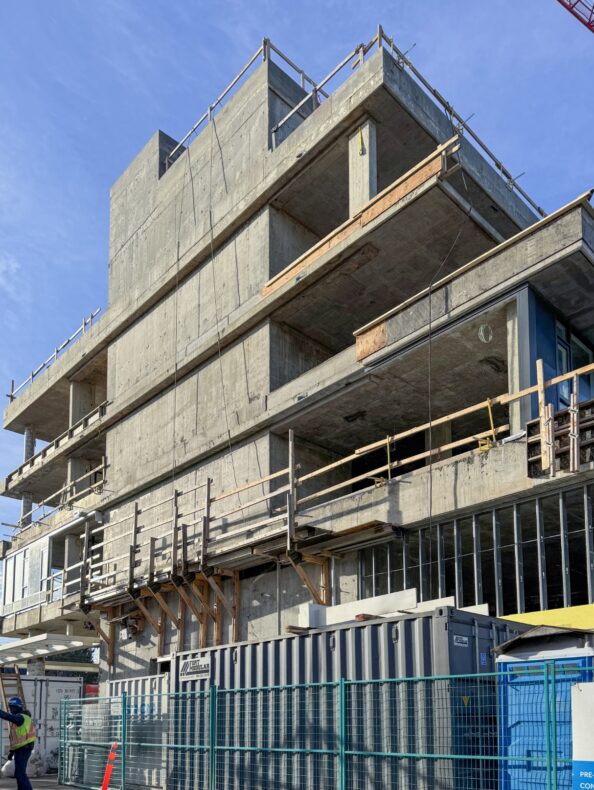 A new study by US researchers in Science shows using new, CO2-capturing concrete and other substances instead of traditional building materials could reduce global carbon dioxide emissions by more than 16 billion tonnes. …Alternatives suggested include mixing carbon-sucking substances from the earth, such as dunite, with concrete, using wood-based materials in bricks, and swapping out asphalt bitumen for bio-oil. Experts believe New Zealand has the right raw materials – such as dunite and wood – to switch out its building materials that store CO2. …Diego Elustondo of the Crown-owned wood science company Scion said the premise of the paper was promising but it appeared to favour storing carbon in masonry materials at the expense of wood-based alternatives. He said the comparison should have considered wood-based materials which were at the same stage of development as other future materials mentioned in the paper.
 At its November 2024 meeting, WorkSafeBC’s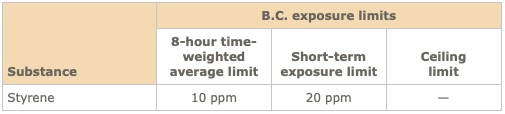
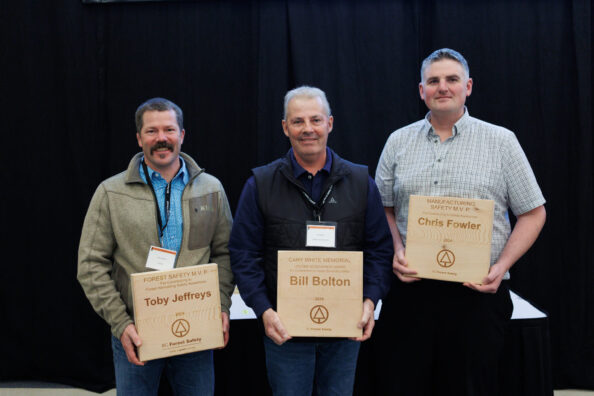 The BC Forest Safety Council celebrated Leadership in Forestry Safety with the 2024 Leadership in Safety Awards at the Vancouver Island Safety Conference on Saturday, October 26th. The 2024 Leadership in Safety Awards were presented by BCFSC’s CEO, Rob Moonen. These awards honour the exceptional contributions to safety in the forestry industry and recognize individuals, crews, and companies that have made significant strides in workplace safety, reinforcing the goal of ensuring every worker returns home safely. This year, three outstanding individuals were celebrated: Bill Bolton, former Falling Manager and senior advisor for the BCFSC received the 2024 Cary White Memorial Lifetime Achievement Award for his unwavering advocacy for faller safety. …Toby Jeffreys, Area Supervisor at Interfor’s Adams Lake Division, was awarded the Forest Safety MVP Award. And Chris Fowler, Safety Coordinator at Canoe Forest Products (CFP), a division of the Gorman Group, received the MVP Award for Wood Products Manufacturing.
 Alberta will join other Canadian provinces helping battle raging wildfires in Los Angeles, the largest in the California city’s history. The province announced Thursday it’s preparing to deploy an incident command team and additional wildfire-fighting resources to support California, including water bombers and night-vision helicopters. Thousands of firefighters have been battling roaring flames that have left neighbourhoods in ruin and burned thousands of structures, while killing at least five people. “Good neighbours are always there for each other in times of need, and we will assist our American friends in any way they need during this crisis,” Premier Danielle Smith wrote on X. …In fighting the Palisades fire, the Los Angeles water system “buckled” under the demand, as some hydrants ran dry, hindering firefighting efforts. According to the Los Angeles Times, more than 2,000 structures have burned and at least 130,000 residents are under evacuation orders due to the wildfires.
 OTTAWA – Emergency Preparedness Minister Harjit Sajjan says dozens of firefighters from Alberta and British Columbia will help fight wildfires in California, and the federal government is co-ordinating efforts with the provinces to deploy resources. Sajjan says in a social media post that 60 firefighters from the two provinces will be deployed as soon as Monday, and that Canadian officials are working to identify and prepare more resources to send in the days ahead. He says in the post that, “Our American friends have asked for help to fight the wildfires in California and Team Canada is responding,” and he concludes with, “Neighbours helping neighbours.” A spokeswoman for Sajjan confirms in an email that Canada has received and approved an official request for help. Alberta announced last week that it is sending up to 40 wildland firefighters with more personnel, waterbombers and contracted night-vision helicopters ready to deploy.