 US Forest Service chief Randy Moore announced his retirement with concern for fired employees. In related news: the firings decimate an already understaffed agency; Western states scramble to prepare for wildfire season; and the hiring-freeze endangers spotted owl protections. Meanwhile: Brussels confirms U-turn on EU green laws; columnist Terence Corcoran says shift is the new normal; and forestry CEO Ken Kalesnikoff says we’ve done a poor job of telling our story.
In tariff news: the White House says tariffs are coming but there’s still room to negotiate; a Montana professor points to local downsides; and an Ontario logger says Canada is missing the point. Meanwhile: an Alberta appeal panel upholds West Fraser Mills safety action; and Stella-Jones reports positive Q4, 2024 earnings.
Finally, BC is Burning documentary looks at the devastation caused by wildfires.
Kelly McCloskey, Tree Frog News


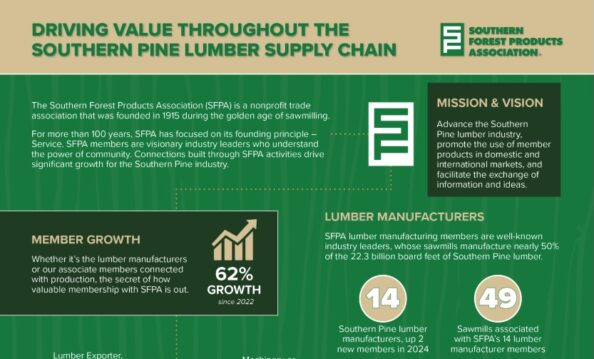 The Southern Forest Products Association believes strong partnerships are essential for sustaining growth and success. That starts with our most valuable partnership — our members. Their commitment is the driving force behind our success. The 2024 SFPA Value Report recaps the association’s: International market development and success in driving demand for Southern Pine lumber exports; A new, consolidated website; Digital promotion efforts; Membership growth; and Industry collaboration.
 TUPPER LAKE, N.Y. — Immigrations and Customs Enforcement conducted a raid Feb. 18 at Tupper Lake Pine Mill in New York state and detained nine employees. In a statement …the parent company of the mill, The Matra Group, said that the employees were authorized to work in the U.S. …“Nine employees were detained, all of whom were, to our knowledge, authorized to work in the United States, as we verify all employees through the I-9 process,” Nicholas Drouin, Matra co-president and director of manufacturing said. All U.S. employers must follow that process to verify workers’ identities and employment eligibility. …The mill — formerly known as the Tupper Lake Hardwoods Inc. — is owned by the Quebec-based Matra Group, a lumber harvesting and distribution company.
  President Donald Trump “thrives on unpredictability”, said Lawrence Yun, chief economist for the National Association of REALTORS. In the last 30 days alone, multiple tariffs by Trump have been announced, imposed, called off and hotly debated. Now, the tariffs are beginning to take shape. And homebuilders are wary. …The real outcry, though, regards lumber. Roughly 30% of the lumber used in the United States last year was imported – more than 85% from Canada. …the housing industry is sharing concerns. Shortly after Trump’s inauguration, the NAHB applauded his day-one executive order that urged government agencies to take action to lower housing costs and expand supply. But NAHB chairman Carl Harris said raising tariffs will have the opposite effect. …“Tariffs on lumber and other building materials increase the cost of construction and discourage new development, and consumers end up paying for the tariffs in the form of higher home prices,” Harris said in a press release.
 Recently there has been discussion about upcoming forest harvesting plans on Tree Farm Licence 47 on Quadra Island. This area is within the unceded and core territory of the We Wai Kai Nation, who approves all forest management activities on the TFL. The Nation and Mosaic Forest Management have worked closely to develop a constructive relationship based on the recognition that as title holder, We Wai Kai has the right to ensure that resources on Quadra Island are being managed consistent with their conservation values and their right to benefit economically from resource extraction on their title lands. The Nation’s logging company, Way Key, is conducting all harvesting on the TFL on Quadra. Both We Wai Kai and Mosaic recognize there is interest in future harvesting activities. We also know that Islanders want a map that identifies where the old growth is (as part of a spatially explicit strategy) before harvesting occurs.
  YELLOWKNIFE, NT
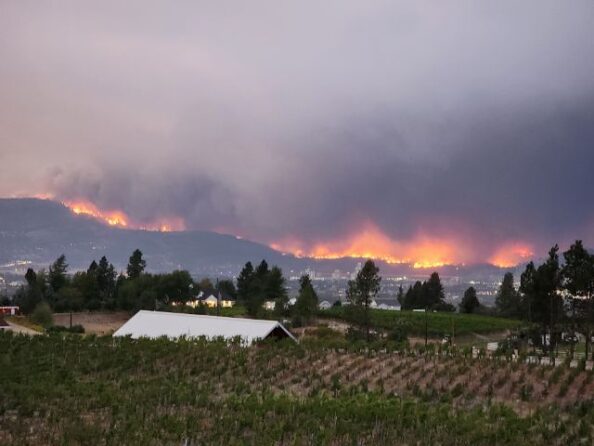 Kelowna, B.C. – A new documentary, B.C. is Burning, is tackling British Columbia’s wildfire crisis by exploring forest management solutions. The project was sparked in 2024 when Kelowna entrepreneur Rick Maddison, who lost his home in the 2003 Okanagan Mountain Park wildfire, came across an article by retired forester Murray Wilson about wildfire prevention. The two teamed up to create a film focused on solutions rather than devastation. “I’m hoping if these ideas in the film are adopted, more communities can be protected from this ongoing threat,” says Maddison. …The documentary features interviews with leading experts, including scientists, carbon specialists, and forestry professionals, providing a comprehensive look at the problem and potential solutions. “We’ve spoken with some of the leading people in the field,” says Wilson. “Their insights could change how we manage our forests—and how we protect our communities.” The team is hoping to raise $45,000 to finish production and distribution of their film.
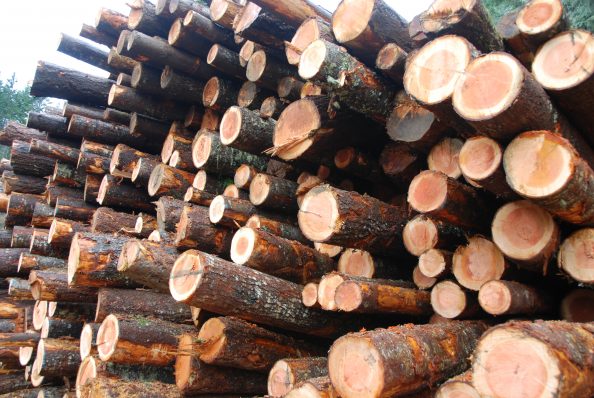 In 2019, the residents of Glade, B.C., learned they had no right to clean drinking water, after members of the Kootenay community waged a legal battle against forestry companies logging in their watershed. A judge sided with the timber companies, arguing that their economic interests outweighed the community’s concerns about its water supply. A similar story has emerged in Wynndel, B.C. — another town in the drought-stricken region — as residents worry about planned logging in their watershed, Duck Creek. Here, in the Kootenays, logging on both private and Crown land is pretty widespread. One resident told reporter Steph Kwetásel’wet Wood that forestry in the area has gotten out of hand, and lack of management on sustainable practices has turned the practice into “corporate slaughter.” …about five per cent (or 4.5 million hectares) of B.C.’s forests are privately owned, which means that the public has little insight, and even less say, into what happens.
 Each spring, the U.S. Forest Service hires dozens of seasonal biologists to venture into remote Northwest forests on federal land and set up acoustic recorders to monitor for sounds indicating the presence of northern spotted owls, a threatened species. There are only as many as 5,000 northern spotted owls left in the Northwest… The counting is crucial for preventing the owls’ extinction. But President Donald Trump ordered a hiring freeze that means the Forest Service cannot hire more than 40 seasonal scientists to count the owls, according to Taal Levi, an associate professor at Oregon State University who works on owl monitoring. The monitoring typically involves about 60 scientists working from central California to Canada, Levi said. It also means the agency will likely go without dozens more scientists needed to monitor threatened and endangered salmon, frogs and other fragile species….
 When U.S. President Donald Trump was elected, Canadian officials issued a weaker than expected 2035 emission reduction target to account for the new political reality. Energy and Natural Resources Minister Jonathan Wilkinson said in an interview that after the U.S. election, the government looked at the opportunities and weighed the risks. Competitiveness was top of mind, more so than tariff threat, he said. “Certainly the United States does factor into the competitiveness issue,” he said. “Clearly the United States is moving away from any kind of regulation relating to climate.” …Wilkinson’s comments are the clearest indication yet of American influence on Canada’s plan to navigate the unfolding energy transition away from fossil fuels and toward clean energy. …Caroline Brouillette, executive director of Climate Action Network Canada, characterized Canada’s “weak” target as “obeying in advance” to U.S. interests.
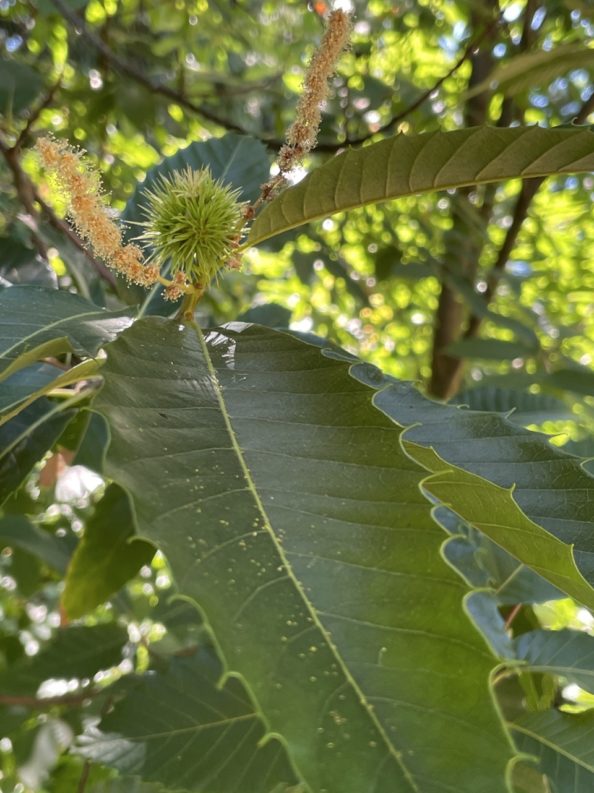 NEW YORK — Chestnut Carbon, a leading developer of nature-based carbon removal solutions, announced today that they have completed the first issuance and sale of Improved Forest Management (IFM) credits sourced from their conservation membership program branded as Forest Carbon Works. The issuance of more than 64,000 credits, or tons of carbon removal, were sold to multiple corporate buyers, including JPMorganChase. These transactions totaled $2.2 million. Chestnut’s U.S.-based IFM membership program, Forest Carbon Works, provides an opportunity for private forest owners to access income-generating carbon markets while preserving the integrity and legacy of their land. The program includes landowners in 36 states with more than 150,000 acres enrolled as of February 2025. These carbon removal credits are certified through Verra on the voluntary carbon market (VCM) and undergo rigorous third-party audits.
 Turkey is poor in oil and gas while its renewable energy sector is heavily reliant on a mix of hydro, wind and solar. But another element is heating up: biofuel – fuel derived directly from biomass, such as wood or plant matter – is gaining interest domestically and creating an export market not available to other renewables. Demand for and output of biomass pellets used in stoves, furnaces and heaters as an alternative to coal or wood to cope with Turkey’s often freezing winters have increased in recent years. Produced by crushing and compressing wood waste, the pellets have a higher per-kilo energy output than gas, coal or oil, and far lower emission levels, according to promoters. Studies estimate Turkey has the raw material to produce up to 1.8 million tonnes of pellets annually, although installed processing capacity has yet to reach this level.
 In December 2024, Drax and Pathway Energy announced a multiyear deal that could see Drax supplying upward of 1 million metric tons of wood pellets to Pathway’s currently proposed sustainable aviation fuel (SAF) plant on the U.S. Gulf Coast. In the months leading up to the announcement, Drax had hinted at such prospects, indicating plans to develop a pipeline of biomass sales opportunities in North America, including in the SAF market. Drax CEO Will Gardiner confirmed as much during a November quarterly earnings call. Currently, Drax has 17 operational wood pellet production plants across North America and a 450,000-metric-ton facility under construction in Longview, Washington. While Drax is well known in the industrial wood pellet industry, Pathway Energy is a new and unique market participant. Pellet Mill Magazine interviewed Pathway Energy CEO Steve Roberts to introduce the company, technology and plans.
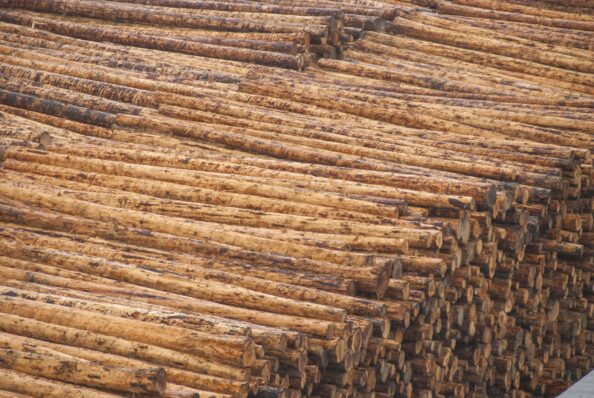 Norwegian forestry companies are making history by revolutionizing how timber is transported. Beginning in 2027, Viken AT Market and AT Skog will be the first in the forestry industry to ship timber on zero-emission vessels—a game-changing move that signals a dramatic shift toward sustainable maritime logistics. This breakthrough is made possible through a partnership with Skarv Shipping, which will provide vessels powered by ammonia and electricity, significantly reducing emissions compared to conventional diesel-powered ships. Norway’s timber industry plays a crucial role in the country’s economy, exporting approximately 1 million tons of timber annually to European markets. However, most of this transport has relied on traditional diesel-powered vessels, which contribute to greenhouse gas emissions. In an effort to push the industry forward, Viken AT Market is committing to zero-emission transport, securing a long-term shipping agreement with Skarv Shipping and Arriva Shipping.
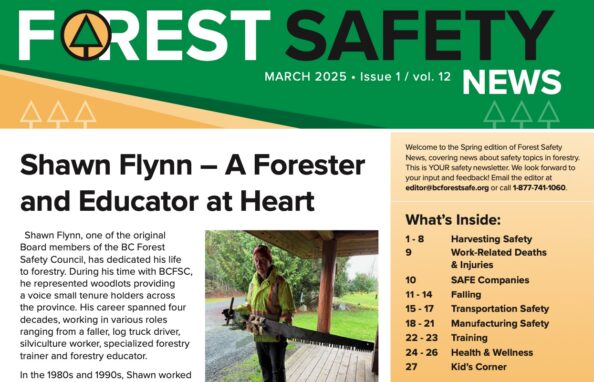 Don’t miss the March edition of the BC Forest Safety Council newsletter. It’s jam-packed with information about Safety Heros like Shawn Flynn and Brian Penny. Health updates about pain management, off-road vehicles, managing the last of the snow and daylight savings! How do you stay safe when you find yourself under water? Does your team have an emergency response plan? Plus, what’s new, upcoming events, and even a cheerful rabbit for you to colour in your down moments! Check out this month’s BC Forest Safety News
 A B.C. company has been fined just under $9,000 for the death of a worker. A WorkSafeBC penalty summary posted online says Crescent Bay Construction Ltd. was fined $8,995.26 on Jan. 23 for the incident at a worksite in Beaton, located south of Revelstoke on the shores of Upper Arrow Lake. “This firm was performing maintenance work on a bridge deck on a forest service road,” said the penalty summary. “WorkSafeBC attended the site after a worker was struck by a tree that fell from a cliff face above the work area. The worker sustained fatal injuries.” WorkSafeBC says their investigation determined “the firm did not adequately identify the hazard of dangerous trees or assess the risks they presented to workers.” The company also failed to “conduct a dangerous tree assessment by a qualified person before work began and failed to ensure the health and safety of all workers at the worksite, both high-risk violations.”
 Consultation on proposed B.C. Exposure Limits (ELs) based on the new or revised 2021, 2022, 2023, and 2024 ACGIH TLVs for selected chemical substances. The American Conference of Governmental Industrial Hygienists (ACGIH) regularly publishes a list of substances for which they have set new or revised Threshold Limit Values (TLVs). A TLV is the airborne concentration of a chemical substance where it is believed that nearly all workers may be exposed over a working lifetime and experience no adverse health effects. TLVs may be expressed as an 8-hour time-weighted average (TWA), 15-minute short-term exposure limit (STEL), or ceiling limit. Before adopting new or revised TLVs published by the ACGIH, WorkSafeBC reviews relevant data on health effects and the availability of validated sampling methods. …We are requesting stakeholder feedback on the proposed B.C. ELs for 22 substances. Feedback will be accepted until 4:30 p.m. on Friday, March 14, 2025.