 KANANASKIS, AB – We, the Leaders of the G7, are deeply concerned that the world has experienced record-breaking wildfires across every forested continent over the past decade, often overwhelming available national resources and requiring governments to request assistance from other countries. These wildfires are endangering lives, affecting human health, destroying homes and ecosystems, and costing governments and taxpayers billions of dollars each year. We resolve to boost global cooperation to prevent, fight and recover from wildfires by taking integrated action to reduce the incidence and negative impacts of wildfires and ensure our readiness to help each other, and partners, when needed. We will take steps to prevent and mitigate the occurrence of wildfires by:
- Adopting a whole of society approach… to share knowledge and drive research on reducing risks.
- Implementing mitigation and adaptation actions… that reduce the risk of extreme wildfires…
- Raising awareness of the different causes of wildfires and measures to prevent them….
 The Institute is seeking an enthusiastic individual to provide strategic and operational leadership as Executive Director. The Executive Director leads the Canadian Institute of Forestry / Institut forestier du Canada (CIF-IFC), guiding the organization through strategic growth and operational excellence. This role ensures the long-term sustainability of the Institute through sound governance, financial stewardship, and stakeholder engagement. The Executive Director works closely with a small team, the Executive Committee, and a broad national network of members, volunteers and partners. They are accountable to the Board of Directors and collaborate with committees, staff, members, sponsors, and regions across Canada. This is a full-time, remote position. Individuals with the requisite qualifications are invited to apply by July 21, 2025.
 Over the past decade, Canadian forestry companies have significantly expanded their footprint in the American lumber industry. While foreign investment remains a key component of a dynamic US economy, industry analysts and policymakers are increasingly scrutinizing the long-term implications of international control over critical domestic manufacturing infrastructure. Canadian-owned firms—including West Fraser, Canfor and Interfor—now operate dozens of sawmills in the US, with many holding more assets south of the border than in their home country. Additional Canadian firms—such as Tolko, Maibec, J.D. Irving, and Kruger—also maintain active operations and land holdings throughout the country. As foreign ownership of US lumber mills grows, several key concerns are emerging: Supply Chain Autonomy… Economic Retention… Market Influence. …Industry stakeholders are urging a closer examination of the issue. Policy suggestions include incentivizing domestic ownership, increasing sourcing transparency, and evaluating regulatory frameworks around foreign investment in strategic industries.


 Cranbrook, BC – United Steelworkers (USW) Local 1-405 members at Galloway Sawmill have had enough and are going public with their frustration with Peak Renewables and Galloway Sawmill owner Brian Fehr and the violation of their collective agreement rights and severance owed to the 20 workers of the Galloway Sawmill. “Workers left at the Galloway Sawmill are entitled and deserve their severance from Peak Renewables and owner Brian Fehr at Galloway Sawmill. The company is reneging on a negotiated closure agreement and the workers are the only ones that get hurt,” said USW Local 1-405 President Grant Farquhar. “That site was closed officially by the employer in December of 2024. Five months later and two months after the commitment was made by the employer to pay the severance was made, the members still haven’t received it.” Brian Fehr, owner of Peak Renewables, bought the Galloway Sawmill from Bud Nelson in 2017. The mill hadn’t run since December of 2022.
  SURREY, BC — Mackenzie Sawmill is back in the courts, a little more than a decade after the sum of three fires ruined a large mill built in 1938. The first of three fires was on Nov. 12, 2010, followed by a second on Jan. 25, 2011 and the third on Oct. 31, 2014 essentially destroyed what was left of it. …Judge Rory Krentz, presided over a hearing in B.C. Supreme Court in Vancouver, where the defendants applied for a dismissal for want of prosecution. Mackenzie ceased operations in early 2011 after the second fire, with two groups of employees entitled to severance pay. The court heard Mackenzie told the union the company intended to build another mill on site, enabling the union employees to keep their jobs. …This was before the third fire, after which Mackenzie indicated it still planned to rebuild the mill. But the union alleges MacKenzie decided before the last fire happened that it wouldn’t rebuild.
 TORONTO – The Ontario government released
 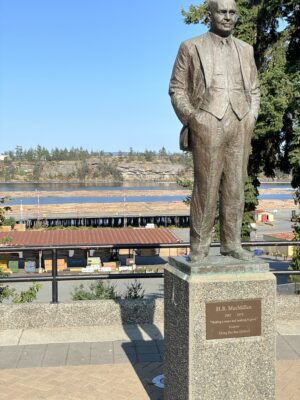 Western Forest Products says it will curtail all operations at its Chemainus sawmill next week, sidelining 150 employees for an indefinite period. The company said the curtailment, set to start June 18, is due to market challenges that include weaker lumber demand and higher US softwood lumber duties, as well as a lack of available viable log supplies. The company also blamed market conditions and a lack of log supplies for a similar shutdown in the spring of last year. Western Forest Products’ other mills at Duke Point, Ladysmith, Saltair and Cowichan Bay, and a value-added remanufacturing plant in Chemainus, will continue to operate, said Babita Khunkhun, senior director of communications for Western Forest Products. She said there is no end date for the curtailment at the Chemainus mill at this point, as the company monitors conditions. The mayor of North Cowichan said he was initially told 55 workers were facing layoffs.
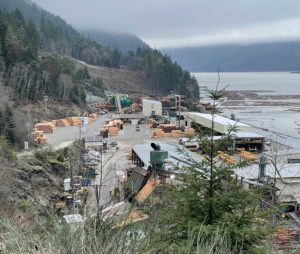 The major assets of the beleaguered San Group are under contract to be sold, awaiting only court approval. The monitor overseeing the credit-protection process has applied to the courts for approval of the sale. A court date is set for this week. …The largest creditors support the sales, despite the fact “they will suffer a significant shortfall on their debt.” The main properties in question are the Coulson manufacturing sawmills and San Group’s value-added facility in Port Alberni. There is also a mill in Langley and an adjacent agricultural parcel. The Surrey-based Fraserview Cedar has agreed to buy the Coulson facility in Port Alberni. The group has said it expects to have the mill up and running this year if the deal closes. A numbered BC company has entered into an agreement to buy the value-added facility. The buyers will lease the site to Ucluelet-based IGV Housing, which specializes in manufacturing scalable housing that combines pre-fab and on-site processes.
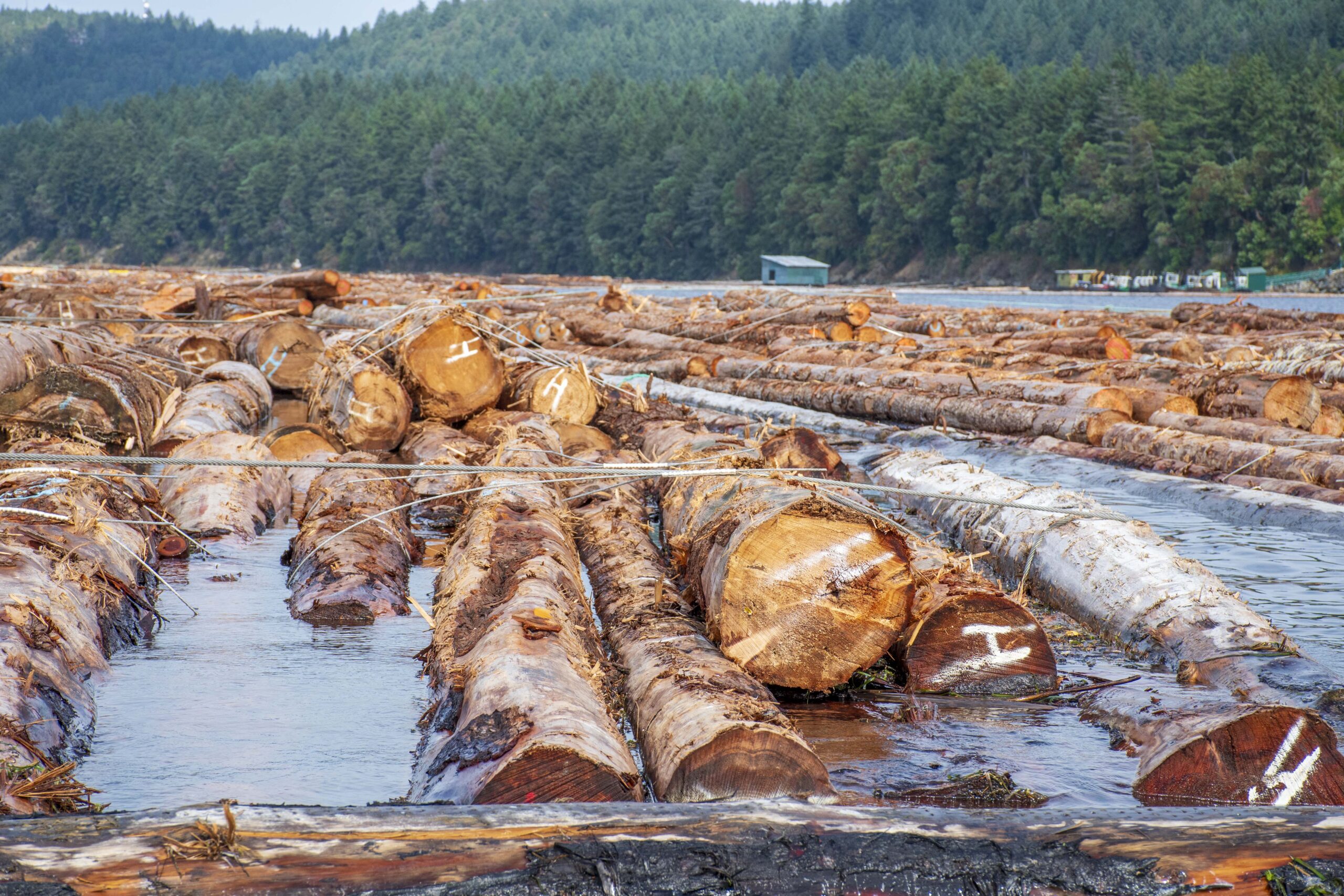 About 100 unionized forestry workers are on the picket line at operations on the mid and north Island, claiming their employer wants to contract out their work. United Steelworkers Local 1-1937 went on strike June 6, citing “significant concessions” demanded by La-kwa sa muqw Forestry Limited Partnership (LKSM Forestry). LKSM Forestry is the former Western Forest Products Mid-Island Forest operation now jointly owned by four First Nations of the Nanwakolas Council — the Tlowitsis, We Wai Kai, Wei Wai Kum and K’ómoks First Nations — as well as Western Forest Products, which still owns the majority of the company. The Steelworkers union said one of the main concessions LKSM is demanding is the use of non-union contractors to do work currently done by union members on sites. That includes jobs performed by union members working for contractors on sites. …The union said it remains open to talks with the company that focus on resolving the outstanding issues.
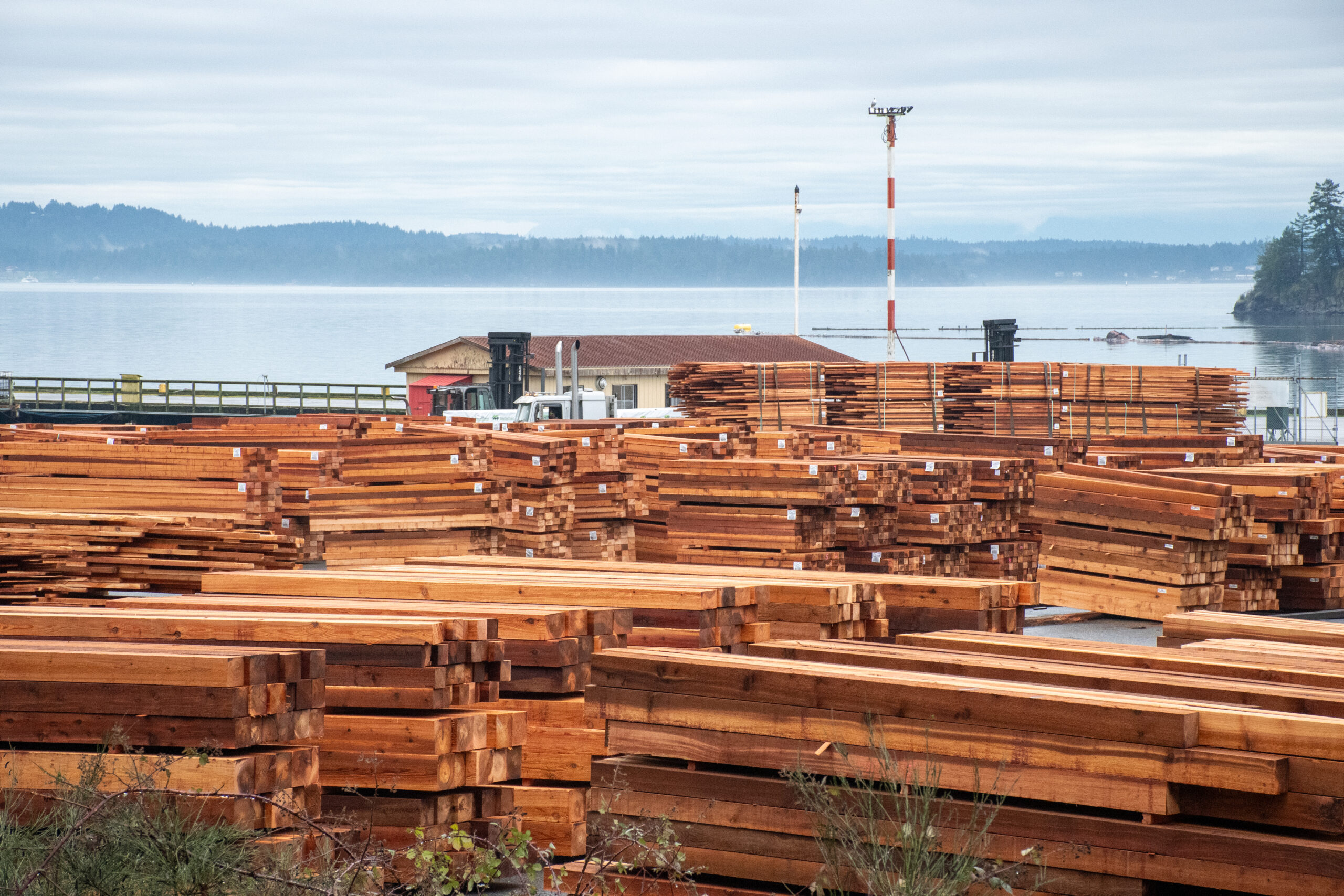 CHEMAINUS, BC — Fifty-five workers are scheduled to be laid off after a shortage of viable logs has forced production at the Chemainus Sawmill starting this month. According to North Cowichan mayor Rob Douglas, Western Forest Products has informed the municipality they intend to start curtailment of the jobs on Jun. 18. “The company has indicated the reason for the shutdown is due to their inability to find a viable supply of fiber,” Douglas says. “We don’t have a date as to when Western Forest Products is going to resume operations at the Chemainus Mill, but we hope it’s very short term.” …“I have reached out to the forest minister (Ravi Parmar),” he says. …Delays in permits and cutting fiber is a long-standing issue in BC, which has led to shutdowns and impacting production, but Douglas says he has been reassured by Parmar that the province is addressing the issue.
 SLAVE LAKE, Alberta — On Saturday, May 24, West Fraser’s Slave Lake Veneer plant celebrated its 50th anniversary with the community of Slave Lake. Several hundred community members, elected officials, Indigenous leaders, employees and retirees joined the company for a day of festivities, including lunch, bouncy castles, face painting and an opportunity to learn more about the history of Slave Lake Veneer’s operations. These directly employ 150 local residents, mostly in the mill, but also in the woodlands department, as well hundreds of more with contractors that supply the operation. …West Fraser acquired Slave Lake Veneer in 1999, as part of its acquisition of Zeidler Forest Products. At the time, the mill operated as both a veneer plant and a stud mill. In 2016, all lumber production was transferred to the newly-acquired sawmill in High Prairie. Today, veneer output is almost 13 times higher than when the plant opened in 1973.




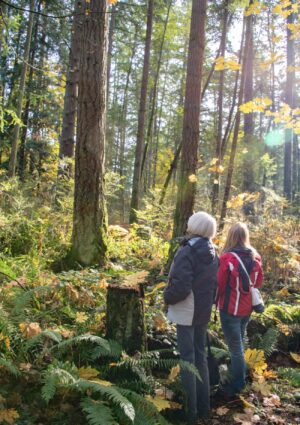 A program that protects privately owned forests for timber and other uses has survived in a megabill being put together in the Senate, after falling victim to House budget cutters in May. The Senate Agriculture, Nutrition and Forestry Committee saved the Forest Legacy Program in its piece of the big tax-cut and spending bill, refusing to cut off $100 million in Inflation Reduction Act funding. “This is a victory not only for forests, but for the families, economies, and ecosystems that depend on them,” said Lesley Kane Szynal, chair of the Land and Water Conservation Fund Coalition, an advocacy group, in a news release Thursday. The Forest Legacy Program pays for conservation easements and land purchases that prevent privately owned forests from being converted to other uses. In many cases, they’ve been used to keep timber operations in business while protecting forest watersheds and allowing for recreational access. [to access the full story an E&E News subscription is required]
 A federal appeals court on Tuesday agreed to let many of President Trump’s sweeping tariffs on US trade partners remain in effect for now, extending a pause issued late last month after a separate court ruled the tariffs were illegal. The Federal Circuit Court of Appeals granted the Trump administration’s request for a longer pause after issuing a temporary stay of the lower court ruling last month. The court put the case on a fast track to be resolved by the end of this summer, noting that “these cases present issues of exceptional importance warranting expedited en banc consideration of the merits in the first instance.” The decision comes after the US Court of International Trade ruled on May 28 that Congress did not delegate “unbounded” tariff authority to the president in the International Emergency Economic Powers Act of 1977. Trump appealed the ruling and, hours later, the appeals court granted the temporary stay.
 LONDON — US and Chinese officials said on Tuesday they had agreed on a framework to get their trade truce back on track and remove China’s export restrictions on rare earths while offering little sign of a durable resolution to longstanding trade tensions. …Lutnick said the agreement would remove restrictions on Chinese exports of rare earth minerals and magnets and some of the recent US export restrictions “in a balanced way”, but did not provide details…. adding that both sides will now return to present the framework to their respective presidents for approvals. …The two sides left Geneva with fundamentally different views of the terms of that agreement and needed to be more specific on required actions, said Josh Lipsky. …They have until August 10 to negotiate a more comprehensive agreement, or tariff rates will snap back from about 30% to 145% on the U.S. side and from 10% to 125% on the Chinese side.
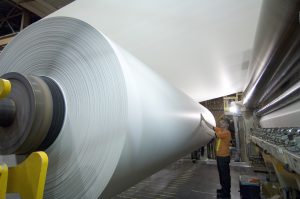 USK, Washington — The owners of the defunct Ponderay Newsprint Mill plan to sell its equipment at auction next month after years of empty promises to reopen what had been one of the largest employers in northeast Washington. The sprawling 927-acre property in Usk has 29 buildings and storage facilities. It is situated adjacent to the Pend Oreille River and the Pend Oreille Valley Railroad. Instead of making paper or reconfiguring the mill to make cardboard, as the new owners promised multiple times in public hearings, the site has produced nothing for the past several years. Instead the owners used vast amounts of electricity to run computers mining for cryptocurrency. The paper mill previously was owned by Lake Superior Forest Products, a subsidiary of Quebec-based Resolute Forest Products, and five major U.S. publishers. They declared bankruptcy in 2020, ending the jobs of about 140 workers. Now that equipment is being listed by Capital Recovery Group to be viewed on July 21 with online auctions to commence on July 22 and July 23.



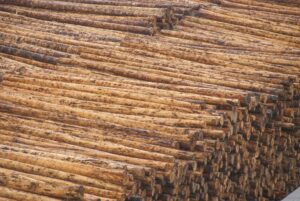 NEW ZEALAND — Forestry Minister Todd McClay has unveiled two-way forestry trade missions with India this year. The inbound visit – supported by industry partners – is expected to showcase New Zealand’s forestry systems and sustainable management practices. “The outbound mission will continue to open doors for deeper commercial and government partnerships,” McClay said. …McClay was speaking at the Fieldays Forestry Hub on Friday. Trade between New Zealand and India was valued at $3.14 billion in 2024. New Zealand’s exports to India last year included forestry products valued at $126 million. New Zealand’s wood exports to India have surged from $9.5 million in 2023 to an estimated $76.5 million this year. Pulp exports have more than doubled, from $20 million to $45.6 million. “India is one of the fastest-growing markets for our forestry exports – and we’re focused on turning that growth into long-term opportunity for New Zealand exporters,” McClay said.

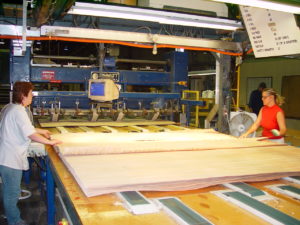 The EU has imposed anti-dumping duties on Chinese plywood imports, just a few days after Beijing tried to ease trade tensions between the two. The provisional levies of up to 62.4% follow a surge in imports of hardwood plywood over the past three years that had damaged domestic producers, the European Commission said. The Greenwood Consortium of EU producers, which brought a complaint against Chinese competitors last year, said it welcomed the move but argued for “definitive duties to be even higher than these provisional levels” when the commission makes a final decision later this year. Brussels has also taken the unusual step of monitoring imports of softwood plywood, which is not subject to duties, after allegations that Chinese exporters were disguising hardwood products in anticipation of the levies. …“The alleged practice consisted of placing very thin outer layers of softwood veneer on top of the hardwood plywood face veneer.