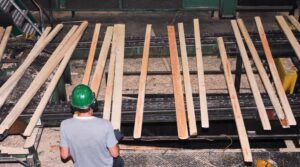
 Another day, another tariff threat for markets to digest. This time it’s lumber getting whipsawed, as U.S. President Donald Trump says he is going to bring in tariffs on Canadian lumber imports to the U.S. soon. Speaking to reporters on Wednesday evening, Trump added lumber to the list of items he plans to slap tariffs on in the near future. …Canada would feel any such policy directly, but perhaps not as painfully as you might think. As is the case with oil, lumber is one front in the trade war where Canada can do a lot of collateral damage of its own. …While the U.S. theoretically has enough trees to meet its own needs, ramping things up both in terms of the logs and the capacity to process them would be next to impossible in the short term. Recall during the pandemic when Canadian lumber prices spiked by more than 300%, yet U.S. buyers kept buying.
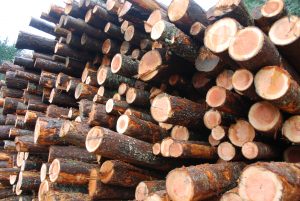 LONDON/BRUSSELS — The US paper and pulp industry is lobbying the Trump administration to ask the EU to declare the US deforestation-free, a step that could make it easier for exporters to meet the bloc’s new environmental rules. From December, the European Union’s anti-deforestation policy will ban imports of commodities linked to forest destruction. Brussels already delayed the policy’s launch by a year. …”A delay does not solve our concerns with the regulation’s complex requirements and significant technical barriers,” said Heidi Brock, CEO of the American Forest and Paper Association (AF&PA). …The law does not contain a category of countries deemed to be deforestation-free – despite EU lawmakers attempting unsuccessfully to add a new “no risk” category of countries which would face even lighter rules. Any changes to the EU law would require a legal proposal from the Commission, and approval from EU lawmakers and member states.
 WASHINGTON — President Trump is taking a blowtorch to the rules that have governed world trade for decades. The

 WILLIAMS LAKE, BC — The City of Williams Lake has cancelled a lobbying junket to Victoria on the news Adrian Dix, minister of Energy, plans to meet with BC Hydro to discuss the imminent shut-down of the Atlantic Power station. The plant, which generates electricity through the burning of wood waste, is Williams Lake’s biggest industrial taxpayer. The company that owns it plans to shut down soon, unless the province can assure it better power rates and reliable fibre supply. The city has been lobbying the provincial government to prevent the power plant from shutting down, and had planned to converge on the BC Legislature tomorrow for the first day of the new BC legislative session. …The Atlantic Power plant is an independent power producers with a power purchase agreement with BC Hydro. The plant is owned by I Squared Capital, an American private equity investment firm.
 B.C.’s rookie forests minister Ravi Parmar had a strong case to make as he travelled to Sacramento last week to meet with California business and government representatives. The state lost more than 16,000 structures in the recent wildfires … and California’s construction industry knows it will need B.C. and Alberta lumber for a rebuild that will take years. …Parmar says U.S. insurance companies confirmed that high-sticking Canada with more border fees for lumber will drive up costs for California fire claims and other new construction. A classic case for this dysfunctional relationship is Interfor Corp. …now one of the biggest lumber producers in the world, with a strategy to respond to trade attacks by expanding U.S. production. …Canadian forest companies shifting their investment to the U.S. involves other factors, such as pine beetle damage and governments restricting timber supply to satisfy often overblown environmental protests. But the effect is what Trump is after, moving jobs from Canada to the U.S.
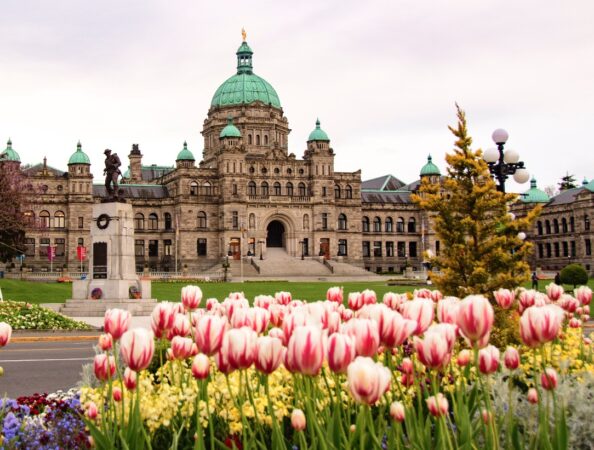 The first session of B.C.’s 43rd Parliament opens Feb. 18, with traditional rituals like the Speech from the Throne. …This threat [of US tariffs] has since become much more real. Double-digit tariffs from the United States on key exports such as energy, minerals and lumber now loom over B.C. with some potentially reaching or exceeding 50 per cent in the case of aluminum and lumber. “The lumber industry, in particular, is vulnerable,” Werner Antweiler, Chair in International Trade Policy, at UBC’s Sauder School of Business said. “They are not very profitable at the moment and any further setback in terms of accessing the U.S. market will really hit hard. So I’m really worried about jobs in the lumber industry.” …But the threat of tariffs could also spur developments that government has previously neglected. They include efforts to finally break down barriers between provinces.





 U.S. President Donald Trump in an all-caps post on Truth Social Thursday teased a new round of sweeping reciprocal tariffs, matching the higher rates other nations charge to import American goods. …Reciprocal tariffs were one of Trump’s core campaign pledges — his method for evening the score with foreign nations that place taxes on American goods and to solve what he has said are unfair trade practices. …He is set to share more details on the tariffs ahead of his visit with Indian Prime Minister Narendra Modi, White House press secretary Karoline Leavitt told reporters on Wednesday. …The tariffs are likely to hit developing countries hardest, especially India, Brazil, Vietnam and other Southeast Asian and African countries, given that they have some of the widest differences in tariff rates charged on U.S. goods brought into their countries compared to what the U.S. charges them.
 Reciprocal tariffs are straightforward in theory: The U.S. would pose the same levies on imported goods from a given country that the other country imposes on their U.S. imports. But it gets far murkier in practice, as countries often charge different tariffs on different classes of goods. Goldman Sachs economists outlined three approaches Trump could take. “Country-level reciprocity” is the “simplest” strategy which would have the U.S. impose the same average tariffs. “Product-level reciprocity by country” would have the U.S. place marching tariffs on a good-by-good basis by trading partner.” Reciprocity including non-tariff barriers” is the “most difficult” approach as it would encompass a complicated web of inputs including inspection fees and value-added taxes. …4.8% is the U.S.’ weighted average tariff rate if Trump implemented the country-level strategy. …Goods from the 20 countries the U.S. has free trade agreements with, including Australia, Canada, Mexico and Panama, won’t be affected – though Trump has targeted several of those countries in recent weeks.