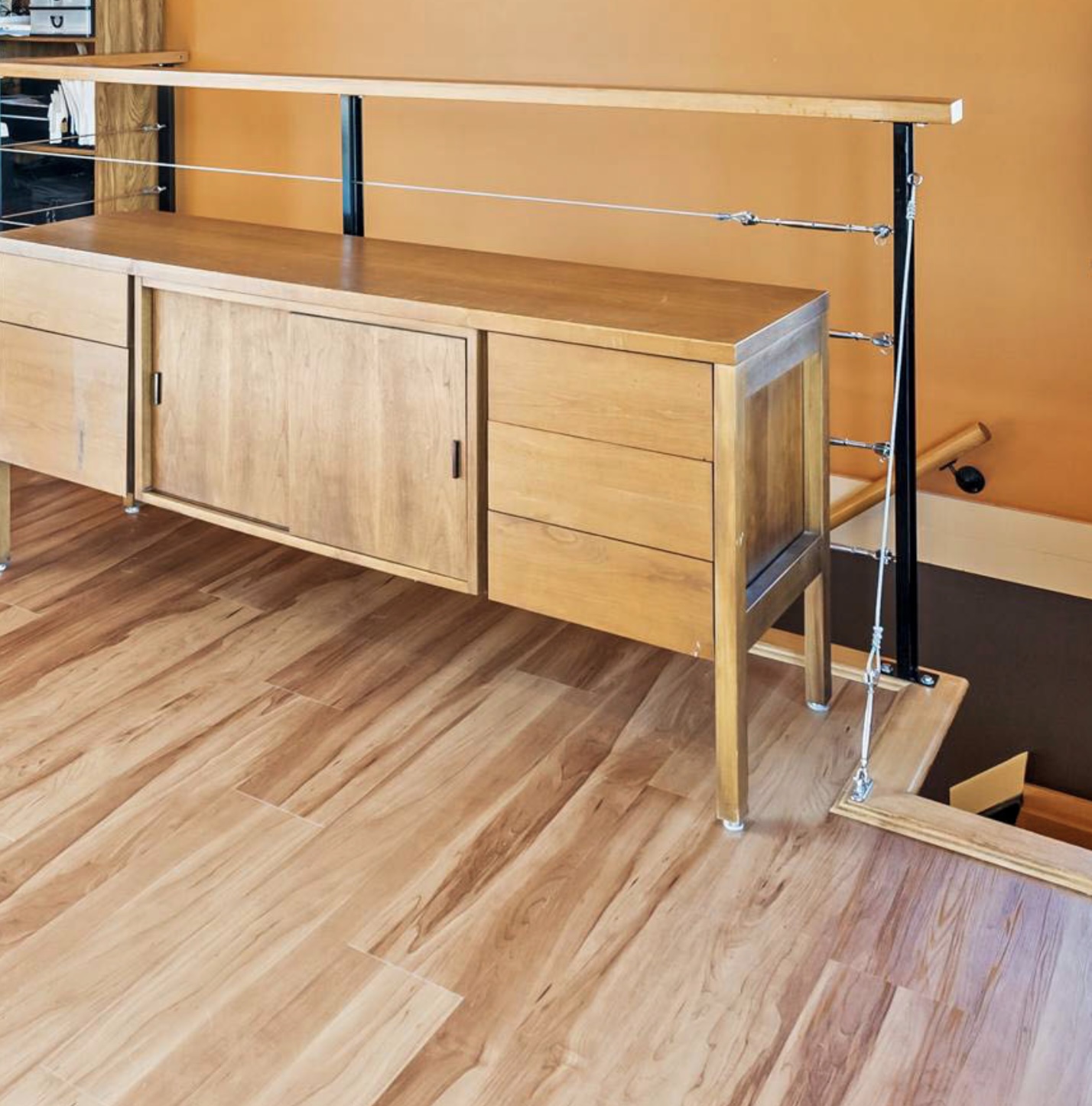
 Canada is becoming far more attractive in commodity goods to the rest of the world, as it diversifies its trade away from the US, says one analyst. Imports outpaced exports in October. Merchandise imports increased by 3.4% in October while exports increased by 2.1%. Because of this, Canada’s merchandise trade balance went from a surplus of $243 million in September to a $583 million deficit in October. …William Pellerin, a trade lawyer, said whether it be Malaysian kitchen cabinet manufacturers, or Chinese goods, he said “Canada is becoming far more attractive at lower pricing in many commodity goods and in many manufactured sectors.” On the other hand, the data shows exports to the US made up 67.3% of all Canadian exports, which is the lowest since the pandemic. …Cabinet and wood makers face a difficult challenge as they face a 25% tariff and lose access to the US market, said Pellerin.
 Lumber futures slid below $530 per thousand board feet, testing the lowest levels since October 2024, as weak near-term demand collided with abundant and re-emerging supply. Homebuilding activity remains subdued and mortgage borrowing costs are still elevated, restraining new starts and repair and remodel demand, while US housing starts have softened and 30-year mortgage rates entered January little changed near the mid-6% range. At the same time structural supply pressures are returning, with several panel and OSB mills ramping up or preparing to add capacity and shifts in North American output seeing Canadian curtailments largely offset by higher production in the US South, keeping physical availability ample and capping any upside. In the meantime, inventory and futures market activity increased over the holiday period, amplifying downside moves when buyers stayed sidelined after year-end and seasonal restocking remained muted. [END]
 President Trump’s tariff and trade policies dominated the world’s political discourse through 2025. …The good news is that the BC economy has been fairly resilient through 2025. …BC trade resilience can also be attributed to a broader export commodity mix, dominated by forestry, agricultural and seafood products, as well as mining and oil and gas. …Forest products were tagged with a sectoral tariff of 10 per cent in October 2025, on top of new anti-dumping and countervailing tariffs on softwood lumber. …This has put tremendous pressure on an industry. …It’s difficult to disentangle the impact of tariffs from overall adverse trends in the BC forest industry, many mill closures and curtailments in recent years. BC forestry exports are among the most exposed to the US market, with about 75% of forestry exports headed south. Exports of softwood lumber were down 26% in August 2025 compared to August 2024. Pulp and paper exports were also down 9% on a year-to-date basis compared to 2024.
 The
The 

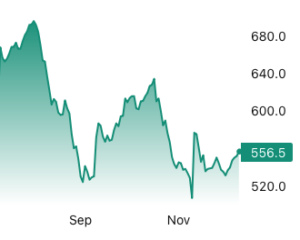 Lumber futures traded above $550 per thousand board feet as markets absorbed a dovish turn from the Federal Reserve that brightened the demand outlook for construction materials. The Fed’s widely anticipated 25bp cut and Chair Powell’s dovish rhetoric pushed traders to price additional easing next year, which should put downward pressure on mortgage rates and lift homebuilding and renovation activity. Those interest rate dynamics have heightened the incentive for builders and distributors to restock, while persistent tariff and trade frictions have constrained supply. Canadian log exports are down year to date even as shipments into the US have risen, Canadian manufacturing output has slipped and US lumber exports are lower, a mix that reduces available millfeed and forces buyers to compete for the supplies that remain.
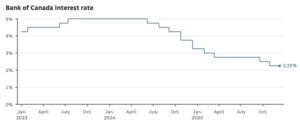 The Bank of Canada is holding its key interest rate at 2.25%, a move that was widely expected after an encouraging round of third-quarter data showed the Canadian economy has withstood some trade war-induced turmoil. Central bank governor Tiff Macklem wrote in his opening remarks that the current rate is at “about the right level” to give the economy a boost while also keeping inflation close to its 2% target rate. Canada’s economy proved more hardy than expected in the third quarter, with GDP and jobs growth beating expectations, and the unemployment rate dropping to 6.5% in November. Inflation is hovering just above 2%, and the Bank of Canada’s core measures of inflation are trending closer to 3%. While the steel, aluminum, auto and lumber sectors have been pummelled by US tariffs, which is weighing more broadly on business investment, “the economy is proving resilient overall,” Macklem said.
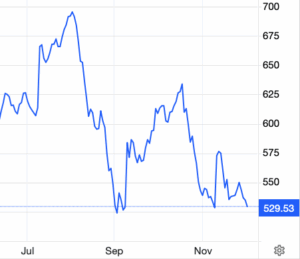 Lumber futures fell toward $530 per thousand board feet, down nearly 10% from November’s peak, as the market contends with pronounced oversupply and lingering weak demand. Mills and distributors continue to carry elevated inventories, a hangover from early 2025 when buyers front-loaded purchases in anticipation of tariffs, leaving the market with a persistent supply overhang. At the same time, US housing starts and building permits remain below last year’s levels, reflecting a prolonged construction slowdown as easing borrowing costs have yet to materialize in higher new building activity and limit near-term consumption of framing lumber. Demand from renovation and new homebuilding also remains subdued, with housing-related wood products consumption estimated to have declined in 2024 and only a modest recovery expected in 2025.
  Prime Minister Carney announced measures to help protect and strengthen the sectors most affected by U.S. tariffs. …The focus of the liquidity initiatives are to reduce bankruptcy or closure risk for leveraged or high-cost lumber mills through initiatives such as the BDC Softwood Lumber Guarantee Program… and enhancing EI worksharing and training grants. The demand support initiatives include working with railway companies to cut freight rates, prioritizing shovel-ready, multiyear projects that use Canadian wood products and creating demand for Canadian Wood products. The structural initiatives include a “forestry concierge” at Natural Resources Canada to help mills navigate loans and programs as well as an industry-led transformation task force to expand, diversify and identify opportunities and support affected communities. …The measures will help the sector but the bigger picture is really about duties and a supply/demand balance that has traditionally been difficult to obtain given this industry’s capital intensity. [to access the full story a Globe & Mail subscription is required]
 The Consumer Price Index (CPI) rose 2.2% on a year-over-year basis in October, down from a 2.4% increase in September. The all-items CPI decelerated largely due to gasoline prices, which fell at a faster pace year over year in October (-9.4%) compared with September (-4.1%). Excluding gasoline, the CPI rose 2.6% in October, matching the increase in September. …The CPI rose 0.2% month over month in October. On a seasonally adjusted monthly basis, the CPI was up 0.1%. …Consumers paid more year over year in October for homeowners’ home and mortgage insurance (+6.8%) and passenger vehicle insurance premiums (+7.3%). Among the provinces, prices rose the most in Alberta for both measures, with a 13.7% increase in homeowners’ home and mortgage insurance and a 17.8% increase in passenger vehicle insurance premiums.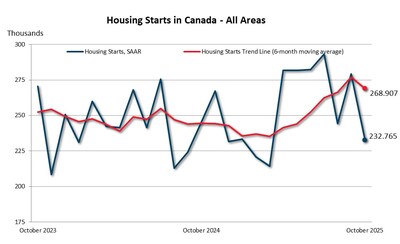


 BURNABY, BC — Interfor reported its Q3, 2025 results. The company recorded a net loss of $215.8 million compared to net earnings of $11.1 million in Q2’25 and a net loss of $105.7 million in Q3’24. Adjusted EBITDA was a loss of $183.8 million on sales of $689.3 million in Q3’25 versus Adjusted EBITDA of $17.2 million on sales of $780.5 million in Q2’25 and an Adjusted EBITDA loss of $22.0 million on sales of $692.7 million in Q3’24. Lumber production of 912 million board feet was down 23 million board feet versus the preceding quarter. This decline largely reflects the Company’s announcement on September 4, 2025, to temporarily curtail production. …Weak lumber market conditions were reflected in Interfor’s average selling price of $618 per mfbm, down $66 per mfbm versus Q2’25. …Interfor’s strategy of maintaining a diversified portfolio of operations in multiple regions allows the Company to both reduce risk and maximize returns on capital over the business cycle.
 NEW YORK — Mercer International reported third quarter 2025 Operating EBITDA of negative $28.1 million, a decrease from positive $50.5 million in the same quarter of 2024 and negative $20.9 million in the second quarter of 2025. In the third quarter of 2025, net loss was $80.8 million compared to $17.6 million in the same quarter of 2024 and $86.1 million in the second quarter of 2025. Mr. Juan Carlos Bueno, CEO, stated: “In the third quarter of 2025, persistent global economic and trade uncertainties, fiber scarcity in Germany as well as the impact of pulp substitution accelerated the decline in pulp market demand and pricing, which negatively impacted our operating results and contributed to a $20.4 million non-cash inventory impairment charge in the quarter.
 VANCOUVER, BC — Canfor Corporation reported its third quarter of 2025 results. The Company reported an operating loss of $208 million and a net loss of $172 million. …Canfor’s CEO, Susan Yurkovich, stated: “The ongoing global economic and trade uncertainty, in conjunction with punitive US softwood lumber duties, led to persistently weak market conditions and subdued demand across all of our operating regions during the third quarter of 2025. …For the lumber segment, the operating loss was $182.2 million for the third quarter of 2025, compared to the previous quarter’s operating loss of $229.2 million. …For the
 B.C.’s GDP is forecast to increase by 1.6% this year,
  Vancouver, BC – Canfor Corporation and Canfor Pulp Products Inc. announced today that they have entered into an arrangement agreement pursuant to which Canfor Corp will acquire all of Canfor Pulp’s issued and outstanding common shares not already owned by Canfor Corp and its affiliates pursuant to a court-approved plan of arrangement under the Business Corporations Act. Under the terms of the Arrangement Agreement, the shareholders of Canfor Pulp, other than Canfor Corp and its affiliates, will have the option to receive, for each Canfor Pulp Share held: 0.0425 of a common share of Canfor Corp, or $0.50 in cash. ….Canfor Corp currently owns approximately 54.8% of the issued and outstanding Canfor Pulp Shares. The $0.50 per Canfor Pulp Share represents a premium of 25% to Canfor Pulp’s closing share price on December 2, 2025, on the Toronto Stock Exchange and a premium of 38% based on the 10-day volume-weighted average share price of Canfor Pulp as of December 2, 2025, on the TSX.




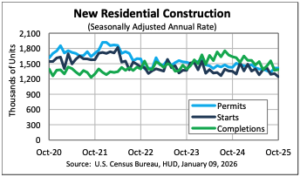
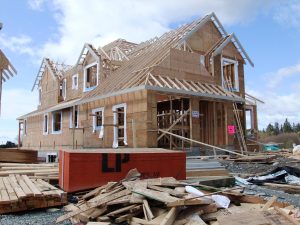 WASHINGTON — US single-family homebuilding rebounded in October, but permits for future construction eased, signaling caution among builders as new housing inventory remains high and demand soft. Single-family housing starts, which account for the bulk of homebuilding, increased 5.4% to a seasonally adjusted annual rate of 874,000 units in October, the Commerce Department’s Census Bureau said on Friday. Starts dropped to a pace of 829,000 units in September from a 869,000-unit pace in August. The reports were delayed by the 43-day government shutdown. …Permits for future single-family homebuilding fell 0.5% to a rate of 876,000 units in October. They increased to a pace of 880,000 units in September from a 858,000-unit rate in August.
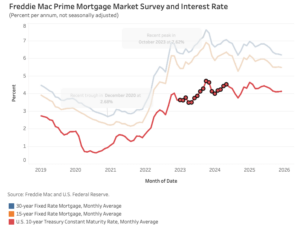 Long-term mortgage rates have been declining since mid- 2025 and ended the year at their lowest level since September 2024. According to Freddie Mac, the 30-year fixed-rate mortgage averaged 6.19% in December, 5 basis points (bps) lower than November. Meanwhile, the 15-year rate declined 3 bps to 5.48%. Compared to a year ago, the 30-year rate is lower by about half a percentage point, or 53 basis points (bps). The 15-year rate is also lower by 45 bps. …Falling lower mortgage rates have started to translate into gains as existing home sales edged up slightly in November. However, this increase remains limited as mortgage rates above 6% are still considered elevated. Nonetheless, as financing costs continue decline, more households are likely to reenter the housing market. …NAHB expects the 30-year mortgage rate to average 6.17% in 2026 and would reach 6% by 2027.



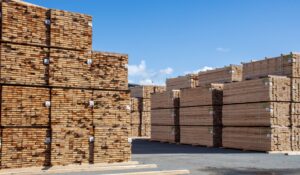 The recent softening demand and prices in the lumber market represent a critical inflection point, marking a transition from unprecedented volatility to a more complex, albeit somewhat stabilized, environment. The key takeaway is that while the extreme highs of the pandemic era are behind us, lumber prices have established a new, elevated baseline, significantly impacting housing affordability and construction costs. This recalibration is driven by a delicate balance of oversupply in some segments, subdued but potentially recovering demand, and persistent supply-side challenges, including increased tariffs on Canadian imports and ongoing labor shortages. …The lasting impact of this period will likely be a more resilient and adaptable construction industry. …The market is not returning to its pre-pandemic state; rather, it is evolving into a new equilibrium where strategic foresight and agility will be paramount for success.


 Nonfarm payrolls grew slightly more than expected in November but slumped in October while unemployment hit its highest in four years, the Bureau of Labor Statistics reported Tuesday in numbers delayed by the government shutdown. Job growth totaled a seasonally adjusted 64,000 for the month, better than the Dow Jones estimate of 45,000 and up from a sharp decline in October. The unemployment rate rose to 4.6%, more than expected and its highest level since September 2021. A more encompassing measure that includes discouraged workers and those holding part-time jobs for economic reasons swelled to 8.7%, its peak going back to August 2021. In addition to the November report, the BLS released an abbreviated October count that showed payrolls down 105,000. While there was no official estimate, Wall Street economists were largely expecting a decline following a surprise increase of 108,000 in September.

 ATLANTA — Home Depot gave a cautious outlook for fiscal 2026 as the housing market continues to lag. Shares of the home-improvement retailer fell 2.4% to $341.62 in premarket trading on Tuesday. The company expects sales to rise between 2.5% to 4.5% in fiscal 2026, the midpoint of which is up from its guidance for 3% growth this fiscal year. Analysts polled by FactSet were looking for growth of 4.5%. …Home Depot said it expects those metrics to rise at a faster clip if the housing market gains momentum and there is increased spend on larger projects, driven by pent-up demand. The Atlanta company’s market-recovery case forecasts sales will grow about 5% to 6%, earnings per share will increase about mid- to high-single digits and comparable sales will be up 4% to 5%. “We believe that the pressures in housing will correct and provide the home improvement market with support for growth faster than the general economy”.
 The US Federal Reserve is poised to deliver its third straight interest rate cut Wednesday, while simultaneously firing a warning shot about what’s ahead. Following a period of remarkable indecision about which way central bank policymakers would lean, markets have settled on a quarter-percentage point reduction. If that’s the case, it will take the Fed’s key interest rate down to a range of 3.5% to 3.75%. However, there are complications. The rate-setting Federal Open Market Committee is split between members who favor cuts as a way to head off further weakness in the labor market and those who think easing has gone far enough and threatens to aggravate inflation. That’s why the term “hawkish cut” has become the buzzy term for this meeting. In market parlance, it refers to a Fed that will reduce, but deliver a message that no one should be holding their breath for the next one.
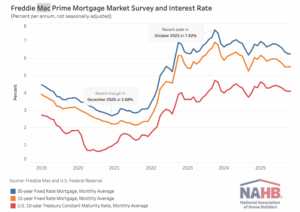 The average mortgage rate in November continued to trend lower to its lowest level in over a year. According to Freddie Mac, the 30-year fixed-rate mortgage averaged 6.24% in November, 2 basis points (bps) lower than in October. Meanwhile, the 15-year rate increased 3 bps to 5.51%. Both the 30-year and 15-year rates remain lower than a year ago, dropping by 57 bps and 52 bps year-over-year, respectively. …Falling mortgage rates have shown some impact on housing activity. Mortgage application activity continues to strengthen, led by increases in adjustable-rate mortgages and refinancing applications. Additionally, existing home sales rose to an eight-month high in October. There is no data available for new home sales in October due to the government shutdown.





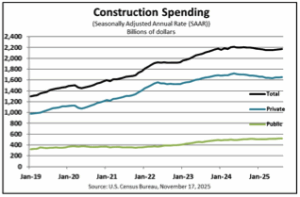 The US Census Bureau announced the following value put in place construction statistics. …Construction spending during August 2025 was estimated at a seasonally adjusted annual rate of $2,169.5 billion, 0.2 percent (±0.7 percent) above the revised July estimate of $2,165.0 billion. The August figure is 1.6 percent (±1.5 percent) below the August 2024 estimate of $2,205.3 billion. During the first eight months of this year, construction spending amounted to $1,438.0 billion, 1.8 percent (±1.0 percent) below the $1,463.7 billion for the same period in 2024. …Spending on private construction was at a seasonally adjusted annual rate of $1,652.1 billion, 0.3 percent (±0.5 percent) above the revised July estimate of $1,647.5 billion. …In August, the estimated seasonally adjusted annual rate of public construction spending was $517.3 billion, virtually unchanged from (±1.2 percent) the revised July estimate of $517.5 billion.
  The Supreme Court could decide on the legality of many of the Trump administration’s tariffs within months, but the ruling won’t impact many of the administration’s levies on imported construction materials such as lumber, steel, aluminum and copper. …Many construction materials imported into the US will remain subject to hefty tariffs regardless of how the Supreme Court rules. Some homebuilding leaders warn that home prices could increase by thousands of dollars beginning next year. …Cristian deRitis, at Moody’s Analytics, said “While importers of other building materials might experience some relief, this could be temporary. The administration may choose to expand the Section 232 tariffs as a fallback strategy if the reciprocal tariffs are invalidated,” deRitis said. …There hasn’t yet been an increase in lumber prices, but NAHB Chairman Buddy Hughes forecasted that the lumber tariffs “will create additional headwinds for an already challenged housing market by further raising construction and renovation costs.”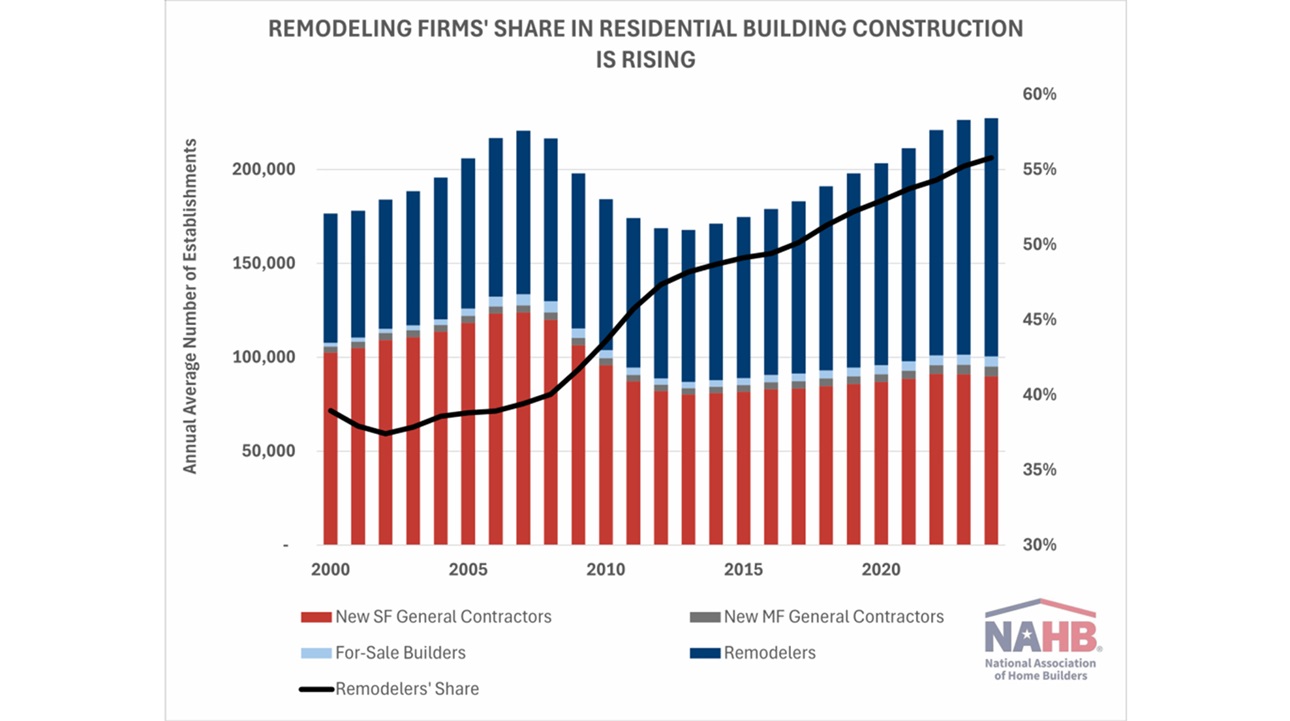



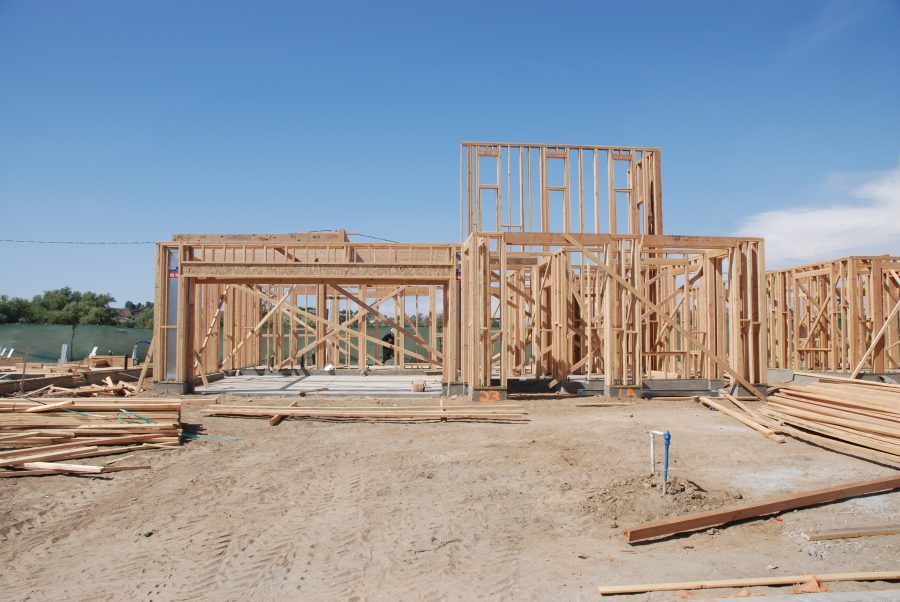 “President Donald Trump’s tariffs could increase builder costs anywhere from $7,500 to $10,000 per home,” said Rob Dietz, chief economist at the National Association of Home Builders… Last year, the NAHB estimated that every $1,000 increase in the median price of a new home prices out roughly 106,000 potential buyers. The biggest impact has been felt in lumber prices, which are expected to total about $4,900 per home on average. …about a third of the wood purchased for homebuilding comes from Canada. Domestic lumber producers generally raise their prices to match import prices. …major players like Home Depot are better able to mitigate and predict rising and volatile prices than smaller retailers. North American Builder’s Supply, based in Illinois, has filed for Chapter 11 bankruptcy protection. …“Over 50% of our inventory is not part of tariffs and is obviously sourced domestically,” Home Depot Executive Vice President William Bastek shared.

 KUCHING, Malasia — Chinese timber companies are struggling in their businesses due to insufficient orders for their products amid a weak global market. They have complained about poor demand in the timber market and intense competition in terms of product prices. Adding to their woes are rising raw material costs, according to the key challenges reported in the Global Timber Index-China Index report in November 2025. …To mitigate the challenges, Chinese enterprises suggested the need to expand into international markets to increase the volume of orders for their products, and called for government policy support for their operations. …Back home, China reported strong domestic retail sales of furniture, reaching 17.9 billion yuan in October, a 9.6 per cent increase from a year ago. …In a related development, China reported a robust export market for its particleboard, which surged by 67 per cent in volume.
 The latest Global Wood Trends report – Softwood Lumber – Tariffs, Turbulence and New Trade Flows to 2030 – says from 2000 to 2024, European lumber output grew slowly at 0.4% per year but still outpaced domestic demand growth. This allowed Europe to expand exports overseas, a trend likely to continue as Russian and Canadian shipments remain constrained. …Production has expanded faster than demand, with exports rising from 10% of output in 2009 to 19% in 2024. Growth has been concentrated in Northern and Central Europe — led by Sweden, Finland, Germany, and Austria — where harvest levels are now close to structural limits. …Global Wood Trends concluded that Europe’s lumber market is entering a period of tightening supply and gradually recovering demand. While production growth is expected to shift toward Northern and Eastern Europe, overall expansion will be limited by structural harvest constraints in Central Europe. Stronger domestic consumption, combined with potentially higher US demand will likely support higher prices for logs and lumber.
 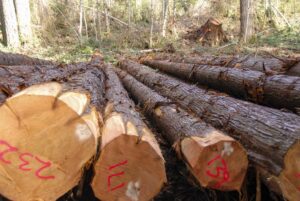 Sweden’s Green Business Index declined in the fourth quarter of 2025 as forestry and crop farming weakened, according to data from the Federation of Swedish Farmers. The total index fell to 100.7 from 106.5 in the previous quarter, marking a broad slowdown across several agricultural industries. The forestry subindex recorded the largest fall, dropping by 19 points to 97.6, its lowest level since spring 2020. The decline reflects weaker export demand, lower prices for sawn wood and pulp, and a soft U.S. dollar that reduced export revenues. New tariffs on Swedish wood products to the United States and a slower global economy further limited profitability. LRF reports that sawmills and pulp producers have experienced tightening margins, while forest owners face lower returns and are reducing harvesting activity.
  Japan’s housing starts rose 3.2% year-on-year in October 2025, defying market expectations of a 5.2% decline and reversing a 7.3% fall in September. It was the first annual increase since March, driven by rebounds in rented units (4.2% vs -8.2%), built-for-sale homes (14.8% vs -8.3%), and prefabricated housing (9.2% vs -0.4%). However, weakness persisted in owned homes (-8.2% vs -5.6%), while issued units slumped sharply (-36.3% vs 53.7%) and two-by-four homes also turned negative (-3.8% vs 2.1%). [END]
 China’s recent environmental policy shift is transforming the global recycled pulp market. After years of tightening restrictions on solid waste imports, China has now expanded its scope even further by banning certain types of recycled pulp. This development highlights the country’s ongoing goal to eliminate “foreign garbage” and improve the quality and sustainability of its locally produced paper. …In January 2021, China fully implemented the National Sword policy — a sweeping ban on most solid waste imports, including unsorted and recycled paper. …In October 2025, China took its environmental agenda a step further by targeting specific types of recycled pulp — particularly those processed through dry-milling techniques. …The new restrictions have rippled across the global paper recycling supply chain. Exporters that previously relied on China’s massive demand are scrambling to find alternative markets, while Chinese paper producers face delays and shortages in pulp supply.
 The global pulp and paper industry is entering a new period of uncertainty after several turbulent years marked by supply chain shocks, rising costs, and shifting market dynamics. While packaging demand continues to grow, analysts warn that the rapid build-up of new capacity could soon trigger a global oversupply of fibre-based products. According to a recent market analysis, the global paper and pulp market was valued at 500 billion USD in 2024 and is expected to reach 650 billion USD by 2033, representing an annual growth rate of around four per cent. The trend, however, hides deep structural divides – strong expansion in packaging and tissue paper, but continued decline in printing and writing grades. …Analysts agree that the coming decade will determine whether the paper and pulp sector can balance growth with sustainability – or whether the combination of overcapacity, energy costs, and environmental constraints will usher in a new era of consolidation.