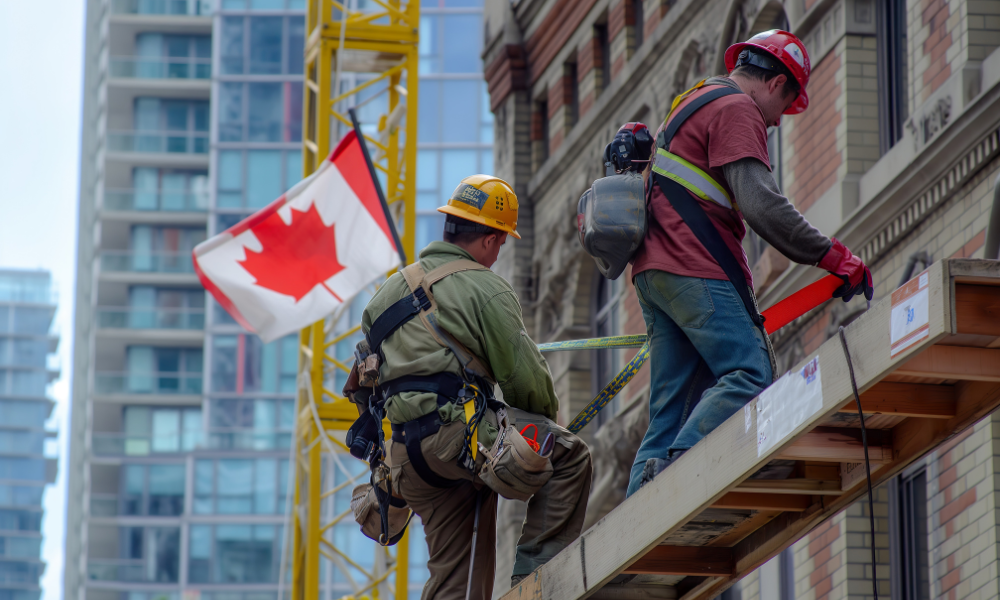
 The looming threat of U.S. president Donald Trump’s tariffs on Canadian goods is more than just an economic challenge—it’s a direct threat to workplace safety. Across forestry, mining, manufacturing, and oil and gas, industry leaders warn that uncertainty surrounding these tariffs is creating dangerous distractions for workers in high-hazard environments. The result? Increased mental stress, loss of focus, and a heightened risk of workplace incidents. …Mike Parent, president and CEO of Workplace Safety North, says this distraction isn’t just theoretical—it’s already affecting worker morale. In forestry alone, existing tariffs on softwood lumber are squeezing the industry, and an additional 25% tariff could push operating costs to unsustainable levels. “This could just completely decimate the logging sector,” Parent adds. …The stress of economic uncertainty doesn’t just cause momentary lapses in concentration—it contributes to long-term mental health challenges. Anxiety, fatigue, and reduced resilience can lead to burnout, increasing the likelihood of accidents.
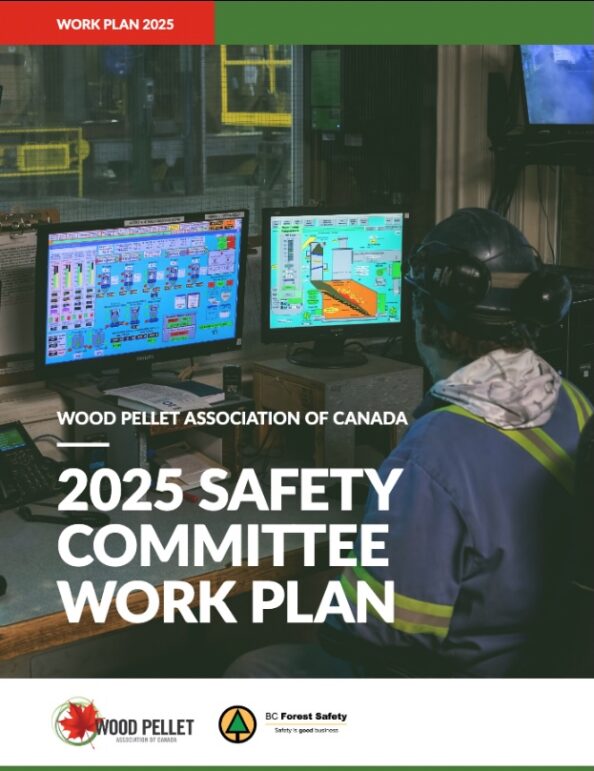 I can’t believe it has been over a decade since the Wood Pellet Association of Canada’s (WPAC’s) Safety Committee was established. Our initial focus was combustible dust in response to tragic sawmill explosions in British Columbia. Over the years, activities have expanded to all health and safety matters. The committee’s mission is “to improve the wood pellet industry’s collective safety performance, earn a reputation with regulatory authorities and the public as an industry that is highly effective at managing safety, and learn and share best practices regarding safety.” As we enter 2025, I want to reflect on a few past successes and share our
 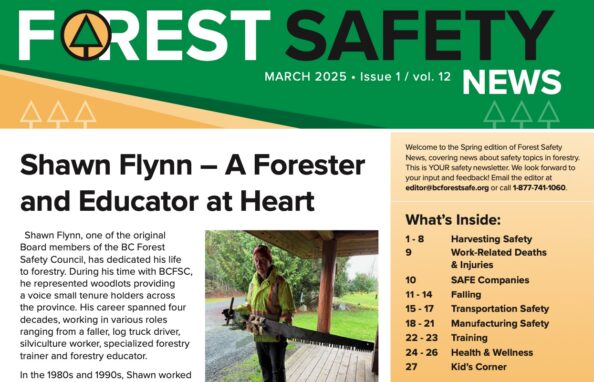 Don’t miss the March edition of the BC Forest Safety Council newsletter. It’s jam-packed with information about Safety Heros like Shawn Flynn and Brian Penny. Health updates about pain management, off-road vehicles, managing the last of the snow and daylight savings! How do you stay safe when you find yourself under water? Does your team have an emergency response plan? Plus, what’s new, upcoming events, and even a cheerful rabbit for you to colour in your down moments! Check out this month’s BC Forest Safety News
 The Alberta Occupational Health and Safety Appeal Body has denied an appeal from a West Fraser Mills worker who was suspended for one day without pay and received a disciplinary letter that he claimed was retaliation for acting in compliance with workplace safety rules. The appeal panel upheld the original ruling, noting that it properly applied the standard of review in determining the employer had met its burden of proof. The case involved S.G., an employee of West Fraser Mills Ltd., operating as Ranger Board. S.G. filed a complaint under section 19 of Alberta’s Occupational Health and Safety Act (the Act), alleging the discipline was imposed in retaliation for acting in compliance with occupational health and safety requirements.
 A B.C. company has been fined just under $9,000 for the death of a worker. A WorkSafeBC penalty summary posted online says Crescent Bay Construction Ltd. was fined $8,995.26 on Jan. 23 for the incident at a worksite in Beaton, located south of Revelstoke on the shores of Upper Arrow Lake. “This firm was performing maintenance work on a bridge deck on a forest service road,” said the penalty summary. “WorkSafeBC attended the site after a worker was struck by a tree that fell from a cliff face above the work area. The worker sustained fatal injuries.” WorkSafeBC says their investigation determined “the firm did not adequately identify the hazard of dangerous trees or assess the risks they presented to workers.” The company also failed to “conduct a dangerous tree assessment by a qualified person before work began and failed to ensure the health and safety of all workers at the worksite, both high-risk violations.”
 Consultation on proposed B.C. Exposure Limits (ELs) based on the new or revised 2021, 2022, 2023, and 2024 ACGIH TLVs for selected chemical substances. The American Conference of Governmental Industrial Hygienists (ACGIH) regularly publishes a list of substances for which they have set new or revised Threshold Limit Values (TLVs). A TLV is the airborne concentration of a chemical substance where it is believed that nearly all workers may be exposed over a working lifetime and experience no adverse health effects. TLVs may be expressed as an 8-hour time-weighted average (TWA), 15-minute short-term exposure limit (STEL), or ceiling limit. Before adopting new or revised TLVs published by the ACGIH, WorkSafeBC reviews relevant data on health effects and the availability of validated sampling methods. …We are requesting stakeholder feedback on the proposed B.C. ELs for 22 substances. Feedback will be accepted until 4:30 p.m. on Friday, March 14, 2025.
 A division of a forestry and construction company with an office in Prince George lost a review of an arbitrator’s decision that awarded fallers $4,000 each for breach of privacy. At issue was the installation of dash cameras in the company’s four-wheel drive pickups in Campbell River… They began installing the dash cameras in February 2023, prompting the United Steelworkers, Local 1-1937 (USW) to file a grievance. They stated the purpose for the rear-facing dash camera included “road conditions not seen by the forward-facing camera” and monitoring “distractions in cab – eating, texting, smoking, horseplay.” USW did not take issue with collection of GPS information or video from the forward-facing cameras while the crew bus was in motion. Its grievance was about the audio and video collected by the rear-facing camera and video by the forward-facing camera while the vehicle was idle.
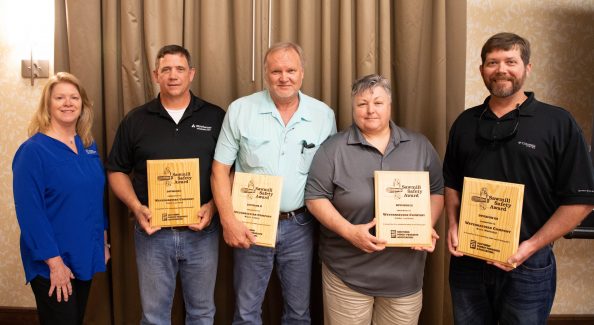
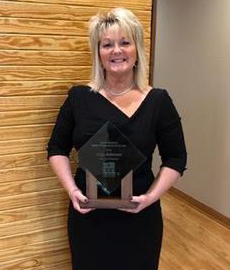
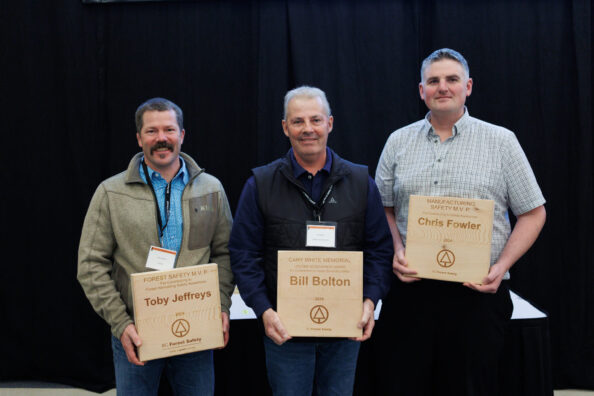 In 2008, BCFSC introduced the Leadership in Safety Awards, celebrating individual safety achievements in forestry. Award recipients are recognized in three categories including safety in harvesting, manufacturing and lifetime achievement. Nominations for leaders in forestry safety can be an individual, crew, team, division, contractor, company, supplier, consultant, trainer, etc. for outstanding safety leadership or achievements. There are three award categories for Leadership Safety. The Cary White Memorial Lifetime Achievement Award is presented to someone who has demonstrated an unwavering commitment to improving safety awareness. The Forest Safety Most Valuable Player recognizes an individual or group that has made a notable contribution to forest industry safety within their operation or company. And finally, the Manufacturing Safety Most Valuable Player recognizes an individual or group that has made a notable contribution to wood products manufacturing safety within their operation or company. Deadline for 2025 nominations is September 23, 2025.
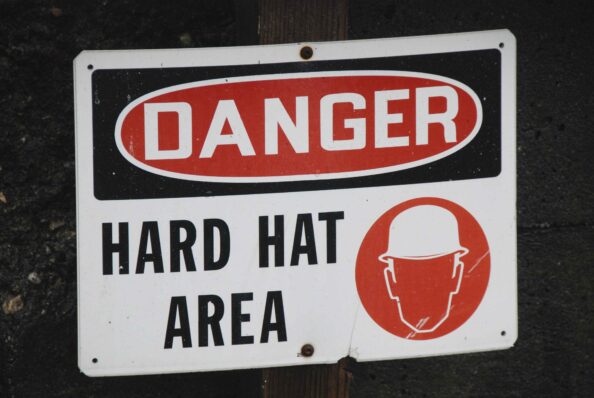 A Washington timber company has been fined nearly $115,000 for child labor violations after a 17-year-old worker was injured while working in a logging operation. The Washington State Department of Labor & Industries issued the citation against MVR Timber Cutting Inc. following an investigation into the incident. The investigation began in May 2024 when L&I received a report of a workplace injury involving the teen, who fractured his foot while jumping between tree stumps. Upon learning that the minor was working as a member of the company’s logging crew, L&I expanded its investigation. …In January, L&I fined MVR Timber Cutting Inc. $56,000 for allowing the minor to work in logging operations 56 times. State regulations prohibit minors under 18 from working in jobs requiring more extensive personal protective equipment than boots, gloves, and safety glasses. Additionally, state law bans teens from working in hard hat zones, prompting L&I to issue an additional $56,000 fine for the 56 violations of that regulation.
 Firefighters in southern California are battling the Palisades and Eaton Fires. …Residents of many fire-prone areas have grown familiar with the orange, apocalyptic haze of wildfire smoke as these blazes have become more common because of climate change. Such smoke can contain an unpredictable cocktail of chemicals associated with heart and lung diseases and even cancer, which is the leading cause of death among firefighters. Here’s what makes wildfire smoke so dangerous. When trees, shrubbery and other organic matter burn, they release carbon dioxide, water, heat—and, depending on the available fuel, various volatile compounds, gaseous pollutants and particulate matter. Those tiny particles, which become suspended in the air, can include soot (black carbon), metals, dust, and more. If they’re smaller than 2.5 microns in diameter, they can evade our body’s natural defenses when inhaled, penetrating deep into the lungs and triggering a wide variety of health problems.


 …Endless hours in front of devices are quietly rewriting the blueprint of childhood, reshaping the way that young people think, interact, develop, and experience the world. Young people today spend between 5 and 9 hours staring at screens, but less than 10 minutes a day enjoying time playing in nature. The result? Rising rates of anxiety, body image dissatisfaction, reduced attention spans, waning creativity, and sleepless nights. Brain scans show kids glued to screens experience premature thinning in the prefrontal cortex—the brain’s control centre for impulse control, attention, emotional regulation, and decision-making. …But there is a solution… The antidote is far simpler than reducing screen time. It’s the original technology: nature. …One movement helping to lead this reconnection is the forest school. Forest schools are built on a simple but radical idea: the best classroom doesn’t have walls. Here, nature is a teacher.