 In his victory speech—Canadian Prime Minister Carney pledged to double the number of homes built annually. Meanwhile: LEED’s new Green Building Standard [v5] focuses on health and well-being of occupants and communities; mass timber projects lead to greater workplace wellness; Domtar’s new wastewater system in Tennessee is still pending; UFP Industries and Stora Enso report positive Q1, 2025 results; and Oregon pursues a new lumber grading system.
In Forestry news: Fort Nelson Community Forest secures wildfire risk reduction grant; the US plan to increase logging is challenged by staff reductions—puts the Endangered Species Act at risk; and recent tweaks to simplify the EU deforestation law spark debate.
Finally, BC Premier David Eby honours those lost on Canada’s National Day of Mourning.
Kelly McCloskey, Tree Frog News Editor


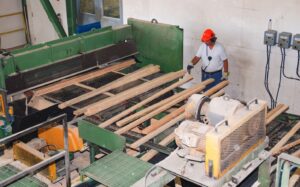 SALEM, Oregon — The Oregon Senate on Monday passed a bill to establish a lumber-grading pilot training pilot program. “This bill opens the door for small sawmill operators to participate in local housing solutions,” said Sen. Todd Nash, R-Enterprise, the bill’s sponsor. “Forty years ago, Eastern Oregon had 69 mills. Today, only seven remain. This is a practical step to support rural economies and increase housing options using locally sourced materials.” Senate Bill 1061, otherwise known as the Oregon Forests to Homes Act, would operate through Oregon State University’s Extension Service, in partnership with the Department of Consumer and Business Services. …Once certified as a grader, a mill owner could sell his lumber directly to a builder. Certified small sawmill operators will be able to sell lumber directly to homeowners or their agents for use in single-family homes or duplexes.



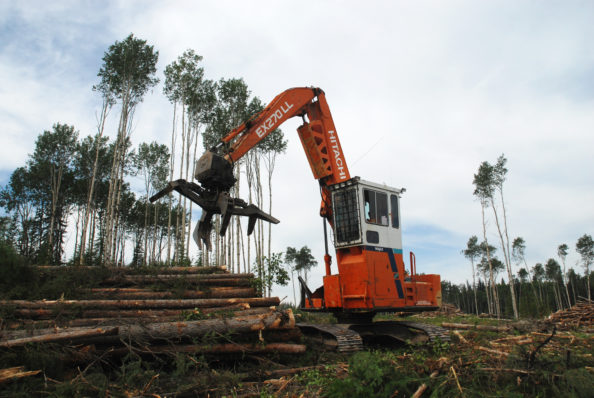 …As northern B.C. sawmills have closed over the past few years, a common refrain has been in each company press release. Punishing tariffs, high log costs, lack of access to B.C.’s plentiful timber and uncertainty in permitting processes… Is this the opening we need to dispense with the notion we need to begin turning B.C. into one big park for the world to enjoy? …Although B.C. has lost many of our lumber manufacturing facilities, our main ingredients are still here – our forests, its trees and a workforce, which when combined, provides for some of the best quality forest products in the world. Despite the economic hit our rural communities and residents have sustained with the loss of our forest industry, it is only a temporary setback, if we treat it as such, and do not let our governments succumb to the “end the forest industry” ideology that is so prevalent today.
 A big change could be coming to U.S. wildlife conservation policy. In mid-April, the National Oceanic and Atmospheric Administration and U.S. Fish and Wildlife Service announced a proposal to change how the term “harm” would be defined in the Endangered Species Act. …According to Paula Swedeen, policy director at Conservation Northwest, the goal of the change is to bring the definition of “harm” in the ESA closer to what the Trump administration believes is its originally-intended meaning. …Washington state has its own conservation plans that are already in place on state lands. According to Swedeen, there’s reason to think that the changes to the ESA won’t impact those too much. …According to Swedeen, the spotted owl is one of the best examples of how endangered species could be put at risk by the proposed new ESA reading. …changes could also impact other endangered species in Washington, like the grizzly bear
 BRUSSELS – For fashion companies grappling with the EU’s ambitious anti-deforestation law, a recent tweak from the European Commission may appear to offer some relief. As the December deadline looms for the landmark EU Deforestation Regulation (EUDR), Brussels has eased what some companies claimed were daunting reporting requirements. Instead of the initially mandated declaration for every shipment of goods linked to forest destruction, companies now only need to submit a single annual due diligence statement. …The Commission hopes this new simplification – which also includes allowing authorised representatives to file for company groups and enabling reuse of statements for re-imported goods – will shave off a significant 30% in reporting burdens and associated costs for affected businesses. However, the EU Commission’s simplification is being met with concern by environmental campaigners. As Reuters reported, the streamlining of paperwork has sparked fears that the teeth of the EUDR might be blunted.
 VANCOUVER, BC — Svante Technologies, a leader in carbon capture and removal technology, announced that its joint carbon capture and storage project with Mercer International has advanced to the Front-end Engineering and Design Phase 2 (FEL-2). Also known as Pre-FEED, this phase involves engineering, cost estimation, and risk analysis to evaluate the project’s commercial viability. …The carbon capture project targets biogenic CO2 emissions from Mercer’s Peace River pulp mill, where the biomass is sourced from sustainably managed forests. Advancing to the Pre-FEED stage will support further development of the integrated design, cost estimates, and risk assessments—key steps toward a final investment decision and potential implementation. …Utilizing a Novel Carbon Capture Technology for Commercial Deployment, Svante’s second-generation capture technology maximizes low-grade waste heat from pulp mills, reducing energy consumption and increasing cost-effectiveness.