 Irving Paper will close half its Saint John, New Brunswick operation due to ‘uncompetitive’ electricity rates. In other Business news: Trump says tariffs on Canada and Mexico ‘will go forward’; how the tariff threat is already driving up housing costs; and BC’s Legislature votes to condemn the tariff move. In related news: the US just launched its 7th review on lumber duties; while BC’s opposition leader says the province should fight back with counter measures.
In Forestry/Climate news: Canada signs nature agreement with Northwest Territories; a BC ENGO calls for caribou habitat protection; US forestry firings wreak havoc in rural economies; will the Fix our Forests Act work; and this CEO says climate change is about economics not politics. In Wood Product news: innovations courtesy of Eco Guardian, Sterling Structural, and Cambium; and is it time to normalize mass timber construction?
Finally, a special feature on Trump’s re-emergence and political risk in Canadian forestry.
Kelly McCloskey, Tree Frog News

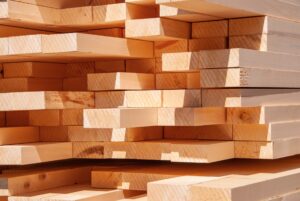 The U.S. Department of Commerce initiated the
 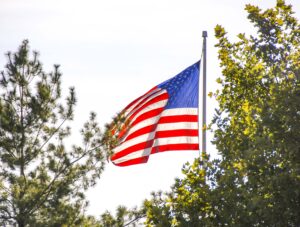 Trump’s executive order to implement 25% tariffs on all Canadian imports, with a lower 10 per cent levy on Canadian energy, was delayed until March 4. …Foreign Affairs Minister Melanie Joly said Monday that Canada needs to send the message it will “fight back” after U.S. President Donald Trump said steep tariffs are indeed coming next week. In a press conference with French President Emmanuel Macron at the White House on Monday, Trump was asked directly whether he was moving ahead with levies against America’s closest neighbours. …While the original executive order was tied to the flow of deadly fentanyl, the president said earlier this month the pause would allow time to reach a “final economic deal.” Prime Minister Justin Trudeau spoke to Trump by phone Saturday ahead of Monday’s virtual G7 meeting… updating the president on efforts at the Canada-U.S. border to counter trafficking in fentanyl.


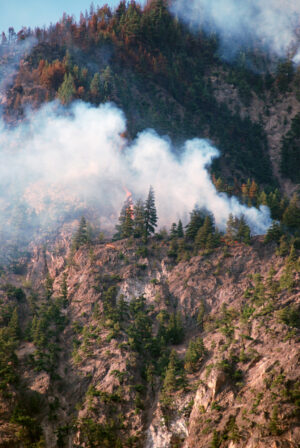
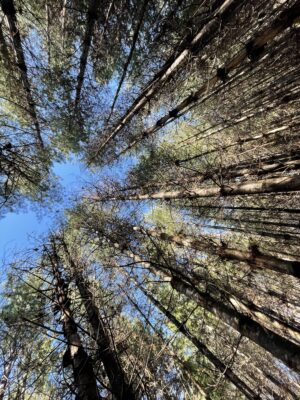 The Kaslo and District Community Forest Society (KDCFS) revisited previous board discussions about future logging plans needed to mitigate fires. During a Feb. 20 meeting, KDCFS members highlighted the demand for cedar and fir while highlighting that several blocks of hemlock trees have been damaged by past fires, rendering some unusable. The Briggs Creek fire that occurred in 2022 led to the destruction of many hemlock trees that will need to be harvested in the next two years before deteriorating. Society forester and treasurer Jeff Mattes explained that the society’s logging plans for the year 2025 will include utilizing a patch-cut system to reserve some of the trees. A patch-cut system refers to the removal of an entire stand of trees less than one hectare.
 Devices used to detect and prevent wildfires in remote forests are expensive, but the one that Northeastern University student Anson He is making will be cheaper to launch on drones over dense woodlands. He is pursuing his master’s degree in computer science at Northeastern’s Vancouver campus. In January, he started a co-op at Bayes Studio — a Vancouver company that uses robotics and machine learning to make forest fire detection tools. He is helping to produce a device that uses less expensive components than others on the market. His role is core to the small company’s success: He is in charge of prototyping the hardware and coding the software for what Bayes calls its Edge device. Other team members work on integrating artificial intelligence into the device’s functionality and connecting the device to servers.
 YELLOWKNIFE, NT
 After a century of wildfire suppression across the West, it’s no secret that the approach to forest management has needed to change. And change is, and has been, underway. But newly proposed changes, now in the form of legislation that would let fuel mitigation projects, including logging, in high-risk zones like the forest surrounding Durango skirt the public input process have some environmental groups up in arms. The
 Consultation on proposed B.C. Exposure Limits (ELs) based on the new or revised 2021, 2022, 2023, and 2024 ACGIH TLVs for selected chemical substances. The American Conference of Governmental Industrial Hygienists (ACGIH) regularly publishes a list of substances for which they have set new or revised Threshold Limit Values (TLVs). A TLV is the airborne concentration of a chemical substance where it is believed that nearly all workers may be exposed over a working lifetime and experience no adverse health effects. TLVs may be expressed as an 8-hour time-weighted average (TWA), 15-minute short-term exposure limit (STEL), or ceiling limit. Before adopting new or revised TLVs published by the ACGIH, WorkSafeBC reviews relevant data on health effects and the availability of validated sampling methods. …We are requesting stakeholder feedback on the proposed B.C. ELs for 22 substances. Feedback will be accepted until 4:30 p.m. on Friday, March 14, 2025.