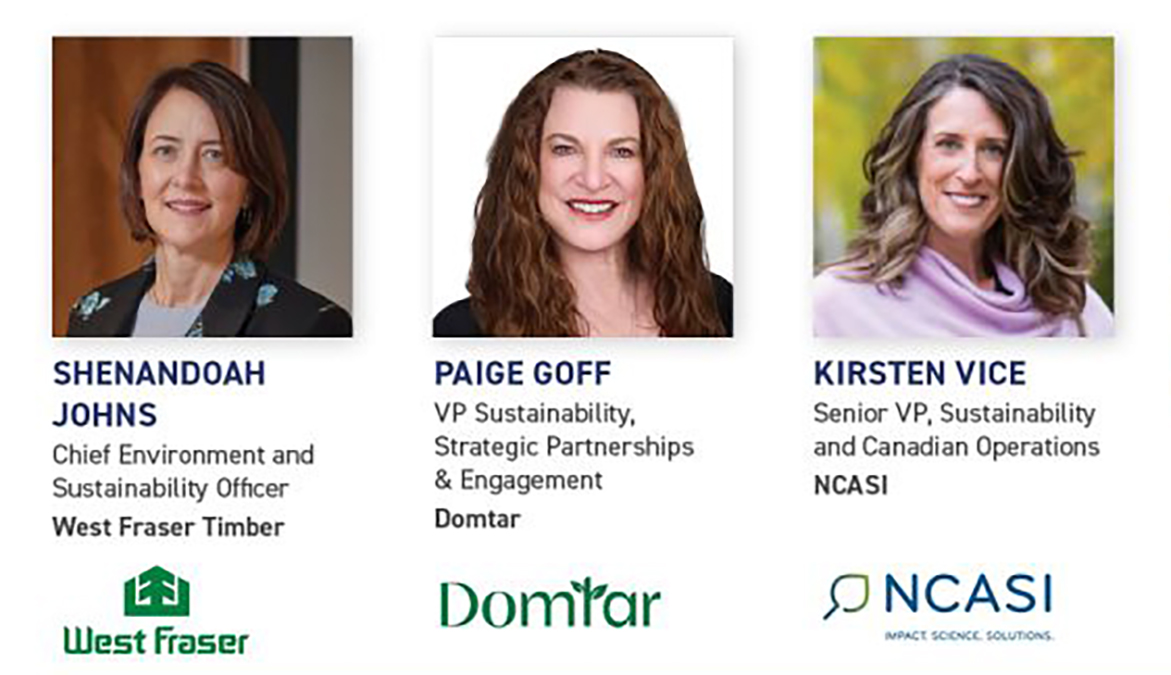
 The second day of the 2026 SFI Annual Conference opened with a panel that cut to one of the more consequential questions facing the forest sector: as global disclosure frameworks multiply and investors demand quantifiable outcomes, does forest certification still do the job? The session — Leveraging SFI Certification for Global Reporting Frameworks and Market Assurances — brought together sustainability executives from West Fraser, Domtar, and the National Council for Air and Stream Improvement (NCASI), moderated by SFI President Jason Metnick. Before introducing the panelists, Metnick noted that SFI had released an interactive crosswalk tool on its website mapping three major frameworks — the Task Force on Nature-Related Financial Disclosures (TNFD), the International Sustainability Standards Board (ISSB), and the EU taxonomy — against SFI’s forest management and fibre sourcing requirements. He described it as a version 1.0, with updates planned as the sector’s needs become clearer.
Shenandoah Johns, Chief Environment and Sustainability Officer at West Fraser, opened with a historical frame. She traced the emergence of certification to the early 1990s, when a binding international convention on forests was blocked at the Rio Earth Summit — blocked, she noted, largely by lack of alignment among developing nations. In the absence of a UN treaty, industry, environmental groups, and Indigenous communities built certification as a voluntary alternative. “If you think about it, that was a remarkable thing to do,” Johns said. She then walked through the five major disclosure frameworks that have arrived in the last five years alone: ISSB, the European Union Deforestation Regulation (EUDR), TNFD, the Corporate Sustainability Reporting Directive (CSRD) in Europe, and Canadian securities disclosure requirements still under development. Each, she said, asks for nature data that current certification audit processes cannot answer. “They each ask for nature data that we can’t answer at this time through the certification audit process.”
The core tension Johns identified was between what certification was designed to do — demonstrate management practices and due diligence — and what regulators and investors are now asking for: location-specific, landscape-scale ecological outcomes. “What I mean by outcomes-based regulation is tell us you want healthy forests. Let us figure out how we’re going to deliver the answer for that.” She described West Fraser’s 2024 pilot project as an early adopter of the TNFD standard, running the full 600-page framework against its Alberta operations. What the pilot revealed was that the data needed to answer TNFD’s questions already exists — but it lives across a wide ecosystem of external sources: government databases, the Alberta Biodiversity Monitoring Institute (ABMI), Natural Resources Canada, satellite monitoring, and global science repositories. Her conclusion was not that certification should be replaced, but that it needs to work alongside a broader data infrastructure. “It’s not certification or disclosure. It’s both.”
Paige Goff, VP of Sustainability, Strategic Partnerships and Engagement at Domtar, took a different angle. Rather than the disclosure landscape, she focused on what SFI certification means on the ground — particularly in the context of small private landowners in the southeastern United States, where Domtar sources much of its fibre. She described the trust-building required to bring landowners of 150 acres or less into a certification process, many of whom hunt and hike their own land and experience an audit as an intrusion. What she hears consistently from those landowners, she said, is that SFI is understandable, not invasive, and that it gives acknowledgment to practices they were already following. “If anything, you’re putting pen to paper.” She also pointed to the consistency of SFI standards — which do not change outside scheduled revision cycles — as a significant practical asset for companies trying to explain their practices to customers and financial institutions. Her bottom-line was a note of caution against overreach: “Fundamentally, we’re doing the right stuff. Let’s not make things more out of it than it is.”
Kirsten Vice, Senior Vice President of Sustainability and Canadian Operations at NCASI, provided the broadest analytical frame of the three. She walked through five converging trends reshaping societal expectations of the forest sector — demographic shifts, changes in global economic power, accelerating urbanization, pressure on natural resources, and technology proliferation — and overlaid these with three nature-related challenges the sector sits at the centre of: climate, biodiversity, and land use competition. “This is one of the only sectors next to agriculture that is profoundly implicated in all three, and therefore has significant risks but significant opportunities.”
On reporting, Vice traced the evolution from voluntary sustainability disclosure toward mandatory financial risk reporting — a shift she said was accelerating now that the International Financial Reporting Standards (IFRS) Foundation, the body that sets financial accounting regulations, has begun incorporating nature-related frameworks into its standards. “Even if a company were to choose not to participate in some of these frameworks, their financial accounting regulations may soon require it.” She flagged 2026 specifically as a year of influence: a nature measurement protocol is under development, and TNFD is being incorporated into the ISSB system this year. The sector, she said, has been largely absent from those discussions. “There is an opportunity for the sector to start to try to shift the perception of where forest management fits in in all of this.” She called for the sector to frame its own targets and goals rather than waiting for external bodies to define them, and to use science-based organizations such as NCASI to build the indicator and metrics foundation that future reporting will require.
The Q&A surfaced one exchange that added meaningfully to the presentations. Metnick asked all three panelists how the sector should better tell its story — whether that was a certification issue, an association issue, or something else. Vice said linking forest management to forest resilience, and in turn to the resilience of communities and wildlife, was “just about the only thing you can do” given the scale of the communication challenge. Johns, drawing on her experience piloting TNFD and preparing West Fraser’s European operations for EUDR compliance, said the disclosure work alone was consuming enormous capacity, and that communicating beyond those frameworks was an additional burden companies were struggling to carry. Goff returned to a theme from her presentation: the industry simply hasn’t done enough to promote what it’s already doing. “We just, as an industry, we haven’t done well in bragging on ourselves and making sure that we tell this story.”
Drafted with the assistance of digital tools to streamline the process.