 Forestry Innovation Investment (FII) is proud to share our “Year in Review”, a compilation of market development activities completed by FII and our many industry, association, government, academic, and research partners over the past year. Throughout 2024/25, B.C.’s forest sector faced significant headwinds, as difficult industry and market dynamics were compounded by trade threats. Despite these ongoing challenges, the forest sector continues to play a vital role in B.C.’s economy and remains a key global supplier of sustainable forest products and advanced wood building systems. To support a resilient forest economy, FII and its partners are actively working to diversify markets for B.C. forest products both domestically and internationally—a goal that has become increasingly important amid current trade uncertainty. Our commitment to a collaborative delivery approach means we build on the strengths and shared resources that other organizations bring to this important work.
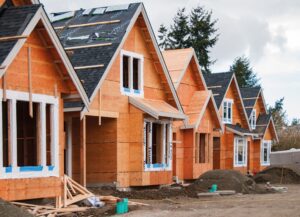 The NDP government is making changes to development cost charges that builders say could help reduce the burden they face as material and labour costs continue to increase and the number of projects under construction drop. Starting in 2026, builders will only have to pay 25 per cent of their fees to municipalities up front and will be able to defer the remaining 75 per cent for four years or until people move into the building. The fees help cover the cost of infrastructure such as community centres, roads, sewers and parks. The changes will also allow developers to use bonds instead of irrevocable letters of credit as financial guarantees, allowing them to preserve access to capital throughout the project. Wendy McNeil, CEO of the Homebuilders Association Vancouver, said the changes will allow builders certainty when it comes to the cost of the project and the timeframe for making payments to municipalities.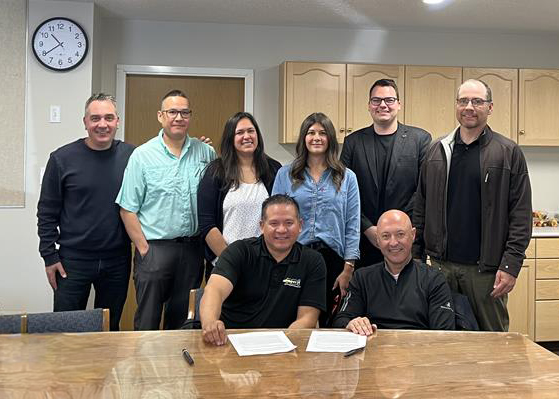
 Domtar (formerly Paper Excellence) has signed a purchase agreement with Cranberry Business Park Ltd. for the sale of the remaining half of its lands at the former Tis’kwat paper mill site in Powell River. “We are looking forward to contributing to the economic future of Powell River and the region,” stated Craig Austin and Thomas Ligocki, from Cranberry Business Park Ltd., in a media release. “With waterfront access and abundant energy sources, this site has so much potential. We are proud to be part of the revitalization of the city’s Historic Townsite, alongside our neighbour at Tis’kwat, the Tla’amin Nation.” “It was a priority for Domtar to find a buyer who would ensure that the lands continue to generate jobs and economic benefit for the broader community well into the future,” stated Carlo Dal Monte, vice-president, Domtar Legacy Assets.
 MACKENZIE — The District of Mackenzie has seen challenges in recent years with a downturn in British Columbia’s forestry industry, but Mayor Joan Atkinson said that diversifying into other industries has made a big impact on her community. … “We suffered a huge loss in taxation from 2024 to 2025 as a result of the closure of two large industrial facilities, but this community has always been resilient,” said Atkinson. …Canfor said it was indefinitely curtailing activity at its Mackenzie sawmill in July 2019. … Paper Excellence permanently shuttered its Mackenzie pulp mill in April 2021. Atkinson noted two factors that have helped the local forestry industry. The first was Forests Minister Ravi Parmar announcing a change in an appraisal system that makes it more economically viable for companies to operate in Northern BC. The second is ownership of nearby timber supply areas by First Nations.


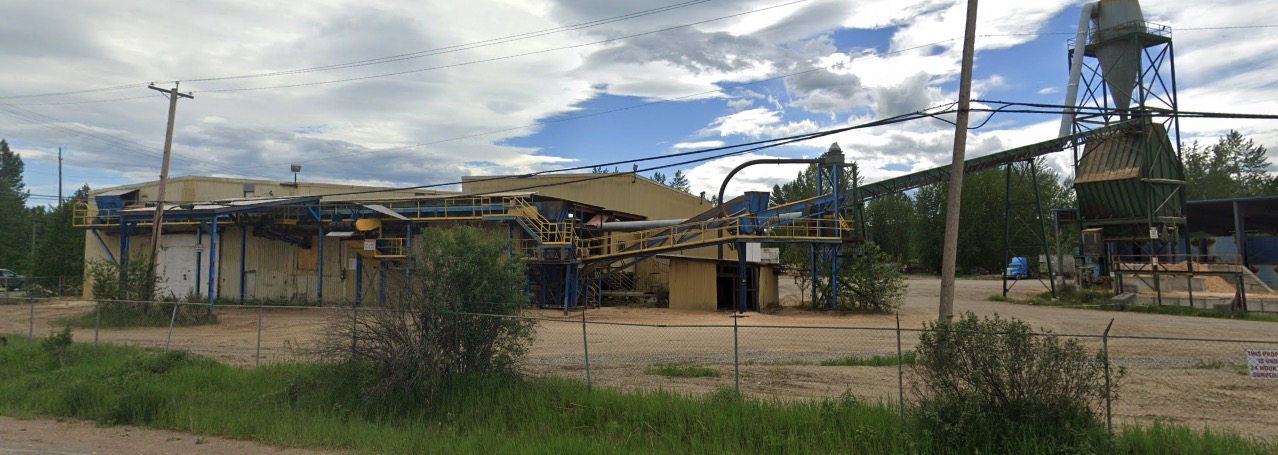 The East Fraser Fibre mill in Quesnel was on fire Saturday, June 21, closing a stretch of Highway 97 at the intersection with Quesnel-Hixon Road. Firefighters from multiple departments including Quesnel Volunteer Fire Department (QVFD), Ten Mile Volunteer Fire Department and Barlow Creek Volunteer Fire Department responded to the blaze. “On arrival we had heavy smoke and flames exiting the roof of the building,” said QVFD chief Ron Richert. “Crews were on scene for almost 12 hours, until seven o’clock in the morning.” Crews were also called back to the East Fraser Fibre building to manage hot spots, where small fires in some areas of the building or grass outside flared up. Richert said the building is now clear of fibre but it is still under investigation.
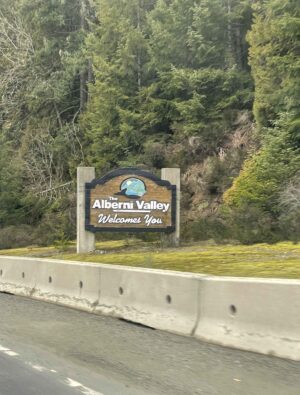 Two industrial properties in the Alberni Valley that were shuttered when San Group declared bankruptcy last year have been sold. The Coulson Mill, located a few kilometres up the Alberni Inlet, has been purchased for an undisclosed amount by Fraserview, a Surrey company that has been producing manufactured wood products since 1994. The remanufacturing plant on Stamp Avenue has been sold to a numbered company, 037BC, which will in turn lease the premises to IGV Housing Ltd. This company, from Ucluelet, specializes in manufacturing scalable and sustainable housing using a hybrid construction system, according to court documents. The company intends to “revitalize the…plant as a central hub for prefabrication and production of affordable housing.” Again, the purchase price was not disclosed. The closing date for the reman plant purchase will be before June 30, 2025.
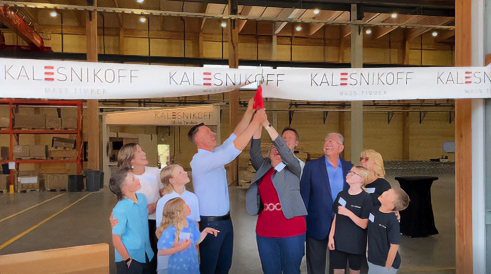 Kalesnikoff Mass Timber recently opened its new 100,000-square-foot mass timber prefabrication and modular facility in Castlegar, B.C., 400 miles east of Vancouver. Starting small just before the Second World War, Kalesnikoff today is a family-owned, fourth-generation company that produces dimensional lumber, glulam beams and columns, glue-laminated timber (GLT) panels, cross laminated timber (CLT) and prefabricated components. The new facility, which is built entirely out of Kalesnikoff’s own mass timber… enables Kalesnikoff to provide new products that can be used for prefabricated walls, flooring, modules and full modular construction. Chief operating officer Chris Kalesnikoff says it’s the first vertically integrated mass timber operation in North America. Kalesnikoff was started by Chris’s great-grandfather and two of his brothers in 1939 as a logging operation. His grandfather and his father (Ken) expanded the sawmill into value-added wood products.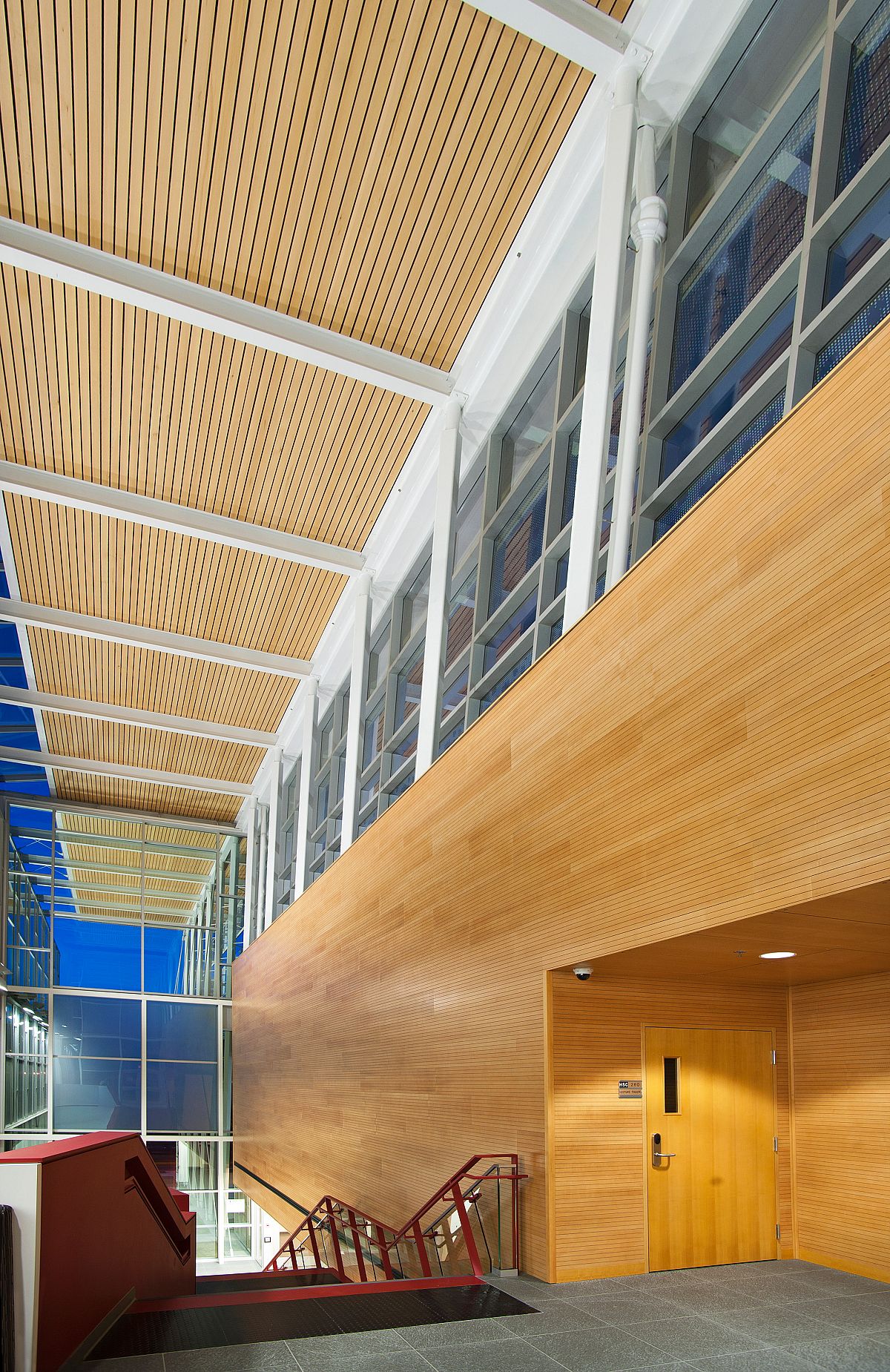
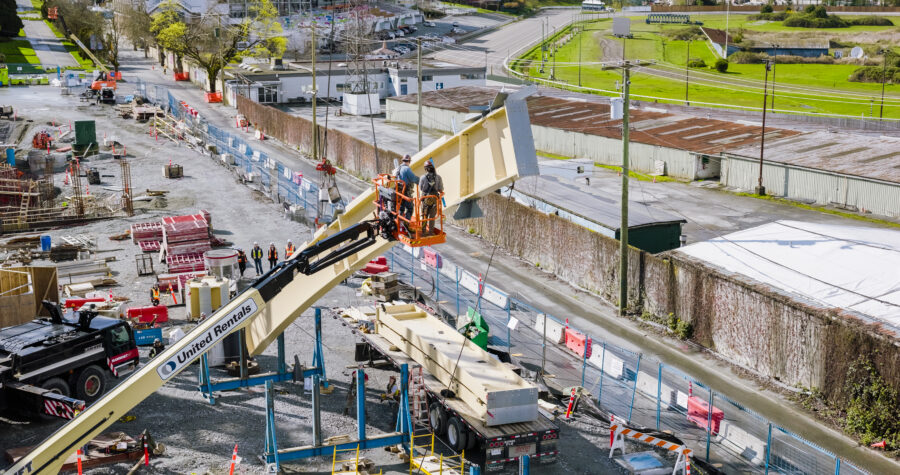
 The Kelowna International Airport (YLW) is proud to share a significant project milestone for Airport Terminal Building (ATB) expansion – the mass timber roof structure of the facility is now complete. The use of mass timber throughout the terminal building expansion highlights the airport’s commitment to sustainability, innovation and community reflection in this project. YLW received $500,000 from the Province’s Mass Timber Demonstration Program, which aims to grow B.C.’s mass timber and engineered wood products industry and position B.C. as a world leader in wood design, engineering and construction. An important design consideration for the ATB Expansion is to incorporate characteristics that showcase our local community. The use of mass timber plays a meaningful role in conveying our region’s natural beauty, heritage and character.
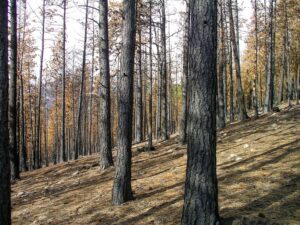 WHITEHORSE, Yukon — Communities in southern Yukon will reduce their wildfire risk after a combined investment of more than $17 million from the federal and Yukon governments. The funding was announced by Dr. Brendan Hanley, Parliamentary Secretary to the Minister of Northern and Arctic Affairs and Member of Parliament for Yukon. …Funding for the Government of Yukon’s Wildland Fire Management branch will decrease fire risk in the communities of Whitehorse, Teslin, and Haines Junction—communities which are part of the northern boreal forest region and prone to aggressive wildfire behaviour. …New treatment will include reducing or managing materials that are flammable or combustible in the wildland-urban interface. These measures follow national standards set out by FireSmart Canada and will increase the wildfire resilience of these three communities.
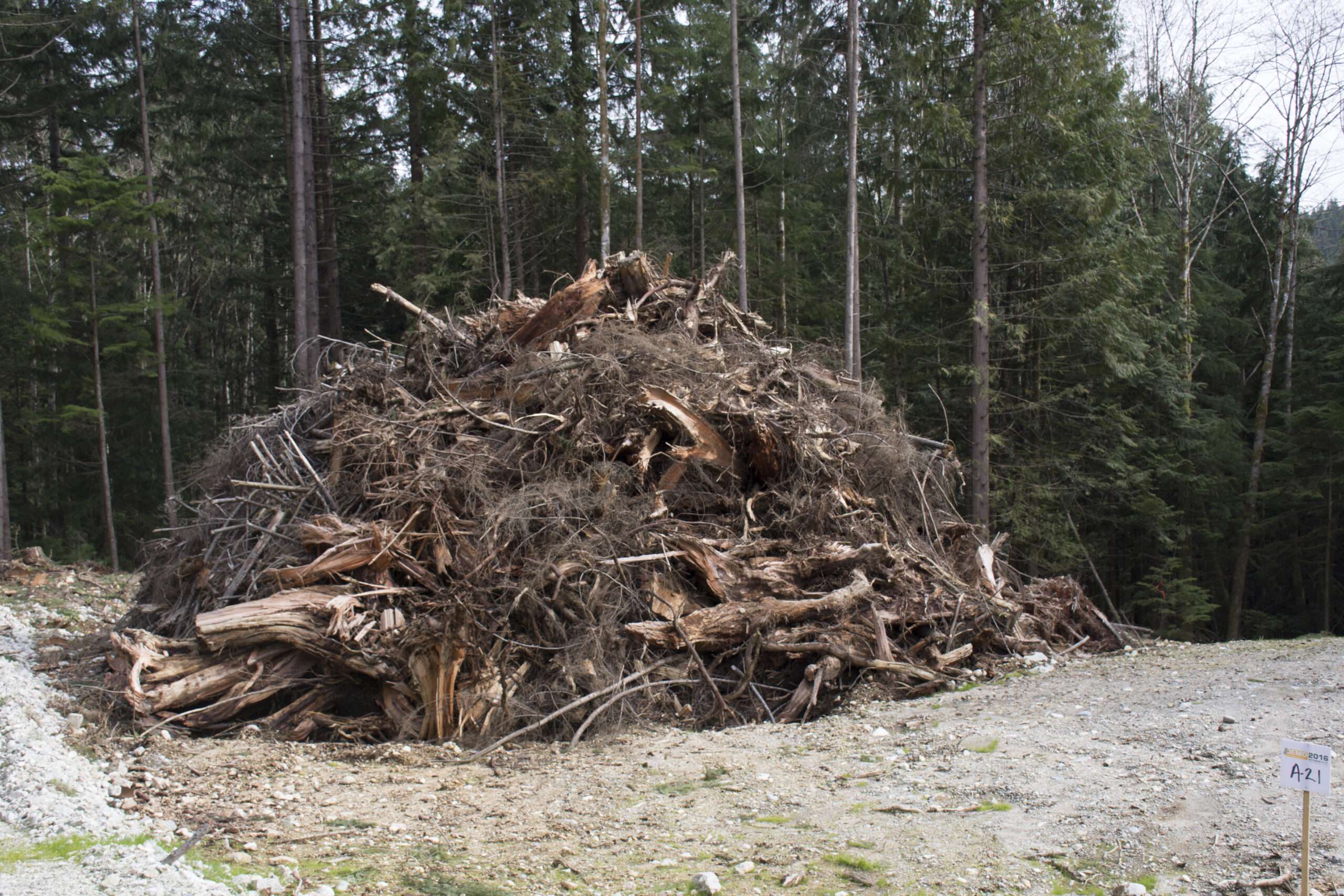 On the Easter long weekend, there was a wildfire on Egmont Forest Service Road that had to be controlled by the local fire department because a logging slash pile being burned was left unattended. How big does a wildfire have to get before the shíshálh Nation or the province will finally fulfill their promises to the residents around North Lake in Egmont? …Four years ago we participated in a community engagement process with BC Timber Sales and the shíshálh Nation regarding the cutting of 60,000 cubic metres (thousands of trees) around North and Klein Lakes. …One of the bigger concerns that we had was the removal of hundreds of large burn piles created by the logging. We were promised by both BCTS and the shíshálh Nation that the burn piles would be dealt with after the logging ended. It is now two years later and the burn piles have not been removed.
 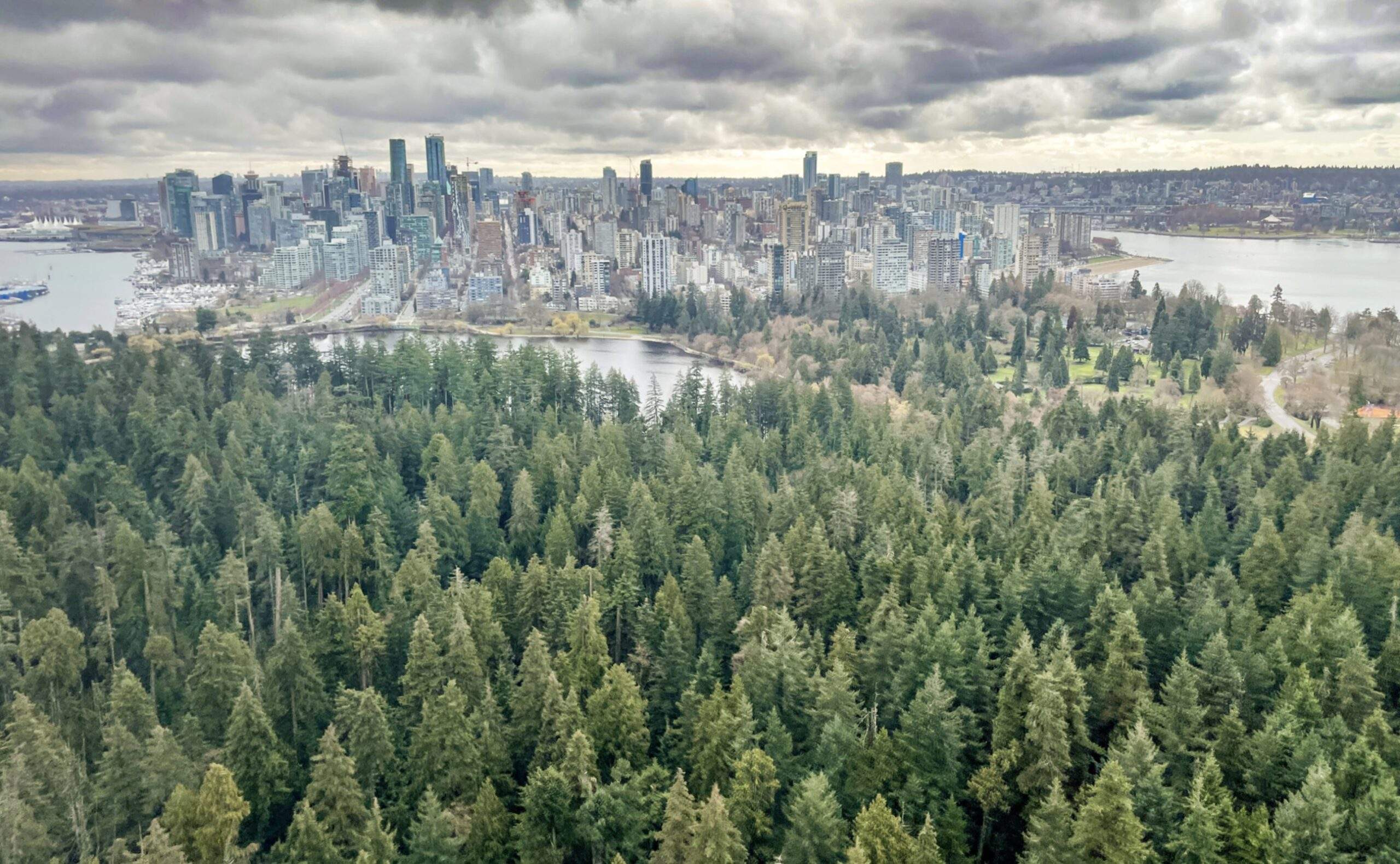 Four years ago, British Columbia endured the deadliest weather event in recorded Canadian history. The 2021 heat dome claimed the lives of more than 600 people, many of whom died alone in overheated homes. As we mark the fourth anniversary of this devastating mass casualty event with record-breaking heat elsewhere in the country, we must confront a troubling truth: B.C. remains dangerously unprepared for the next one. Despite some advancements, including updated building codes, rebates for heat pumps and a now-depleted $30-million fund to provide vulnerable households with air conditioning units, one of the most critical aspects of climate readiness has seen little to no progress. In fact, it’s getting worse. Our communities are rapidly losing tree canopy, green space and permeable surfaces — the very elements that keep cities cooler during extreme heat.
 Llenllenéy’ten (High Bar) First Nation (HBFN) has signed a historic Joint Development Agreement (JDA) with West Fraser Timber Co. Ltd. (West Fraser). The JDA was signed during HBFN’s National Indigenous Peoples Day event in Clinton on June 21. A press release issued by High Bar on June 24 stated that “The landmark agreement highlights HBFN’s commitment to sustainable forest management through partnership with the private sector to achieve mutually beneficial outcomes.” The relationship ensures fibre supply for West Fraser, and opens the door for more diverse fibre product development. At the same time, HBFN notes that the agreement creates a path toward increased resource revenues and decision-making authority for HBFN, which marks a meaningful step toward economic reconciliation. Under the JDA, West Fraser will transfer a portion of its timber harvesting rights to Llenllenéy’ten (High Bar) First Nation.
 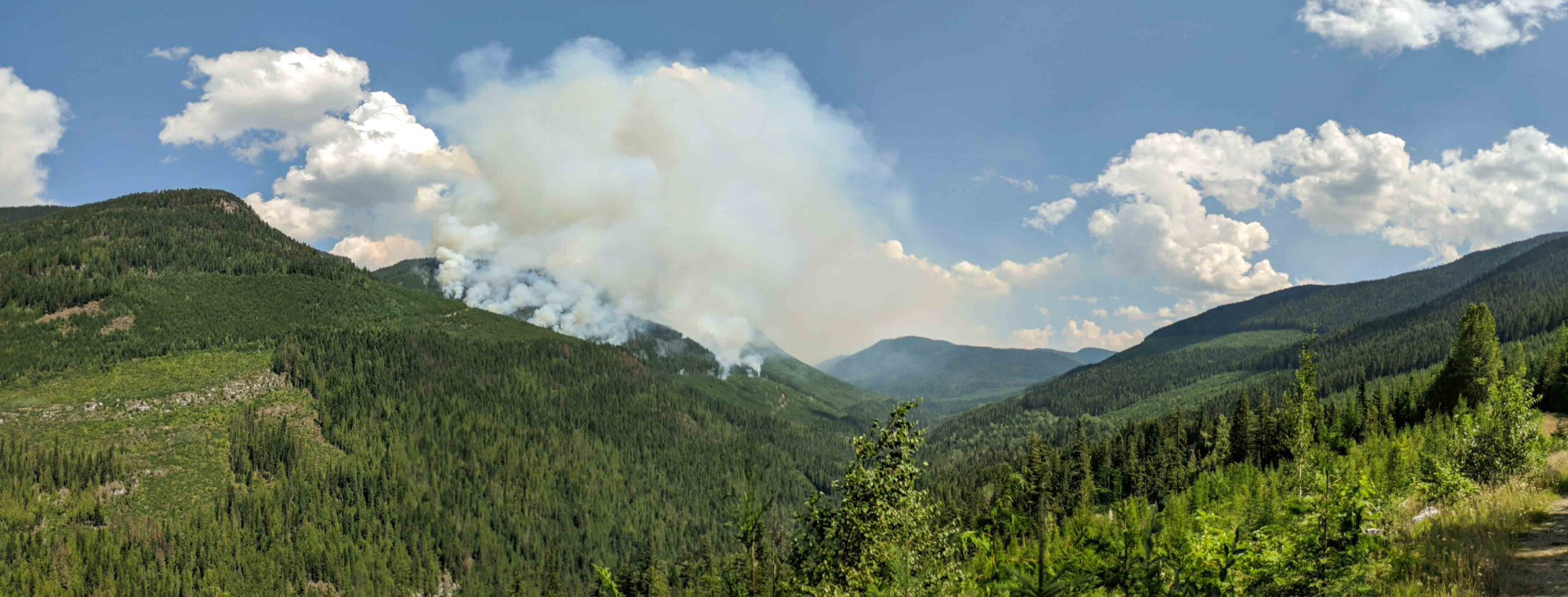 With wildfire season in full swing, an immigration consultant says there is a simple way to end the shortage of qualified people to fight wildfires: Let existing, trained firefighters who are non-residents stay once their work permits expire by letting them choose a path to permanent residency. Jennie McCahill is representing Irish national Jake McGavin, a team leader with a wildfire-fighting contractor called Carmanah Wildfire, which is based in Sidney but has firefighting crews spread all over B.C. …McGavin, who turns 29 in September, is in his third season fighting wildfires in B.C. He’s been lucky to have received a pair of two-year work permits, but the second is soon to run out. …He wants to stay in Canada not only because he’s fallen in love with B.C. …”Unfortunately, Immigration, Refugees and Citizenship Canada does not recognize wildland firefighting as skilled work.”
 Over 7,600 people shared their views on outdoor recreation in a first-ever public survey conducted by Mosaic. “The feedback we received tells us how important Mosaic’s managed forests are to people’s lives,” said Jimmie Hodgson at Mosaic. “It reinforces our responsibility to work toward solutions that reflect what we heard.” Early findings show:
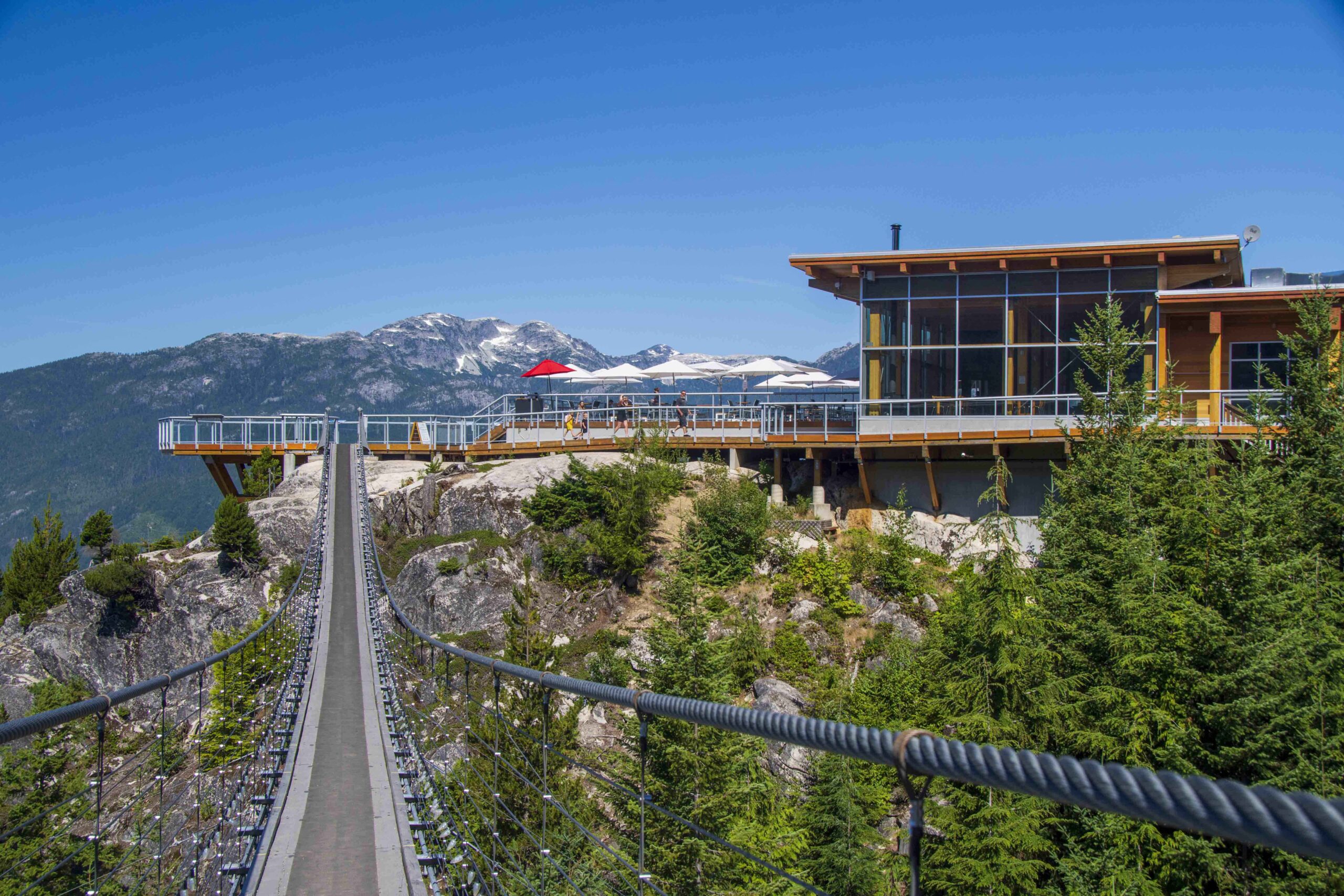 Sḵwx̱wú7mesh Úxwumixw (Squamish Nation) and the Province have signed an agreement to guide forest stewardship in Squamish Nation territory at a ceremony held at the top of the Sea-to-Sky gondola overlooking Átl’ḵa7tsem (Howe Sound). “This agreement will ensure our cultural sites and key environmental areas are protected for future generations. These have been our lands for thousands of years, and the fact they are now back under our direct control provides a greater sense of security for our people, and a strong optimism for our future,” said Sxwíxwtn Wilson Williams, Councillor and elected spokesperson, Sḵwx̱wú7mesh Úxwumixw (Squamish Nation). …The next step will be to complete a ministerial order, which will include consultation with First Nations, and engagement with the public. It aims to establish objectives for the forestry sector to follow in alignment with the agreement and provide the Squamish Nation certainty in sites of high value.
 Firefighters are urging hikers and mountain bikers not to enter trails closed due to a wildfire just north of Squamish, B.C., ahead of the Canada Day long weekend. The Dryden Creek wildfire, which was discovered on June 9, is considered under control by the B.C. Wildfire Service, but a local state of emergency remains in Squamish and a campfire ban remains in effect for the district. Fire suppression work is ongoing in the area, and evacuation orders and alerts remain due to the danger of trees falling and rocks rolling loose. Despite that, firefighters say they’re seeing people disobey trail closures, which could prove to be a risky decision. “Especially last weekend, numerous hikers and mountain bikers accessed trails that were closed,” said B.C. Wildfire fire information officer Jennifer Lohmeyer on Tuesday. “Some people even moved barriers that had been put in place to indicate that the trail was closed,” she added.
 The City of Delta is undertaking an inventory of its trees. Crews started last week in Ladner, collecting data on street and park trees as part of Delta’s Urban Forest Strategy. In its request for proposals this spring for a qualified arboricultural consultant to conduct the urban forest subsection inventory of individual city-owned urban trees, the city noted it wanted to focus on street and park specimen trees. The project does not include trees on private property, nor is it the intent to include larger stands of trees in the city’s natural areas. The purpose of the project is to expand a tree inventory that was started in-house in 2023, improve asset management, as well as gain an accurate cost of a city-wide tree inventory for areas with low, medium and high canopy coverage.
 It’s been hot in southern Ontario [with] apocalyptic news coverage out of Toronto…. “The world is burning,” announces the headline of a parenting advice column in The Globe and Mail. “Should we tell our children?” The author’s children are not told about forest fires… They are not told about the huge, ongoing increase in greenhouse gas emissions in Asia, cancelling out many times over the modest reductions achieved at great cost in North America and Europe. …The answer… is that natural variability is larger than the trend line produced by statistics. It’s true that Canada has seen more communities damaged or destroyed by fire, but that’s largely because there are more communities. …The Second World War was nearing its end, but the war on forest fires was just beginning, with the deployment of heavy equipment as well as aircraft. Saving timber was the goal, and the unintended consequences have piled up ever since.
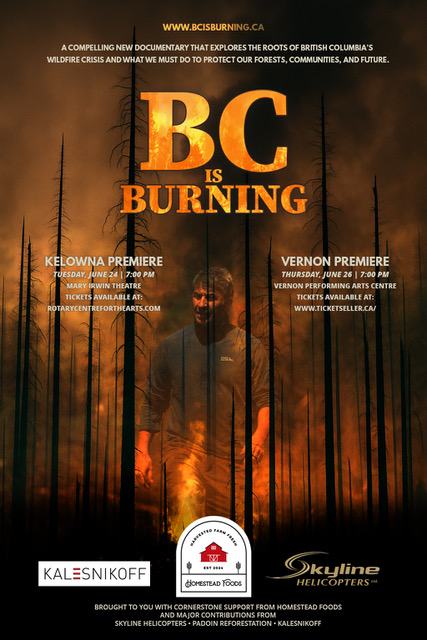 New film reveals the roots of B.C.’s wildfire crisis—and what we must do to stop it. A powerful new documentary exploring the causes and consequences of British Columbia’s escalating wildfire crisis will premiere to the public at the Vernon Performing Arts Centre Thursday June 26 at 7:00 pm. Titled B.C. is Burning, the 45-minute film delivers a sobering but hopeful look at what’s fueling today’s megafires—and the science-based solutions that could protect our forests, our communities, and our future. B.C. is Burning was independently produced and funded through community support, with Homestead Foods generously contributing half of the total budget. We also gratefully acknowledge major support from Skyline Helicopters, Padoin Reforestation, and Kalesnikoff.
 The Great Bear Rainforest on British Columbia’s North and Central Coast sequesters millions of tonnes of carbon dioxide across 6.4 million hectares of snow-capped mountains, ancient western red cedars, and Sitka spruce. It is considered one of the world’s largest carbon sinks—meaning it absorbs more carbon dioxide (CO2) than it releases. Under the Great Bear Carbon banner, a collection of coastal First Nations has entered the voluntary carbon offset market. The organization generates carbon offsets by preserving trees and ecosystems that naturally store CO2, with each carbon offset verifying the removal of one tonne of carbon from the atmosphere. Businesses, governments and individuals can purchase carbon offsets to compensate for their environmental impact. The Great Bear Carbon program helps raise revenue to support the local First Nations and their stewardship efforts.

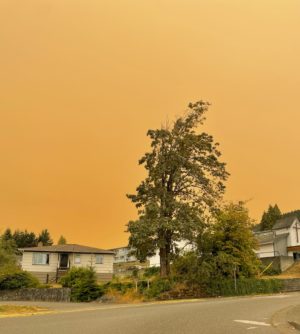 Wildfire smoke and extreme heat are combining to create a lethal cocktail of environmental conditions that multiply the risk of death in Metro Vancouver, a
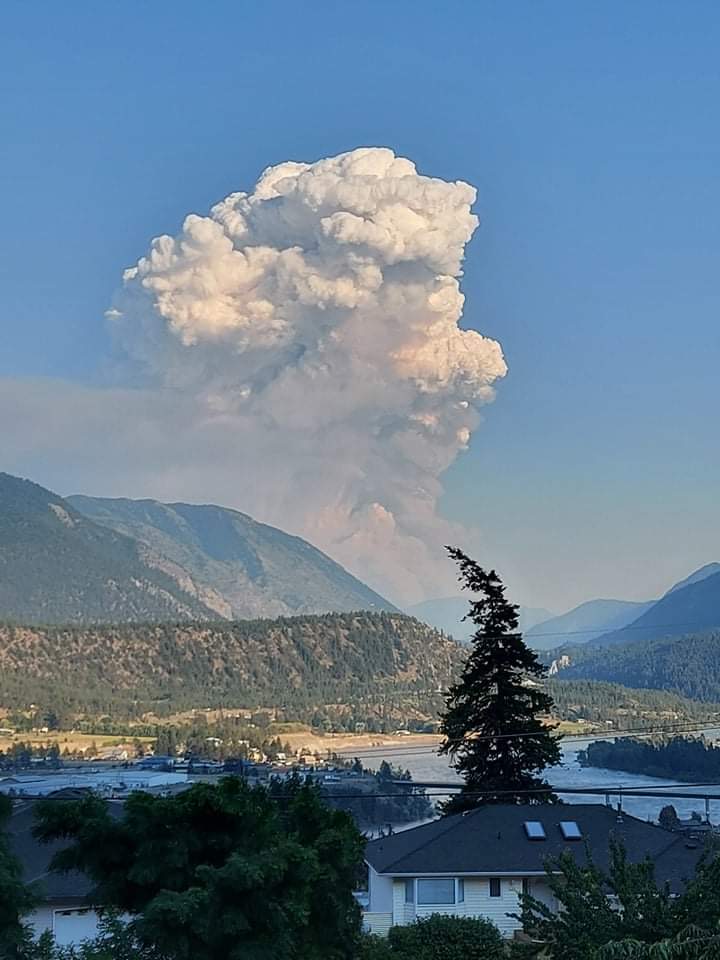 The Thompson-Nicola Regional District has declared a local state of emergency for the Blue Sky Country region due to an encroaching out-of-control wildfire near Lytton, B.C. It has also issued an evacuation order for two properties on Spencer Road South as the blaze poses “immediate danger to life.” The BC Wildfire Service says the Nikaia Creek wildfire is about six hectares in size and is one of more than 70 wildfires burning across the province. It says crews, supported by firefighters from Lytton First Nation, made “good progress” overnight and they are now focused on the north and south flanks of the blaze. The Thompson-Nicola Regional District also issued an evacuation alert Monday night for nine properties in the Harper Lake area near Chase, B.C., due to the rapidly growing Mount Scatchard wildfire.