The US Lumber Coalition urged the US Trade Representative to communicate to Canada and Mexico that the US-Mexico-Canada Agreement binational panel review system needs to be scrapped during the USMCA review process. The review system… can challenge actions taken to stop the unfair trade using this special dispute settlement panel process. The panel review gives powers to international tribunals that the Constitution reserves for US courts. …Canada, in a recent submission, argued that USMCA binational panel review replaces not only review by the US Court of International Trade (CIT), but also appellate review by the US Court of Appeals for the Federal Circuit (CAFC), effectively arguing that a USMCA panel does not need to concern itself with any US Appeals Court decisions or precedents. “The idea that a USMCA binational panel is not bound by a US Court of Appeals precedent is, quite frankly, outrageous,” stated Zoltan van Heyningen.



 Canada has “no intention” of pursuing a free trade deal with China, Prime Minister Carney said, after US President Trump threatened to slap punitive tariffs on Ottawa. Carney said that the country respects its obligations under the Canada-US-Mexico trade agreement, known as CUSMA in Canada and the USMCA in the US, and will not pursue a free trade agreement without notifying the other two parties. Carney’s remarks come after Trump threatened to put a 100% tariff on Canadian exports if Ottawa “makes a deal” with Beijing. …Treasury Secretary Scott Bessent also echoed Trump’s sentiments on Canada and China, saying that the UScould not “let Canada become an opening that the Chinese pour their cheap goods into the US.” …Carney said: “What we have done with China is to rectify some issues that have developed in the last couple of years,” adding that the deal was “entirely consistent with CUSMA.”

 VIETNAM — The United States has decided to postpone the tariff increase on certain finished wood products, including upholstered chairs, kitchen cabinets, and bathroom cabinets, from January 1, 2026, to January 1, 2027. The postponement of the tax increase on some finished wood products helps Vietnamese businesses temporarily avoid the policy shock at the beginning of 2026. However, this is not a sign of loosening, but rather a tactical retreat, requiring the wood industry to be more proactive and cautious in policy planning and restructuring the overall development strategy of the entire industry. …Mr. Ngo Sy Hoai, Vice President of the Vietnam Wood and Forest Products Association (VIFOREST), commented that if postponing the tariff increase is considered an “opportunity,” then extreme caution is needed. In reality, tariff pressure has spread throughout the entire supply chain, from domestic manufacturers to importers and retail systems in the US.


 ALEXANDRIA, Va.




 Southern Pine lumber exports (treated and untreated) are almost equal to 2024 year to date through October 2025 at 488 MMBF, according to October 2025 data from the USDA’s Foreign Agriculture Services’ Global Agricultural Trade System. October 2025’s 60 MMBF of exports were up 47% over October 2024 and up 33% compared to September 2025. When looking at the report by dollar value, Southern Pine exports are up 4% YTD ($190 million) compared to 2024. Meanwhile, the October value of $25 million is the highest mark since June 2022, when the value hit $29 million. Mexico leads the way YTD 2025 at $56 million, followed by the Dominican Republic at $39 million, and India at $18 million. Treated lumber exports, meanwhile, are down 4% through the first 10 months of the year compared to 2024. The Leeward-Windward Islands market leads the way through October at $18 million, followed by Jamaica at $16 million, and Belize at $10 million. Softwood lumber imports are running 8% behind 2024 levels.

 ST. LOUIS — What is the life cycle of a building? Each year, in the United States, new home construction accounts for 50 million tons of carbon emissions. The majority stem from harvesting, manufacturing and transporting building materials — from lumber and masonry to glass and tile to roofing and mechanical systems. But what happens at the end of the cycle? When a building is no longer inhabitable or needed, what happens to all the energy invested in those materials? “It’s demolished,” Hongxi Yin said. “It goes to the landfill.” Yin, an expert on sustainable construction, is the InCEES professor in advanced building systems and architectural design in the Sam Fox School of Design & Visual Arts at Washington University in St. Louis. Over the last decade, he has led a series of research studios exploring ways to improve building efficiency, supply chains and construction processes.
 Two conservation groups are suing the Trump administration, challenging a U.S. Department of Agriculture rule that strips public comment requirements from most national forest projects. In a federal
  Together, we have served as US Forest Service chiefs for both Republican and Democratic administrations. We know that forest management decisions never come without debate, opinions and — more often than not — disagreement. Each of us has had to strike the difficult balance between leaving some forests intact, while sustainably using others to benefit communities and economies. But regardless of who is in the White House, one thing has always remained true: Americans value their national forests, and they want to see them protected for the benefits they provide us, like clean air, water, abundant recreation opportunities and sustainable economies. …The current administration needs to know: Repealing the Roadless Area Conservation Rule would not be in the long-term interest of the American people, the National Forests or the communities they serve. Each of us has been faced with tough decisions. Keeping backcountry and healthy forests free of unnecessary roads was never one of them.
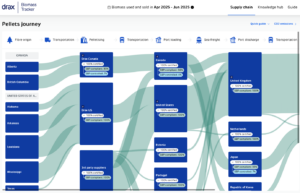 Drax launched its Biomass Tracker, a new digital tool that provides greater visibility into the journey our woody biomass takes through the company’s global supply chain. The interactive tool shows the countries and states where Drax sources its biomass, the types of fibre used in Drax’s own woody biomass, how it is transported, and the carbon associated with each stage of its journey to Drax Power Station or to third-party customers. It also includes data on independent sustainability certifications, helping to strengthen accountability across the sector. The Biomass Tracker uses quarterly real-world data presented through an interactive Sankey diagram, allowing users to explore each stage of the supply chain from fibre origin (for Drax-own pellets), pelletising to transport, storage and use. …The tool is available to access on
 The Washington wood-products industry says timber harvests will spiral downward if lawmakers pass a bill championed by Lands Commissioner Dave Upthegrove. At Upthegrove’s request, legislators are considering authorizing the Department of Natural Resources to sell “ecosystem services,” possibly by delaying or canceling timber harvests. DNR officials say ecosystem services could be a new source of revenue as businesses buy carbon credits to “offset” their emissions. Carbon credits could add to the money rural counties and schools receive from timber sales, according to DNR. The timber industry, backed by the Washington State Association of Counties, argues its more likely ecosystem services would replace timber sales. Rural public services would get less money, Paul Jewell, the counties’ policy director, said. More importantly, rural counties will lose timber jobs, he said. “Sales of ecosystem services can’t replace those economic benefits,” he told the House Agriculture and Natural Resources Committee on Jan. 28.
 Over the past year, a wave of high-profile development proposals — from oil fields and mining roads to timber projects — has reshaped a fast-moving debate, propelling Alaska into the center of the national conversation over how to balance energy production with conservation. These projects have revived long-running tensions over what the state’s public lands are for, and who they ultimately benefit. The federal government has long viewed Alaska as resource-rich, a posture that’s intensified under the Trump administration. After meeting Trump in 2018, Gov. Mike Dunleavy called Alaska “America’s natural resource warehouse.” But the last time Alaska figured this prominently in national energy and conservation debates was in the late 1970s, said Philip Wight, at the University of Alaska Fairbanks. What makes today’s landscape different, Wight said, is a unified federal government pushing multiple contentious development proposals at once, with fewer moderate Republicans willing to oppose them ….
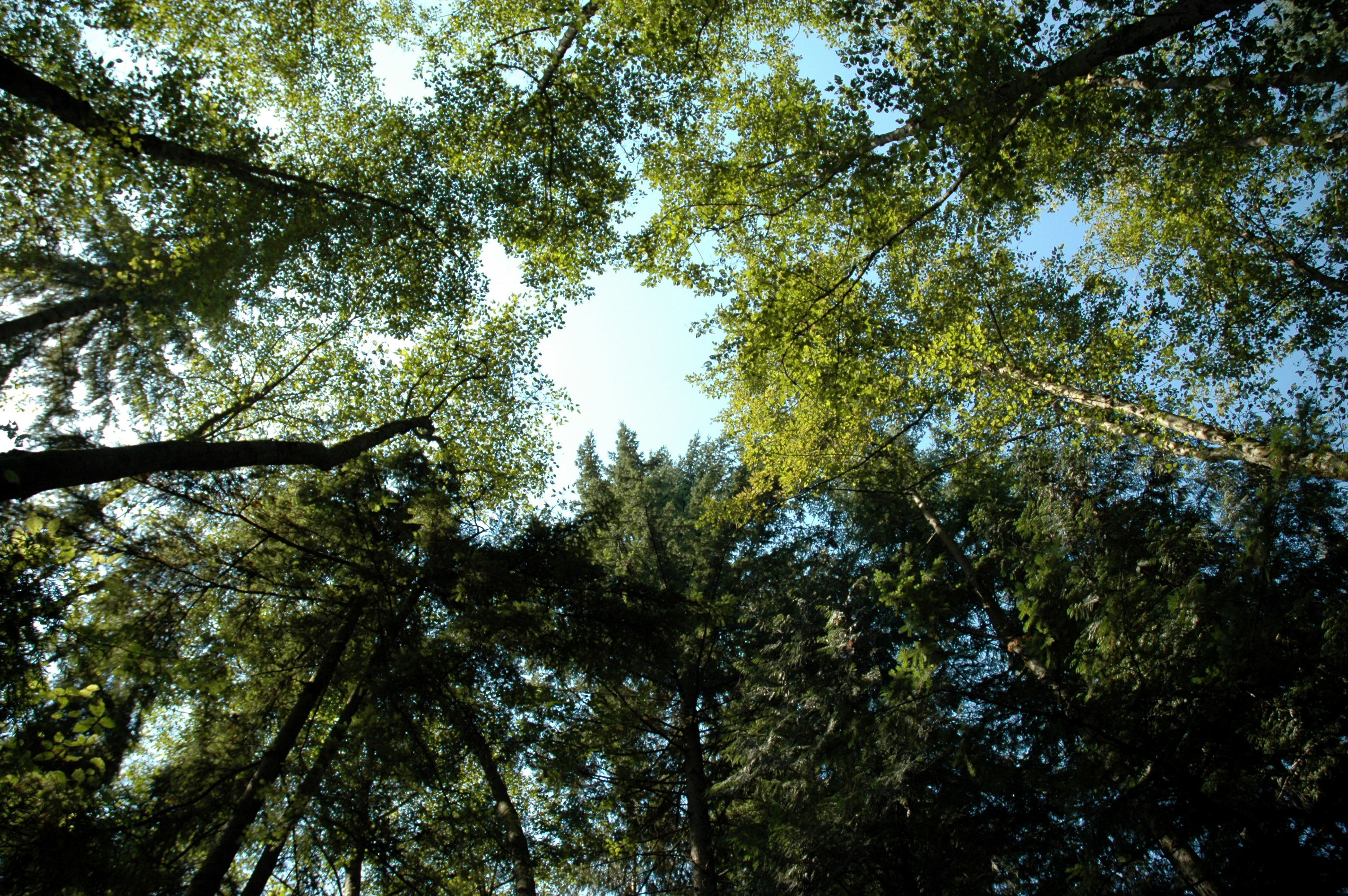 A 34-year-old rule exempting some commercial logging projects on federal lands from environmental review is unlawful, a federal judge recently ruled. Judge Michael McShane in the U.S. District Court in Medford earlier this month struck down the exemption, and with it, reversed recent approvals for three commercial logging projects covering tens of thousands of acres in Fremont-Winema National Forest in southern Oregon. The decision is the result of a 2022 lawsuit brought against the U.S. Forest Service by regional conservation groups Oregon Wild, WildEarth Guardians and GO Alliance. Since 1992, the U.S. Forest Service has been able to bypass environmental reviews required by federal law for logging projects on federal land, if the logging is meant to “improve forest stand conditions,” habitat or prevent wildfires, without “significant effect” on the human environment.
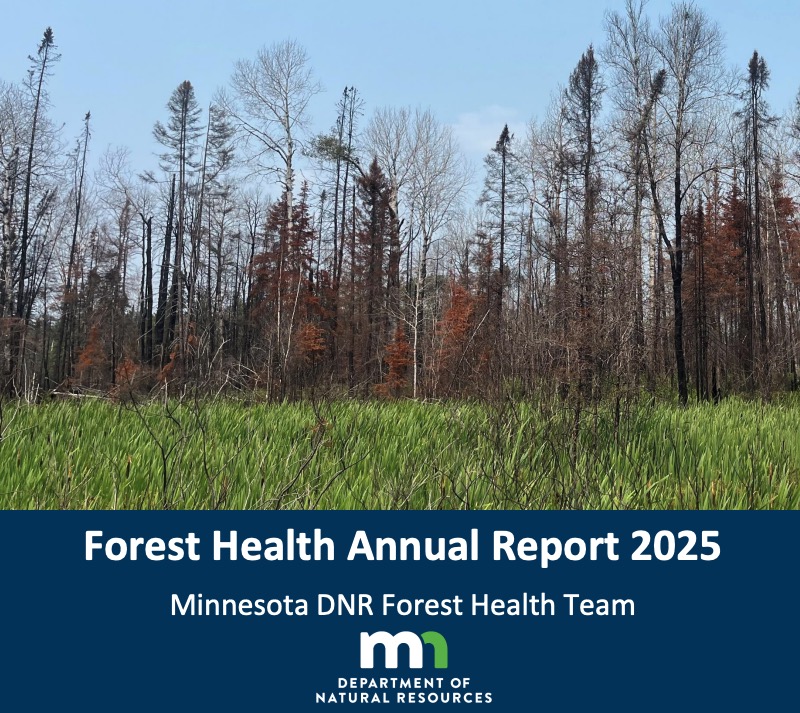 The Minnesota Department of Natural Resources aerially surveyed more than 13.5 million acres last year, checking for forest damage across the state’s forestland. Its findings are included in the recently released 2025 Forest Health Annual Report. Brian Schwingle, forest health program coordinator, said the annual survey and report is important because it tracks trends and reveals what is impacting trees, allowing the managers to make decisions for healthier, more resilient forests. “The two biggest tree health stories in 2025 in Minnesota were the derecho, the big blowdown in Bemidji, and the three big wildfires in northeast Minnesota in May,” he said, noting prior spruce budworm damage helped fuel the fires. In July, a derecho damaged 11,600 acres in and around Bemidji. Derecho, a Spanish word for straight, is a widespread, straight-line windstorm associated with a band of fast-moving thunderstorms. They can leave serious damage in their wake.

 NEW YORK
 UK energy company Drax’s ambitions of becoming a significant wood pellet supplier to Asia are in danger of faltering as Japanese policymakers wind back generous subsidies for the biomass sector. Japan is set to soon surpass the UK as the world’s largest wood pellet importer after a post-Fukushima push to diversify power sources that caused hundreds of plants to spring up that burn wood pellets, palm kernel shells — a palm oil byproduct — and other organic materials. But policymakers in Japan are pulling support for the controversial industry after realising the hurdles to bringing down fuel costs. Tokyo has already cut subsidies for new projects of more than 10 megawatts. “The real intention is quite simple: no new government support, phasing out. We don’t see any clear path of bringing down costs in the foreseeable future,” said one government official. “Existing projects might survive but no new projects are coming.”