
Kelly McCloskey

Robert McKellar
Over the past two years, Tree Frog has periodically turned to political risk consultant Robert McKellar to help readers better understand the geopolitical forces increasingly shaping the business environment in which the North American forest sector operates. In his feature Trump’s Second Term and Political Risk in the Canadian Forest Sector, Robert explored how changing politics, government policy and international relations can create both risks and opportunities for forest companies. In doing so, he also introduced readers to the discipline of political risk management—a practical framework for anticipating and responding to an increasingly uncertain world.
Robert’s earlier articles generated thoughtful feedback and reinforced a common observation: the pace of global change is becoming increasingly difficult to follow. Every day seems to bring another headline about tariffs, trade disputes, wars, sanctions, shipping disruptions, energy prices, artificial intelligence, or some other geopolitical development. For many of us, the challenge is no longer keeping up with the news—it’s deciding what actually deserves our attention. Which developments are likely to influence markets, trade and investment in the forest sector? Which simply warrant monitoring? And which are little more than background noise? Those questions are central to political risk management. They are also questions we increasingly hear from readers trying to make sense of a relentless news cycle and what it means for their businesses and organizations.
In this article, Robert steps back from the daily headlines to explain how political risk professionals approach that challenge. His answer offers a practical framework for separating signal from noise—and a useful way of thinking about the global forces increasingly shaping the future of the forest sector.



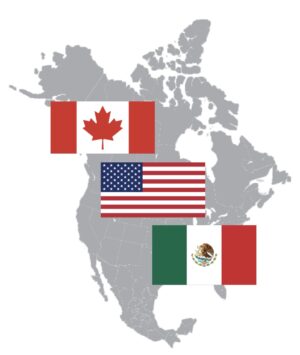 China will be front and centre at the renegotiations of the USMCA on trade despite not having a seat at the bargaining table. …With the USMCA now subject to annual reviews, the US is using the continuing trade talks to put pressure on Canada and Mexico to collaborate with its efforts to undercut China. Washington is alleging that China is exploiting loopholes in the USMCA to avoid US tariffs on its exports by using Mexico and Canada to gain back-door entry to the US market. But there is a difference between blatant customs fraud and legal shipments facilitated by third countries as part of global trade. The US, however, appears intent on blurring that distinction… providing Washington with a convenient pretext to fiddle with the USMCA’s rules of origin and compel more US content to the detriment of the two other signatories to the pact. [to access the full story a Globe and Mail subscription is required]

 WASHINGTON — The Canadian government told the Trump administration new legislation combating forced labour in supply chains should shield Canada from new tariffs. In a written submission the Government of Canada said it “remains committed to working closely with the US to eradicate forced labour from global supply chains.” …Ottawa’s case was among more than 1,500 written submissions ahead of a hearing in Washington this week on the use of Section 301 of the Trade Act of 1974 to rebuild his global tariff wall. US Trade Representative Jamieson Greer launched a trade investigations into 60 countries, including Canada. Greer said Canada, Mexico, the UK and some other countries should be hit with 10% duties because they are not doing enough to enforce bans on forced labour. …Canada already had legislation intended to curb forced labour in supply chains. But the federal government tabled a bill last month to boost enforcement.
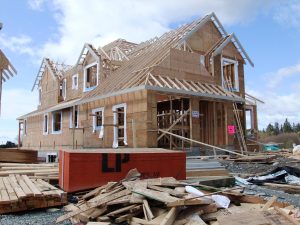 The Trump administration’s decision to forgo renewal of the United States-Mexico-Canada Agreement (USMCA) on the July 1 deadline has opened a new front in the ongoing trade war — and one with direct consequences for US homebuilders and the mortgage professionals who serve them. US Trade Representative Jamieson Greer confirmed on Wednesday that the three countries met virtually for the required joint review and that the US declined to extend the agreement in its current form. The USMCA remains in effect until 2036 but will now be subject to annual reviews that could force significant renegotiation of major sections of the treaty, a development that has rattled an already strained construction supply chain. …Canadian softwood lumber already carries a combined duty burden of 45%. That cost has steadily compressed builder margins even as new home demand remains sluggish and housing starts have declined every year since their 2021 peak.
 Alberta’s forestry sector enters a second half of 2026 with cautious optimism, even as weak housing markets supply, U.S. tariffs and softwood lumber duties continue to weigh on the industry. Ken Greenway, Alberta Forestry and Parks’ executive director of strategy, policy and economics, said northern Alberta’s timber industry remains relatively stable compared to some other parts of Canada, where forestry communities have faced sharper contractions. “We haven’t seen huge disruptions,” Greenway said. “Pulp is a weak market and that’s an area of concern, but softwood products prices are slowly moving to the positive side.” …“It’s a cyclical market, we’re at the bottom of a cycle at the moment. The current contraction across Canada – we have not seen as much in Alberta. We hope to withstand this storm.” The industry is also becoming more involved in wildfire mitigation.
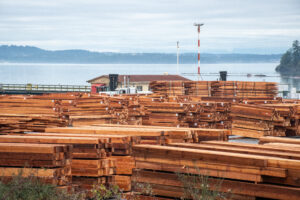 Western Forest Products says a curtailment at its Cowichan Bay sawmill is expected to last until this fall. The curtailment began on May 11, affecting 54 employees. On Wednesday, WFP told CHEK News it currently expects the curtailment to remain in effect through September. The forestry company says the curtailment is due to “persistently weak market conditions” and that it is trying to mitigate impacts on employees by “providing work opportunities at our other operations where possible.” “Conditions are being monitored closely, and we will keep employees informed should the expected duration change,” said Western Forest Products. The curtailment in Cowichan Bay comes as an indefinite curtailment continues at the WFP sawmill in Chemainus. The Chemainus sawmill was curtailed in July 2025, affecting approximately 120 workers, and in January it was announced that the curtailment was expected to last for all of 2026. [END]
 BC Supreme Court Justice Barbara Young sent a chilling message to BC landowners when she refused to reopen the case where she designated Aboriginal title over private land in Richmond. Montrose Properties argued it had never received any formal notification that its fee-simple title could be affected by the outcome. This being the first case where Aboriginal title was applied to private as well as Crown land in BC, the federal, provincial and Richmond city governments all supported reopening the application. …Young didn’t rule out that the Cowichan Nation might someday seek to take over all the private land included in the designation of Aboriginal title. …It will be months and maybe years before her findings and those of the New Brunswick court are reconciled. …In the interim, Young has put provincial landowners on notice that they… are at risk from a claim of Aboriginal title.
 VANCOUVER, BC — Canfor Corporation announced it has completed the acquisition of PinkWood Ltd, Western Canada’s largest I-joist facility based in Calgary, Alberta. The acquisition, announced on June 9, 2026, complements Canfor’s existing operations in Alberta and British Columbia “We’re excited to welcome the PinkWood operation, its management team and its employees to the Canfor family,” said Susan Yurkovich, President and CEO of Canfor. “The acquisition represents a strong strategic fit for both companies and supports the continued growth of Canfor’s value-added manufacturing capabilities.” PinkWood will retain its name and operate as a wholly owned subsidiary of Canfor. The operation will add 120 employees, and 46 million linear feet of annual I-joist production capacity.


 BELLEVILLE, Ontario — The government is investing more than $3.3 million in

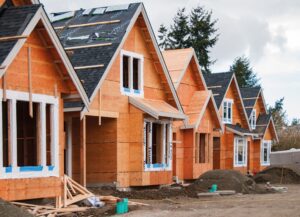 A sweeping bipartisan housing affordability bill President Trump has refused — so far — to sign is set to become law on Friday, provided the president doesn’t act. The legislation, called the 21st Century ROAD to Housing Act, aims to improve housing affordability by incentivizing local governments to build more homes by streamlining complex environmental review processes, making it easier for credit unions and banks to issue mortgages, expanding access to modular homes, and restricting large corporate investors from purchasing single-family homes. Following months of negotiations, the bill passed Congress by wide margins in late June. …But even without Trump’s signature, the housing bill is on track to become law on Friday due to a quirk of constitutional law. …Trump could still veto the bill before Friday, although the final version passed Congress so overwhelmingly — 85-5 in the Senate and 358-32 in the House — that the legislative branch could potentially override his veto.

 Two new inspections into kraft pulp and paper mills in Washington have been opened, following ongoing investigations at the Nippon Dynawave mill where a tank failure killed 11 workers. The Washington State Department of Labor & Industries said investigations are going on at two other active paper mills in the state that use the same process, where caustic chemical compounds are used to help break down wood into pulp for paper product manufacturing. In the weeks following the implosion of a massive tank at the paper mill that spilled hundreds of thousands of gallons of chemicals – believed to be the deadliest industrial accident in state history – managers of similar operations have been dialing up their insurance brokers to find out how well they’re protected. One investigation is occurring at a mill run by Smurfit Westrock, also in Longview. The other, run by Port Townsend Paper Company, is in Port Townsend.




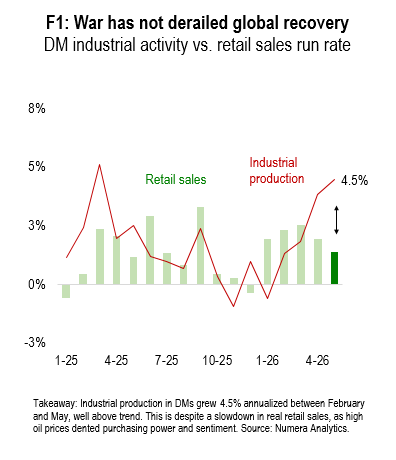
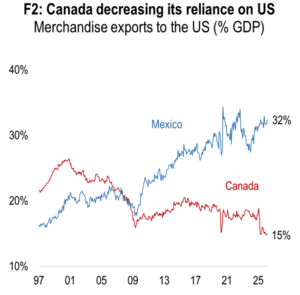 The US has formally declined to renew the USMCA trade agreement for a further 16 years. While existing tariff-free trade terms will continue, the decision triggers annual reviews until the agreement expires in 10 years. President Trump openly views the agreement as detrimental to US manufacturing, placing the burden of concessions firmly on Mexico and Canada. But as today’s chart shows, Canada has a much lower reliance on the US than Mexico, and the Carney administration is taking active steps to diversify its export base further. Exports from industrial sectors subject to tariffs – metals and auto – have fallen sharply, but the hit to activity is limited, as these account for just 2.5% of GDP. …Adjusted for a shrinking working-age population, production in these sectors has picked up. …Goods exports to the US make up close to one-third of Mexico’s GDP. Canada’s share is also high at 15%, but has fallen over time.
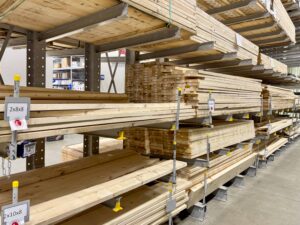 The Canadian lumber industry saw enormous price spikes during the pandemic years of 2020-2022, with costs close to triple what they are today for some products. … “We saw prices skyrocket during COVID, but so too did the cost to operate,” said Aspen Dudzic, the Alberta Forest Products Assocation’s communications director. “And interestingly, post-COVID, we saw the market prices for lumber go down, but the costs to operate have not come down in the same way.” Even though lumber costs have seen a huge drop in prices in a vacuum, why haven’t these cost savings been passed on to the consumer? …“The supply chain is really complex,” Dudzic said. “Nothing we do operates in a vacuum, so there’s a lot of other compounding costs that we have to look at, like inflationary pressures, upticks in fuel and energy prices. …Top of mind is the ongoing trade war with the US.
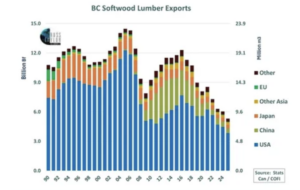 BC has seen lower timber harvests and lumber and lumber exports. …BC exported 2.5 million m3 of softwood logs in 2025, a trend that has been in place since 2022. …BC lumber exports have always focused on the US market, with 64% of production and 76% of total exports directed at the US in 2025. But with US duties and tariffs totalling over 45%. the volumes started to drop in 2025 Q4. Total BC lumber exports in 2025 were 5.1 billion bf, a drop of 12% from 2024. Lumber exports to the US were 3.83 billion bf in 2025, a drop of 14.3% from 2024. …In the first quarter of 2026, total BC lumber exports were lower by 20.1% compared to 2025 Q1, with exports to the US down by a whopping 24.7% (the bite of US duties and tariffs is evident), lower to Japan by 17.7% but higher to China by 10%. It will be challenging for BC mills in export markets for much of 2026 unless demand improves or prices move higher—both unlikely until 2027.
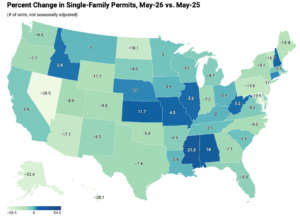 State-level permitting activity continued to reflect a divided housing market through the first five months of 2026. Elevated mortgage rates and ongoing affordability challenges continued to weigh on single-family construction across much of the country, while multifamily permitting remained comparatively stronger, supported by gains in several regions despite continued weakness in parts of the South. Over the first five months of the year, the number of single-family permits issued nationwide reached 380,130. Compared with the same period in 2025, this represents a 6.1 percent decline compared with the May 2025 total of 404,977. In contrast, multifamily permitting activity remained stronger, with 208,192 permits issued nationwide, marking a 6.5 percent increase from the same period last year.
 On July 9, 2026, Mercer International received a notice from Nasdaq staff that the company’s common stock had failed to meet the exchange’s minimum bid price requirement of $1.00 per share for 30 consecutive business days, triggering a formal non-compliance status under Nasdaq rules. The notification does not immediately affect the listing or trading of Mercer’s securities, but it places the company under an initial 180-day compliance period in which it must restore its share price to at least $1.00 for ten consecutive business days to avoid potential future delisting pressure. Mercer is working to regain compliance, though it acknowledges there is no assurance it can meet the requirement within the timeframe. The development… could influence investor sentiment and the company’s capital markets flexibility depending on its ability to achieve and sustain the mandated bid price threshold. [to access the full story a Globe and Mail subscription is required]
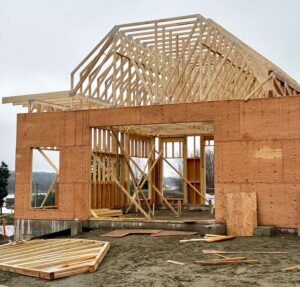 High mortgage rates aren’t the only reason homeownership remains out of reach for many Americans. Behind the scenes, homebuilders are grappling with an overlooked challenge — a shortage of skilled workers — that is slowing construction and making it harder to close the nation’s housing gap. Builders say the labor shortage is creating a ripple effect throughout the housing market, delaying projects, raising construction costs and limiting the number of new homes coming online at a time when demand continues to outpace supply. “Labor is one of the largest and most expensive inputs when it comes to home production and land development,” Jim Tobin, president and CEO of the NAHB. He said that every month, the construction industry is short by approximately 250,000 workers. …A recent NAHB report estimates builders will need roughly 723,000 new workers annually to keep pace with demand and help close the nation’s 1.5 million-home housing gap.
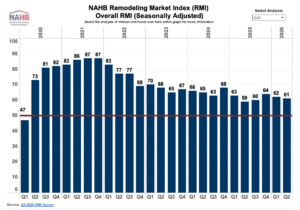 In the second quarter of 2026, the NAHB Remodeling Market Index (RMI) posted a reading of 61, down one point compared to the previous quarter. The RMI has remained in the low 60s consistently over the past year. Even with this slight decline from the previous quarter, remodeler sentiment remains the standout sector within the housing industry, outperforming both its single-family and multifamily counterparts. …However, ongoing economic uncertainty and current cost pressures due to inflation are causing project delays, especially for larger ones. In the latest RMI survey, 74% of remodelers reported that their suppliers have increased prices of materials since March due to higher fuel costs, with the average increase in materials prices over that span being 6.7%.
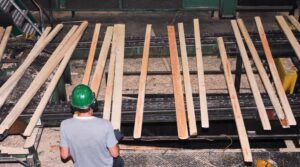 Softwood markets across Latin America and the Asia-Pacific are approaching a turning point, according to the latest market report from Global Wood Trends and O’Kelly Acumen. The report says some of the world’s lowest-cost plantation producers are increasingly linked to major importing markets where domestic supply growth is limited. “With harvests expected to decline in key exporting regions, China remaining structurally dependent on imports, and Japan nearing peak production, the regional supply balance is likely to tighten through 2035 – creating new risks and opportunities for producers, investors, traders, and wood consumers,” it says. The ‘Global Softwood Roundwood Supply – Latin America & Asia-Pacific’ report… says Latin America, Asia, and Oceania. Latin America remain a highly competitive source of softwood roundwood. Brazil, Chile, Argentina, and Uruguay account for nearly all regional softwood supply, supported by large-scale plantation forestry and investment by integrated forest-product companies and institutional owners.
  SURREY, British Columbia — The Honourable Randeep Sarai, Secretary of State (International Development) announced over $8 million in RTRI funding for four Surrey businesses to help them diversify exports, grow locally, and compete globally – building prosperity for British Columbians and all Canadians. These investments support the Government of Canada’s measures to help businesses in sectors affected by global trade disruptions – such as forestry, manufacturing, and steel and aluminum – boost productivity, reduce costs, build more resilient supply chains, and reach new markets. … More details about these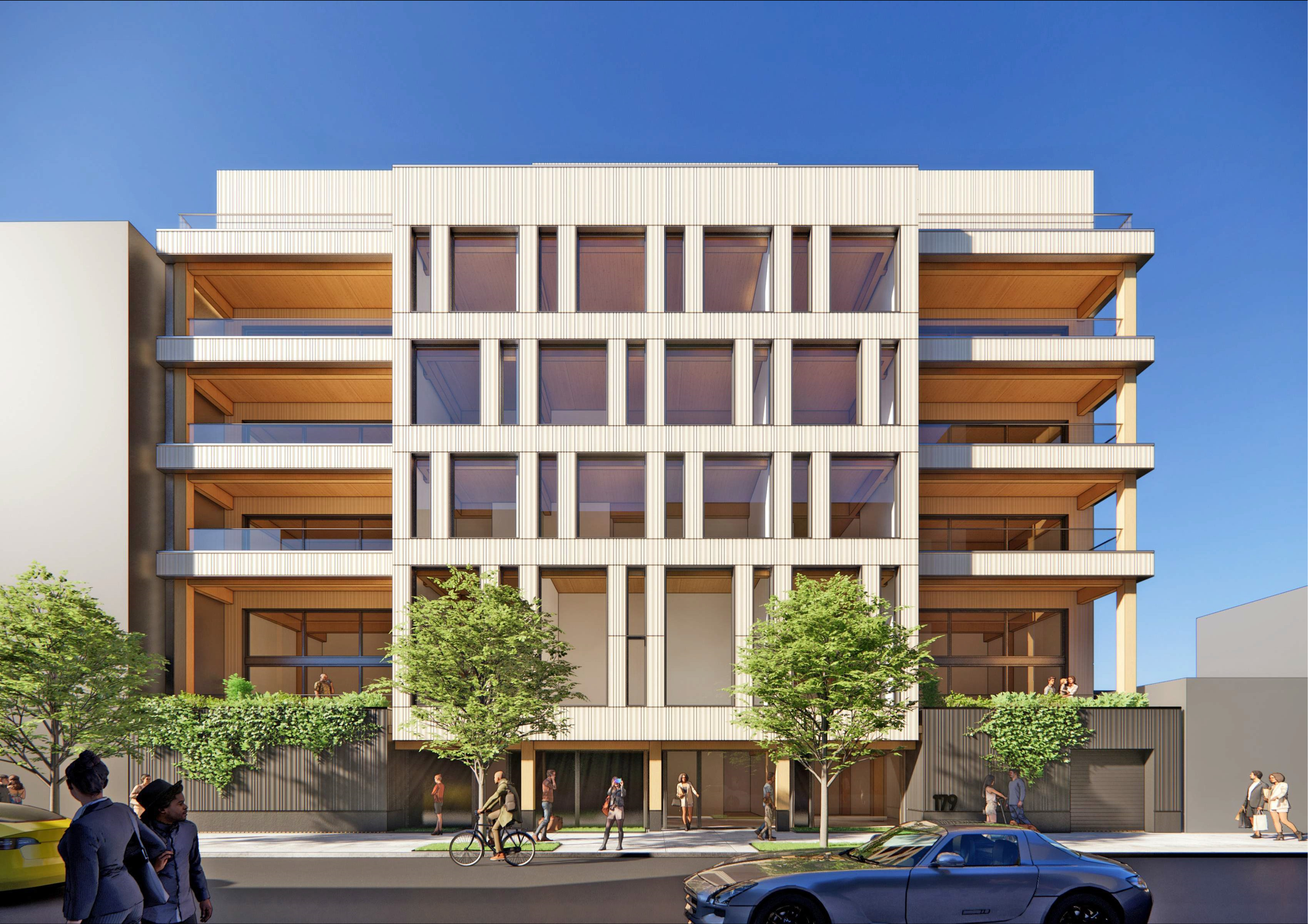
 NEW Zealand — Increased trade is key to driving an innovative wood processing and manufacturing sector that will strengthen regional communities, reduce emissions, and build a more resilient and prosperous New Zealand, according to Mark Ross, Chief Executive of the Wood Processors and Manufacturers Association of New Zealand (WPMA). …“This includes supporting trade policies that open markets for high-value wood products, backing programmes such as the Value-Added Wood Exports Growth Accelerator, along with encouraging investment in domestic wood processing to grow the sector,” Mr Ross said. …The policy also highlights leading value-added wood and forestry trade missions into Asia and the Gulf region. The seven priority markets are Brazil, Switzerland, Argentina, Bangladesh, Nigeria, Uruguay and the European Free Trade Association (Iceland, Liechtenstein and Norway). …The Building the Future: New Zealand’s Next Billion Customers’ can be found
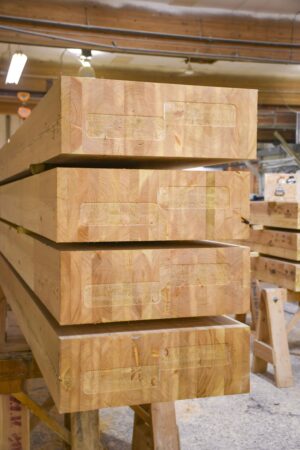 AUSTRALIA — The completion of the 6-Star Green Star Design redevelopment marks the first mass-timber social housing project in New South Wales, and one of the state’s earliest Class 2 timber apartment buildings. Completed in April 2026, the redevelopment delivers 75 new social homes for 130 tenants across two eight-storey towers and a separate three-storey terrace. …Since the initial concept, the project underwent several development application amendments to accommodate the use of mass timber. …One of cross-laminated timber (CLT)’s greatest advantages is speed. At Glebe, the eight-storey apartment floor was erected in as little as two weeks, while the three storey-terraces were fully completed in just three weeks. More than 2500 cubic metres of CLT and glulam were used in the construction. …The integration of a traditional brick façade introduced a slower, labour-intensive layer that disrupted sequencing. …While Australia is not short on sustainable building ambitions, regulatory frameworks have not kept pace with mass timber construction.
 OTTAWA – The 2026 wildfire season has been manageable so far, largely because of significant amounts of rain across Western Canada, but federal officials cautioned Thursday the summer forecast is hotter and drier than normal in much of the country. … The southern Prairies and eastern Quebec have had more rain than usual this year, and it’s expected that above-average precipitation will continue in Alberta and the Northwest Territories. Forecasts for July and August are calling for higher than usual temperatures for Ontario, Quebec, northern parts of the Prairies and the territories. …The latest information from the Canadian Interagency Forest Fire Centre shows there have been 3,100 fires across the country so far this season, compared to around 2,900 at this time last year. …But the total area burned this year is less than last year, at around 12,000 square kilometres, down from 46,000 square kilometres.
 British Columbia is expanding the BC Timber Sales Value-Added Manufacturing Program by creating a new dedicated category that will secure fibre for custom cutters and processors. BC’s action builds on Canada’s Forest Sector Transformation Task Force, which was commissioned in response to U.S. President Donald Trump’s new duties and tariffs on Canadian wood products. The task force recommends strong support for value-added operators so Canada can build high-quality products at home. “British Columbia’s path forward for forestry can’t just be providing dimensional lumber to Americans. We have to make more in B.C.,” said Ravi Parmar, Minister of Forests. …Custom cutters and processors are a group within the value-added wood-manufacturing sector without their own sawmilling facilities. …BC Wood Specialties Group Association’s chair, Kelly Marconi said “our custom cutting and processing members were part of the task force’s public consultation, so we are pleased to see this inclusive change.”
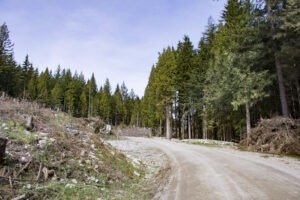 ALBERTA — Harvesting plans for forestry companies operating in the High Prairie and Slave Lake regions were presented June 17 at a joint open house in High Prairie. Plans were displayed by West Fraser Timber that operates High Prairie Forest Products, Tolko Industries, and by Millar Western Forest Products that bought the Slave Lake Pulp Mill from West Fraser and became the owner in April 2024. No representative was present from West Fraser. Companies hosted the event to allow citizens to comment on the proposed plans. Tolko plans to have operations in the Sweathouse area south of Snipe Lake, Salt Prairie and Whitemud, says woodlands supervisor Callie Skellett. …Millar Western plans to harvest trees in three areas, forestry superintendent Stuart Adkins says.



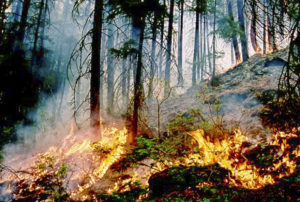 CALIFORNIA — A bipartisan bill intended to protect people and forests from wildfires in the Shasta-Trinity and other national forests is dividing lawmakers and conservationists in Northern California and nationwide. Supporters of the Fix Our Forests Act say it speeds up the bureaucratic process for approving projects that reduce wildfire risk in national forests. These include control burn and vegetation removal projects. A chorus of conservationists opposed to the bill say they worry about uncontrolled logging in some of the country’s pristine forestlands. …According to the bill’s wording, it would limit how much environmental protection oversight projects that reduce vegetation would have to surmount before they’re approved. It also would limit legal challenges to those projects from community and environmental groups. The latter has been dividing lawmakers across both parties for more than a year.
 OREGON — The federal government has released its long-awaited proposal to triple logging across three national forests in northeast Oregon and southeast Washington. But critics say the Trump administration’s effort to boost a flagging timber industry in the Blue Mountains could ultimately harm another key pillar of the local economy: Elk hunting. It could also push elk out of forests onto private land, where the animals could damage crops and other property, according to a regional manager with the Oregon Department of Fish and Wildlife. The federal government’s plans for the Blue Mountains, which were released in draft form Thursday, could shape logging, recreation and environmental protections across 4.9 million acres spanning the Malheur, Umatilla and Wallowa-Whitman national forests for the next 15 years. …And more roads are likely to mean fewer elk. …People can weigh in on the
 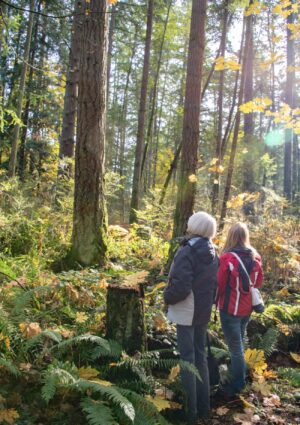 To Caleb Chaplin, it’s clear what sets a patch of old forest on his family’s land in Naples apart from the woods around it. …Some of the trees are up to 200 years old. Foresters call these woods “late successional and old growth.” They’re also some of the rarest features on Maine’s landscape, trap lots of greenhouse gas and provide critical habitat for unique species. Chaplin said his family was planning to harvest the stand this year. …Then they learned the New England Forestry Foundation would pay them to delay harvesting. Chaplin said it was a tough decision at a time when these big trees are drawing some of the highest prices in the timber market. Ultimately, the family agreed to leave the stand alone for 10 years, and work with the foundation to develop a permanent conservation plan.
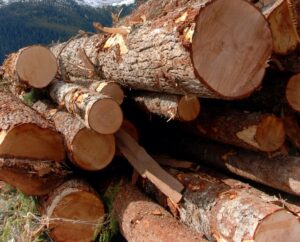 ITALY — The good news is that European forests continue to grow: according to the 2025–2026 Annual Report of the European Organisation of the Sawmill Industry (EOS), a body representing around 80 per cent of European sawn timber production, European forests now cover over 232 million hectares, equivalent to 35.4% of the continent’s land area, and over the last 35 years they have expanded by more than 23 million hectares, with an average increase of around 665,000 hectares each year. At the same time, Europe’s forest stock has reached 38.3 billion cubic metres, an increase of around 45% compared with 1990. Yet – and this is the less positive news – the availability of raw materials for the timber industry remains one of the main challenges to the sector’s competitiveness and to Europe’s sustainability objectives, as emerged from the Forestry-Timber General Assembly organised in Bologna by Filiera Legno (an association representing almost 600 companies in the timber industry).
  VANCOUVER — Technological limitations, high costs and infrastructure challenges raise questions about relying on carbon capture, utilization and storage as a cornerstone of federal and Alberta climate policy, according to a new
 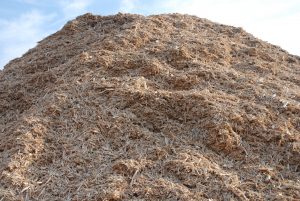 Demand for biofuels has been growing in many parts of the world. …Disruption to oil exports via the Strait of Hormuz this year created a further incentive to switch to biofuels to ensure energy security. While biofuels can’t fully replace petroleum, they can be blended into gasoline and diesel, allowing countries to stretch existing fuel supplies. Many environmentalists contest the idea that biofuels are a sustainable alternative source of energy. And as more farmland is used to produce them, there’s less available to make food, increasing the risk of global food shortages and hunger in the poorest nations. …The priciest biofuel is sustainable aviation fuel, or SAF, which uses advanced refining processes to convert waste oils into jet fuel that can be blended for use in aircraft. There’s also so-called advanced or second-generation biodiesel, made from non-food sources such as crop waste, wood chips and even algae, which avoids competing with food crops.
 Western Europe has been scorched by its hottest June on record, scientists have said, as the UK enters its third heatwave of the year and wildfires ravage France and Spain. Inflamed by carbon pollution, the deadly June heatwave helped push surface air temperatures for the region 3.06C above their average from recent decades. Globally, June 2026 was 0.56C hotter than the 1991-2020 average and 1.39C hotter than preindustrial levels, making it the second-warmest June on record, the agency found. …Western Europe is facing its third heatwave in six weeks and widespread dryness is helping small wildfires explode into unchecked blazes. Copernicus said the succession of heatwaves illustrated “the growing challenge” posed by worsening heat extremes. Raging infernos have laid waste to large areas of southern Europe in recent days, prompting the EU to scramble firefighters and water-bearing planes to help national services overwhelmed by simultaneous blazes.
 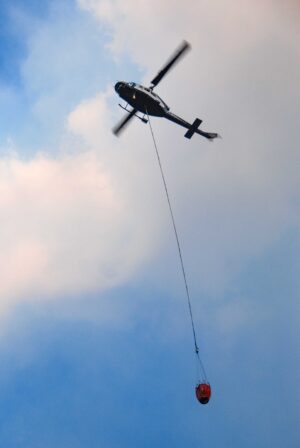 COLORADO — A pilot from Sooke on Vancouver Island was killed after the helicopter he was flying while battling wildfires in Colorado crashed into a reservoir. The aircraft reportedly went down in the Silver Jack Reservoir, shortly after 5 p.m. Sunday. The Gunnison County Sheriff’s Office says a dive team recovered the body of 56-year-old Nicholas Dale of Sooke, BC, from the submerged helicopter. The sheriff’s office says the helicopter was battling the 148-square-kilometre Gold Mountain wildfire when the crash occurred. It said the U.S. National Transportation Safety Board and Federal Aviation Administration are still investigating the incident. …The Associated Press reported that a procession of law enforcement vehicles carried Dale’s body to the city of Grand Junction, as residents turned out to express their gratitude to the fallen pilot and the thousands of firefighters still battling the blaze. …Dale was the fourth person killed in recent weeks while battling Colorado wildfires.

 Hundreds of firefighters have been battling forest infernos in heatwave-scarred Europe, as temperatures are set to rise again on Sunday, local time. The latest wildfires have already devastated more than 17,000 hectares of land across France, Spain and Portugal where temperatures in some places are forecast to reach 40C. Authorities registered