 The Georgia wildfires that destroyed 120 homes are blamed for death of a firefighter. In related news: BC’s Wildfire Service reports out of control wildfire near Coombs; Campbell River First Nation takes action to reduce fire risks; Whistlerites lag on preparedness despite concerns; and last year’s Manitoba wildfires cost $500M. Meanwhile: a new study says warming temperatures may exacerbate forest pest damage; and sustainable forestry concerns are raised by BC ENGOs; the Association of Vancouver Island and Coastal Communities, the Northwestern Ontario Municipal Association; and Harrison Hot Springs council.
In Business news: Prime Minister Carney announced a national sovereign wealth fund; Ontario communities brace for sawmill job losses; and New Zealand and India sign a free trade agreement. Meanwhile: Canada’s home builders report near-record low builder confidence; Canada’s insurance sector urges caution on mass timber; and BCIT hosts mill-ready training for lumber workforce.
Finally, Canada’s supply management defenders could borrow from the lumber trade wars.
Kelly McCloskey, Tree Frog Editor




 OTTAWA — The Canadian Kitchen Cabinet Association (CKCA) supports the Government of Canada’s launch of a
 The Trump administration is demanding what amounts to an “entry fee” from Canada to engage in trade talks toward a revised Canada-United States-Mexico Free Trade Agreement (CUSMA), four sources said. “The Americans are setting conditions before negotiations begin,” said one high-ranking individual. The US demand was also confirmed by former Quebec premier Jean Charest, who was appointed to Prime Minister Mark Carney’s new advisory committee on Canada-US economic relations. …On the US side, there are suggestions that Canada should try to get Trump’s attention by making an immediate concession, especially since the president is juggling several major issues right now. However, Canadian sources said they have twice offered concessions to the US administration without receiving anything in return. …Former Canadian diplomat Louise Blais, in her capacity as a strategic advisor to the Canadian Council on International Affairs, said the Americans “perceive Canada as unwilling to come to the table.”
 The Trump administration has begun processing refunds for billions of dollars in tariffs that the US Supreme Court struck down in February. In what is to be the biggest repayment programme in history, companies can apply online for money they were charged under the “Liberation Day” tariffs – plus interest – to be returned. …But individual consumers, who were hit by the tariffs indirectly through higher prices, are not expected to be compensated. …”All importers of record whose entries were subject to IEEPA duties are entitled to the benefit” from the high court’s ruling, Judge Richard Eaton wrote. As of early April, more than 56,000 importers had completed the necessary steps to apply for refunds online when the portal opened, with their claims worth $127bn. The portal, known as the Consolidated Administration and Processing of Entries (Cape), went live on Monday.
 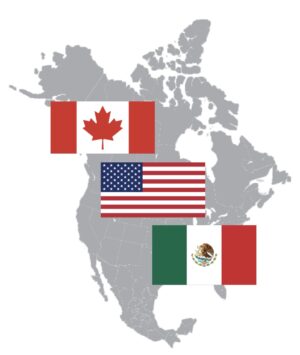 Canada-United States Trade Minister Dominic LeBlanc said the government wants to resolve trade frictions with the Trump administration as part of a comprehensive agreement, rather than through “one-off” deals. LeBlanc said the irritants U.S. officials raise privately are the same ones they’ve outlined publicly. A recent report by U.S. Trade Representative Jamieson Greer’s office flagged Canada’s supply-managed dairy system, regulations affecting major US technology firms and other long-standing trade concerns. “If we’re going to resolve some of these issues that Ambassador Greer referred to, Canada is ready and willing to do that work,” LeBlanc said. But he said any progress must come as part of a “larger agreement” that would ease pressure on tariff-affected sectors of Canada’s economy and provide greater certainty around the Canada-U.S.-Mexico Agreement review process. The minister’s comments shine a light on the strategic considerations of the US, Canada and Mexico in the trade discussions.
 A Nanaimo public hearing on a controversial rezoning application to allow for the industrial development of forested lands near Cedar is entering its third week. …The application was put forward last spring by Harmac Pacific, which operates the Nanaimo Forest Products site. The land is zoned as “rural resource,” meaning the property can’t be used for industry. The rezoning proposal includes a parkland designation for an 11.3-hectare section of “forested buffer” alongside the popular Cable Bay Trail. Paul Sadler, CEO of Harmac Pacific, said the company built the Cable Bay trail in 1990. “We’re interested in protecting it,” he said, adding that the buffer section would quadruple the size of the park area.Sadler said he feels that the public hearing process has been “hijacked” by those opposed to the rezoning… noting that any applications to use the site after it is rezoned would undergo environmental assessments and a government permit process.
 San Group companies and federal bank launch multi-pronged legal attack after insurer denies claims over major 2024 fire in Delta. …At the heart of the dispute is Lloyd’s Underwriters and its move to deny a nearly $31-million insurance claim over claims the fire was not an accident, but a deliberate act of arson carried out by the owners. In a Dec. 30, 2025, letter Lloyd’s informed the Business Development Bank of Canada (BDC) and San Group subsidiary Acorn Forest Products that it was voiding the company’s primary and excess insurance policies. According to court documents, Lloyd’s determined the fire was “caused by arson perpetrated by Acorn, alone or in collusion with others” and through the acts or under the guidance of the company’s “directing minds.” The San Group has strongly denied the allegations. Both Acorn and its parent company maintain that Lloyd’s has failed to provide proof of arson and is using the allegation to avoid a massive payout.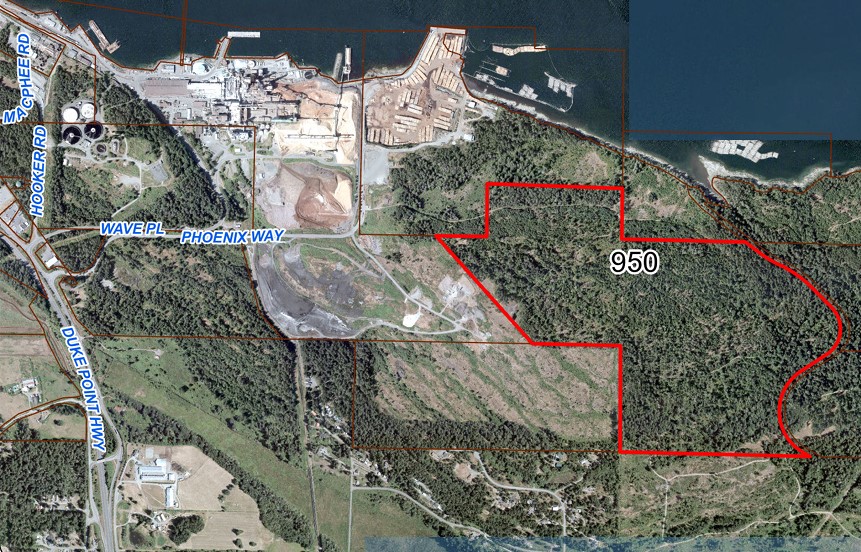
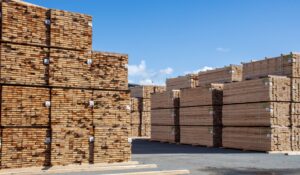 After meeting with Prime Minister Mark Carney on Thursday, Premier David Eby confirmed that US liquor products will remain off BC liquor store shelves, despite pressure from American officials. Eby wants the Americans to ease duties and tariffs on the softwood lumber sector before relenting on U.S. liquor products. …The issue gained renewed international attention after US Commerce Secretary Howard Lutnick called the measures against American alcohol products “disrespectful”. …One of the major sticking points for Eby is what he sees as preferential treatment by the US for lumber from Russia and Europe, just as punitive measures are ratcheted up on Canadian softwood products. “The reality is that British Columbians are pissed off about our industry being attacked, our families losing jobs for absolutely no reason, to prefer Russian and European lumber to Canadian lumber,” he said.


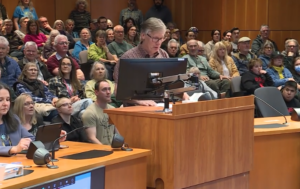 NANAIMO, BC — The debate over a contentious rezoning proposal came to a head Thursday night at Nanaimo council, with what may have been a record crowd for the public hearing. …At stake, Nanaimo Forest Products, which owns Harmac Pacific, wants to rezone roughly 72 hectares of land to heavy industrial. Harmac Pacific’s CEO said “Nanaimo is desperately short of industrial land and council initiated this process when approving the official community plan in 2022. …Paul Sadler, CEO and the General Manger of Harmac Pacific said the company wants to maintain ownership and choose businesses that are complementary to its own such as sawmills or companies that “can take advantage of its green energy supply” …The company, in discussions with Nanaimo City Council, has agreed to an average 100 meter buffer from the park. …But the majority of speakers were opposed. …The Snuneymuxw First Nation also has serious reservations. …The hearing continues April 22.


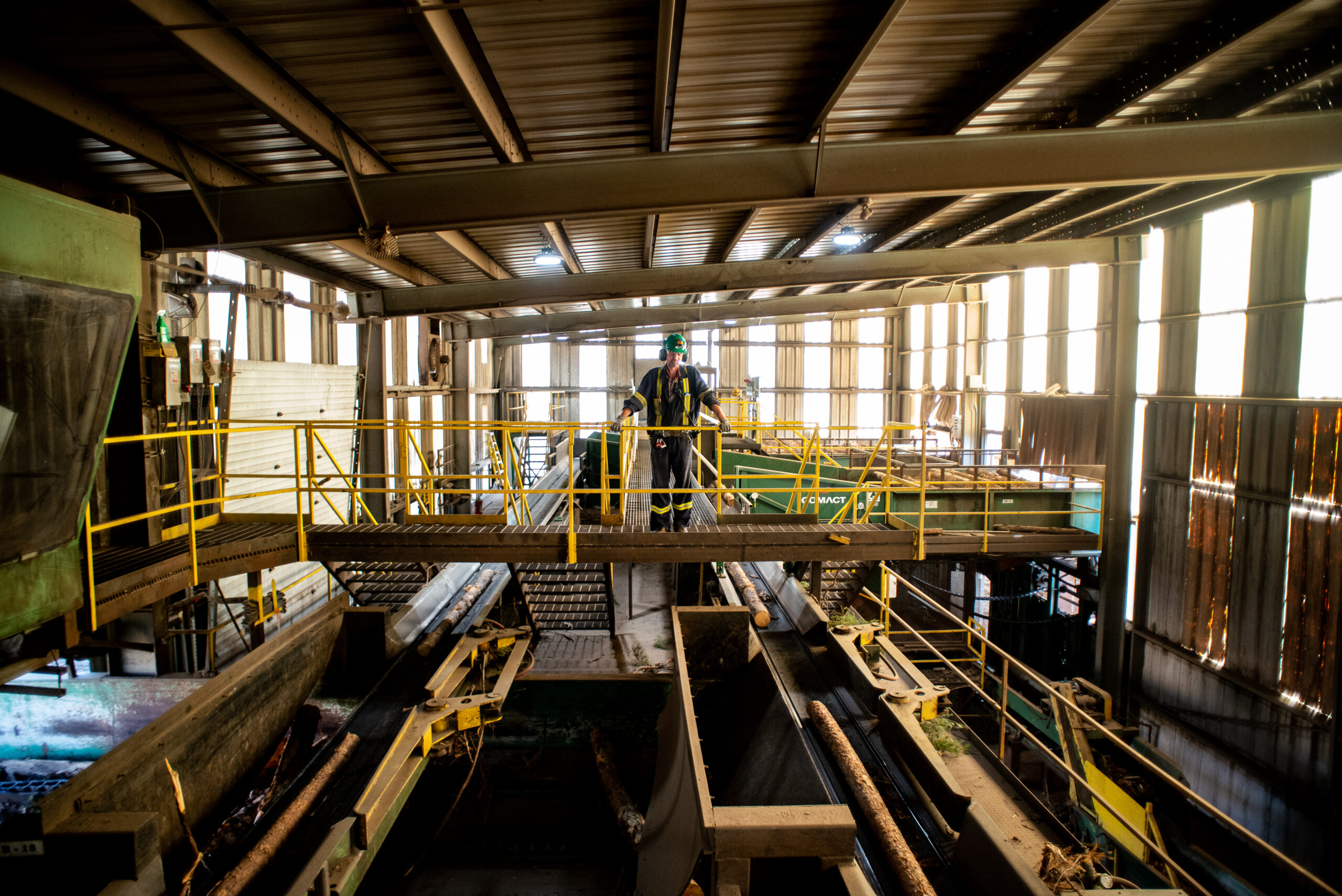






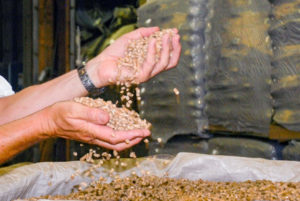 Researchers at the U.S. Forest Service’s Southern Research Station and Louisiana State University have published a paper that investigates how the European Union Deforestation Regulations could alter global wood pellet trade patterns. The paper is titled “Wood pellet market restructuring under the European Union deforestation regulation: A dynamic spatial equilibrium analysis.” …“Our results suggest the EUDR reallocates global trade rather than reducing global production,” the researchers wrote. While the regulation succeeds in reducing the European Union’s reliance on imports and increases its share of consumption of deforestation-free products, it does not materially lower the total amount of wood pellets produced and burned worldwide. …The main economic result is a shift in trade flows, where pellets that are blocked from the European market are redirected to Asian buyers. …The large production losses projected for the US Southeast, compared to the much smaller losses for Canada.


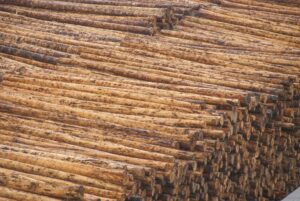 India is a strategic priority for New Zealand because of its growing global influence, economic scale, and regional importance. This is why New Zealand is building a broad, deep, and enduring strategic relationship with India. By 2030, India’s GDP is expected to reach around NZ$12 trillion, making it one of the world’s largest economies. India’s rapidly growing middle class is projected to soon reach 715 million – those consumers alone will be a larger market for New Zealand than the European Union or ASEAN. …The impact and value of the NZ-India FTA will grow over time – delivering greater market access through streamlined border processes and phased tariff cuts. …On forestry and timber – a major export to India – over 95% of our exports become tariff-free immediately at entry into force. Almost all other exports benefit from tariff elimination over seven years, providing a valuable market option for wood exporters.
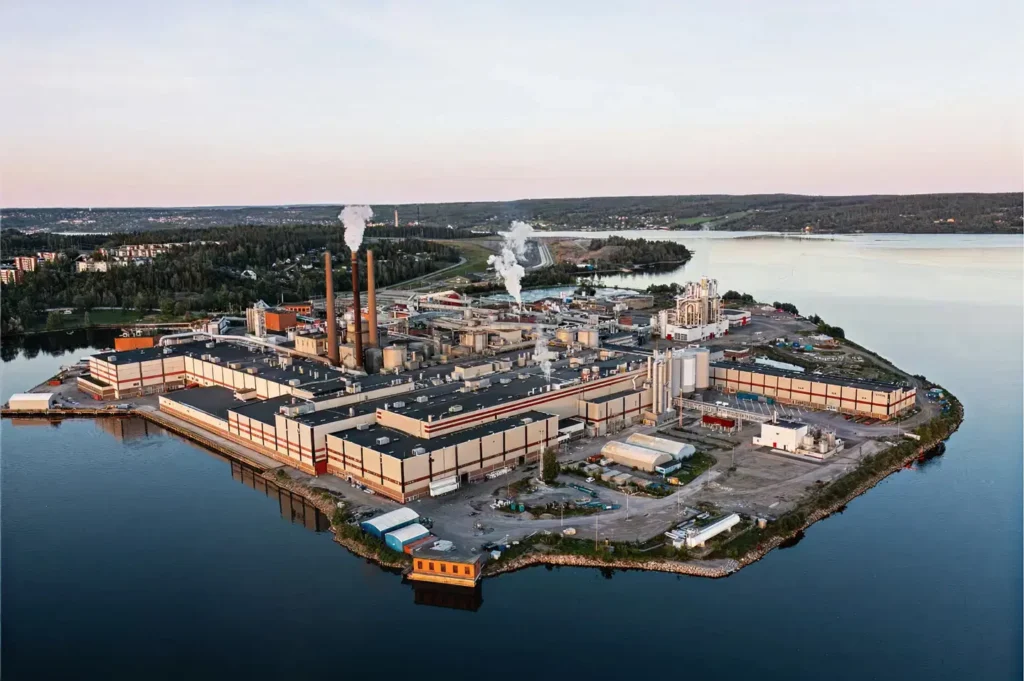
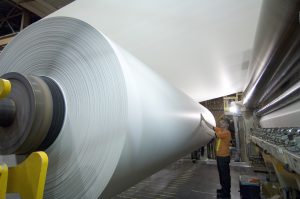 Seven paper mills have closed in France since the beginning of 2024, raising concerns about a broader decline in the country’s paper and pulp industry. The warning comes from COPACEL, which highlighted the trend during its annual press conference. The industry group also pointed to a fragile outlook for several production sites entering 2026. Out of a total of 81 paper mills in France, seven have permanently ceased operations. According to COPACEL, the closures have significant consequences for employment, regional development and industrial sovereignty. France is already a net importer of pulp, paper and cardboard, increasing its reliance on foreign supply. At the same time, two packaging paper companies are undergoing court-led restructuring, while a group operating two large pulp mills is in conciliation proceedings. Several other companies are considered financially vulnerable. Meanwhile, French manufacturers face persistently high production costs linked to energy prices, taxation and administrative complexity.
 RUSS TAYLOR provided the latest quarterly report from the


 For the second consecutive month, a leading index reported an increase in North American containerboard pricing. Month-over-month containerboard prices rose $30 per ton in April, following March’s $40 per ton increase, according to monthly data released Friday in Fastmarkets RISI’s Pulp & Paper Week publication. When also taking into consideration the $20 per ton decrease the index reported in February, containerboard pricing has a year-to-date net increase of $50 per ton. …On the boxboard front, most prices remained relatively flat in April. Solid bleached sulfate remains in oversupply, although demand was flat to slightly improved.
 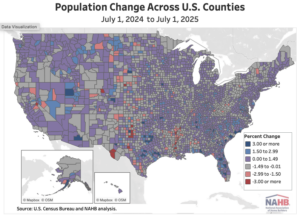 US population growth slowed notably in the latest Vintage 2025 population estimates from the U.S. Census Bureau, with the nation expanding by just 0.5% in 20251, roughly half the pace of the prior year. The deceleration was primarily driven by a sharp decline in net international migration (NIM), which dropped from 2.7 million to 1.3 million, while natural change remained relatively stable. Population gains remain concentrated in the South and parts of the West, while many areas in the Midwest and Northeast experienced slower growth or population declines. …At the county level, population growth slowed across much of the country. Among the nation’s 3,143 counties and the District of Columbia, the majority experienced decelerating population gains in 2025. …Population flows continue to shift away from the largest and most expensive counties toward smaller and less densely populated areas.
 JAKARTA — The Industry Ministry is pushing for packaging diversification and the development of alternative materials to strengthen the competitiveness of domestic manufacturers, particularly in the food and beverage sector, as global dynamics continue to drive up plastic prices …“We see the geopolitical situation in the Middle East as a catalyst to improve efficiency and accelerate innovation in more sustainable packaging alternatives,” said Putu Juli Ardika. In response, industry players have begun diversifying packaging materials, turning to paper, glass, metal and recycled plastics such as recycled polyethylene terephthalate (rPET), according to the ministry. Putu noted that the shift reflects both cost considerations and a broader push toward sustainability. Furthermore, the ministry sees strong potential in paper-based packaging, supported by Indonesia’s well-established pulp and paper industry. Paper packaging is increasingly being adopted across the retail, food and beverage, e-commerce and logistics sectors.

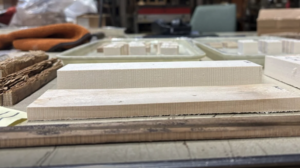 More efficient use of lumber byproducts leads to more sustainable forest management. That’s why Michigan Technological University researchers are developing a biomaterial lighter than steel and just as strong, made from leftover wood waste, that could revolutionize the lumber industry. …Xinfeng Xie, associate professor of forest biomaterials, and his team have partnered with the Defense Advanced Research Projects Agency’s Waste Upcycling for Defense (WUD) program to turn scrap wood into a strong, sustainable building material. …Led by Xie, students began by using a group of wood-decay fungi, also known as xylophagous fungi, to break down lignin, the tough, rigid structural polymer in plant cell walls. This biological approach leaves behind cellulose nanofibers that are stronger than steel, and its only byproducts are carbon dioxide and water. …The project also provides a physical product that has a positive impact on the future of their industry.


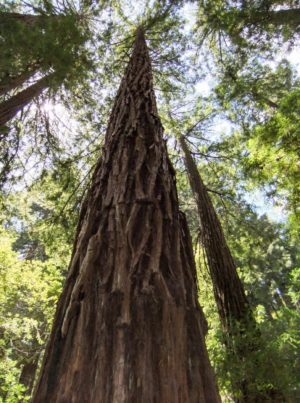 Last Wednesday, BC Premier David Eby released a statement celebrating B.C.’s wild places and passion for protecting the environment… commemorating Earth Day. …The problem? Conservation advocates, the BC Greens and a former BC Liberal cabinet minister who led a government biodiversity review said Eby’s claim about strengthening ecosystem protections largely isn’t true. Ken Wu, of the Endangered Ecosystems Alliance, said that after a promising start under Eby, BC has “stalled and started going backwards” when it comes to protecting ecosystems such as old-growth forests. …Former BC Liberal MLA Mike Morris, said he gives the Eby government “a failing grade” on strengthening ecosystem protections. …BC Green Party MLA Jeremy Valeriote said he hasn’t seen any evidence the government is strengthening ecosystem protections. …“With a huge deficit, and a premier taking it on the nose from the Conservatives on economic development, there’s a lot of focus on Look West,” he said.
 Premier Tim Houston says he would institute a ban on entering the woods again, if the circumstances called for it, in spite of a judge saying last year’s province-wide decree was unreasonable. Houston was reacting to a Nova Scotia Supreme Court ruling that says the province failed to consider individual mobility rights — enshrined under Section 6 of the Charter of Rights and Freedoms — when it told people to stay out of the woods on Aug. 5, 2025. The ban was imposed during an extended period of drought when wildfire risks were high to extreme. It remained in place across the province for several weeks. The court decision, released last week, suggested that Charter rights should be considered in a more meaningful way before the next emergency. Houston said he respects the decision but he stood by last year’s ban. He disputed the judge’s conclusion that the province did not consider Charter rights.
  In a province that is largely carpeted with forests, it is no surprise that timber production has long been a mainstay of Nova Scotia’s economy. Yet recent years have not been kind to the sector. Several major pulp mills have ceased production. …Worsening trade relations with the US have created further headwinds. Yet out of the apparent demise of traditional lumber, some see opportunity for. “Cheap, low-grade pulp was the key to the past,” says Royden Trainor, at the Greenspring Bioinnovation Hub, a public-private partnership working to promote the low-carbon bioeconomy in Nova Scotia. The way forward, he says, is to focus on opportunities where value can be added to forest raw materials. This involves looking towards the fibres that can be used to produce chemical products and advanced materials. Trainor highlights how residues from pulp mills or food processing plants can be used to produce biofuels, biochar and biochemicals.
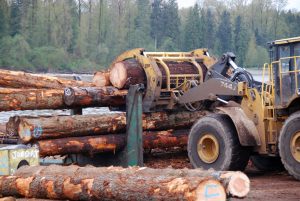 Autonomous skidders that drag felled trees around logging sites. A database detailing each tree in the forest. A screen that shows loggers which trees to cut and which to leave standing to maximize financial returns decades down the line. Weyerhaeuser, the country’s top logger and one of its oldest companies, is betting artificial intelligence can deliver these and other big changes to American forestry, which has come a long way from oxen and axes. Many applications envisioned by Weyerhaeuser executives are unique to a company that manages timberlands in the US and Canada that together cover an area roughly the size of Indiana. …Among the initiatives is the creation of a digital twin of Weyerhaeuser’s timberlands using satellite imagery, drone photography and lidar. …Weyerhaeuser is also studying semiautonomous logging equipment. At a meeting with investors, executives showed video of a driverless skidder, dragging freshly downed timber around a Southern logging site. [to access the full story a WSJ subscription is required]
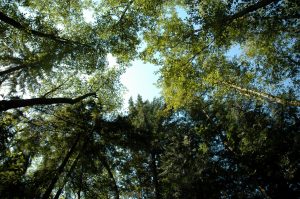 The recently announced major restructure of the US Forest Service may disrupt a number of forestry positions in Idaho. But the details as to how those positions will be affected and what work will continue or be eliminated under the plan remain unclear. Anna Webb, an entomologist and federal employee union representative based in Boise, received a notice about two weeks ago that her position in the agency would be affected. …Leaders of the federal employee union that represents Forest Service employees for the Boise, Payette, Salmon-Challis and Sawtooth national forests are concerned about the disruption to local employees as well as the potential long-term consequences to forest health. …Although Idaho’s forests are overseen by two out-of-state regional offices, many regional and some national positions are based in Idaho — all of these may be affected by the proposed restructure.
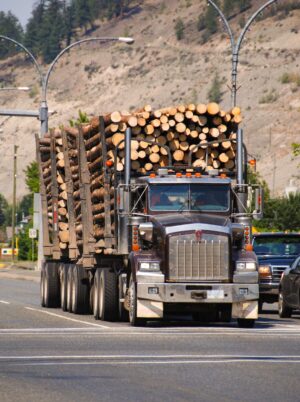 Louisiana’s timber industry is at a critical turning point. For generations, forestry has been one of the economic backbones of our state, especially in north Louisiana. Families like mine have built their livelihoods around logging, trucking and land management. But today, that foundation is weakening — not because our forests are failing, but because our markets are. Over the past several decades, Louisiana has lost a significant portion of its wood-using infrastructure. Mill closures across north Louisiana have reduced demand for fiber, leaving a growing supply of timber without a market. While our forests continue to thrive and produce, the outlets that once supported them have steadily disappeared. …Expanding markets like pellet-to-power could help restore demand for low-grade timber, which is essential to keeping logging operations viable. These industries have the potential to sustain hundreds of jobs, increase fiber demand and bring new economic activity to rural parishes.

 Drax has extended its wood pellet shipping contract with Ultrabulk through March 2031, with a mechanism to reduce carbon emissions year on year from sea freight journeys, according to Drax. The agreement follows the first UK arrival of the M.V. Ultra Yorkshire, a Handymax carrier operated by Ultrabulk, which completed its first transatlantic voyage carrying over 29 thousand tonnes of biomass pellets from the Port of Greater Baton Rouge to the Port of Liverpool. The cargo is set for rail transport to Drax Power Station in Selby. …The company estimated the voyage produced around 90% less CO2 than standard maritime fuels such as VLSFO or ULSGO.
 This
This 
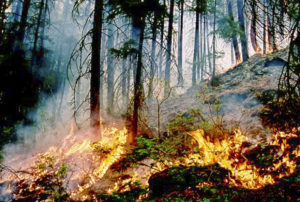 GEORGIA — Smoke has filled the air across parts of the Peach State this week as wildfires continue to burn out of control in southern Georgia, forcing evacuations and destroying homes. According to the Georgia Forestry Commission, crews responded to 34 new wildfires Wednesday that burned about 75 acres statewide. But officials say the biggest concern remains two large, active fires that have already scorched tens of thousands of acres. The Pineland Road Fire in Clinch County has grown to nearly 29,606 acres and is about 10% contained. In Brantley County, the Highway 82 Fire has burned more than 4,400 acres and is roughly 15% contained. Officials say dry conditions, high winds, and a lack of rain are making the fires harder to control. …The growing wildfire threat prompted Brian Kemp to declare a state of emergency, allowing more state and federal resources to assist, including expected support from FEMA.