 Canada’s lumber industry is at a tipping point, as Trump calls for more tariffs in response to Ontario’s Reagan TV ad. In related news: industry leaders say the additional tariff is uncalled for; Carney distances himself from provincial ads; Trump declines to meet Carney; West Fraser’s James Gorman says BC’s system needs reform; Greg Stewart explains Sinclar’s production reductions; and trade-expert John Weekes says don’t count on USMCA negotiations resolving the matter. Meanwhile: US inflation ticks up; US cabinet sales decline; and Fannie Mae’s GDP forecast rises.
In Forestry news: BC’s Forest Advisory Council says changes are needed; Quebec’s Safety Board releases report on skidder-operator death; Nova Scotia debuts the Fairy Creek documentary; and Oregon seeks input on Public Lands Rule. Meanwhile: World Resources Institute says wildfires are burning at twice the rate of 20 years ago; BC Forest Professionals and Nova Scotia Woodlot Owners focus on wildfire prevention; and the US government shutdown is impacting wildfire mitigation in Oregon.
Finally, after 16 years, BC Forest Safety Council CEO Rob Moonen is retiring in March 2026.
Kelly McCloskey, Tree Frog Editor




 Industry leaders say they are disappointed with the additional 10% tariff on Canadian goods announced Saturday by US President Trump… over Ontario ad. Jean Simard of the Aluminum Association of Canada said that this announcement is “very unfortunate and uncalled for.” …“I don’t think it’s going to add anything to the situation that the U.S. will be facing moving into the fall season with prices that will be increased by these stacked up tariffs on everything that moves into the U.S.” A $75-million television ad from the Ontario government, featuring remarks by former US President Reagan on tariffs is what prompted Trump to announce he was ending trade discussions with Canada. …“We might see the same phenomenon that unfolded in the course of the months of July and August, where our metal started moving towards Europe instead of the U.S,” Simard said.
  President Trump said that he, personally, wants to attend next month’s Supreme Court hearing on his tariff policies. The U.S. Supreme Court will hear oral arguments, beginning on November 5th, whether the president can unilaterally impose tariffs under emergency powers and is acting legally in his bypassing of Congress. The case involves the import tariffs against Canada, Mexico, and China, over allegations of fentanyl trafficking, as well as Trump’s reciprocal tariffs. …Canada is suffering under some of the toughest US tariff actions for some of its largest export sectors — the auto industry, along with steel, aluminum, and Canada’s softwood lumber. …John Weekes, one of the chief Canadian negotiators of the original North American Free Trade Agreement said a lot of Canadians seem to be holding onto hope that Trump’s tariff war will disappear when the USMCA is renegotiated next year. To that, John Weekes says don’t bet on it.

 BURNABY, BC — Interfor announced today revised operating plans for the fourth quarter of 2025. Due to persistently weak market conditions and ongoing economic uncertainty, Interfor will further temporarily reduce lumber production across its operations in British Columbia, Ontario, the US Pacific Northwest and the US South. These curtailments are expected to reduce lumber production in the fourth quarter of 2025 by approximately 250 million board feet, or 26%, as compared to the second quarter of 2025, which reflected a more normal operating stance. The curtailment volumes are approximately evenly split between Interfor’s Canadian and U.S. operations. …These curtailments are an amendment to Interfor’s previously announced curtailments on September 4, 2025. “Lumber prices in all regions of North America have continued to weaken, from already unsustainably low levels,” said Ian Fillinger, Interfor’s CEO. …While necessary, we fully recognize the impact these actions will have on our employees, contractors, suppliers and communities.”


 The judges at New Brunswick’s highest court are wrestling with how to award costs in the first part of a massive and complex litigation that has entangled the province’s biggest landowners. The New Brunswick Court of Appeal heard arguments from three timber firms that successfully argued their case in preliminary motions in a lower court in the Wolastoqey Nation’s big title claim for about 60% of the province’s territory. …Lawyers for J.D. Irving, Acadian Timber, and H.J. Crabbe and Sons argued that because the case is so complex and important for the rights of all private properties in the disputed territory, they deserve a bigger payout. …The case is expected to cost millions over the years. This is one of the reasons the Liberals say they decided the government should settle the dispute. …The judge said the court would make its decision known at a later date.



 Luke Lindberg, U.S. under secretary of agriculture for trade and foreign agricultural affairs with the USDA, in conjunction with U.S. Secretary of Agriculture Brooke Rollins, has announced a three-point plan to increase exports, advance rural prosperity, and chip away at the trade deficit. The three-point plan includes:
 PORT OF LONGVIEW, Washington — If Northwest Advanced Bio-Fuels has its way, the Port of Longview may soon have a $2.4 billion sustainable aviation fuel plant. But the mega-project to turn timber waste into jet fuel has faced a slew of challenges on its way to landing at the giant riverfront Barlow Point site, a deal that’s still not inked after nearly four years. The people behind Northwest Advanced Bio-Fuels say the project is mere weeks away from finding the financing needed to lock in a site and build the plant — the first of a handful of additional facilities around the region to fulfill Delta Airlines’ immense need for sustainable aviation fuel. To port officials, however, the project is one of about 20 that have considered its flagship Barlow Point site, any one of which could put money down today and start the long process of realizing a mega-project there tomorrow.
 LITTLE ROCK — Arkansas’ leading industry, agriculture, is facing a crisis. But it’s not just row-crop farmers that are struggling — the forestry industry is as well. The market for timber has become so bad that mills are closing and loggers are getting out of the business. “This is devastating to the timber industry in South Arkansas. Eight of the last 11 weeks, we have experienced mill closures in Arkansas, some permanent, some temporary,” said John Dawson, president of Arkansas Pulpwood Co. in Camden. “We’re seeing loggers drop out. Lifelong families that are two, three, four generations of loggers are getting out of the business. Banks in South Arkansas are moving away from loaning money to loggers,” Dawson said. As you’d expect, demand for paper has plummeted. …But demand for lumber is down too. …There’s simply too much supply for the diminishing demand.




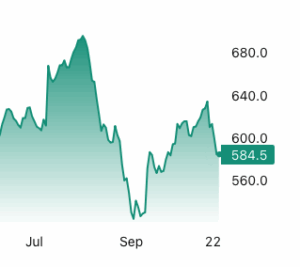 Lumber futures tumbled toward $590 per thousand board feet, a near one-month low, as weakening US housing activity and pre-tariff front-loading left wholesalers awash with stock while stacked US duties on Canadian imports and trade uncertainty pushed prices lower. US homebuilding has slowed, with housing starts falling 8.5% in August to a 1.307 million annualized pace and building permits drifting lower. Many US buyers front-loaded inventories ahead of expected import tariffs earlier this autumn, leaving distributors to work down excess stock before fresh order flow returns. On the supply side, a 10% Section-232 tariff added in mid-October atop roughly 35% in existing duties lifted border costs above 45% for many Canadian shipments, forcing sellers to find new markets or accept lower domestic prices. Producers like Interfor have trimmed output since mid-October, but the cuts are too recent to significantly reduce inventories or regional log supply.
 VANCOUVER, BC —
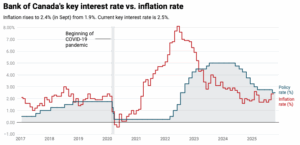 OTTAWA — Some economists say surprisingly strong September inflation figures will give the Bank of Canada pause ahead of its interest rate decision next week. Annual inflation accelerated to 2.4% last month, Statistics Canada said Tuesday. That’s a jump of half a percentage point from 1.9% in August and a tick higher than economists’ expectations. …The September inflation report will be the Bank of Canada’s last look at price data before the central bank’s next interest rate decision on Oct. 29. The central bank lowered its benchmark interest rate by a quarter point to 2.5% at its last decision in September. The Bank of Canada’s preferred measures of core inflation showed some stubbornness in September, holding above the three per cent mark. “This will make the Bank of Canada’s decision a bit more interesting next week than previously expected,” said BMO chief economist Doug Porter.
 Alain Ouzilleau, owner of Groupe Cabico, spent millions upgrading his two factories in Quebec and Ontario into state-of-the-art facilities shipping around $100-million worth of high-end kitchen cabinets to the US each year. Almost overnight, that business has been thrown into jeopardy. …“We have very long-term loyal customers,” Mr. Ouzilleau said. “But the 50% that is planned to be effective January 1st is just a death sentence.” …Hundreds of other Canadian cabinet and furniture makers also stand to lose their key export business, with limited ability to expand in a crowded domestic market. …What started as tariffs on steel, aluminum and automobiles has expanded to include copper and lumber, with a tariff on heavy trucks slated to come into force in November. The Trump administration is also conducting investigations into aircraft, semiconductors and industrial machinery, among other industries, suggesting more tariffs are on the horizon. [to access the full story a Globe & Mail subscription is required]
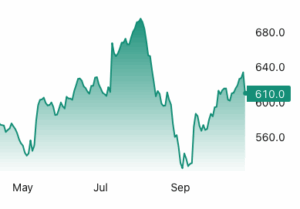 Lumber futures fell below $610 per thousand board feet, their lowest level since October 8 and down 12% from a three-year high in early August, as a slowing US housing market outweighed potential supply curbs from tariffs. August building permits dropped to a seasonally adjusted annualized rate of 1.33 million, the lowest since May 2020, while housing starts fell 8.5%, marking the fourth-lowest reading in over five years. Earlier this month, the US imposed a 10% tariff on Canadian lumber, with the Trump administration stating it aims to expand domestic timber harvesting and reduce reliance on foreign lumber. Looking ahead, expected Federal Reserve rate cuts could stimulate construction and home buying and encourage homeowners to borrow for repairs and renovations, the largest driver of lumber demand. However, signs of a slowing labor market and rising inflation suggest demand may remain subdued.
 Prices of products manufactured in Canada, as measured by the Industrial Product Price Index (IPPI), increased 0.8% month over month in September and gained 5.5% year over year. Meanwhile, prices of raw materials purchased by manufacturers operating in Canada, as measured by the Raw Materials Price Index (RMPI), increased 1.7% month over month and rose 8.4% year over year. …Prices for lumber and other wood products declined 4.4% in September, after two straight monthly increases. The decrease was caused by falling softwood lumber prices (-10.7%), the largest decrease since June 2022. In August 2025, the United States announced a significant increase to the duties it levies on Canadian softwood lumber.




 Section 232 tariffs were once seen as a fortress for US metals. Yet, that fortress now casts a much longer shadow. Companies far removed from the steel and aluminum sector could soon find themselves ensnared in tariffs they never imagined, thanks to the inclusion process for “derivative” products. The Trump Administration has steadily expanded Section 232 authority well beyond their original steel and aluminum targets, to copper, automobiles, trucks, lumber, and even wooden cabinets. These tariffs, which range from 10% (for lumber) to 50% (for steel and aluminum), are layered on top of normal import duties. At first glance, these measures appeared to strike only those industries handling raw materials. But in 2025 the Administration sought to close what it saw as a loophole: downstream products containing tariffed metals that could enter duty-free. As a result, section 232 tariffs were imposed on the raw material and a finite list of derivative products.
 Ikea is increasing the amount of products it makes in the US as the world’s largest home furnishings retailer comes under pressure from US President Donald Trump’s tariffs on furniture and kitchen cabinets. The flat-pack retailer, which made revenues of $5.5bn in the US last year, currently produces only about 15% of products that it sells in the US domestically. That compares with 75% local production in Europe and 80% in Asia. “We want to continue to expand in the US and Canada — how do we optimise a good supply set-up where we secure the right access to materials, to components, to production? That’s very long-term work that we’re doing,” Jon Abrahamsson Ring, chief executive of Inter Ikea. Trump imposed tariffs of between 10% and 50% on imports of foreign furniture and wood products. Ikea, which is responsible for about 1% of total industrial production, is set to take a significant hit.
 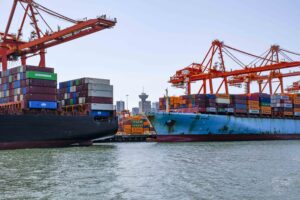 With new tariffs taking effect on furniture and lumber, an analysis released by Goldman Sachs finds American consumers are paying for more than half of the cost of the levies imposed by President Donald Trump. In a research note to its clients, the global investment and banking giant said U.S. consumers will absorb 55% of tariff costs by the end of this year. American businesses would pay 22% of the costs, foreign exporters would absorb 18% and 5% would be evaded, according to the Goldman Sachs analysis. Consumers could end up paying 70% of the cost by the end of next year, the report said. “At the moment, however, US businesses are likely bearing a larger share of the costs because some tariffs have just gone into effect and it takes time to raise prices on consumers and negotiate lower import prices with foreign suppliers,” the analysis adds.




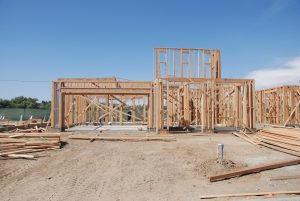 Anthony Cabrera, who started working with a contractor in March to construct the three-bedroom house, was eager to get ahead of a fresh round of tariffs on key building materials and home items that took effect earlier this week. Mr Cabrera had already seen his initial budget of roughly $300,000 balloon to $450,000 as prices for a range of products. …A recent report from Goldman Sachs found that US consumers will shoulder as much as 55% of the cost. It takes time to raise prices on consumers, the economists noted, and US firms will increasingly pass on costs in the coming months. The new tariffs “will create additional headwinds for an already challenged housing market” Buddy Hughes, chairman for the NAHB, said. Affordable housing construction could be hit particularly hard, said Elena Patel, of the Urban-Brookings Tax Policy Center. …Matthew Walsh, at Moody’s Analytics, said that cost uncertainty will be the most immediate effect.

 Ireland must realise the “massive opportunity” that exists as timber construction is set to triple market value and deliver climate action, Forest Industries Ireland (FII) said. The director of FII, Mark McAuley has welcomed a
  More companies that provide rayon, lyocell and modal to fashion brands are sourcing less from ancient and endangered forests, according to the nonprofit Canopy. Although the vast majority of cellulosic fibers are still spun from virgin materials, some of the biggest producers have been quickly adopting forest-friendly and circular materials. 70% of companies making semi-synthetic, cellulose-based fibers now exhibit green practices that reduce pressures on forests. 54% of fiber producers that the group tracked have reached the nonprofit’s favorable green rating. …Canopy uses this annual report in part to help brands make informed sourcing decisions. The use of recycled materials for such fibers is still rare, although it grew to 1.1% in 2024. Such textiles represent only 6% of the global fiber market, according to Textile Exchange. It found that fibers approved by Forest Stewardship Council (FSC) or other certification made up as much as 70 percent of cellulosic fiber market share.
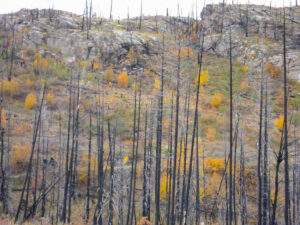 For the Northwest Territories government’s 2024 Forest Health Report, published last month, researchers were only able to survey about one third of the area they would normally study. Smoke from nearby wildfires reduced visibility for crews on the ground and in the air, making it difficult for researchers to do their work. Even so, one of the report’s findings is the sheer impact of a drought that has covered much the NWT since June 2022 – and its effect on forests. Of about four million hectares of forest surveyed by researchers in 2024, more than 220,000 hectares showed stresses from either the ongoing drought or the high water of 2020 and 2021, the report asserted. Because the survey work was limited by factors like smoke, researchers think the real extent of the issue “is likely substantially larger.” …Drought can contribute to tree and plant mortality, which in turn creates fuel for wildfires.
 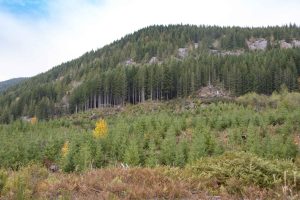 Canada’s vast forests are the envy of much of the world, but they’ve seen brighter days. Our changing climate has beckoned wilder wildfires, disease and drought. And after decades of cutting big and fast to maximize profits, the country’s logging industry is in freefall. But there’s opportunity in crisis — or that’s the bet some First Nations in British Columbia are making. …“Now we’re dealing with a lot of scrub in that corner that we didn’t get to before,” Garry Merkel, a professional forester and a member of the Tahltan Nation. …In Manitoba, the forestry industry watched this summer as profits went up in smoke. Devastating fires burned more forest in logging areas than any year in recorded wildfire history, according to an analysis by Manitoba reporter Julia-Simone Rutgers. And forestry companies are “scared to death,” said.
 HALIFAX – A documentary on BC’s Fairy Creek blockade is making waves in Nova Scotia. “Fairy Creek” covers a period of eight months in 2021, when thousands of activists blockaded logging roads leading to old-growth forests on Vancouver Island. …Now, it’s getting a Nova Scotia debut with screenings in Halifax, Tatamagouche, Inverness, Annapolis Royal and Wolfville. …Neal Livingston, a Nova Scotia filmmaker, says… “We don’t have a history of that (in Nova Scotia).” Livingston says the film is especially timely for Nova Scotians, as activists in Cape Breton say they have been targeted by recent legislation. …The province introduced an omnibus bill that would make blocking forest access roads illegal and come with a fine of up to $50,000 and/or six months in jail. This fine is a steep increase from the current $2,000 penalty.
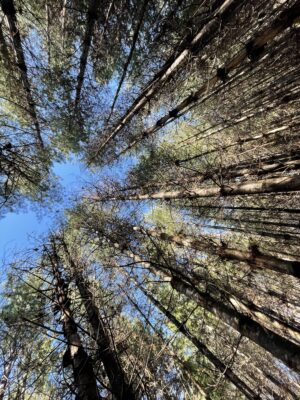 The bipartisan Fix Our Forests Act passed out of the Senate Agriculture Committee on Tuesday morning, marking the first advancement of the bill since it previously stalled in committees under both the Biden and the previous Trump administration. The Act would create an interagency Fireshed Center focused on wildfire prediction and tracking, establish fireshed management areas in forests with high wildfire risks, and expedite the review of wildfire-related forest management projects under the National Environmental Policy Act. The act has gained support from lawmakers on both sides of the aisle, along with numerous environmental and wildfire-focused organizations. Critics of the Act claim it would further open up

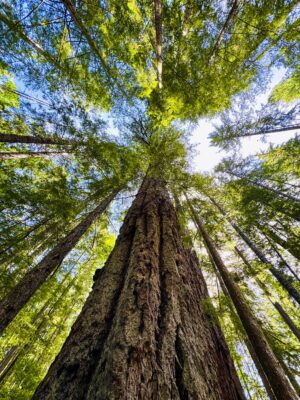 EUGENE, Oregon — With the Trump administration poised to rewrite forest management policy, groups are on guard for changes to climate and lumber harvesting sections. Travis Joseph has a message for environmental groups worried that the Pacific Northwest’s oldest trees are about to fall to loggers: Timber companies don’t really want to cut them down. Joseph, who heads a timber industry group and is a former aide to ex-Democratic Rep. Peter DeFazio of Oregon, made that proclamation. …“I love these trees, too,” said Joseph, CEO of the American Forest Resource Council (AFRC). “But they’re at risk. Let’s save them. Let’s come in here and protect them.” Joseph’s group says the threat to big trees in western Oregon — these giants were 5 or 6 feet across at the trunk — isn’t logging. It’s wildfire that’s becoming a bigger menace as climate change makes summers hotter and reduces the winter snowpack. [to access the full story a subscription is required]
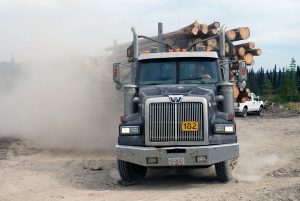 CLANCY, Montana — Healthy forests depend on a strong forest products industry. Sawmills help support thousands of Montana jobs, reduce wildfire risks, and provide a renewable resource. Despite recent mill closures in Missoula and Seeley Lake, Marks Lumber in Clancy continues to carry on. …Both Roseburg Forest Products in Missoula and Pyramid Mountain Lumber in Seeley Lake closed last year. Marks Lumber has been open for 36 years, and they have adapted to industry changes before. “ …In light of the recent closures, they have made some changes, including shifting to more board production (processed wood) rather than the raw tree, which is more expensive to manufacture, and slowing down on how much logging they do. Marks Lumber also had to change where their sawdust and chips go. Roseburg used to buy that material, but now they send them to Weyerhaeuser Forest Products in Columbia Falls.

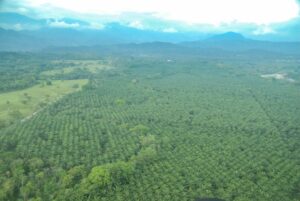 The European Union proposed granting companies six months of leeway to comply with its landmark law to curb deforestation across the world, rejecting a longer delay despite industry complaints. The EU’s Deforestation Regulation aims to tackle the felling of trees associated with imports. Yet it has faced criticism at home and abroad for being too bureaucratic. The European Commission proposed Tuesday giving large companies six months of relief from sanctions after the law goes into effect at the end of the year. Bloomberg previously reported plans to delay implementing the rules by a year. …Both parliament and member states will need to sign off on the changes before the end of the year, and have the right to propose amendments. …A six-month adjustment period will be welcomed by environmental activists, alarmed by high rates of deforestation, said Luciana Chávez. [to access the full story a Bloomberg subscription is required]
 SWEDEN — Ingka Investments, the investment arm of Ingka Group (the largest IKEA retailer), has agreed to acquire approximately 153,000 hectares of land in Latvia and Estonia, of which 89% are forestland, from Södra, Sweden’s largest forest owners’ association. Completion is subject to approval by the relevant regulatory authorities. “Our unique ownership structure allows us to invest with a long-term perspective rather than short-term quarterly thinking.” …As the world’s largest IKEA retailer, Ingka Group operates in 31 markets and represents 87% of global IKEA sales. …Niks Sauva, Country Manager, Ingka Investments Latvia, continued: “We’re committed to creating more value locally in the Baltics. Our goal is to increase the share of wood processed regionally to strengthen the Baltic forestry value chain.” …Completion is subject to approval by the relevant authorities in Latvia and Estonia.
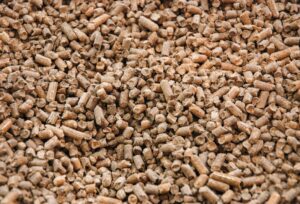 PASCAGOULA, Mississippi — A fire is burning inside one of the wood pellet domes at the Port of Pascagoula. The fire started Monday afternoon inside one of the two Enviva domes at the port. Jackson County Emergency Management Director Earl Etheridge said there is no danger of explosion. Jackson County firefighters are on scene to assist Enviva and port crews. The fire started Monday afternoon inside one of the two Enviva domes at the port. …Etheridge says that Enviva is injecting the dome with pressurized nitrogen to suppress the fire. The fire is contained to the dome. Crews are working to offload the 20,000 metric tons of wood pellets.
  Atmospheric carbon dioxide (CO₂) rose faster in 2024 than in any year since records began. …Our new satellite analysis shows that the Amazon rainforest is struggling to keep up. And worryingly, the satellite that made this discovery could soon be switched off [due to proposed NASA budget cuts.]. Systematic measurements of CO₂ in the atmosphere began in the late 1950s. …Across six decades of measurements, CO₂ has gradually increased. …The largest change was over the Amazon, where much less CO₂ is being absorbed. Similar slowdowns also appeared over southern Africa and southeast Asia, parts of Australia, the eastern US, Alaska and western Russia. Conversely, we detected more carbon being absorbed over western Europe, the US and central Canada. …It’s not yet clear whether 2023-24 is a short-term blip or an early sign of a long-term shift. But evidence points to an increasingly fragile situation, as tropical forests are stressed by hot and dry conditions.
 Google has announced plans to address greenhouse gases beyond carbon dioxide by purchasing credits to support the emerging market for removing short-lived but highly potent “superpollutants.” The company will buy up to 25,000 tonnes of superpollutant-destruction credits by 2030 from two organisations, Recoolit and Cool Effect—equivalent to about one million tonnes of CO₂ removal over the long term. While carbon dioxide remains a key focus, Google said gases such as methane, hydrofluorocarbons (HFCs), chlorofluorocarbons (CFCs) and nitrous oxide have a much greater near-term warming impact. “It’s the right thing to do for the planet,” said Randy Spock, Google’s carbon credits and removals lead. “CO₂ is obviously very important… but if we think only about CO₂, then we’re just looking at one piece of the puzzle.” …Sam Abernethy, a climate scientist at Spark Climate Solutions, said: “Superpollutants only get a few percent of climate finance… that’s a misallocation given their importance.”