CASS COUNTY, Michigan — A man was sentenced to prison after he was found at a Michigan sawmill with a walnut tree that did not belong to him. Trever Wallace was sentenced to three years and two months up to 10 years in prison for his criminal concealment of a fully mature walnut tree, Cass County Prosecutor Victor Fitz said. …The tree’s owner was able to locate it at the sawmill before Wallace could profit from it, Fitz said. The defendant pleaded guilty as charged to larceny over $1,000. On Friday, Cass County Assistant Prosecutor Jason Ronning asked for prison time due to the defendant’s nine prior felony convictions and two misdemeanor convictions, including thefts. Fitz did not know the current state of the tree.


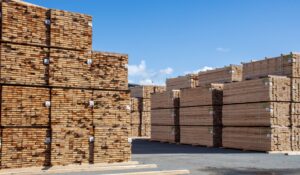 The US imports about 40% of the softwood lumber the nation uses each year, more than 80% of that from Canada. President Trump says that the US has the capacity to meet 95% of softwood lumber demand and directed federal officials to update policies and regulatory guidelines to expand domestic timber harvesting and curb the arrival of foreign lumber. …As researchers studying the forestry sector and international trade, we recognize that the US has ample forest resources. But replacing imports with domestic lumber isn’t as simple as it sounds. There are differences in tree species and quality, and U.S. lumber often comes at a higher cost, even with tariffs on imports. Challenges like limited labor and manufacturing capacity require long-term investments, which temporary tariffs and uncertain trade policies often fail to encourage. In addition, the amount of lumber imported tends to mirror the boom-and-bust cycles of housing construction, a dynamic that tariffs alone are unlikely to change.
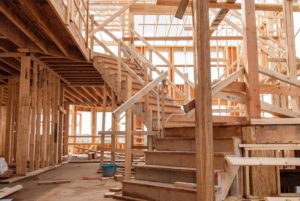 President Trump ushered in new tariffs on imported furniture, kitchen cabinets and lumber on Tuesday, adding a fresh round of levies as he once again threatened to expand his trade war with China. Tariffs ranging from 10% to 50% on foreign wood products and furniture snapped into effect just after midnight. The tariffs are meant to encourage more domestic logging and furniture manufacturing. But critics say that the levies will raise prices for American consumers and could slow industries including home building that rely on materials from abroad. …Critics have called it a stretch to issue the furniture and lumber tariffs under the national-security-related law. …Some American manufacturers lobbied for the tariffs. …Some economists expect the higher price of lumber, along with home furnishings, will slow the pace of home building. That could set back the Trump administration’s goals of improving a weak housing market. [to assess the full story a NY Times subscription is required]
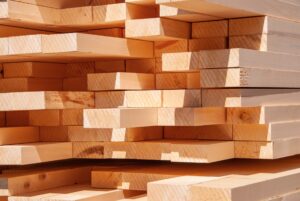 The US is now collecting tariffs on imported timber, lumber, kitchen cabinets, bathroom vanities and upholstered furniture, duties that threaten to raise the cost of renovations and deter new home purchases. …Trump described his wood and furniture tariffs as helping to “strengthen supply chains… and increase domestic capacity utilization for wood products.” Yet
 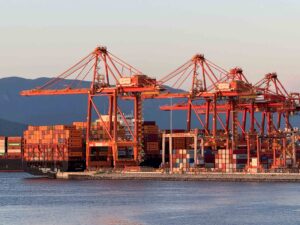 President Trump has warned of disaster if the Supreme Court overturns his signature tariffs. For starters, it would unleash a bureaucratic nightmare involving reams of refund paper checks. Should the court uphold a US Court of Appeals ruling that Trump’s country-based tariffs are illegal, the government could owe the bulk of the $165 billion in duties collected so far this fiscal year back to companies that paid them. But they won’t have an easy time getting their money back; refunds are typically issued slowly and while the administration could streamline the process, experts fear that’s unlikely. …That means Trump likely won’t part with the funds easily if the tariffs are struck down, and the administration is expected to move quickly to reimpose levies using other legal authorities if that happens. The Supreme Court is expected to hear arguments in November in the case.

 PRINCE GEORGE – Prime Minister Mark Carney met with President Donald Trump to discuss the connection between energy cooperation and support for Canada’s steel and aluminum industries. However, this meeting raised some eyebrows among forestry industry leaders, who wondered why softwood was left out of the conversation. Brink Forest Products owner John Brink believes that the omission of softwood tariffs in discussions with the president is yet another setback for an already struggling sector. MLA Kiel Giddens also voiced his disappointment that softwood lumber was left off the agenda, especially since forestry ranks among Canada’s leading employers. Brink notes that wood manufacturing plants are still shutting down across the province, and he believes the West must unite to send a strong message to Ottawa.
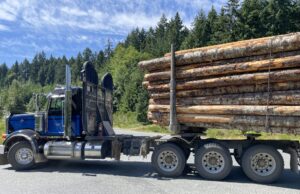
 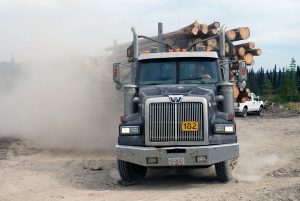 Linda Bell says there has been turmoil and chaos along parts of the US and New Brunswick border as trucks carrying lumber navigate the new tariffs that came into effect on Tuesday. But Bell says there’s been confusion as to what’s included under the new tariffs. In her almost three decades working as the general manager of the Carleton Victoria Wood Producers Association in Florenceville, she says it’s the first time there appears to be a duty on roundwood. “Trucks that were headed over there have been turned back and had to be unloaded. Some have been allowed to cross. We really don’t know what is going on,” she said. She said a few large mills in Maine who’ve been buying New Brunswick wood for five decades have halted all deliveries until the confusion can be cleared up. …Minister Mélanie Joly said there are different interpretations happening at various border locations.
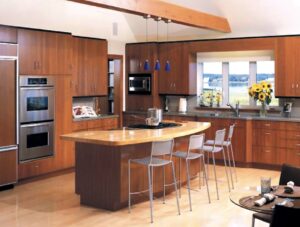 NEW YORK — Cabinet dealers, interior designers and remodeling contractors in the U.S. hope new tariffs on imported kitchen cabinets, bathroom vanities and upholstered wooden furniture will boost domestic production of those products. But several small business owners in the home improvement industry say they expect some short-term pains from the import taxes. Potential customers may postpone kitchen and bathroom renovations until costs — and the economy — seem more stable. …The American Kitchen Cabinet Alliance lobbied for tariffs to help offset what they described as a flood of cheap cabinets from countries such as Vietnam, Malaysia, China and elsewhere in the decades since manufacturing moved offshore. …Although the White House said the tariffs were intended to boost domestic production and protect U.S. businesses from predatory trade practices, some cabinet makers say that will be difficult because their supply chains are multinational.
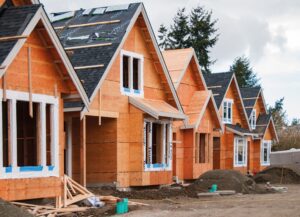 President Trump’s new tariffs on imported lumber and wooden fixtures have taken effect, potentially raising the cost of home construction and renovations. …“These new tariffs will create additional headwinds for an already challenged housing market by further raising construction and renovation costs,” says NAHB Chairman Buddy Hughes. …According to an NAHB analysis, U.S. sawmills are operating at just 64% of their potential capacity, a figure that has dropped steadily since 2017. “It will take years until domestic lumber production ramps up to meet the needs of our citizens,” the trade group says”. …Framing costs, including the roof, averaged about $49,763 for new single-family homes last year, accounting for about 12% of the total cost of a new build, according to an NAHB breakdown. Cabinets and countertops cost $19,056 on average, accounting for 4.5% of the total, the analysis found. …Builder profit margins have already been shrinking, and many companies have pulled back on new construction.
 The Trump administration and its advocates have long sold tariffs as a smart and necessary way to reindustrialize the country, bolster national security, and revitalize the economy more broadly. In practice, however, they put tariffs on cabinets and sofas for “national security” reasons, exempt others because of potential political blowback, and do all sorts of other things that likely undermine the economic and security objectives the administration says its tariffs are achieving. And they do it all with little regard for the facts, economics, or law. Throw in some foolish nostalgia (contra the president, furniture manufacturing is today a tiny share of North Carolina’s economy and workforce), and the furniture tariffs make for an almost-perfect example of the canyon between protectionist rhetoric and US tariff reality. The only thing preventing perfection is that there isn’t a “national emergency” or fake “fiscal crisis” attached.


 The Mississippi Department of Environmental Quality permit board on Wednesday reversed a decision from earlier this year and granted wood pellet manufacturer Drax a permit that allows it to release more emissions from a facility in Gloster. The board held a two-day evidentiary hearing after denying the company the permit in April. The permit falls under Title V of the Clean Air Act and allows Drax’s facility Amite BioEnergy, to become a “major source” of Hazardous Air Pollutants, or HAPs. The board voted unanimously in favor of granting the permit said Kim Turner. Evidence from the hearing “sufficiently addressed” concerns the board previously had. MDEQ has found the facility in violation multiple times since Drax opened the Amite County plant in 2016. …Drax applied for the permit in order to better reflect its production capacity. Since violating the current permit, Amite BioEnergy has had to decrease its pellet output.
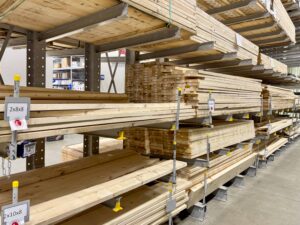 The European Commission proposed preliminary antidumping duties on imports of softwood plywood from Brazil, following an investigation launched

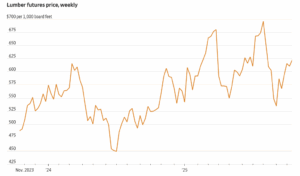 Lumber futures have risen about 19% from a low hit in early September, driven by the production cuts, hopes that declining interest rates will revive the housing market and Trump’s import tax. The 10% levy is on top of steep duties on Canadian lumber, which are adjusted annually in a heavily litigated process that is the result of a decades-long trade dispute. Those antidumping and countervailing duties rose in August to about 35% for most Canadian producers, up from roughly 15%. Canada’s sawmills are by far the largest source of softwood lumber from beyond U.S. borders, fulfilling about 24% of domestic consumption last year. Other significant importers of softwood lumber, the type used to frame houses, include Brazil and European countries such as Germany and Sweden. Homebuilders argue that import taxes will raise construction costs. U.S. lumber producers and timberland owners, however, urged Trump to enact a tariff.
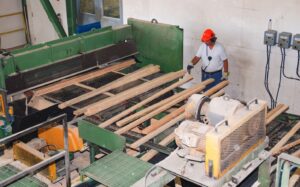 North America’s softwood lumber market looks likely to end 2025 no more settled than it was at the beginning. Producers and buyers alike continue navigating a landscape shaped by fluctuating demand, shifting trade patterns, and an uncertain housing outlook. Despite modest production declines in early 2025, the lumber market remains oversupplied. Mills across the US and Canada are contending with high inventories built up earlier in the year. Expectations of tariff hikes spurred an early rush of exports from Canada to the US, flooding the market while demand was soft. However, in the first half of 2025 softwood lumber exports from Canada to the US declined, while US imports from Europe in the first seven months of 2025 increased by 6% year-over-year. Underlying these supply pressures is a US housing market stuck in the doldrums. August saw an 8.5% decline in overall housing starts, with single-family construction down nearly 7%.
 Canada’s international trade deficit swelled to $6.3 billion in August, its second-largest shortfall on record, as new United States tariffs took a heavy toll on key exports and injected fresh volatility into cross-border flows. The latest figures, released by Statistics Canada, show how US trade policy continues to affect Canadian exporters and make the Bank of Canada’s next interest rate decision more complicated. Exports in August fell 3% by value and 3.2% in volume, led by sharp declines in copper ore and lumber shipments, both of which were hit by new US tariffs. …Imports, meanwhile, rose 0.9%, buoyed by higher consumer goods, a sign of resilient household demand, even as business investment remained soft. …Exports to the US, Canada’s largest trading partner, fell 3.4% in August after three consecutive monthly gains, and were down 8% year-over-year. Exports to non-US destinations edged up 1.8% from a year ago but slipped 2% from July.


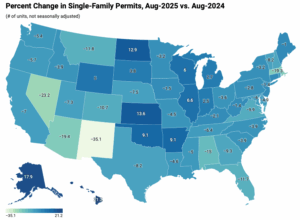 In August, single-family permit activity softened, reflecting caution among developers amid persistent economic headwinds. This trend has been consistent for eight continuous months. On the multifamily front, permitting also cooled in August but remains in the positive territory. While single-family continues to bear the brunt of affordability headwinds, the multifamily space is showing tentative signs of rebalancing. Over the first eight months of 2025, the total number of single-family permits issued year-to-date (YTD) nationwide reached 637,096. On a year-over-year (YoY) basis, this is a decline of 7.1% over the August 2024 level of 685,923. For multifamily, the total number of permits issued nationwide reached 330,617. This is 1.4% higher compared to the August 2024 level of 326,080. HBGI analysis indicates that this growth for multifamily development has been concentrated in lower density areas and among smaller builders.
)


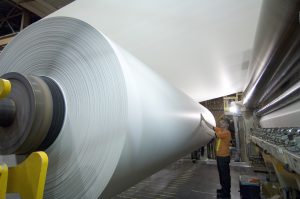 China’s pulp and paper industry continues to expand at an unprecedented pace, with new mill projects, advanced technologies, and state-backed financing driving record output. What began as a push to meet domestic demand has now evolved into an era of overcapacity and a structural imbalance that is reshaping trade dynamics, pricing strategies, and sustainability priorities worldwide. This expansion has far-reaching effects: global producers are contending with lower-priced exports, disrupted supply chains, and a shifting balance of power that challenges traditional market leaders in North America and Europe. …Industry observers expect consolidation in China’s pulp and paper sector, as smaller and less efficient mills struggle to survive. Strategic investments in transparency, benchmarking, and efficiency will be crucial for staying competitive in a tightening global market.
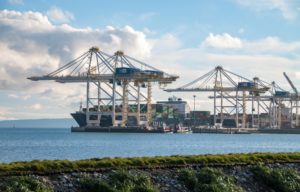 The UK timber industry is currently experiencing a crisis, even as it reports record sales of softwood, raising concerns over supply chain challenges, rising costs, and sustainability issues. The surge in softwood sales, particularly in the construction and woodworking sectors, has overshadowed the ongoing difficulties facing the industry. While the demand for timber has been high, particularly due to the growing construction boom and a shift toward more sustainable building materials, the challenges related to timber shortages and price increases remain deeply concerning for businesses across the sector. …The Timber Trade Federation (TTF) reports that softwood sales in the UK reached record levels in 2024. However, one of the most pressing issues facing the UK timber sector is the disruption of supply chains. The UK has faced considerable difficulty in securing a steady supply of raw timber. The global timber shortage has exacerbated the situation.
 Construction plastics are a major source of plastic waste in the province, and they urgently need to be measured, tracked and upcycled, says a B.C. organization that promotes sustainable built environments. Canada’s Federal Plastics Registry is expanding in 2026 to include construction plastics, but industry efforts are already underway to gather data and pilot new ways of reducing and reusing them, said Vancouver-based
 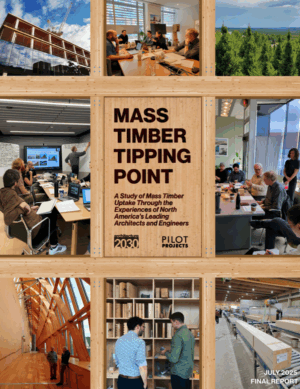 Mass timber is gaining momentum as a structural material that, along with many other attributes, can reduce the embodied carbon in new buildings and retrofits. Despite this potential, and widespread enthusiasm in the design community, the uptake of mass timber has been relatively slow. Architecture 2030 and Pilot Projects Collaborative’s new report,
  As National Forest Products Week is observed each October, the US Endowment for Forestry and Communities is highlighting one of its partner programs that supports and advances US-based manufacturing. The Endowment is administering $5 million of the USDA Forest Service’s $80 million Wood Innovation Grants program, overseeing 18 individual projects across the country. Each project includes matching funds from subaward recipients, resulting in a total impact of approximately $10 million. Together, these investments will advance wood product manufacturing, strengthen forest management and foster energy innovation for timber-producing communities. …“Our forests are only as strong as the markets that sustain them. Through programs like the Wood Innovation Grants, we’re creating new opportunities for innovation while reinforcing the resilience of both ecosystems and the communities that depend on them. Strengthening U.S. wood products manufacturing is necessary to achieve these goals.”
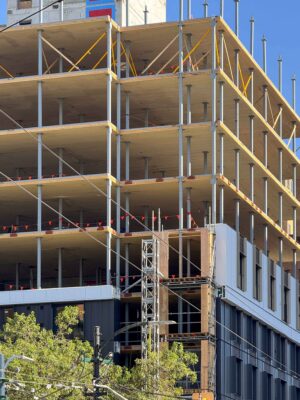 While sustainable solutions are facing drastic funding cuts, mass timber as a sustainable construction material is steadily gaining traction across the US. Construction using mass timber began in 2015 in the US, and since then the number of projects has grown about 20% annually. Today, over 2,500 mass timber projects are built or in progress in the US, including corporate offices for companies such as Google, Microsoft and Under Armour. …“We have lots of tech firms and big companies that say, ‘Hey, we’re battling it out for workers. We want the best space possible,’” said Bill Parsons, COO at WoodWorks. …Legislation that promotes and programs that fund mass timber, such as the Mass Timber Federal Buildings Act and the Wood Innovations Grant Program from the USDA, are still progressing. …Studies have shown that living or working in a mass timber building improves occupants’ mental health and well-being, even lowering their blood pressure and heart rates.
 BC’s forest communities are on life support. Families are losing jobs, mills are shuttering, and entire towns are being hollowed out. And now, with another punishing softwood lumber tariff slapped on by the U.S., the bleeding has gone from slow to catastrophic. Premier David Eby calls it an “existential crisis” and wants the prime minister to declare a national emergency. Here’s a better idea: How about the premier stops being the emergency? For eight years, the B.C. NDP has dismantled the foundation of our forest industry. They have made it harder to cut, harder to haul, harder to process, and harder to survive. Now Eby is running to Ottawa and blaming the Americans while ignoring the damage his government has already done. Let’s be clear. The forest industry is not collapsing because of one more tariff. It is collapsing because this government has gutted it from the inside.
  The Saskatchewan NDP’s critic for forestry is calling on the province to provide support to help forests in the north recover from this summer’s destructive wildfire season. Cumberland MLA Jordan McPhail said more than 2.9 million hectares of forest was destroyed by fire over the summer, and this is having an impact on the forestry sector. “They’re literally seeing future profits go up in smoke,” he said. The northern Saskatchewan MLA said the provincial government can play a positive role by investing in reforestation work. McPhail said provincial regulations dictate that forestry companies replant two trees for every single tree they take. These dictates do not apply in instances where trees are destroyed by fires. …The Government of Saskatchewan said the province is committed to doubling growth in the forestry sector and is prepared to support the industry to do this.
 CASTLEGAR, BC — A BC Timber Sales manager for the Kootenay-Boundary admits they may have a hard time selling wood in the coming months as local mills cope with additional U.S. tariffs. George Edney told Castlegar city council this week that his organization, which manages and auctions 20% of the timber on Crown land, will have sales opening next week in the Boundary. …Interfor has curtailed its Grand Forks operations indefinitely due to “persistently weak market conditions.” …Edney said if the wood they offer in the Boundary doesn’t sell at the upset price, they can drop the price and try again, or they can withdraw it altogether, although typically they want the wood in the market. …Edney said they sold 581,000 cubic meters that BC Timber Sales in the Kootenays in 2024-25. Their target volume for 2025-26 is 715,000 cubic metres.
 ONTARIO — The Northwestern Ontario Innovation Centre has partnered with the Thunder Bay Community Economic Development Commission (CEDC), the Centre for Research and Innovation in the Bio-Economy (CRIBE), Lakehead University and Confederation College to launch the Boreal Springboard, an innovative initiative aimed at strengthening and diversifying the forestry sector in Northwestern Ontario. Graham Bracken, at the Northwestern Ontario Innovation Centre, said the launch comes at a critical time for forestry in the region. …“The trade pressures were really the impetus to focus people’s minds,” Bracken said. “The sector is really integrated, and any threat to protection on the sawmill side weakens the rest of the sector. There’s a real drive to look to trade diversification and try and develop new value-added products that we can access other markets with.” Bracken says these investors will bring skills, technologies, and solutions that can be adapted to strengthen and grow the sector.


 Europe’s sawn timber industry is grappling with growing strategic uncertainty and rising compliance costs while the EU prepares to delay implementation of its landmark anti-deforestation law for a second time. While the postponement of the regulation to December 2026 may offer temporary relief, it also threatens to erode market incentives for early adopters and undermine confidence in the bloc’s regulatory direction. Producers across the continent have already invested billions of euros to meet the regulation’s demanding traceability requirements—developing digital platforms, upgrading Enterprise Resource Planning (ERP) systems, and restructuring supply chains to prove that every cubic meter of wood originates from deforestation-free sources. …In a strongly worded letter to the EC’s Environment Commissioner Jessika Roswall, a
 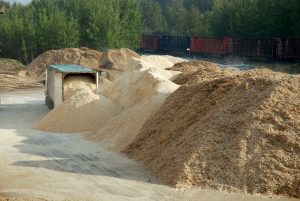 Given market sentiment and operating rates, in addition to recent mill closures and curtailments, how has demand for wood fiber changed recently and over the past 10 years? …Total capacity of the wood-using U.S. pulp and paper sector declined 18% in the past 10 years. This decline is specific to wood-using mills, excluding facilities that rely exclusively on recycled fiber, but the sector reported drops in all end uses, with reductions in printing and writing capacity falling 49%. This represented over half of the lost capacity nationwide. Newsprint, household/sanitary, and market pulp segments also had notable declines, each representing 10%-16% of the lost capacity. Regionally, capacity reductions in the U.S. South accounted for most of the volume lost (64%), with the U.S. West and North each representing 18%. The West experienced the largest and most severe drop in capacity for a given region, with pulp and paper mill closures and reductions decreasing capacity by 26%.
 BILLINGS, Montana — A federal judge on Wednesday dismissed a lawsuit from young climate activists seeking to block President Donald Trump’s executive orders promoting fossil fuels and discouraging renewable energy. U.S. District Judge Dana Christensen said the plaintiffs showed overwhelming evidence climate change affects them and that it will worsen as a result of Trump’s orders. But Christensen concluded their request for the courts to intervene was “unworkable” because it was beyond the power of the judiciary to create environmental policies. The 22 plaintiffs included youths who prevailed in a landmark climate trial against the state of Montana in 2023. …Legal experts said the young activists and their lawyers from the environmental group Our Children’s Trust faced long odds in the federal case. …The climate activists will appeal Wednesday’s ruling, said Julia Olson, chief legal counsel at Our Children’s Trust.