 US homebuilder confidence remains low as permits slide, but expectation of an interest rate cut boosts future sales expectations. In other Business news: the future of Domtar’s Glenwood, Arkansas sawmill is in question; and UPM extends its pulp mill closures in Finland. Meanwhile: AF&PA joins trade-group opposition to proposed US rail merger; and the American Journal of Transportation opines on Trump’s tariff war impact on trade, trucking and home ownership.
In Forestry/Wildfire news: Canada’s growing Wildland Urban Interface increases fire danger; what to know about the newly created US Wildland Fire Service; and wildfires continue to rage in Oregon’s Lane County; as fire bans are lifted for northern Vancouver Island. Meanwhile: Plilomath, Oregon adapts with mass timber; the Canadian Wood Council features Toronto’s Limberlost Place; and the BC Institute of Technology advances careers in the lumber and sawmill sector.
Finally, a US Lumber Coalition commentary claims most of lumber duties paid by Canadian mills will go into the US Treasury.
Kelly McCloskey, Tree Frog News Editor



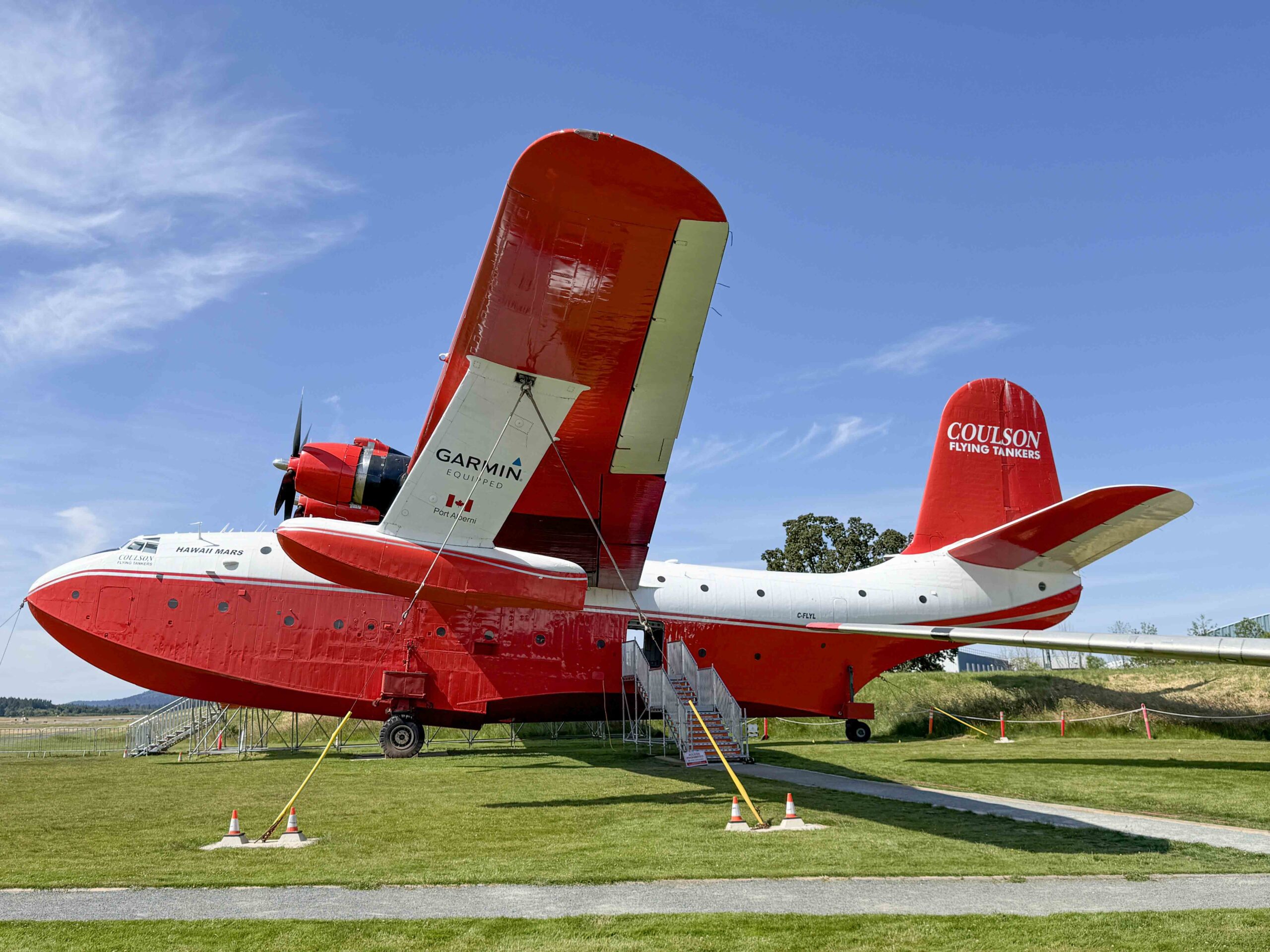 Coulson Aircrane says the Saskatchewan government has agreed to pay more than twice what it should have for four firefighting aircraft — a decision the B.C.-based company says will cost Saskatchewan taxpayers an extra $100 million. Coulson, one of the leading companies in the world for retrofitting planes for firefighting, made the claim last month in an application to the Court of King’s Bench. “We are concerned the government of Saskatchewan has awarded a very large (over $187,000,000) contract for forest fire airplanes, without affording any reasonable opportunity to Coulson or any other competitor to bid on the contract,” says an affidavit filed by company president Britt Coulson. Coulson is asking the court to quash the sale and order a fair, transparent competition. …He says the government failed to hold a proper, competitive tendering process, resulting in Conair making “an immense profit.” …Conair has declined to comment, as the matter is before the courts.
 WENDAKE, QC

 LEBANON COUNTY, Pa. — A large fire at Weaber Lumber comes just over a month after the company filed for bankruptcy. Weaber, Inc. filed for Chapter 11 bankruptcy on Aug. 1, according to online records. The company also filed a WARN notice in July at its distribution center on 25 Keystone Drive. In that notice, the company said 145 people would be laid off from July 26 through Sept. 9 of this year. The fire broke out Monday night around 10 p.m. at the company’s headquarters at 1231 Mt. Wilson Road, and it took firefighters until Tuesday morning to bring the blaze under control over eight hours later.
 SOUTH ANNVILLE TOWNSHIP, Pa. — A three-alarm fire ripped through Weaber Lumber in Lebanon County. Crews responded to the fire in South Annville Township around 10 p.m. on Monday. Flames could be seen leaping from the burning building. The blaze was upgraded to the third alarm, prompting a large firefighter response. According to Lawn Fire Company Chief Dillon Wilson, approximately 1.1 million gallons of water have been used from the on-site hydrant system to combat the fire. Tankers also brought in additional water to the scene. Chief Wilson said most of the building was engulfed in flames when crews arrived. “It got ahead of us,” Wilson said. The chief believes this building might have the most combustible materials under one roof in the state. Weaber Lumber has experienced multiple fires over the years. …For 80 years, Weaber has been proudly committed to the lumber industry and is one of the nation’s leading hardwood manufacturers.

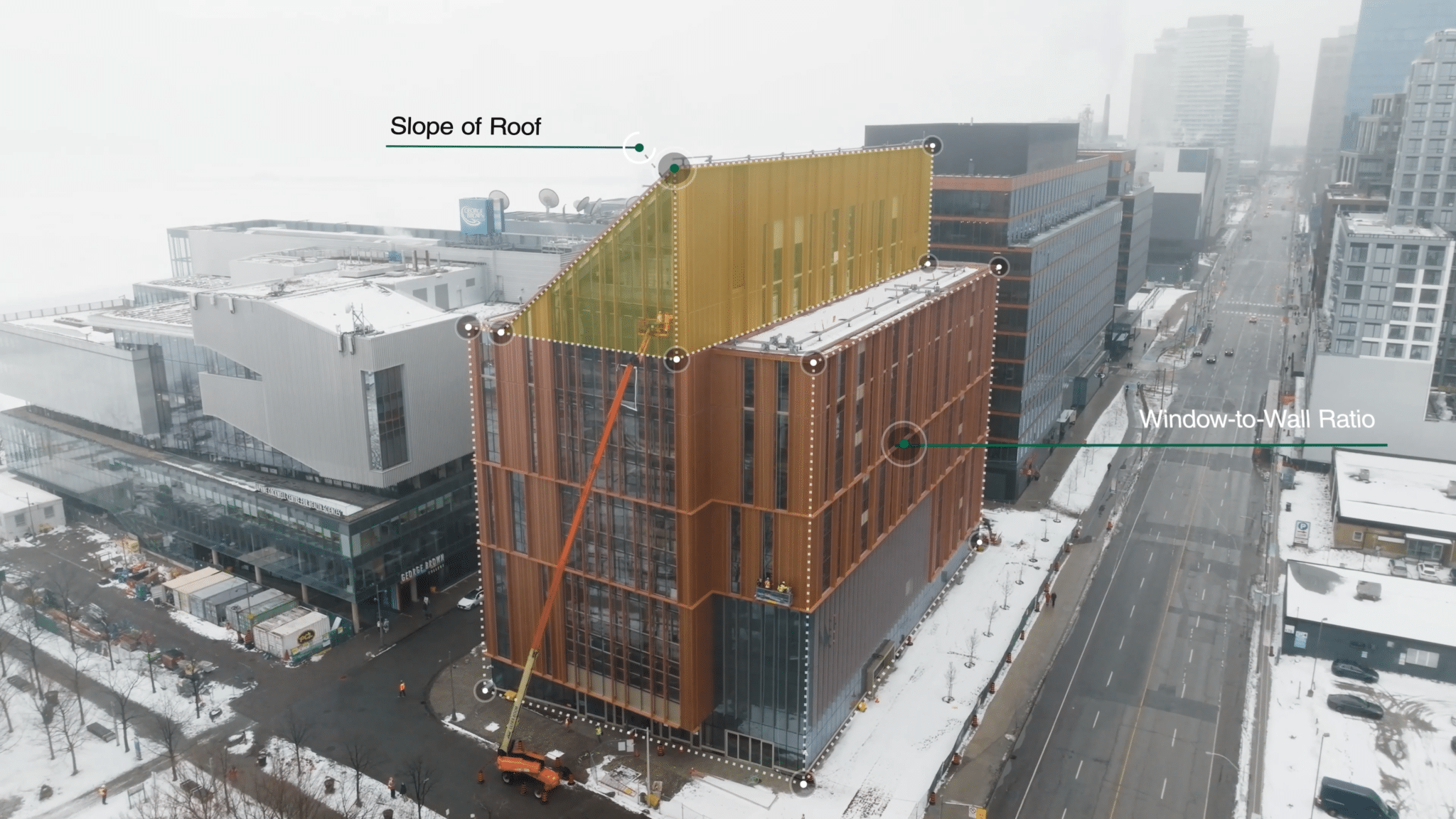
 The Canadian Wood Council (CWC) welcomes
 Forest Products Association of Canada (FPAC) welcomes
 The BCIT School of Construction and the Environment offers two Associate Certificate programs designed to support workforce development in the North American lumber and sawmill sector:
  ORONO, Maine — At the

 This summer, five exceptional students from across Canada were selected for the Forest Products Association of Canada’s (FPAC) 2025 Green Dream Internship Program, an initiative that continues to spotlight the next generation of forestry professionals. Now in its twelfth year, the Green Dream Internship offers students a unique opportunity to explore the forest sector from the inside out. Over six weeks, interns shared their experiences through creative storytelling—capturing everyday moments in forest operations, conducting interviews, and reflecting on their career journeys. Each intern received a $1,000 scholarship to support their studies. “As these students return to their studies and continue building their expertise, they now carry with them an even deeper understanding of the sector’s challenges, innovations, and opportunities,” said Derek Nighbor, FPAC’s President and CEO.
 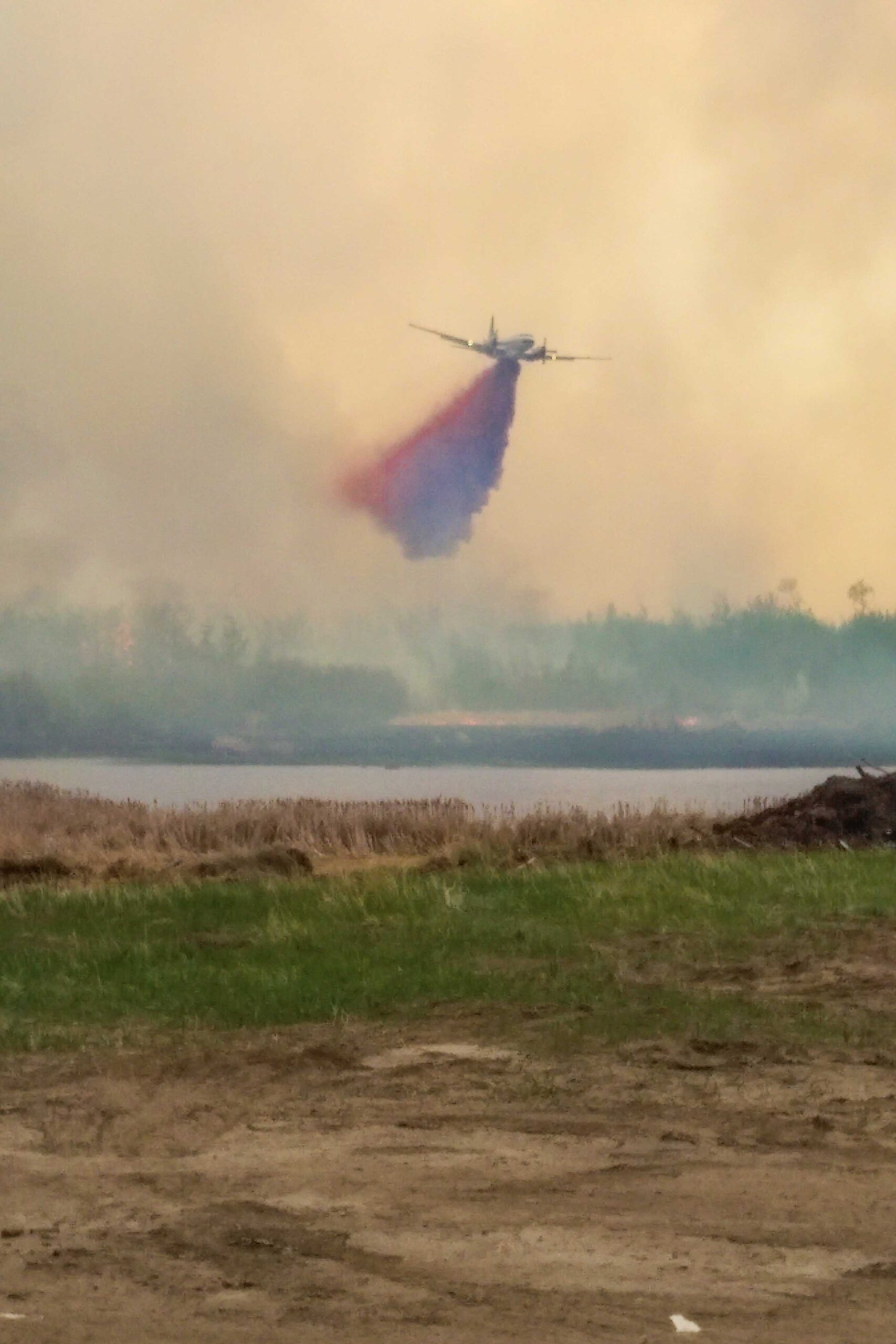 Dropping fire retardant solutions from planes is a crucial strategy in wildfire fighting, but some experts are concerned about their impact on the environment, including aquatic ecosystems. Once dropped, these retardants leave a rust-coloured or pinkish liquid coating on roads, roofs, and vegetation. This technique, commonly used since the mid 20th century, helps fire crews contain blazes by depriving flames of oxygen, explains Jen Baron, a postdoctoral researcher at the University of British Columbia’s Centre for Wildfire Coexistence. Since 2009, the B.C. Wildfire Service has relied on Phos-Chek LC-95A, a widely used retardant from Perimeter Solutions… Its main ingredient, ammonium polyphosphate, is a common fertilizer. Additives, like iron oxide, give the retardant its signature red colour, helping crews to see where it has been dropped. …Uldis Silins, a professor of forest hydrology at the University of Alberta says studying retardants like Phos-Chek remains crucial, especially because their specific chemical composition is proprietary and therefore unknown.
 Zoom Presentation
  The ancient forests near Fairy Creek, where the largest act of civil disobedience in Canadian history took place in 2021, have been fairly silent for nearly four years. But as logging in Vancouver Island’s old-growth forests picks up, protesters have returned to protect these ancient trees. On Friday, BC Supreme Court judge Amy Francis approved an injunction requested by Tsawak-qin Forestry Inc.—co-owned by Western Forest Products and the Huu-ay-aht First Nations—after two days of hearings. Those named in the injunction—including Elder Bill Jones…are banned from blocking the logging company’s access to old-growth forests in the Tree Farm License 44 area. …The removal of the sculpture and the people protesting could happen at any time. Today, blockaders at Cougar Camp—named for the sculpture blocking the logging road—said they were ready and waiting to be arrested while protecting Upper Walbran.
 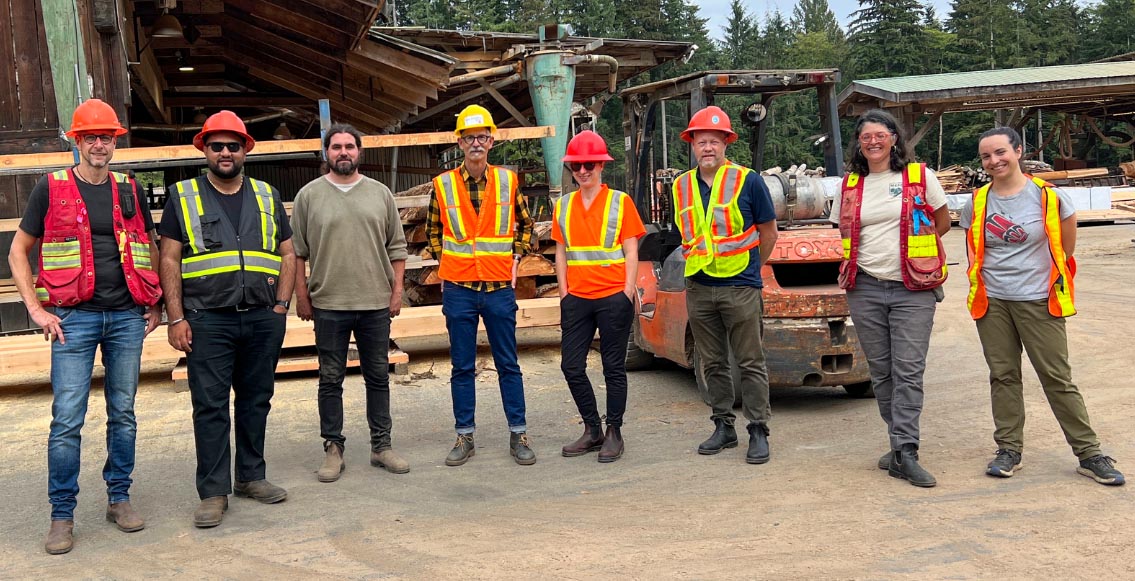 On September 11, 2025, UBC’s Faculty of Forestry welcomed British Columbia’s Minister of Forests, Ravi Parmar, to the Malcolm Knapp Research Forest (MKRF) to witness the critical work being done to advance sustainable forest management and educate the next generation of foresters. The tour, led by Dr. Dominik Roeser, Associate Dean of Research Forests and Community Outreach, and joined by Dr. Robert Kozak, Professor and Dean of the Faculty of Forestry and Hélène Marcoux, Malcolm Knapp Research Forest Manager, provided an important opportunity to showcase MKRF’s role in bridging scientific research, education and practical forest management. Minister Parmar’s visit included important conversations focused on forest stewardship and the role research plays, not just in understanding forests, but also in driving innovation, education, and creating future opportunities. Minister Parmar was able to see firsthand the vital research taking place to support both industry and government, and the advancement of sustainable forest management practices in British Columbia.
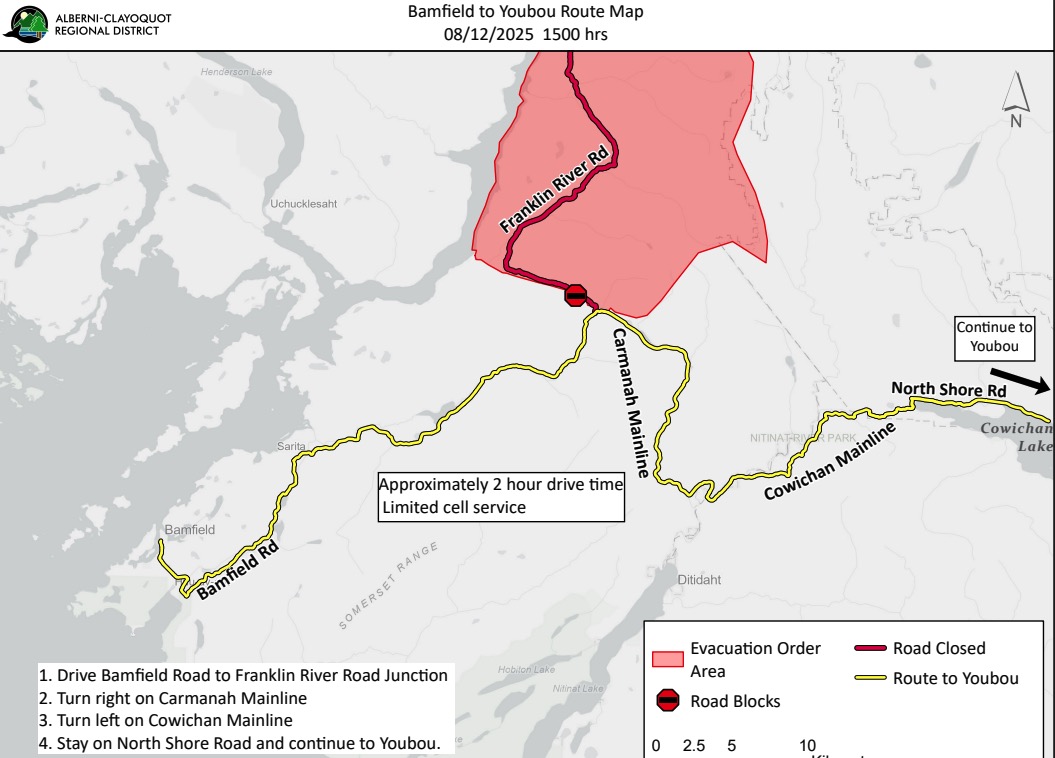 The fire-ravaged Bamfield Main Road, which connects Bamfield and several First Nation communities to Port Alberni, will reopen by the end of October, the Transportation Ministry announced. The ministry said temporary closures could still occur, however, during periods of heavy rain and strong winds. It said a geotechnical assessment to identify hazards, and assessments of the stability of trees are ongoing. Based on those findings, thresholds are being established for wind and rain events that will trigger increased patrols of Bamfield Main and potentially closures. A weather station and closure gates will be installed in the coming weeks, according to the ministry, which is leading efforts to reopen the road with Mosaic Forest Management, the company that oversees the affected stretch. …Ditidaht Nation Chief Judi Thomas said she suspects the Alberni-Clayoquot Regional District, Huu-ay-aht First Nation and Mosaic and Bamfield would be more than happy to support a provincial paved alternate route.
 A B.C. Supreme Court justice has ordered a group of people blocking a logging road in the Walbran Valley on southern Vancouver Island to stop. The decision to grant an injunction to Tsawak-qin Forestry Limited Partnership, a joint partnership between the Huu-ay-aht First Nations and Western Forest Products, alongside an enforcement order is expected to set the stage for the RCMP to remove people from the area. This fight over British Columbia’s old-growth forests comes four years after the start of the historic Fairy Creek protests, where more than 1,100 people were arrested. The Walbran Valley blockade began in late August and has prevented a logging company from working and accessing tools, equipment and vehicles on the other side of the blockade. Pacheedaht Elder Bill Jones, who was at the forefront of the Fairy Creek protests, is one of the parties named in the court filing, and the only person to respond to the application.
 VANCOUVER — The B.C. Supreme Court is set to rule on an injunction to halt a blockade against old-growth logging in the Walbran Valley on Vancouver Island, but a lawyer for one of the blockaders says the law is evolving and in need of a “course correction.” The Pacheedaht First Nation has decried the blockade on its traditional territory near Port Renfrew, B.C., claiming it is undermining its authority and should disband. The First Nation said in a statement that forestry is a “cornerstone” of its economy, and is calling for the blockaders to “stand down and leave.” The statement came after Tsawak-qin Forestry Inc., a firm co-owned by the Huu-ay-aht First Nations and Western Forest Products Inc., filed a lawsuit last week in B.C. Supreme Court alleging that “a group of largely unknown individuals” began the blockade of a road on Aug. 25.
 The Cariboo Wood Innovation Training Hub (CWITH) is inviting people to bring their ideas and opinions to an upcoming workshop on contemplative forestry. The workshop will be facilitated by Jason Brown, an affiliate forest professional with Forest Professionals British Columbia, on Saturday, Sept. 20. Participants will explore the concept of contemplative forestry, an approach which meets two extreme views on forestry in the middle. …Stephanie Huska, project lead with CWITH, said the workshop is a way to open the door to conversations which historically have not been included in natural resource management discussions based on western worldviews. …A contemplative approach to forest management values manual work as a form of spiritual practice, allows forests to ‘speak’ for themselves, admits there are some aspects of life we don’t have the language for and sees forestry as a mutually beneficial, place-based vocation.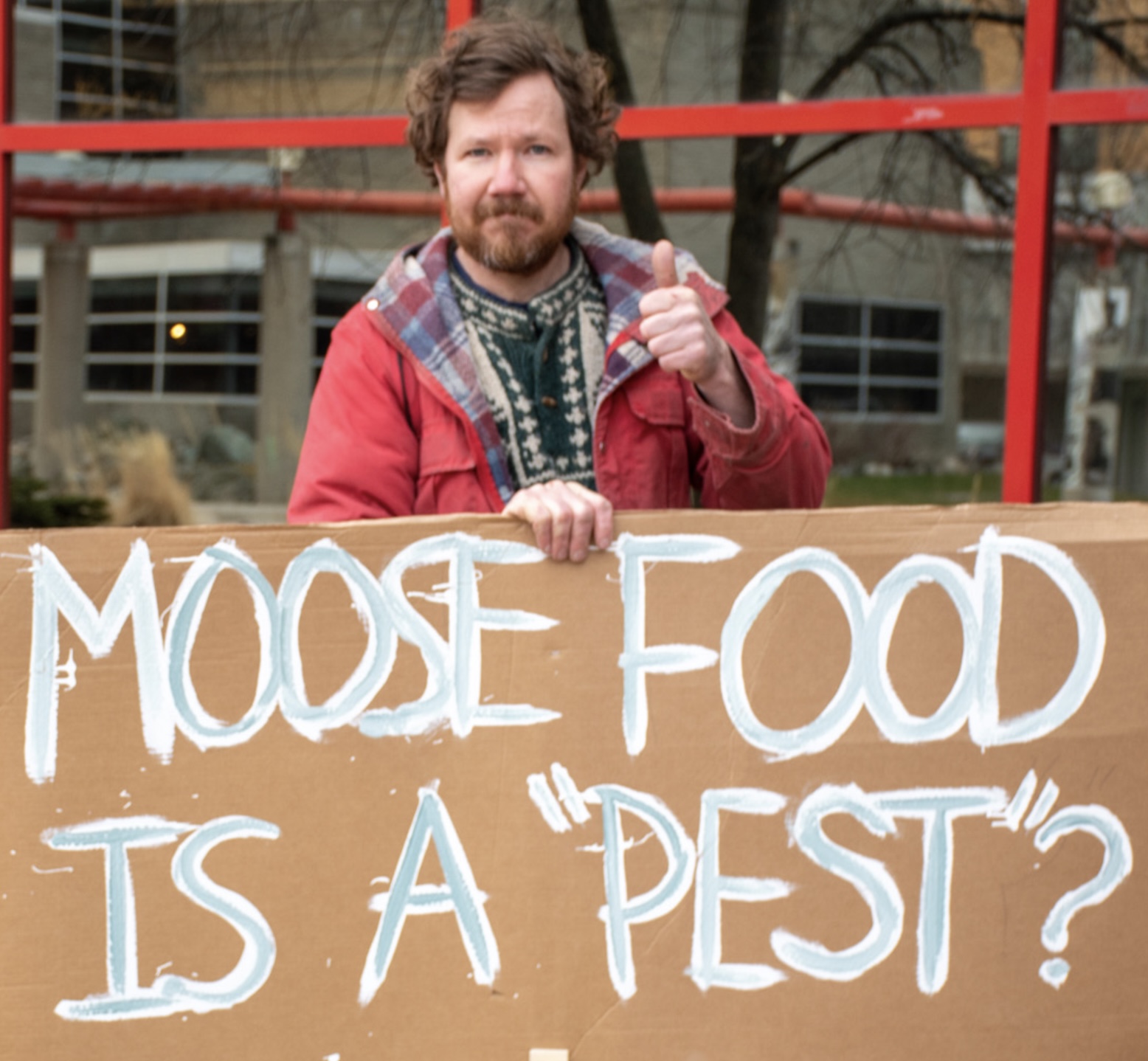
 As summer winds down, I’m pleased to welcome you to this special edition of the Forest Practices Board’s newsletter. This season marks a significant milestone for us—our 30th anniversary. For three decades, the Board has worked diligently to provide independent oversight of forest and range practices in British Columbia, helping to ensure that our natural resources are managed sustainably and in the public interest. …This issue highlights some of the conversations, initiatives, audits, investigations and special reports the Board is involved in as we embark on this anniversary year.
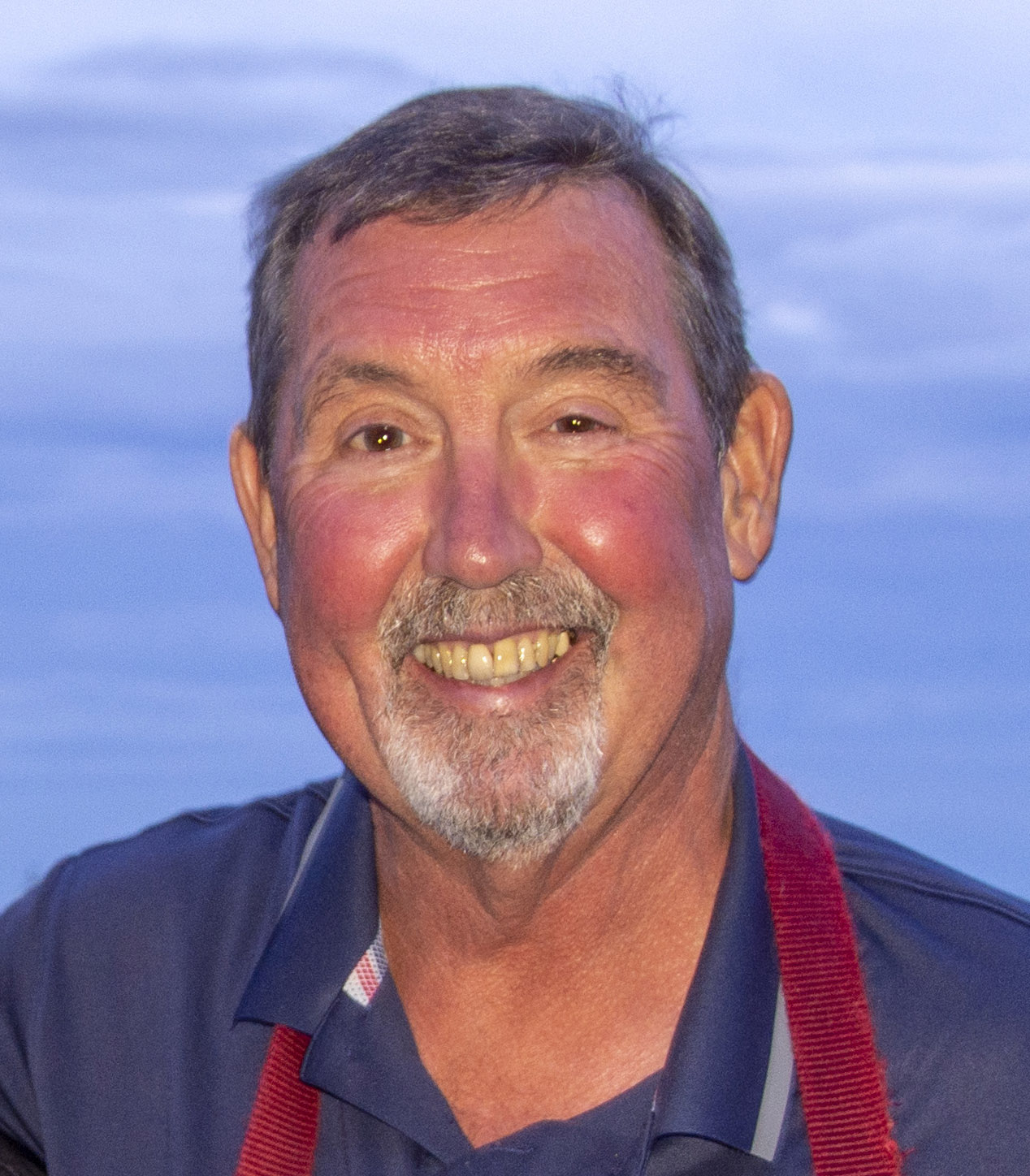
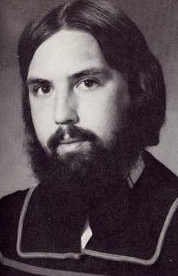 Zoom Presentation, September 16th, 7:00 pm. The BC Forest History Association is honoured to host Larry Pedersen as the first speaker for the 2025 Speaker Series. Larry Pedersen was BC Provincial Chief Forester from 1994 to 2004. A graduate from UBC with a Bachelor of Science in Forestry in 1975, he became a registered Professional Forester in 1977. During his career, he advanced through a number of positions in the Forest Service and he also worked in the private sector. In his presentation titled Reflections from British Columbia’s 14th Chief Forester, Larry will discuss some important historical events that helped shape forestry in the province, explain how he ended up in the job, discuss some of the challenges that he faced, and will tell some stories about things that were said and done during his tenure. The presentation is intended to highlight just a few of the many important events that have shaped forestry in the province. To register for this Zoom presentation use this
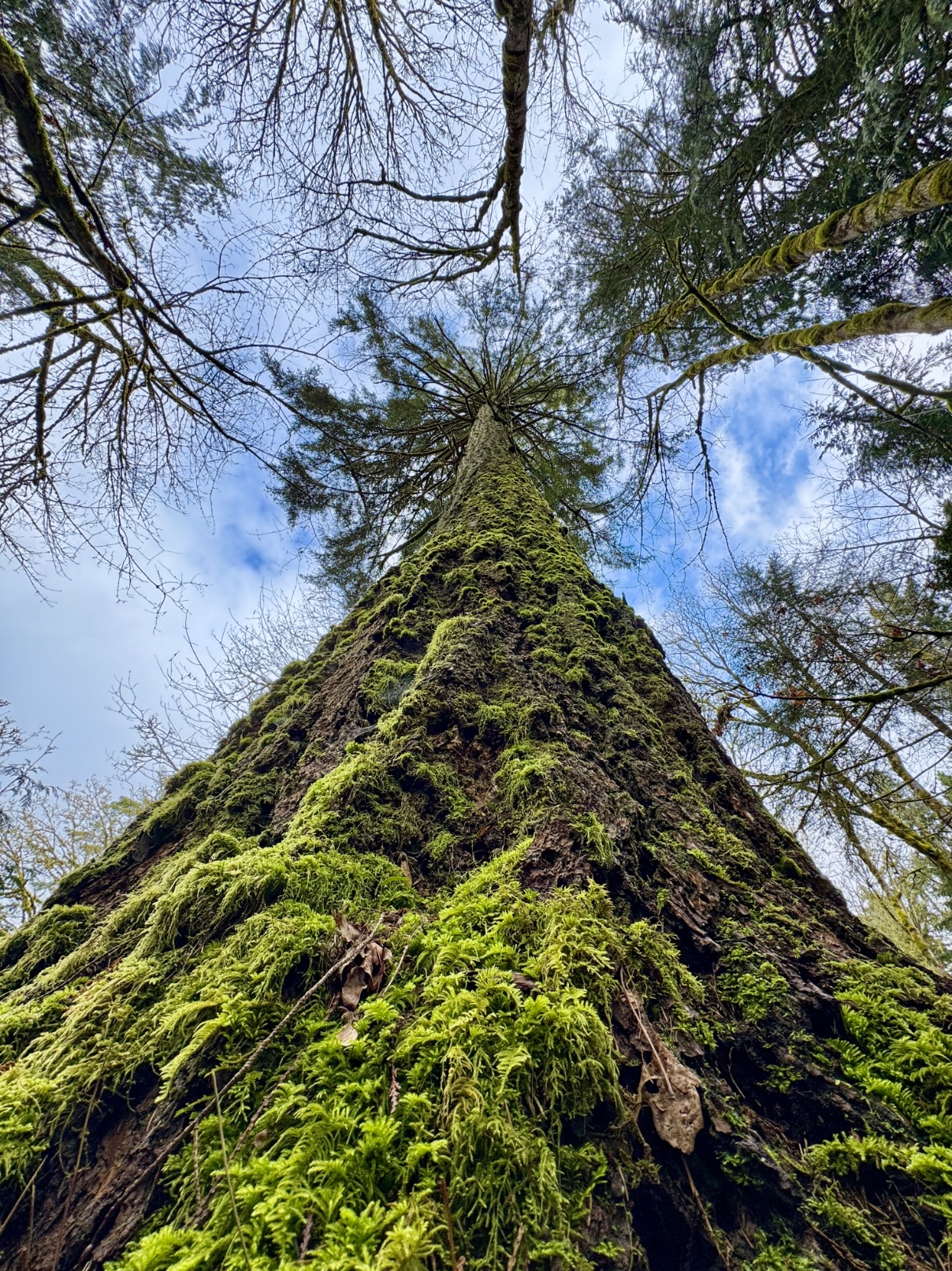
 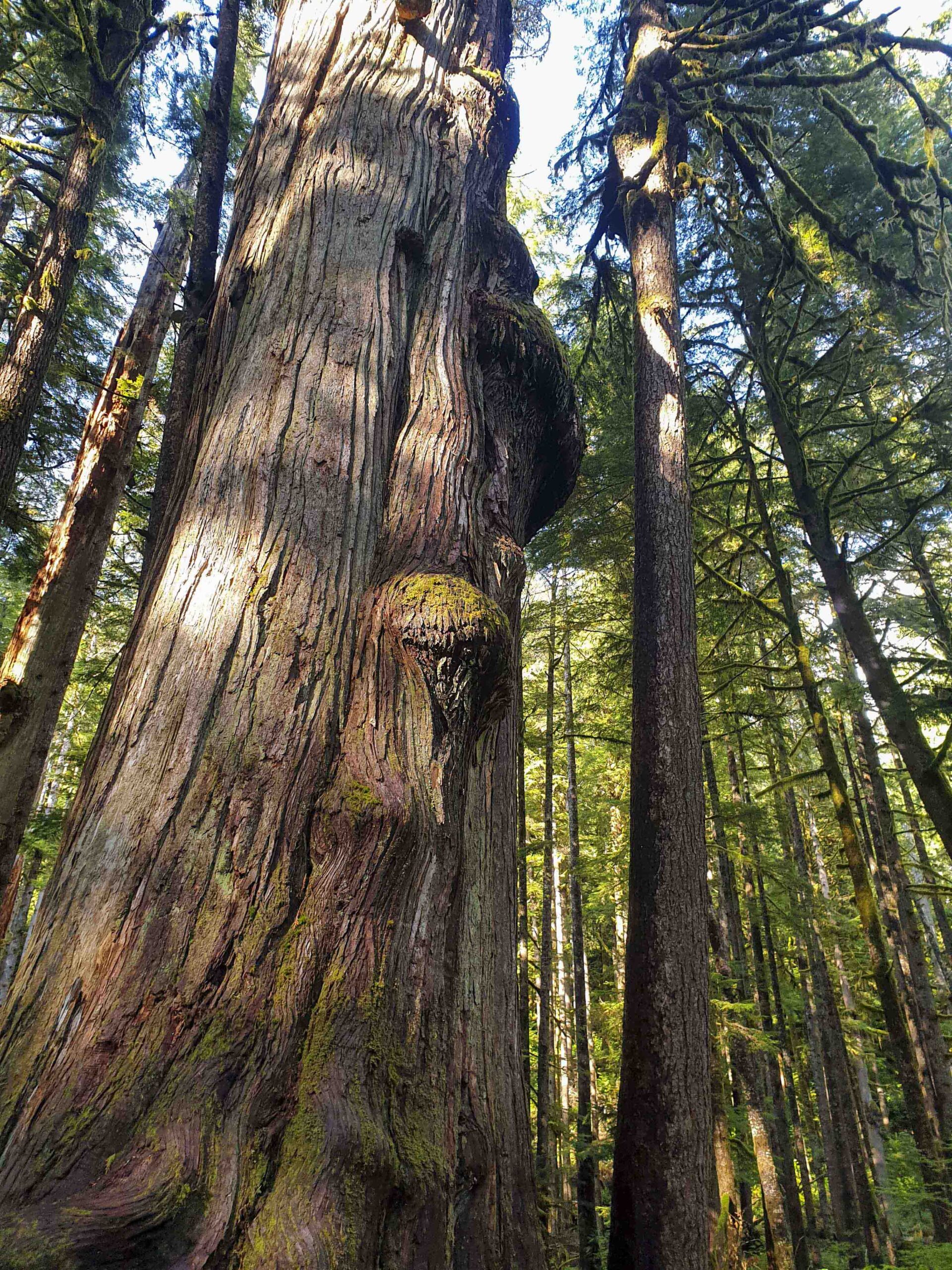 …Paul George, co-founder of the Western Canada Wilderness Committee …hit on popularizing the fight to protect old growth with a poster depicting a young woman gazing up the towering trunk of a massive, moss-covered Sitka spruce tree [in the] Carmanah Valley. The poster’s tag line — “Big Trees Not Big Stumps” — was a model of economy. …like five wasp stings to the hide of MacMillan Bloedel, the company that wanted to cut that tree and every other one like it down. Today we’d say it went viral. But not in the sense of a social media post that explodes with millions of views today only to be forgotten tomorrow … it would prove to have the lasting power of long COVID. …The poster came to mind [when a] small group of protesters planted themselves on a logging road leading into… the upper Walbran Valley, which borders the Carmanah on Vancouver Island’s southwest coast.
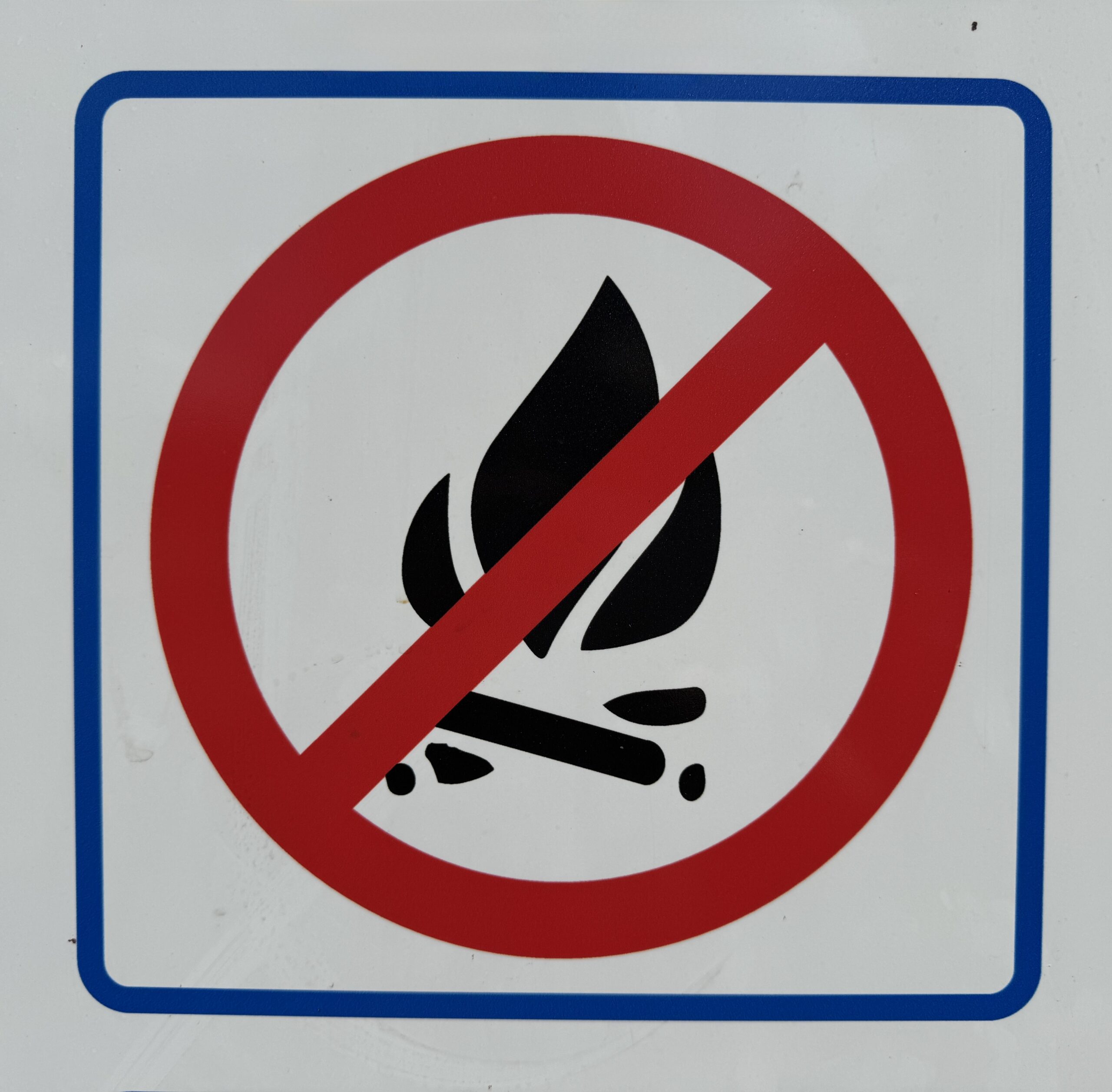 The existing Category 1 campfire prohibition for the Cariboo Fire Centre and Tsilhqot’in (Xeni Gwet’in) Declared Title area will be extended. It will go in effect at noon tomorrow (September 11) and will remain in effect until September 30 or until the order is rescinded. A Category 1 campfire is defined as any fire smaller than 0.5 metres high by 0.5 metres wide. The Cariboo Fire Centre said this prohibition applies to all areas in the Fire Centre that are outside of municipal boundaries. In addition, it also applies to these land types within municipal boundaries: Parks, conservancies and recreation areas; Recreation sites, recreation trails, interpretive forest sites and trail-based recreation areas; Ecological reserves; and Wildlife management areas and private managed forest land.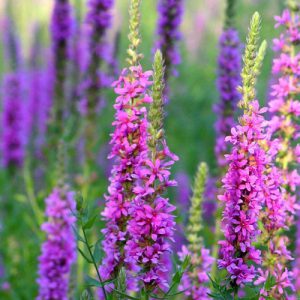

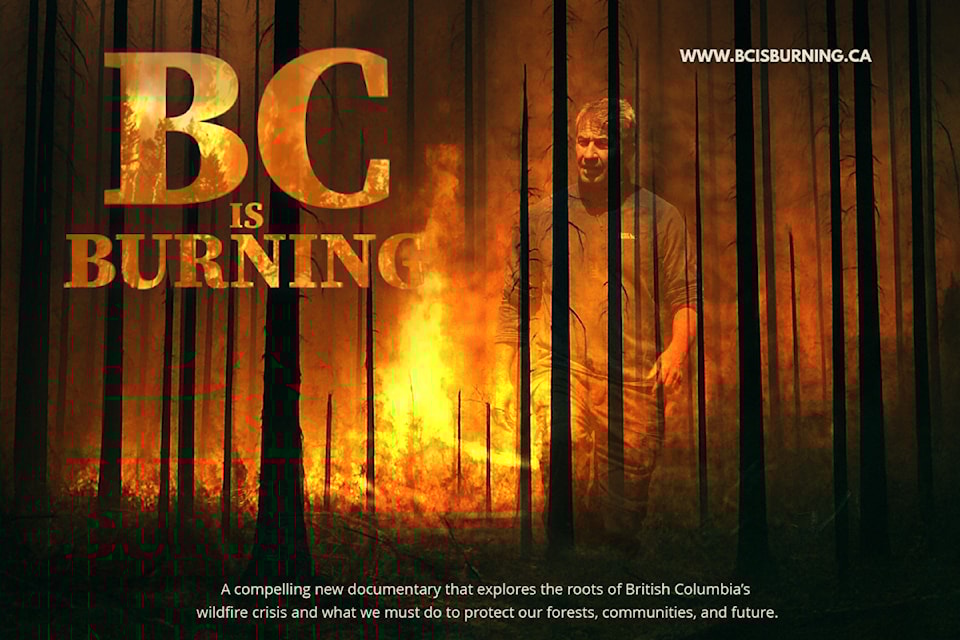 A documentary addressing British Columbia’s escalating wildfire crisis and the urgent need for solutions is playing in Castlegar on Sept. 11. The film was produced by former Castlegar resident Murray Wilson. Wilson graduated from Selkirk College’s Forest Technology program in 1981 and then worked in Salmo and Nakusp before spending more than three decades in forestry across British Columbia. “My early forestry work in the Kootenays showed me the wildfire risks communities face and the solutions we need, which is at the heart of B.C. is Burning,” said Wilson.
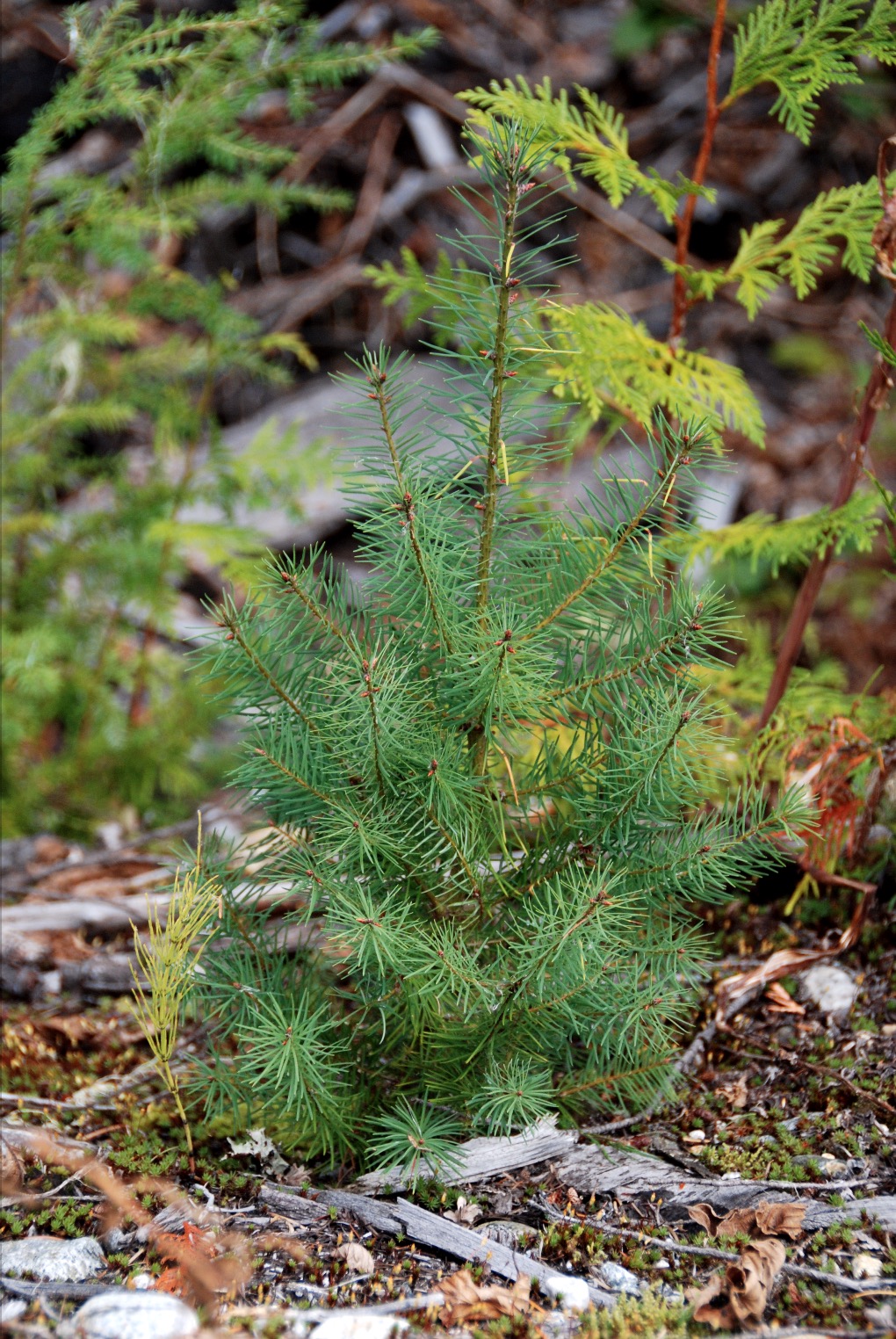 As Nova Scotia grapples with one of its most severe wildfire seasons, a controversial decision by the provincial government has flown under the radar: the approval of aerial glyphosate spraying on 3,577 acres of drought-stricken, fire-prone forest. This move not only risks human health and ecosystems but also exacerbates the very wildfires it claims to mitigate. …Glyphosate-based herbicides are used in forestry to kill deciduous plants and shrubs that compete with commercial softwood species. However, this practice replaces diverse, resilient forests with flammable monocultures. By inhibiting plant growth and causing vegetation to wilt and die, glyphosate leaves behind dry, combustible biomass — effectively turning forests into tinderboxes. In a province already parched by drought and under travel bans due to fire risks, adding fuel to the fire is nothing short of reckless.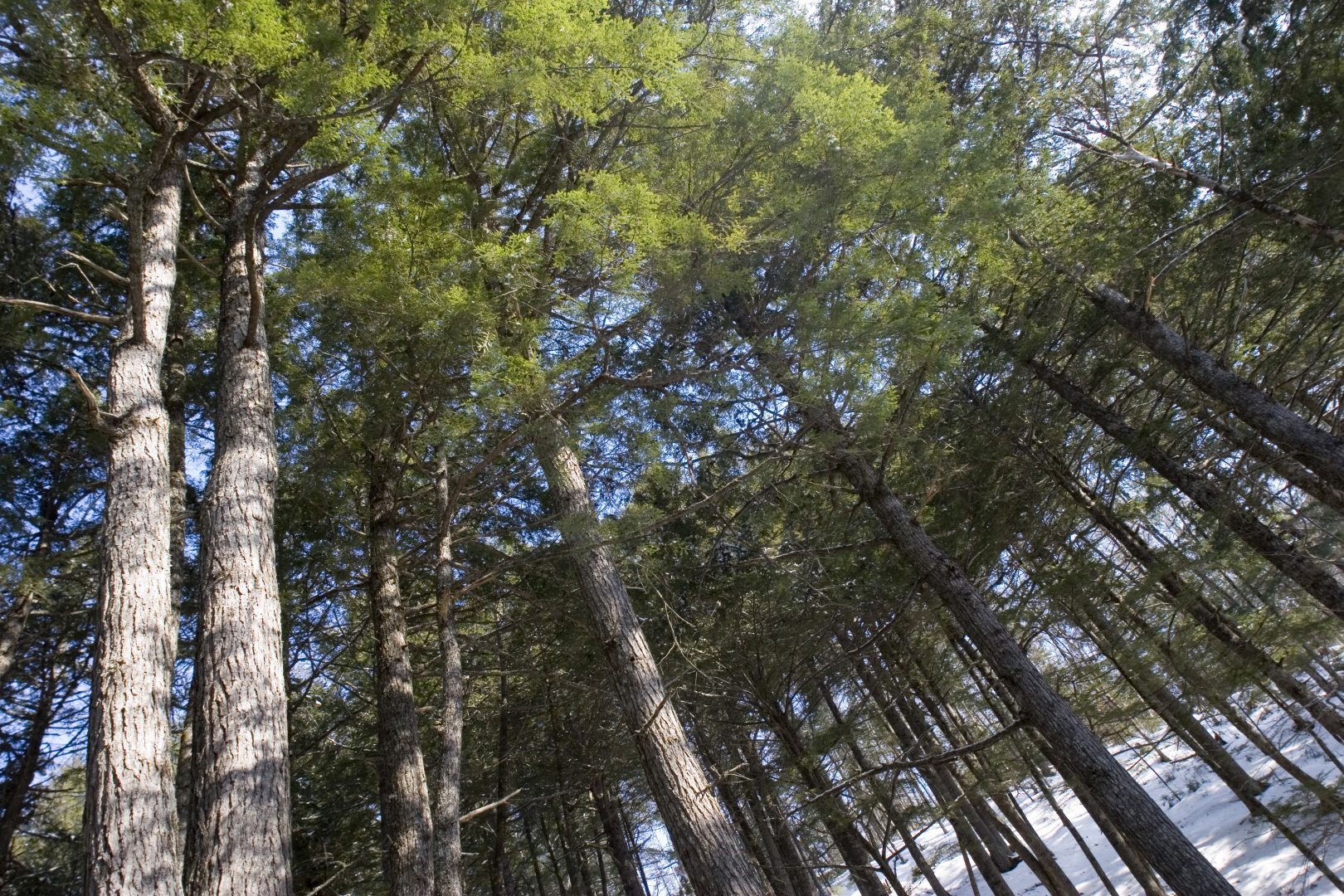


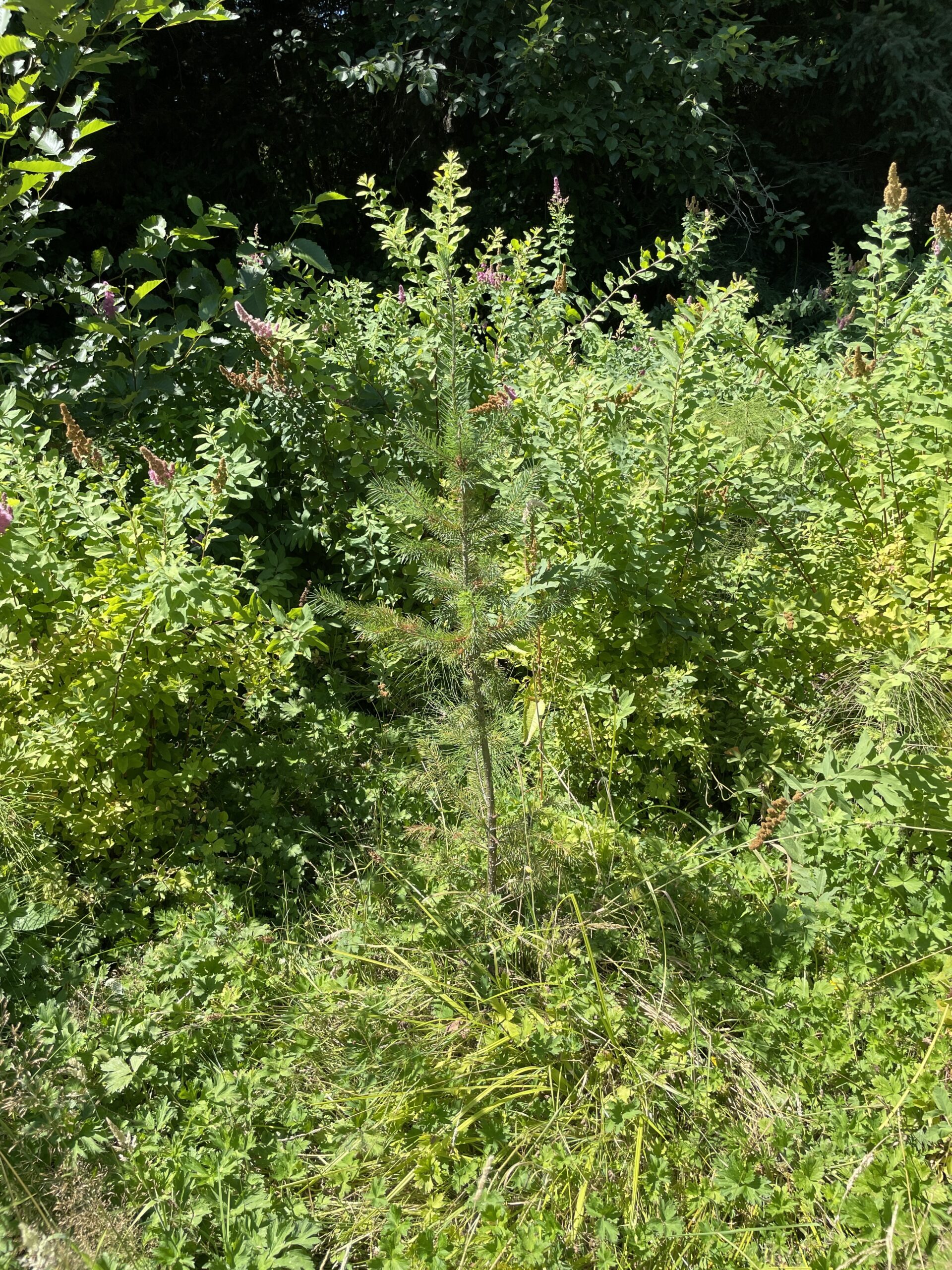 Amid calls from some First Nations and municipalities in northeastern Ontario to stop glyphosate spraying on Crown land, environmental groups are raising concerns over the herbicide’s effect on biodiversity. …Wildland fire ecologist Bob Gray said leafy deciduous trees, like aspen, are more resilient to wildfires than softwood conifers like pine and spruce. “Softwoods are highly resinous,” he said. “The foliage and bark is highly flammable. When you’ve got large contiguous areas of conifer forest, you can have large continuous forest fires.” If a timber company’s goal is to promote the growth of softwoods for harvest, at the expense of hardwoods, it can make that area more prone to wildfires. …Jocelyne Laflamme is a Ph.D. candidate at the University of British Columbia found that aspen becomes more flammable in the fall, when they lose their leaves. …In August, forest company Interfor cancelled plans to spray herbicides on trees along the north shore of Lake Huron.

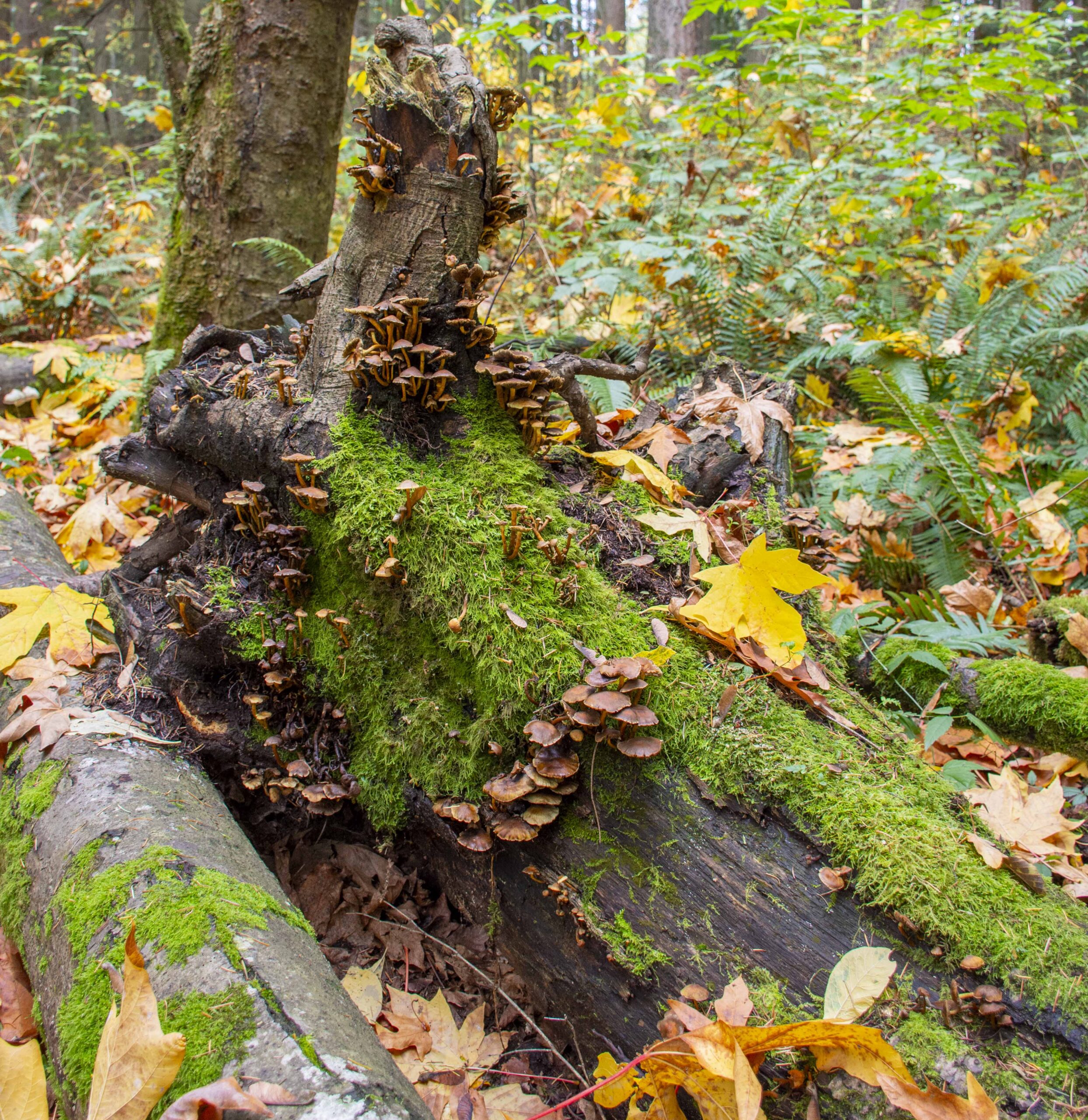 Mark Harmon, a longtime faculty member at Oregon State University, has been watching number 219, and more than 500 other logs nearby, decay for 40 years. He has trekked to this site in the H. J. Andrews Experimental Forest, a watershed nestled in Oregon’s western Cascade Mountains, at least 100 times. His goal: establish an exhaustive baseline dataset that any scientist could use to test hypotheses about tree decomposition or to compare patterns of decomposition in the Pacific Northwest with those in other regions. …In a 2020 analysis, Harmon and his colleagues estimated that decay rates can vary by a whopping 244-fold across species and climates. …Scientists used to assume that decomposition was instantaneous, Harmon says—that when a tree dies, it essentially disappears. “But that’s not true anywhere on Earth, and it’s never been true,” he says. A dead tree is “just a transition to something else.”
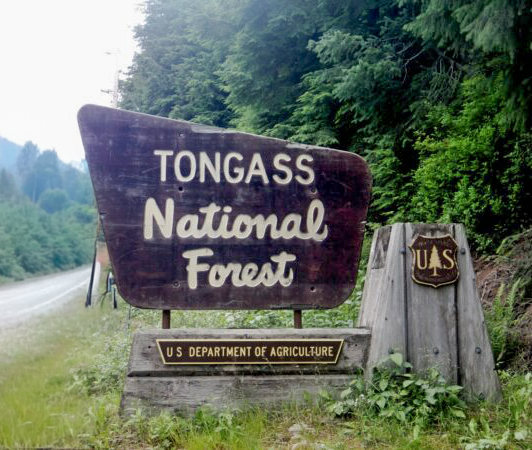 The U.S. Department of Agriculture announced this summer it was moving to rescind the Roadless Rule, a 2001 law that protects large swaths of National Forest land from development. That includes more than half of the Tongass National Forest, where Juneau is located. On Saturday, more than 100 people gathered in the state capital to protest the move. …Alaska’s Congressional delegation unanimously supports the rollback of the Roadless Rule. U.S. Sen. Lisa Murkowski has said that most of the Tongass would still be protected without it — the parts of the forest that are already designated as wilderness. …But protesters say Alaskans have more to lose in risks to the land and waterways than what they have to gain through further development. Lingít elders and fishing and tourism industry experts took the mic Saturday to deliver a message: the Roadless Rule should be left alone.
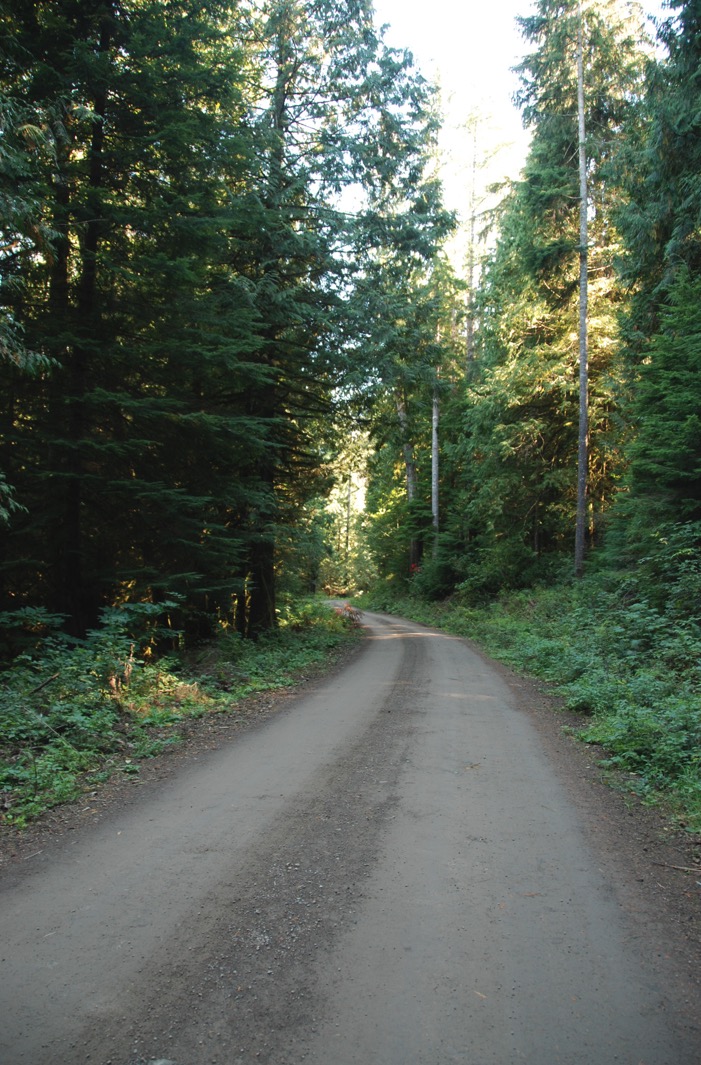 President Donald Trump’s Secretary of Agriculture has moved to rescind the “roadless rule” that protects portions of national forests from development — including 4.4 million acres in California — and members of the public can still submit comments about the change to the federal government. Every national forest in California would be affected. Commenters can weigh in through the online form on regulations.gov through Sept. 19; the docket is FS-2025-0001-0001. Since 2001, the roadless rule has protected designated areas from development and logging, limiting or barring the construction or reconstruction of roads. About 21% of California’s national forestlands are protected. Throughout the U.S., the 2001 rule covers 59 million acres. The administration has said the move to end the rule would open up these forests to more logging and has said that more roads would help with wildfire prevention. As NPR reported, the U.S. Forest Service has previously found that roads appeared to do nothing to mitigate wildfires.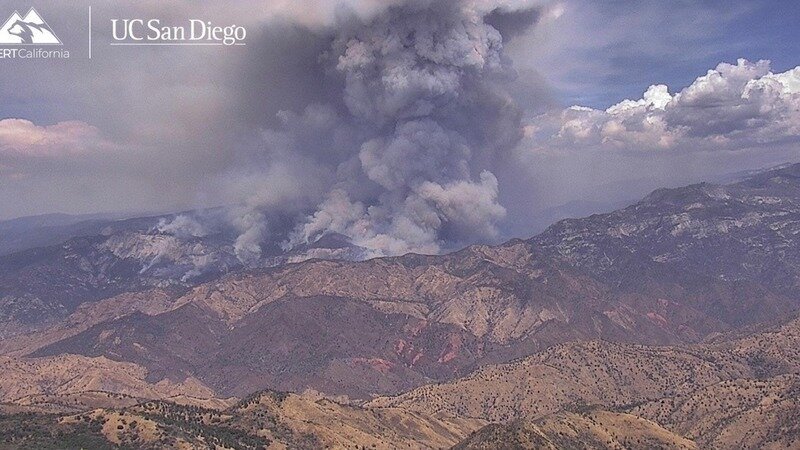


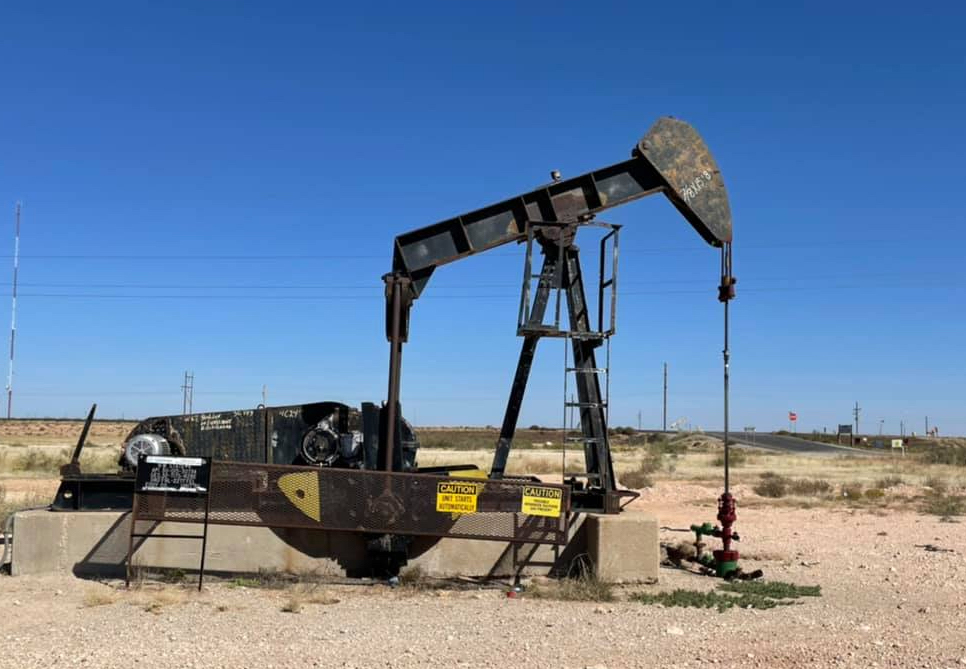 Planet-warming emissions from a group of the world’s largest fossil fuel producers have significantly ramped up the intensity of heat waves, a new study suggests, one of the first peer-reviewed papers to link dozens of climate-fuelled weather events to specific companies. The study led by a group of Swiss-based climate scientists says about one-quarter of the 213 recent heat waves they studied, including the 2021 B.C. heat dome, would have been virtually impossible without human-caused climate change. It says emissions from some individual companies, including relatively smaller ones and some of Canada’s oil-and-gas producers, would have been enough to make otherwise impossible heat waves statistically possible. …The researchers linked emissions from the group of cement and fossil-fuel producers to about half the increase in heat wave intensity connected to human-caused climate change.
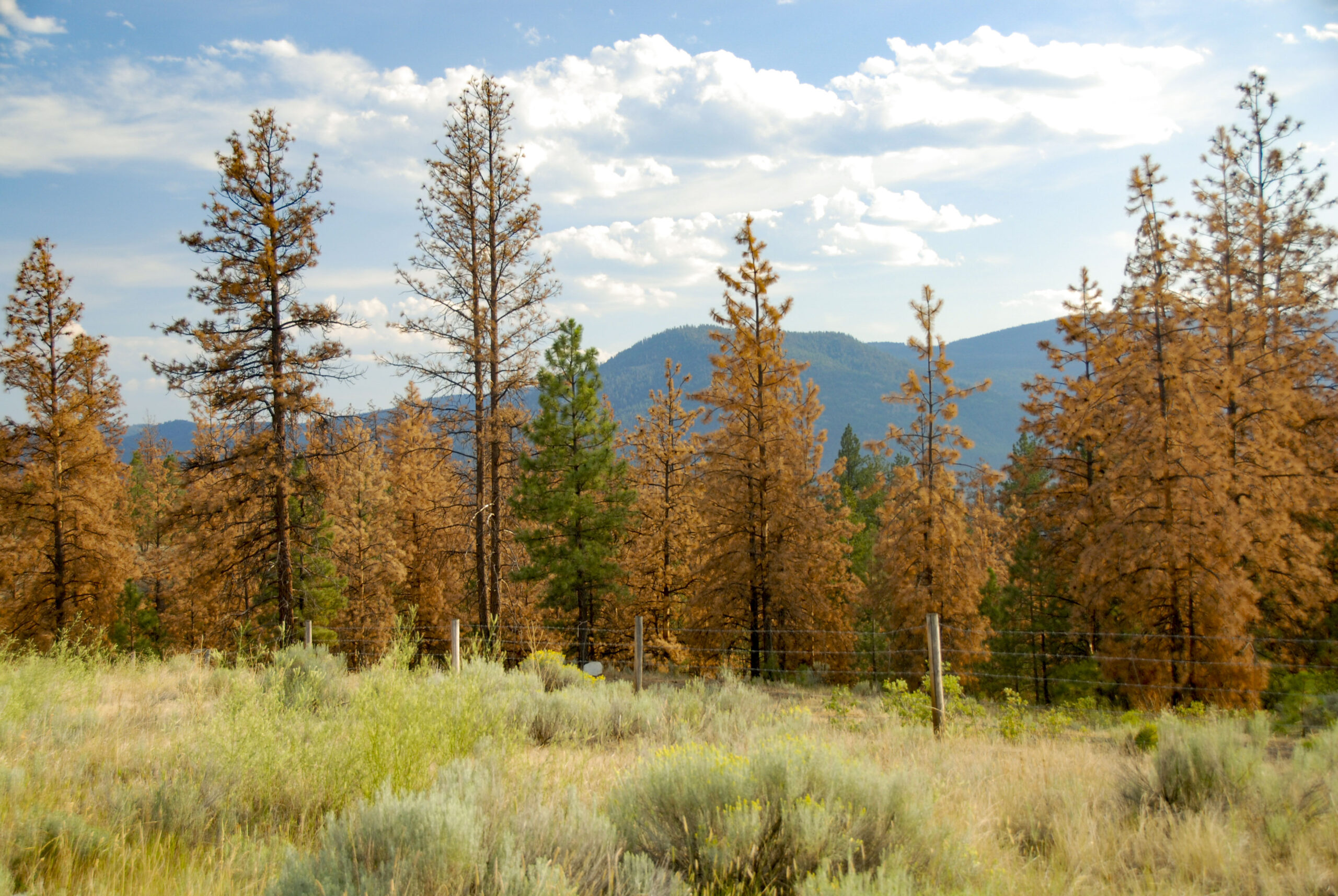 The American Biomass Energy Association and Pellet Fuels Institute are among 400-plus associations, businesses and landowners representing the forest products sector that sent a letter to President Donald Trump on Sept. 8 urging immediate action to stabilize the U.S. forestry sector and its access to markets in the face of mounting mill closures, devastating natural disasters, pests and diseases, and unfair foreign trade practices. “Together, these forces are pushing many landowners to exit forestry altogether,” the groups wrote. “If forests are abandoned or converted, the consequences for our domestic timber supply, as well as markets for housing, infrastructure, consumer products, energy, rural livelihoods, and environmental security, will be severe. …The letter outlines four immediate steps the Trump administration can take to spark job creation and economic growth. This includes promoting the use of biomass for electricity and expanding the definition of qualifying wood biomass under the Renewable Fuel Standard.

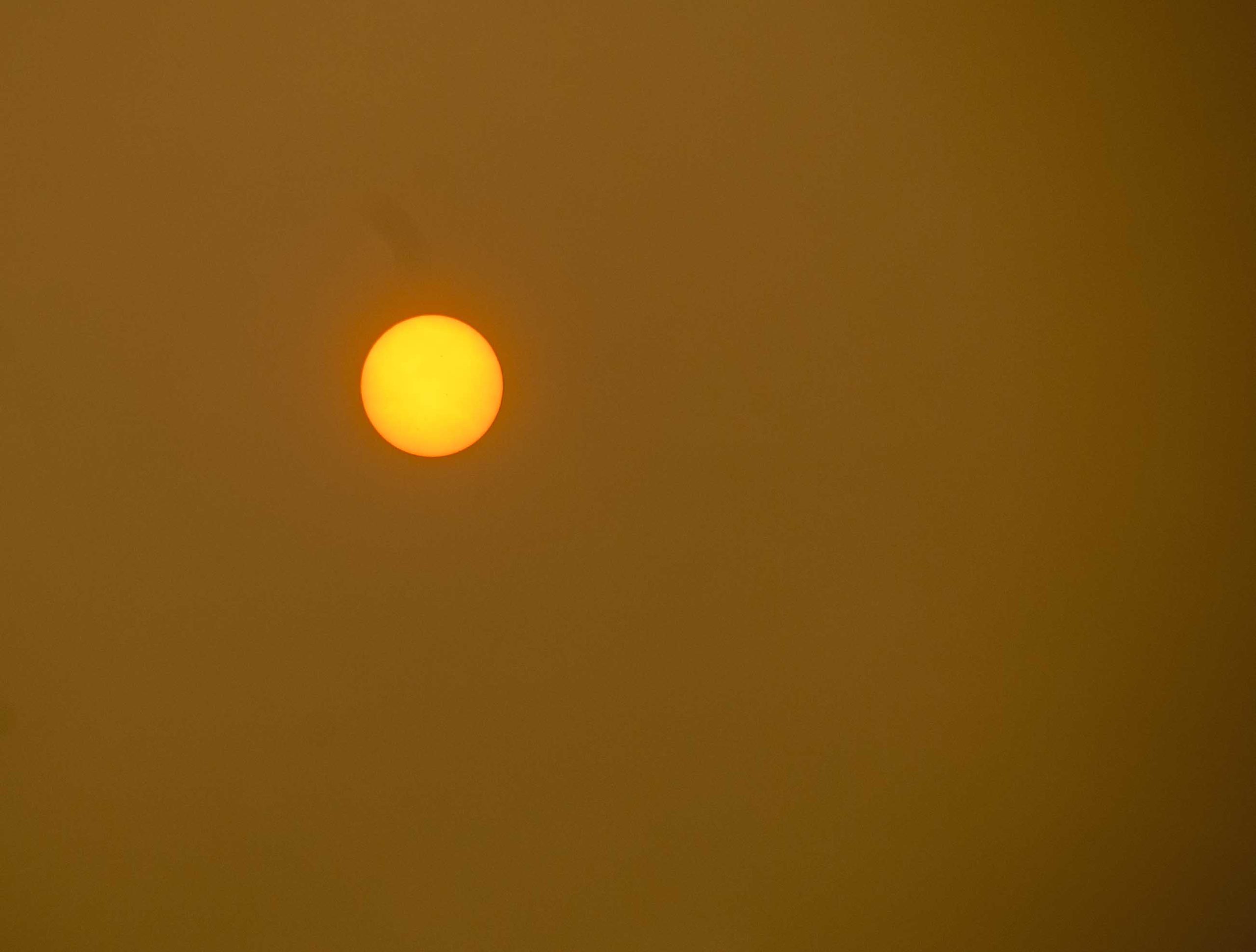 Provincial investigators looking into the cause of this spring’s wildfire near Lynn Lake, Man., allege it started at the nearby Alamos Gold Inc. mining site and that the company was negligent because it didn’t use water to extinguish its burn piles, according to search warrant documents obtained by CBC News. Manitoba Conservation investigators allege the fire, which eventually grew to over 85,000 hectares, started on May 7 after a burn pile reignited at the Toronto-based gold producer’s MacLellan mine site, about 7.5 kilometres northeast of Lynn Lake. By late May, the fire had come within five kilometres of Lynn Lake and forced the evacuation of the nearly 600 residents of the town… Dozens of properties in the area were destroyed. …The investigators asked Alamos Gold staff how they ensured the burn piles were extinguished. The workers said they stirred the piles and installed a fire guard around them, according to the documents.