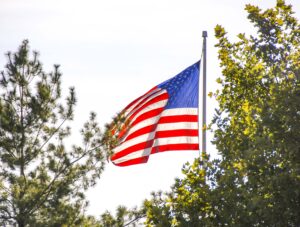
 WASHINGTON — U.S. President Donald Trump said again Wednesday he plans to hit Canada and Mexico with devastating duties — but a White House official confirmed on background that the tariff plans could change through negotiations. …He signed an executive order to implement “reciprocal tariffs” by raising U.S. duties to match the tax rates that other countries charge on imports starting April 2. He ordered 25% tariffs on all steel and aluminum imports into the United States on March 12. Trump also floated the idea of imposing tariffs on automobiles and forest products in April. …Trump himself seems to be having a hard time keeping track of his massive tariff agenda. …Many experts say Trump’s actions are intended to shake up Canada and Mexico ahead of a review of the continental trade pact. The Canada-U.S.-Mexico Agreement was negotiated during the first Trump administration to replace the North American Free Trade Agreement.
Related coverage in the WSJ (transcript of podcast by Kyle Peterson, WSJ Editorial Board Member): Trump Says Canada and Mexico Tariffs Are Coming Soon
 Yesterday, we featured an op-ed by political risk management expert Robert McKellar on how Donald Trump’s re-election is changing the political risk landscape for the Canadian forest sector. While U.S. trade disputes are not new, the unpredictability of Trump’s approach to trade policy creates new challenges that Canadian exporters must assess and manage. McKellar presents a structured way to evaluate these risks using the devil’s advocacy approach, a method that considers both worst- and best-case scenarios to develop a balanced assessment. Trump has proposed three different types of tariffs—bi-national, product-specific, and reciprocal—which, if applied together, could significantly impact the sector. By examining multiple possibilities, McKellar provides companies with a way to better prepare for potential disruptions rather than reacting in crisis mode. And as today’s
 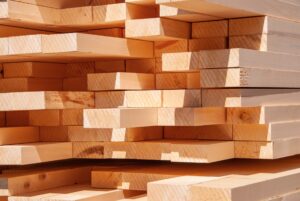 The U.S. Department of Commerce initiated the


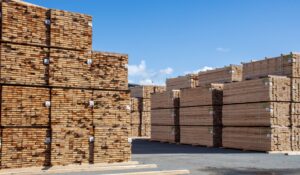 Canadian producers of softwood lumber are bracing for a decision this week from the U.S. Department of Commerce that could mean a surge in anti-dumping duty rates, compounding the industry’s worries over President Donald Trump’s threats for sweeping tariffs on all imports from Canada. Most Canadian producers are currently paying 7.66% in anti-dumping duties, but that could jump to 20 per cent, trade experts say. The Commerce Department’s decision, slated for Thursday, will be preliminary, with an effective date in August. …Analysts are [also] predicting that there will be higher countervailing duty rates, with the Commerce Department scheduled to issue a preliminary ruling in May. Forestry analyst Russ Taylor forecast that countervailing duties could rise to about 10%. Most Canadian softwood producers are paying countervailing and anti-dumping duties that currently total 14.4 per cent. …The Commerce Department’s administrative review is based on softwood markets in 2023, when prices were low. [to access the full story, a Globe and Mail subscription is required]
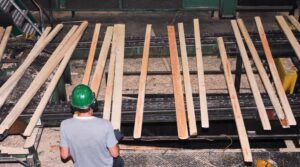 Another day, another tariff threat for markets to digest. This time it’s lumber getting whipsawed, as U.S. President Donald Trump says he is going to bring in tariffs on Canadian lumber imports to the U.S. soon. Speaking to reporters on Wednesday evening, Trump added lumber to the list of items he plans to slap tariffs on in the near future. …Canada would feel any such policy directly, but perhaps not as painfully as you might think. As is the case with oil, lumber is one front in the trade war where Canada can do a lot of collateral damage of its own. …While the U.S. theoretically has enough trees to meet its own needs, ramping things up both in terms of the logs and the capacity to process them would be next to impossible in the short term. Recall during the pandemic when Canadian lumber prices spiked by more than 300%, yet U.S. buyers kept buying.
 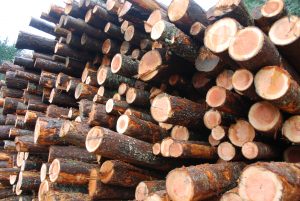 LONDON/BRUSSELS — The US paper and pulp industry is lobbying the Trump administration to ask the EU to declare the US deforestation-free, a step that could make it easier for exporters to meet the bloc’s new environmental rules. From December, the European Union’s anti-deforestation policy will ban imports of commodities linked to forest destruction. Brussels already delayed the policy’s launch by a year. …”A delay does not solve our concerns with the regulation’s complex requirements and significant technical barriers,” said Heidi Brock, CEO of the American Forest and Paper Association (AF&PA). …The law does not contain a category of countries deemed to be deforestation-free – despite EU lawmakers attempting unsuccessfully to add a new “no risk” category of countries which would face even lighter rules. Any changes to the EU law would require a legal proposal from the Commission, and approval from EU lawmakers and member states.
 WASHINGTON — President Trump is taking a blowtorch to the rules that have governed world trade for decades. The


 A key government program designed to help older forestry workers transition into retirement has officially closed after assisting more than 2,200 individuals since its inception in 2019. The Bridging to Retirement Program, launched in response to economic challenges in the forestry sector, has distributed over $92 million in funding, helping affected workers retire early while opening up job opportunities for younger employees, according to the government. The program, which began in October 2019, reached capacity and officially ceased intake on February 26, 2025. Initially funded with $40 million, the program was later expanded to $50 million and renewed in 2021 with a three-year funding commitment. Eligible workers aged 55 and older were provided with financial support of up to $75,000 each, based on their experience and employer contributions. …When first announced in 2019, the provincial government pledged $69 million in forestry support programs to mitigate job losses, strengthen community resilience, and promote economic recovery. …While the program has concluded, new concerns loom over the B.C. forestry sector.
  At the 2025 COFI Convention, we’re diving deep into B.C.’s forest sector competitiveness and sustainability—and how we compare to leading global regions. Join Kurt Niquidet, COFI’s VP & Chief Economist, and Glen O’Kelly, CEO of O’Kelly Acumen, as they reveal findings from a new study benchmarking B.C. against 10 international jurisdictions—including Sweden, Finland, Austria, the U.S., and Brazil. Key insights include: Strengths & Weaknesses – What industry leaders are saying about B.C.’s competitive position; Global Comparisons – How B.C. stacks up on economic and sustainability performance; and Opportunities for Growth – Strategies to strengthen B.C.’s competitive edge. This is a must-attend conversation for anyone invested in the future of B.C.’s forest industry. Don’t miss it—Register before the end of Early Bird Pricing on March 3!
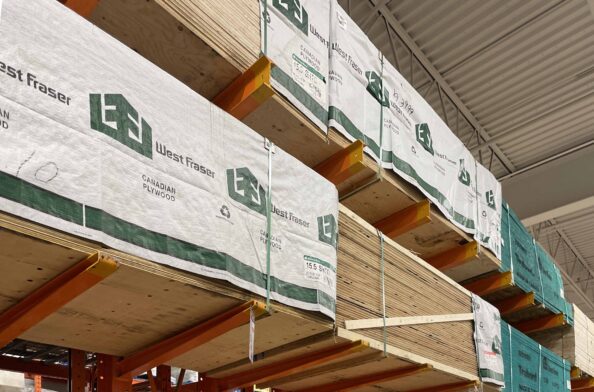 Production at High Prairie Forest Products would be impacted by potential tariffs on forest products going to the United States. General manager Brandon Marsh addressed Big Lakes County council about the negative impacts at its regular meeting Feb. 12. …“Here in High Prairie, we rely on our southern neighbours for roughly 50 per cent of our trade,” said Marsh, “This 25 per cent tariff would greatly reduce our ability to move the volume of product we produce here in our community. With the existing solid wood lumber agreements with the U.S., we already have varying levies of penalty applied to our product, which gets compounded with an additional dumping duty. …Part of West Fraser Forest Products Co. Ltd., the High Prairie operation has a staff of about 140 full-time employees while also supporting a large contractor base for other services. Those people rely an a strong market for their jobs to support families and communities, he said.
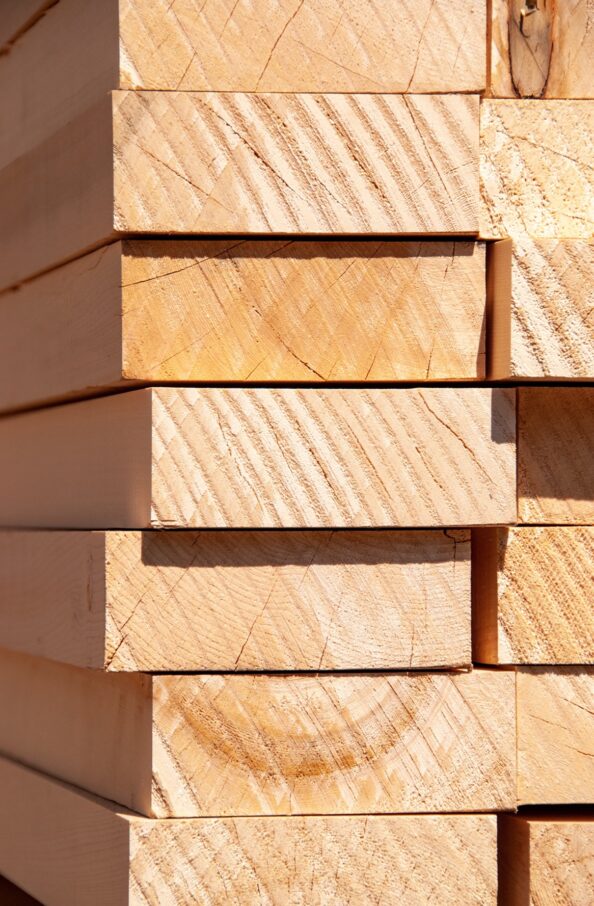 VICTORIA — B.C.’s Forests Minister Ravi Parmar says the expectation of more duties and additional tariffs piled onto Canadian softwood lumber would “absolutely be devastating” for the country’s industry. Parmar says the government expects the U.S. Commerce Department will issue anti-dumping duties by Friday of as much as 14 per cent, on top of the current 14.4 per cent duty. It comes after U.S. President Donald Trump told media on Air Force 1 that his administration was eyeing a 25 per cent tariff on lumber some time around April. Parmar says he knows many forestry workers are going to be worried about their jobs and he’ll continue to fight for them. He says the extra tariffs are “very likely” and Canada should take Trump at his word. …He said provincial and federal governments need to continue to make the case that while such tariffs hurt Canadians, they will also hurt Americans.
 Hinton Town Council will add its voice in support of the Alberta Forest Products Association (AFPA) advocacy efforts. Nicole Galambos of the AFPA – of which both West Fraser and Mondi are members – appeared as a delegation before council with a presentation called Trade Barriers and Albert’s Forest Industry. “Today [there are] some pressing trade challenges facing our sector, particularly some of the softwood lumber duties and tariffs, in addition to emerging US trade barriers and global competition,” Galambos told council, asking for their help. …AFPA suggested there are six steps the Government of Alberta can take to support the forest industry, the first of which is advocate for Alberta forest products in the US. The second is keep Alberta’s regulatory costs low, with Galambos pointing out that high costs have led to mill closures in BC. The third is … a Build With Alberta Wood Act similar to those in BC and Quebec.
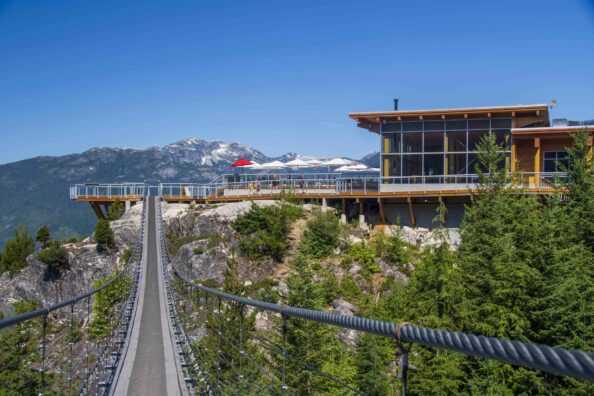 SQUAMISH, BC — Peter Dickson has owned FraserWood Industries, a Squamish-based timber manufacturer, since 1998. He has grown his business, earning contracts near and far, including the Sea to Sky Gondola service building and log cabins at Walt Disney World. One third of his business is exported to the US. …“The biggest problem is our American customers will be reluctant to sign moving forward with the uncertainty.” …David Girard sits on the government relations committee for the Sea to Sky Canadian Home Builders Association, and he said the tariffs would have an outsized impact on consumers and demand for Canadian products, and cause reduced employment. According to a recent survey by KPMG, 48% of Canadian companies contacted said they would invest or produce in the U.S. to retain American customers and reduce costs. But for FraserWood, that’s not an option.
 WILLIAMS LAKE, BC — The City of Williams Lake has cancelled a lobbying junket to Victoria on the news Adrian Dix, minister of Energy, plans to meet with BC Hydro to discuss the imminent shut-down of the Atlantic Power station. The plant, which generates electricity through the burning of wood waste, is Williams Lake’s biggest industrial taxpayer. The company that owns it plans to shut down soon, unless the province can assure it better power rates and reliable fibre supply. The city has been lobbying the provincial government to prevent the power plant from shutting down, and had planned to converge on the BC Legislature tomorrow for the first day of the new BC legislative session. …The Atlantic Power plant is an independent power producers with a power purchase agreement with BC Hydro. The plant is owned by I Squared Capital, an American private equity investment firm.
 B.C.’s rookie forests minister Ravi Parmar had a strong case to make as he travelled to Sacramento last week to meet with California business and government representatives. The state lost more than 16,000 structures in the recent wildfires … and California’s construction industry knows it will need B.C. and Alberta lumber for a rebuild that will take years. …Parmar says U.S. insurance companies confirmed that high-sticking Canada with more border fees for lumber will drive up costs for California fire claims and other new construction. A classic case for this dysfunctional relationship is Interfor Corp. …now one of the biggest lumber producers in the world, with a strategy to respond to trade attacks by expanding U.S. production. …Canadian forest companies shifting their investment to the U.S. involves other factors, such as pine beetle damage and governments restricting timber supply to satisfy often overblown environmental protests. But the effect is what Trump is after, moving jobs from Canada to the U.S.
 The first session of B.C.’s 43rd Parliament opens Feb. 18, with traditional rituals like the Speech from the Throne. …This threat [of US tariffs] has since become much more real. Double-digit tariffs from the United States on key exports such as energy, minerals and lumber now loom over B.C. with some potentially reaching or exceeding 50 per cent in the case of aluminum and lumber. “The lumber industry, in particular, is vulnerable,” Werner Antweiler, Chair in International Trade Policy, at UBC’s Sauder School of Business said. “They are not very profitable at the moment and any further setback in terms of accessing the U.S. market will really hit hard. So I’m really worried about jobs in the lumber industry.” …But the threat of tariffs could also spur developments that government has previously neglected. They include efforts to finally break down barriers between provinces.



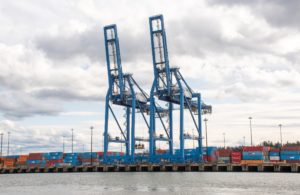 The Trump administration has opened a broad new front in its global trade conflict, proposing to affix levies reaching $1.5 million on Chinese-made ships arriving at American ports. Such fees would apply even on vessels made elsewhere — an approach that risks increasing costs on raw materials to factory goods. …It is engineered to discourage reliance on Chinese vessels in supplying Americans with products, while aiming to spur the revival of a domestic shipbuilding industry after a half-century of veritable dormancy. …The proposal would isolate China while diminishing American reliance on its industry. …The plan was the result of an investigation, started during the Biden administration, into the dominance of the Chinese shipping industry, in response to a petition filed by labor unions. Almost one-fifth of container vessels arriving at American ports are made in China. [to access the full story a NY Times subscription is required]



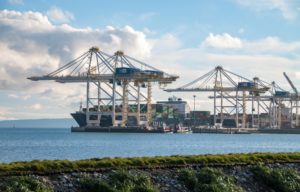 U.S. President Donald Trump in an all-caps post on Truth Social Thursday teased a new round of sweeping reciprocal tariffs, matching the higher rates other nations charge to import American goods. …Reciprocal tariffs were one of Trump’s core campaign pledges — his method for evening the score with foreign nations that place taxes on American goods and to solve what he has said are unfair trade practices. …He is set to share more details on the tariffs ahead of his visit with Indian Prime Minister Narendra Modi, White House press secretary Karoline Leavitt told reporters on Wednesday. …The tariffs are likely to hit developing countries hardest, especially India, Brazil, Vietnam and other Southeast Asian and African countries, given that they have some of the widest differences in tariff rates charged on U.S. goods brought into their countries compared to what the U.S. charges them.
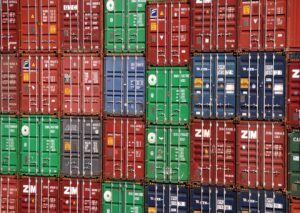 Reciprocal tariffs are straightforward in theory: The U.S. would pose the same levies on imported goods from a given country that the other country imposes on their U.S. imports. But it gets far murkier in practice, as countries often charge different tariffs on different classes of goods. Goldman Sachs economists outlined three approaches Trump could take. “Country-level reciprocity” is the “simplest” strategy which would have the U.S. impose the same average tariffs. “Product-level reciprocity by country” would have the U.S. place marching tariffs on a good-by-good basis by trading partner.” Reciprocity including non-tariff barriers” is the “most difficult” approach as it would encompass a complicated web of inputs including inspection fees and value-added taxes. …4.8% is the U.S.’ weighted average tariff rate if Trump implemented the country-level strategy. …Goods from the 20 countries the U.S. has free trade agreements with, including Australia, Canada, Mexico and Panama, won’t be affected – though Trump has targeted several of those countries in recent weeks.
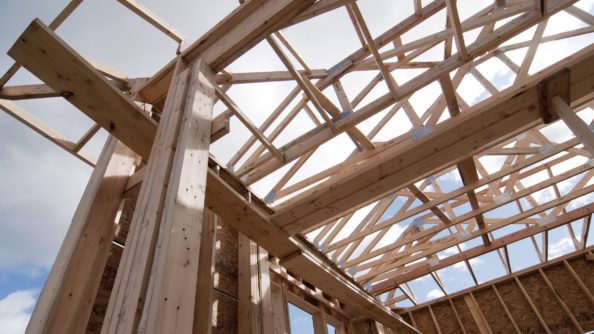 BOZEMAN, Mont. – The Trump administration’s tariffs are stirring discussions in Montana, with concerns about their impact on local economies. At Montana State University, Dr. Nicole Karwowski, an assistant professor of economics … explains that while tariffs can benefit certain business and factory owners, as well as shareholders of domestic firms, the broader impact tends to be negative. She highlights that these beneficiaries gain from the increased costs international companies face when competing in the U.S. market. The local economy in Bozeman is particularly affected, Karwowski says, due to the rising cost of construction materials. “We import a lot of our timber from Canada. And housing prices are already skyrocketing in places like Bozeman especially. So the different types of construction materials and raw materials are increasing in cost because of these tariffs. Then we’re going to see it harder to be building more in places like Bozeman,” she said.
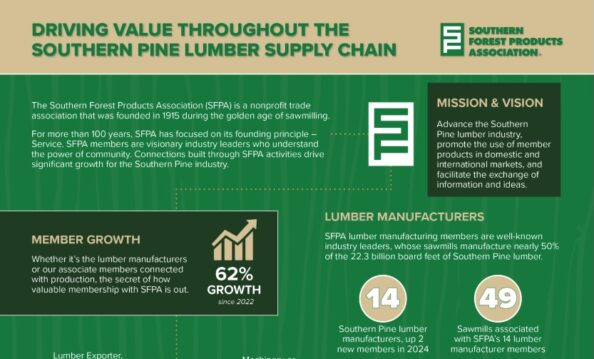 The Southern Forest Products Association believes strong partnerships are essential for sustaining growth and success. That starts with our most valuable partnership — our members. Their commitment is the driving force behind our success. The 2024 SFPA Value Report recaps the association’s: International market development and success in driving demand for Southern Pine lumber exports; A new, consolidated website; Digital promotion efforts; Membership growth; and Industry collaboration.
 TUPPER LAKE, N.Y. — Immigrations and Customs Enforcement conducted a raid Feb. 18 at Tupper Lake Pine Mill in New York state and detained nine employees. In a statement …the parent company of the mill, The Matra Group, said that the employees were authorized to work in the U.S. …“Nine employees were detained, all of whom were, to our knowledge, authorized to work in the United States, as we verify all employees through the I-9 process,” Nicholas Drouin, Matra co-president and director of manufacturing said. All U.S. employers must follow that process to verify workers’ identities and employment eligibility. …The mill — formerly known as the Tupper Lake Hardwoods Inc. — is owned by the Quebec-based Matra Group, a lumber harvesting and distribution company.
  WASHINGTON —