Category Archives: Carbon, Climate & Bioenergy

Carbon, Climate & Bioenergy

Building new homes in the path of floods and wildfires could cost billions, threaten affordability: report

By Canadian Climate Institute
Cision Newswire
February 6, 2025
Category: Carbon, Climate & Bioenergy
Region: Canada

TORONTO – Governments across Canada are racing to build more housing to improve affordability. Yet a new study has found those efforts risk putting hundreds of thousands of homes in harm’s way, and adding billions of dollars in costs each year, unless policy is improved to direct development away from the threat of wildfires and floods. According to new research published by the Canadian Climate Institute, building new homes in areas at a high risk of flood or wildfire could force governments, insurers, and homeowners to spend up to $3 billion more each year in costs for rebuilding and disaster relief. The Institute’s report, Close to Home: How to build more housing in a changing climate, is a first-of-its-kind analysis in Canada using original modelling of the financial costs of future floods and fires on new housing slated for construction by 2030.

Read More

Canada Unveils Direct Air Capture And Storage Offset Protocol

By Violet George
Carbon Herald
January 30, 2025
Category: Carbon, Climate & Bioenergy
Region: Canada

Canada is advancing its carbon removal strategy by developing a protocol for Direct Air Carbon Dioxide Capture and Geological Storage (DACCS).  This plan will establish a system for companies that extract CO2 directly from the atmosphere and permanently store it underground to generate federal offset credits. These credits will be tradable under Canada’s existing Greenhouse Gas Offset Credit System Regulations. This initiative aims to stimulate investment in the nascent field of direct air capture (DAC) technology, which is considered a critical tool for mitigating climate change.  The proposed protocol, released by Environment and Climate Change Canada, is subject to public review until March 28, 2025… By creating offset credits for DAC ventures, Canada is progressing toward its net-zero emissions target. The federal offset credit system will offer financial incentives, potentially making carbon removal a commercially viable industry.

Read More

How Bioenergy and the Forest Sector Can Help Meet Canada’s Energy Demands

By Forestry for the Future
Maclean’s Magazine
January 30, 2025
Category: Carbon, Climate & Bioenergy
Region: Canada

Every winter, Canadians bemoan the rising cost of heating their homes and businesses. Yet… few Canadians know about bioenergy—a sustainable approach that can play an important role in meeting Canada’s energy needs while simultaneously helping address climate change. Bioenergy refers to when biomass … is used to generate energy. Bioenergy is already widely used in some Nordic countries and is the largest source of renewable energy globally today. “Biomass energy is a true alternative to fossil fuel-based energy sources as it does not release any long-term stored carbon to the ecosystem,” says Cal Dakin, director of innovation and woodlands for Mercer International. Canada’s forest sector is in a prime position to help address energy challenges as well as build a more sustainable and circular economy as the primary source of biomass.

Read More

Forests may be more resilient to climate change than previously thought

By Ammara Khan
University of Toronto News
January 6, 2025
Category: Carbon, Climate & Bioenergy
Region: Canada

Forests may be more resilient to climate change than previously thought. A team of international researchers have found that increased inputs from plant roots can keep carbon levels in soil stable even as temperatures and nitrogen deposits in the atmosphere rise. The collaborative research project, published in Nature Ecology and Evolution, looked at the effects of increased temperatures due to climate change and increased nitrogen in the atmosphere released by burning fossil fuels – two environmental threats that had been studied separately… the research team found when rising temperatures were coupled with higher nitrogen levels, the plants added more carbon to soil by increasing their growth, activity and root turnover (the rate that their roots grow, die and decompose), maintaining soil carbon levels.

Read More

Climate misinformation is exploding — and Canadian politicians are spreading it

By Michelle Cyca
The Narwhal
January 2, 2025
Category: Carbon, Climate & Bioenergy
Region: Canada

Like climate change itself, conspiracy theories and misinformation are growing crises. And where they intersect with the environment, the problem seems to spread like wildfire. …Year after year, poll after poll has consistently shown a majority of Canadians believe in human-caused climate change. But across the country, Conservative politicians are fomenting weariness and skepticism about climate science to appeal to their bases and undermine their opponents — and it appears to be working. …What’s more, the same poll found the number of Canadians who believed humans were responsible for climate change declined by nine percentage points from the previous year. There is a clear political split on views regarding climate change, with Conservative voters less likely to believe in climate change than NDP or Liberal voters. …How can we extinguish the misinformation that’s torching an increasingly large share of reality?

Read More

Canada sees decline in greenhouse gas emissions, but missing target

By Nick Murray
Global News
December 19, 2024
Category: Carbon, Climate & Bioenergy
Region: Canada

For the first time since the pandemic, Canada had a year-over-year decline in its greenhouse gas emissions — though it is still a long way off its 2030 target. A preliminary emissions report from the federal government shows greenhouse gases emitted in 2023 fell by six million tonnes compared to 2022, the equivalent to what about 1.4 million passenger vehicles emit over the course of a year. Under the Paris climate agreement, Canada committed to reducing its emissions by 2030 to 40% to 45% less than what they were in 2005. The latest figures show as of 2023 they were down 8.5%. …The report is a snapshot of a country’s annual GHG emissions which Canada normally publishes in April when it has to submit it to the United Nations. The report showed a small increase in emissions in 2023 from transportation sources, offset by decreases in the oil and gas sector, agriculture and emissions from buildings.

Read More

Canada says it wants to slash its emissions in half by 2035

By Jordan Omstead
The Canadian Press in Business in Vancouver
December 12, 2024
Category: Carbon, Climate & Bioenergy
Region: Canada

TORONTO — Canada is aiming to cut its emissions in half by 2035 compared to 2005 levels, the federal government announced Thursday, a target more modest than what a federal advisory body had previously recommended. The target of reducing emissions by 45% to 50% balances both ambition and what is achievable, Environment and Climate Change Minister Steven Guilbeault said. …He added that the target’s lower end accounts for potential headwinds, including how United States president-elect Donald Trump approaches key climate policies. …”As a responsible government, we have to account for the possibilities that it may be more difficult in the coming years to continue moving forward because our major trading partner may decide to take a different course when it comes to tackling climate change,” Guilbeault said. Canada’s Net-Zero Advisory Body recommended an emissions reduction target of 50% to 55%. …Catherine Abreu, a climate policy analyst, called the target “pathetic”.

Read More

Fraser Institute News Release: Ottawa’s “Net Zero” emission-reduction plan will cost Canadian workers $8,000 annually by 2050

By The Fraser Institute
Cision Newswire
January 30, 2025
Category: Carbon, Climate & Bioenergy
Region: Canada, Canada West

VANCOUVER, BC – The federal government’s plan to achieve “net zero” greenhouse gas emissions will result in 254,000 fewer jobs and cost workers $8,000 in lower wages by 2050, all while failing to meet the government’s own emission-reduction target, finds a new study published today by the Fraser Institute, an independent, non-partisan Canadian public policy think-tank. “Ottawa’s emission-reduction plan will significantly hurt Canada’s economy and cost workers money and jobs, but it won’t achieve the target they’ve set because it is infeasible,” said Ross McKitrick, senior fellow at the Fraser Institute and author of Canada’s Path to Net Zero by 2050: Darkness at the End of the Tunnel. The government’s Net Zero by 2050 emission-reduction plan includes: the federal carbon tax, clean fuel standards, and various other GHG-related regulations, such as energy efficiency requirements for buildings, fertilizer restrictions on farms, and electric vehicle mandates. By 2050, these policies will have imposed significant costs on the Canadian economy and on workers. 

Read More

Arbios Biotech biomass to bio-oil facility is set to go

By Cheryl Jahn
CKPG Today
January 29, 2025
Category: Carbon, Climate & Bioenergy
Region: Canada, Canada West

PRINCE GEORGE – It was 2021 when Canfor announced a final investment decision on a project to produce biofuel. The plant will use hydrothermal liquefaction technology to convert forestry residues and wastes into high value into renewable biocrude, which can be further refined to produce low-carbon transportation fuels. “What we do is essentially, what nature does over millions of years we do in 25 to 30 minutes,” explains Rune Gjessing, CEO of Arbios Biotech. “We’re taking organic matter, manipulating it, and then producing oil.” In August 2022, a formal naming of the Arbios facility adjacent to the Canfor Intercon Pulp mill to Chuntoh Ghuna, meaning “the forest lives.” …The world’s largest hydrothermal liquefaction facility in the world, converting 25,000 dry tonnes of wood residuals into 50,000 barrels of biofuel annually. …The plant uses residuals from the forest sector. …The biofuel produced will be used for aircraft and marine purposes.


Read More

Transition to more biomass heating in Northwest Territories requires better supply chain, advocates say

By Jocelyn Shepel
CBC News
January 30, 2025
Category: Carbon, Climate & Bioenergy
Region: Canada, Canada West

A gathering of advocates, researchers and government officials in the N.W.T. this week is looking at biomass as a viable alternative to diesel in the territory. The Arctic Energy Alliance’s “Biomass Week” started Monday in Yellowknife and continues all week. Biomass is organic matter — for example, wood — that is used to generate energy. Statistics Canada data shows that diesel accounted for roughly half of the territory’s total energy demand in 2023. A significant portion of that diesel is used for space heating and power generation, according to the Canada Energy Regulator. The non-profit Arctic Energy Alliance wants to help steer the territory away from fossil fuels and toward cleaner energy sources. …If the territory is to move away from fossil fuels, Heyck believes biomass is a viable option. He says having more certified wood-stove installers and people who can service and install pellet stoves in the territory is helping.

Read More

B.C. First Nation leader clarifies Northern Gateway comment

By Derrick Penner
Vancouver Sun
January 22, 2025
Category: Carbon, Climate & Bioenergy
Region: Canada, Canada West

The president of the Union of B.C. Indian Chiefs agreed that Canada faces “perilous times”, but walked back comments he made Tuesday that suggested he had reversed his opposition to the dormant Northern Gateway pipeline project. …“I sincerely apologize for any confusion,” Phillip added, with respect to his comments Tuesday that if Canada doesn’t “build that kind of infrastructure, Trump will and there will not be any consideration for the environment or the rule of law.” Phillip said his answer was still no to “large-scale, destructive resource projects,” such as Northern Gateway. …“Any natural resource development that is being planned must have the consent of First Nations involved and must follow high environmental standards, including not increasing our greenhouse gas emissions and contributing to global warming,” Tom said. …Premier David Eby, said “diversification has to be part of our key strategy,” but skirted a direct mention of Northern Gateway.”

Read More

Construction of Arbios Biotech’s first-of-its kind fuel facility now complete in Prince George

By Ted Clarke
The Prince George Citizen
January 15, 2025
Category: Carbon, Climate & Bioenergy
Region: Canada, Canada West

 Arbios Biotech announced Tuesday it has completed construction of the world’s largest hydrothermal liquefication facility, built in the shadow of the Nechako River cutbanks. Located on slice of land next to Canfor’s Intercontinental Pulp Mill and across the road from Tidewater Midstream’s Prince George Refinery, a project that will turn tree bark into high-value renewable bio-oil in now just months away from going into production. …The facility will use first-of-its-kind technology to convert hog fuel (bark and other underutilized residues from sawmills) into bio-fuel that can be refined into drop-in fuel for the transportation sector. Gill is not worried that biomass supply will ever go away, despite closures of sawmills and pulp mill operations in the region and more threatened by poor forestry market conditions.

Read More

Watchdog gives B.C. government multiple failing grades on climate change

By Wolf Depner
The Campbell River Mirror
January 14, 2025
Category: Carbon, Climate & Bioenergy
Region: Canada, Canada West

A new report from a group tracking B.C.’s climate change response gives the provincial government multiple failing grades. The 2024 Climate Action Progress Report tracks the province’s response to 10 recommendations first issued in 2021 by the B.C. Climate Emergency Campaign, a group of civil society groups “anxious about the climate emergency, who are collaborating to increase the ambition of climate policy and action” in B.C. The group — which says it represents more than 600 businesses, non-profits, think-tanks, churches and Indigenous organizations — presented its latest assessment Jan. 14. The verdict included a trio of ‘Fs’ along with “minor progress” in seven of 10 other policy areas. “The provincial government’s CleanBC climate action plan is insufficient to limit warming to 1.5°C and will not keep British Columbians safe from the worst impacts of climate change,” it reads. 

Read More

Calgary company considering northern BC as potential site of biomass diesel manufacturing plant

By Ted Clarke
Prince George Citizen
January 13, 2025
Category: Carbon, Climate & Bioenergy
Region: Canada, Canada West

In 2023, Expander Energy  Inc., and Rocky Mountain Clean Fuels Inc., announced a project to produce low carbon bio-synthetic diesel fuel by combining pieces of waste wood and synthetic gas using a patented gasification process. Expander Energy CEO Gord Crawford said his company is working on a feasibility study funded by the federal government’s Clean Fuels Fund to determine new locations for future gasification plants that turn forest products into fuel. Northern BC is being considered as a potential plant site. “These plants won’t be located in Vancouver, they’ll be in Prince George, Fort St.. John, places like Fort St. James, rural and remote.”… Northern BC has all the elements needed to support a carbon-neutral project, including fibre supply, renewable energy from the electrical grid and an existing track record of industrial development.

Read More

Winter is going: Nanaimo leads Canada in loss of sub-zero winter days

By Jessica Durling
Nanaimo News Bulletin
January 11, 2025
Category: Carbon, Climate & Bioenergy
Region: Canada, Canada West

A new study indicates that over the past 10 years, the Nanaimo region has gained more winter days above 0 C than anywhere else in Canada. The study comes from Climate Central, a non-profit based in New Jersey… The report found that over the 10-year period from 2014 to 2023, Nanaimo gained 18 winter days above 0 C, and now averages 70 days each winter when the temperature doesn’t dip below zero. …She warned that the rapid change in year-over-year temperature can have devastating impacts on Vancouver Island’s ecosystems, with one example Dahl being waterways, which are heavily influenced by the snowpack from each winter. …The main bark beetle of concern on Vancouver Island is the Douglas-fir beetle, which prefers recently dead, dying or severely stressed trees. Stress can be due to severe drought, disease or sometimes even lightning strikes. In addition, inclement weather can lead to boosted populations with windthrown trees. 

Read More

The BC NDP is not the climate leader it is cracked up to be

By Barry Saxifrage
The National Observer
January 2, 2025
Category: Carbon, Climate & Bioenergy
Region: Canada, Canada West

BC’s New Democratic Party was just re-elected in a campaign where they touted their climate leadership. Despite these reassuring words, Canadians should pay close attention to what’s happening. The province has turned into a climate laggard, with emissions stuck far above 1990 levels. And, perhaps shockingly, all the increase in climate pollution has happened while the BC NDP has been running the government. …For comparison, I’ve shown what Canada and its peers in the G7 advanced economies have done. BC is doing even worse than the G7’s climate laggard, Canada. …A second startling takeaway is how the entire rise in provincial emissions happened while the BC NDP was running the government. …Provincial emissions rose by a net total of 16 million tonnes of CO2 (MtCO2) during the years when the BC NDP were in power. Provincial emissions fell by a net 2 MtCO2 during the years the BC Liberals controlled government.

Read More

Canadian carbon removal company scores US$40M grant from fund backed by Bill Gates

by Amanda Stephenson
Victoria Times Colonist
December 18, 2024
Category: Carbon, Climate & Bioenergy
Region: Canada, Canada West

A Canadian company that has received a US$40-million grant from Bill Gates’ climate solutions venture firm says its Alberta test site will be removing carbon directly from the atmosphere as early as this spring. Montreal-based startup Deep Sky announced Wednesday it was awarded funding from the Gates-founded Breakthrough Energy Catalyst to help finance what it calls its Deep Sky Alpha project. Construction work at the project site, located north of Calgary in the town of Innisfail, is already under way… It is the first Canadian company to receive an investment from Breakthrough Energy Catalyst, which funds commercial projects for emerging climate technologies in an effort to accelerate their adoption and reduce their costs.

Read More

Williams Lake energy plant in limbo despite record need for power

By Ruth Lloyd
The Williams Lake Tribune
December 13, 2024
Category: Carbon, Climate & Bioenergy
Region: Canada, Canada West

Atlantic Power’s Williams Lake biomass energy plant is still in limbo, while B.C. imported record amounts of electricity last year. The plant’s future remains uncertain, after having given a one year termination of contract notice to BC Hydro at the beginning of 2024. The wood biomass plant is the city’s largest single taxpayer. Atlantic Power said the Williams Lake plant would cease operations due to the lack of affordable fibre to maintain financial viability, but the original October deadline to revoke this notice has been relaxed due to the impact of the provincial election. …But fibre for the plant has become harder to get, as its supply is further away and there is competition from users like Drax. …Ministers of Energy and Climate Solutions, Environment and Parks, Forests and Jobs, Economic Development and Innovation are now the focus of efforts by the city.

Read More

Northwest Territories uses 20,000 tonnes of wood pellets per year. Here’s why they aren’t made locally

By Liny Lamberink
CBC News
December 13, 2024
Category: Carbon, Climate & Bioenergy
Region: Canada, Canada West

The Northwest Territories (N.W.T.) has a lot of trees – so why are wood pellets used for heating all hauled up from northern Alberta? That question was central to a discussion that unfolded Thursday at the territory’s Legislative Assembly. Robert Sexton, the territory’s energy director, told the standing committee on economic development and environment that roughly 14,500 cords of wood used to heat homes in the territory every year all come from within the N.W.T. But the 20,000 tonnes of wood pellets used annually are coming from the south. …That means there’s a risk the supply chain could be interrupted and it’s already becoming “somewhat more difficult” because pellets are being exported to Europe. The territory often boasts of being a leader in biomass heating… Several MLAs who make up the standing committee asked about developing a local supply of wood pellets or chips. 

Read More

Canada Invests in Climate Change Adaptation to Keep Communities Safe in Northern Ontario and Across Canada

By Natural Resources Canada
Government of Canada
January 29, 2025
Category: Carbon, Climate & Bioenergy
Region: Canada, Canada East

OTTAWA — Across the country, the impacts of climate change are becoming more severe and more frequent with extreme events like floods, wildfires and heatwaves on the rise. …Marc G. Serré, Parliamentary Secretary to the Honourable Jonathan Wilkinson, along with Member of Parliament Viviane Lapointe and Member of Parliament Anthony Rota, announced over $2.7 million in funding for five projects based in northern Ontario under Natural Resources Canada’s Climate Change Adaptation Program (CCAP). These projects aim to support professionals, decision makers and First Nation communities in northern Ontario and across Canada to advance the implementation of climate change adaptation plans and actions through the development and delivery of tools, training and resources. One of the projects will also identify lessons learned from previously implemented adaptation actions.

Read More

Biodiversity in several Hamilton areas in ‘severe decline’ says botanist after conducting land survey

By Justin Chandler
CBC News
January 24, 2025
Category: Carbon, Climate & Bioenergy
Region: Canada, Canada East

Hamilton’s urban forests and woodlands may look nice and green, but according to a recent land survey commissioned by the Hamilton Naturalists’ Club, looks can be deceiving. The non-profit club says Hamilton’s biodiversity is in “severe decline.” In the spring, Hamilton field botanist Paul O’Hara went out to 11 natural areas in central and western Hamilton… To people living in the area today, it may seem very lush, but the region was once maybe a hundred times richer in biodiversity, O’Hara said. To people living in the area today, it may seem very lush, but the region was once maybe a hundred times richer in biodiversity. That “shifting baseline” is a problem when it comes to protecting our natural world, said Brian McHattie, program director at the naturalists’ club.

Read More

Humboldt County supervisors to discuss ‘critical shortcomings’ in proposed wood pellet project

By Ruth Schneider
Times Standard
January 13, 2025
Category: Carbon, Climate & Bioenergy
Region: Canada, Canada East

The Humboldt County Board of Supervisors will return to the topic of a massive wood pellet project… Fifth District Supervisor Steve Madrone proposes sending a letter with comments on the project proposed by Golden State Natural Resources that would create two wood pellet processing plants in Tuolomme and Lassen counties to harvest trees cut down in forest thinning projects, trucking the pellets to the Port of Stockton where they would be shipped to international energy markets. The proposed letter outlines various concerns about the project and urges more transparency… A critical complaint of the proposal is about the risk of Golden State Natural Resources partnering with Drax Global, a power generation company that has a history of environmental violation complaints both in the U.S. and abroad.

Read More

First Nations get federal funding for green fuel project

By Gary Rinne
Northern Ontario Business
January 9, 2025
Category: Carbon, Climate & Bioenergy
Region: Canada, Canada East

FORT FRANCES  — A corporation owned by 10 First Nations in the District of Rainy River is moving forward with a plan to produce low-carbon transportation fuels from wood waste. Wanagekong-Biiwega’iganan Clean Energy Corporation (WBCEC) has received $2.25 million from the federal government’s Clean Fuels Fund to conduct an engineering study for a commercial plant in Fort Frances. It would transform waste from the 1.5 million-hectare Boundary Waters Forest — such as bark, sawdust and logging debris — into airline fuel, diesel and naphtha, a type of fuel. …WBCEC has partnered with Vancouver-based Highbury Energy Inc., an energy technology innovator. …WBCEC has been working with lumber producers and other stakeholders in the district to secure feedstock for the proposed biorefinery.

Read More

Canada investing $2.5 million towards proposed biofuel refinery in town

By Ken Keller
Fort Frances Times
January 8, 2025
Category: Carbon, Climate & Bioenergy
Region: Canada, Canada East

The federal government is investing more than $2 million in a project that could see a revolutionary new industry take root in Fort Frances. In a media event held yesterday, Thunder Bay-Rainy River MP Marcus Powlowski made an announcement of $2.5 million that will be going to Wanagekong-Biiwega’iganan Clean Energy Corporation (WBCEC). The investment from the federal government will help fund the Front-End Engineering Design (FEED) phase of a project that is working to establish an industrial plant that will turn local wood waste into low-carbon fuels. WBCEC is an entity made up of the ten local First Nation communities in the southern end of Treaty #3 working in partnership with Vancouver-based Highbury Energy Inc., who made the announcement of their partnership and plans to establish a biofuel refinery in Fort Frances in December 2024.

Read More

U.S. company offers its Northwestern Ontario timberlands for carbon removal project

By Gary Rinne
TB Newswatch
January 7, 2025
Category: Carbon, Climate & Bioenergy
Region: Canada, Canada East

THUNDER BAY — An American company that controls some large patches of forest northwest of Thunder Bay is considering the potential sale of its timberlands for use as a carbon offset initiative. “I think it’s very exciting that we could see a big carbon offset project in Northwestern Ontario,” said Nancy Luckai, a registered professional forester and professor emerita in natural resources management at Lakehead University. Wagner Forest Management – based in New Hampshire – owns 480,000 acres (195,000 hectares) of forest in eight former Abitibi-Consolidated freehold blocks located roughly between the Dog Lake area, Graham and Sioux Lookout. …She said these projects require more than just leaving a forest intact. …”So there has to be some investment into the property to ensure that the rate of growth, the rate of carbon sequestration, is actually greater than what would happen under natural conditions.”

Read More

U.S. company offers its Northwestern Ontario timberlands for carbon removal project

By Gary Rinne
NWOnewswatch.com
January 7, 2025
Category: Carbon, Climate & Bioenergy
Region: Canada, Canada East

An American company that controls some large patches of forest northwest of Thunder Bay is considering the potential sale of its timberlands for use as a carbon offset initiative… Wagner Forest Management – based in New Hampshire – owns 195,000 hectares of forest in eight former Abitibi-Consolidated freehold blocks located roughly between the Dog Lake area, Graham and Sioux Lookout. It purchased the blocks from Abitibi in 2005 in a bidding process in which the Ontario government also participated. Last July the company extended an invitation to investors interested in the potential development of its holdings as “one of the largest nature-based carbon removal projects in the Voluntary Carbon Market.”.. Wagner’s forest management practices are currently certified through the Sustainable Forestry Initiative.

Read More

Ten Treaty 3 First Nations Launch Clean Energy Corporation to Convert Wood Waste into Sustainable Fuels

The Fort Frances Times
December 11, 2024
Category: Carbon, Climate & Bioenergy
Region: Canada, Canada East

Scrap wood fibre in the Rainy River district could get a new life, thanks to a partnership working towards a green fuel production facility. Ten First Nations in the Rainy River District near Fort Frances have joined forces to create ground-breaking Wanagekong-Biiwega’iganan Clean Energy Corporation (WBCEC). In partnership with Highbury Energy Inc., a Vancouver-based clean energy innovator, the initiative aims to transform wood waste—including bark, sawdust, and logging debris—into low-carbon transportation fuels. …The corporation is currently engaging with industry stakeholders such as Boundary Waters Forest Management Corporation, West Fraser OSB, Manitou Forest Products, Nickel Lake Lumber, and Resolute Forest Products (Sapawe Sawmill) to secure local wood waste as feedstock for a proposed biorefinery in Fort Frances. …This initiative aligns with similar projects Highbury Energy is involved in, including one in British Columbia to replace natural gas with a clean renewable fuel gas in a pulp mill lime-kiln.

Read More

US Withdrawal From the Paris Climate Accord and its Impact on the Voluntary Carbon Market

By George Fatula, Nicholas Neuberger & Scott Segal
JDSupra
February 4, 2025
Category: Carbon, Climate & Bioenergy
Region: United States, International

To formally pull the United States out of the Paris Agreement, the Trump administration will need to formally submit a withdrawal letter to the United Nations, which administers the pact. The withdrawal would become official one year after the submission. The formal withdrawal of the United States and subsequent changes to agreements under the UN Framework Convention on Climate Change cannot be transmitted to the United Nations until President Trump’s nominee to be US Ambassador to the UN, Rep. Elise Stefanik (R-NY), is confirmed by the Senate. …The withdrawal raises key questions about the future of the voluntary carbon market (VCM), particularly in light of the Paris Climate Accords’ role in driving offset demand. …Without the federal endorsement of climate goals, corporate strategies might shift away from investing in carbon offsets, diminishing demand for carbon credits. Furthermore, uncertainty surrounding federal support could delay or derail the development of new VCM projects.

Read More

US Forest Service scrubs website of references to climate change

By Eric Barker
The Lewiston Tribune
February 1, 2025
Category: Carbon, Climate & Bioenergy
Region: United States

News sites report employees across all agencies overseen by U.S. Department of Agriculture were instructed to take down climate change pages. Several recently active U.S. Forest Service web pages about climate change and its impacts on things like wildfires and ecosystems were either blocked or taken down by the agency Friday. People attempting to access the pages were shown messages saying “You are not allowed to access this page” or “Looks like you wandered off trail.” …Both Politico and the Hot Shot Wake Up, a news site specializing in wildfire coverage, reported employees across all agencies overseen by the U.S. Department of Agriculture were instructed by email to delete landing pages about climate change and those that track climate change references. The reason wasn’t immediately clear but it may be linked to President Donald Trump’s skepticism that climate change is real and caused by burning fossil fuels.

Additional coverage in Politico, by Zack Colman and Marcia Brown: USDA ordered to scrub climate change from websites

Read More

America’s second Paris withdrawal is not like the first

By Andrew Freedman
Axios
January 21, 2025
Category: Carbon, Climate & Bioenergy
Region: United States

President Trump’s move to withdraw the U.S. from the Paris Climate Agreement for a second time sends a clear signal to international partners that the U.S. is hot and cold on climate action. …There may be sufficient momentum now in both the Paris regime as well as the burgeoning clean energy sector that this will make only a symbolic difference. To have the U.S., which is the second-largest emitter behind China, exit the agreement has the potential for other countries to start viewing the U.S. as an unreliable partner on climate and potentially other issues as well. Last time the U.S. left, no other country followed that move. This time could be different, given the rightward, anti-climate policies tilt in some key countries. …America’s withdrawal from Paris doesn’t take effect immediately, although the executive order notes the administration will treat it as such.

Read More

What is the Paris Agreement? Trump pulled the US out — again

By Angela Fritz
CNN
January 20, 2025
Category: Carbon, Climate & Bioenergy
Region: United States

President Donald Trump signed actions on the first day of his second term to pull the United States out of the Paris Agreement, an international climate change treaty in which nearly 200 countries agreed to work together to limit global warming. …Representatives from the US were leaders in the Paris Agreement negotiations. It was adopted by nearly 200 countries during the Obama administration in 2015. Trump announced his intent to pull the US out of the Paris Agreement in 2017, though it wasn’t formalized until November 4, 2020, a day after the presidential election that Biden ultimately won. On the first day of his term, Biden announced his intent to reenter the Paris Agreement. On the first day of Trump’s second term in January 2025, Trump ordered the withdrawal from the Paris Agreement again as he sought to increase US production of fossil fuels. …In the meantime, a leading United Nations climate change official reiterated “the door remains open to the Paris Agreement.”

Additional coverage by David Thurton in CBC: Guilbeault says it’s ‘deplorable’ Trump will pull out of Paris Agreement as California burns

Read More

Prime apple-growing areas in US face increasing climate risks

By Sara Zaske
WSU Insider
January 6, 2025
Category: Carbon, Climate & Bioenergy
Region: United States

Some of the most productive apple regions in America are facing big challenges from a changing climate, according to a Washington State University study. Researchers analyzed over 40 years of climate conditions that impact the growth cycle of apple trees from bud break and flowering through fruit development, maturation and color development. While many growing areas are facing increased climate risks, the top three largest apple-producing counties in the U.S. were among the most impacted: Yakima in Washington, Kent in Michigan and Wayne in New York. In particular, Yakima County, the largest of the three with more than 48,800 acres of apple orchards, has seen harmful trends in five of the six metrics the researchers analyzed.

Read More

The Search for a Somewhat Sustainable Aviation Fuel

By Katie Brigham
Heatmap
January 6, 2025
Category: Carbon, Climate & Bioenergy
Region: United States

There’s no quick fix for decarbonizing medium- and long-distance flights. Batteries are typically too heavy, and hydrogen fuel takes up too much space to offer a practical solution, leaving sustainable aviation fuels made from plants and other biomass, recycled carbon, or captured carbon as the primary options… That creates an opportunity for developers of second-generation sustainable aviation fuel technologies, which involve making jet fuel out of captured carbon or alternate biomass sources, such as forest waste. These methods are not yet mature enough to make a significant dent in 2030 targets… But this tech will need to be a big part of the equation in order to meet the aviation sector’s overall goal of net zero emissions by 2050, as well as the EU’s sustainable fuels mandate.

Read More

Carbon Credit Companies Vie to Outlast a Two-Year Slump

By Henry Kronk
The Wall Street Journal
December 18, 2024
Category: Carbon, Climate & Bioenergy
Region: United States

Businesses serving the global voluntary carbon market are reducing head counts, revising services and following buyer demand as they fight for survival in a market that has yet to rebound from a steep contraction that took hold in 2023. …Criticism of carbon projects like Kariba REDD+ and others have tanked most credit prices. The average value for newly issued credits from REDD+ projects—which conserve standing forests—fell from a high of $16.27/metric ton in early 2022 to a low of $8.06/mt in June. …A survey in May found the voluntary carbon market (VCM) contracted from $1.9 billion in 2022 to $723 million in 2023. …Buyer interest has shifted. The first is a move away from projects that reduce emissions to those that actively remove them from the atmosphere, such as projects that regrow forests on degraded land. …Buyers have also turned their attention to carbon reduction efforts supported by national or international frameworks. [to access the full story a WSJ subscription is required]

Read More

The Firm That Wants to Power AI With Southern Yellow Pine

By Ryan Dezember
The Wall Street Journal
December 18, 2024
Category: Carbon, Climate & Bioenergy
Region: United States

Power producer Drax is scouting locations in the American pine belt to build electricity generators fueled by burning wood chips. The plan calls for constructing wood-fired power plants in parts of the U.S. South where pulp and paper mills have closed and left timber growers without buyers for those trees unfit for making lumber or poles. The plants’ exhaust will be piped underground instead of out of smokestacks, which generates lucrative carbon credits for which Drax is already lining up buyers. Plus, there’s the electricity. Technology companies are so eager to run their power-hungry AI data centers without fossil fuels. …Biomass power has long been dangled before Southern timberland owners as a potential solution to the glut of pine that has depressed prices and complicated harvests. …To sidestep concerns of the U.S. power plants contributing to deforestation, Drax plans to buy wood only from properties managed for timber production, not old-growth stands, Fitzmaurice said. [to access the full storey a WSJ subscription is required]

Read More

Biochar’s carbon storage potential undervalued due to outdated assessment methods, study finds

By Stanford University
Phys.Org
February 4, 2025
Category: Carbon, Climate & Bioenergy
Region: United States, US West

Biochar, a charcoal-like material derived from plant biomass, has long been hailed as a promising tool for carbon dioxide removal. However, a new study by Stanford researchers highlights a critical issue: current methods for assessing biochar’s carbon storage potential may significantly undervalue its true environmental benefits. The paper points the way to more accurately evaluating biochar, and boosting its credibility as a climate change solution. The research challenges conventional durability metrics and proposes a more nuanced framework for evaluating biochar projects. It grew out of an early project looking at soil’s ability to capture carbon dioxide. …By reanalyzing the largest existing biochar durability dataset, the researchers uncovered that relying solely on hydrogen-to-carbon ratios ignores critical factors such as soil type, environmental conditions, and biochar feedstock variability. Without these factors, models often fail to predict real-world outcomes for carbon storage and benefits to soil health and crops.
Read More

Mass deletion and alteration of federal websites includes Alaska reports and data

By Mark Sabbatini
The Juneau Empire
February 3, 2025
Category: Carbon, Climate & Bioenergy
Region: United States, US West

The U.S. Forest Service’s “Sustainability and Climate” webpage is gone, as are the news sections for the homepages of Alaska’s National Forests and the Tongass National Forest. Likewise for a vast amount of federal government weather, disaster assistance, fisheries, health, education and other reports …“More than 8,000 web pages across more than a dozen U.S. government websites have been taken down since Friday afternoon,” The New York Times reported Sunday morning. The mass removal is occurring “as federal agencies rush to heed President Trump’s orders targeting diversity initiatives and ‘gender ideology.’” …The U.S. Department of Agriculture, which oversees the Forest Service, has ordered all websites to be taken down that document or reference climate change. …The Forest Service’s “Sustainability and Climate” website, for instance, now displays only the text “You are not authorized to access this page.”

Read More

Taking Gov. Tina Kotek’s temperature on Oregon’s climate change response

By Monica Samayoa
Oregon Public Broadcasting
February 4, 2025
Category: Carbon, Climate & Bioenergy
Region: United States, US West

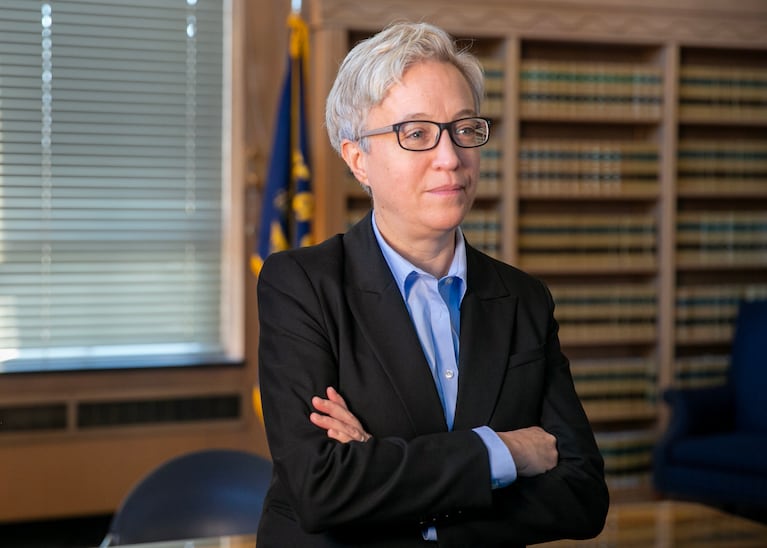
Tina Kotek

Oregon Gov. Kotek calls herself a “climate champion,” a moniker her supporters also used during her campaign for governor. …But Kotek is now halfway through her term as the state’s top government official [and] hasn’t made climate or environmental issues central to her agenda. …Oregon has many programs aimed at reducing greenhouse gas emissions from the state’s biggest emitters, including the transportation and buildings sectors. But Kotek has her eyes set on other ways to reduce the state’s overall greenhouse gas emissions — carbon storage or carbon sequestration. …“Elliott State Research Forest has been really important to me to make sure we can have carbon sequestration as part of the goals for the research forest, see how it’s actually working, get us onto the carbon credit market,” she said. …Kotek said overall, the Elliott is an important part of reducing the state’s greenhouse gas emissions.

Read More

Conditions that fueled Los Angeles fires were 35% more likely because of climate change, scientists find

By Evan Bush
NBC News
January 28, 2025
Category: Carbon, Climate & Bioenergy
Region: United States, US West

Climate change increased the likelihood of the extreme conditions that allowed the recent fires to roar across the Los Angeles area, an international group of scientists said Tuesday. The hot, dry and windy conditions that preceded the fires were about 35% more likely because of human-caused global warming, according to a new report from the World Weather Attribution group, which analyzes the influence of global warming on extreme events. …“This was a perfect storm when it comes to conditions for fire disasters,” John Abatzoglou, at the University of California, Merced said. …The authors analyzed weather and climate models to evaluate how a warmer atmosphere is shifting the likelihood of fire weather. …The researchers found that the kind of conditions that drove the L.A. area fires are expected to occur on average once in 17 years in today’s climate. Such conditions would have been expected once every 23 years without climate change.

Read More

Organizations oppose proposed wood pellet projects

By Larry Adams
Woodworking Network
January 23, 2025
Category: Carbon, Climate & Bioenergy
Region: United States, US West

Over 185 community, business, and environmental organizations have opposed two wood pellet projects in California as part of a public comment period in regards to the projects. The comment period, now closed, looked at the draft environmental impact report (DEIR) on two proposed Golden State Natural Resources (GSNR) plants that would produce more than one million metric tons of wood pellets per year drew comments from more than 45,000 individuals. The proposed project would include two industrial-scale wood pellet processing facilities, one in Tuolumne County, and one in Lassen County. The finished pellets would then be shipped by rail to the Port of Stockton for international shipping. …In May, the GSNR said it signed a Memorandum of Understanding with British energy company, Drax, for the joint exploration of sustainable biomass opportunities… The 90-day review period for the DEIR for GSNR’s proposed forest resiliency demonstration project has officially ended. …submitted comments are being reviewed

Read More

Climate and community resilience on the docket in 2025

By Jay Kosa
Salish Current
January 22, 2025
Category: Carbon, Climate & Bioenergy
Region: United States, US West

Whatcom County has embraced climate resilience as a goal and recognizes that mature forest protection is one of the best ways to preserve what we already have in these natural systems. Updating the funding mechanism to better address the near-term needs of local beneficiaries like Mount Baker School District would alleviate tensions that can arise when communities are asked to choose between better near-term revenue for schools and the myriad benefits of conserving mature forests. A $2 billion public education package is up for consideration. This funding package would move K–12 public schools toward being fully funded, taking pressure off of the Department of Natural Resources to provide timber revenues to fill gaps in school operating budgets (a use for which common school funds were never intended).

Read More

Forest owner wants to put burned acreage back into carbon offset market, but critics skeptical

By Alex Baumhardt
Oregon Capital Chronicle
January 21, 2025
Category: Carbon, Climate & Bioenergy
Region: United States, US West

A large Oregon forest meant to offset planet warming emissions was burned three years ago in a wildfire, and the project had to be pulled from a carbon credit market that aims to fight against climate change. Now, its owners want to re-enter some of those burned acres into California’s carbon market, which generates credits based on the amount of emissions stored by trees. When trees are burned, they release some of those stored emissions, but the owners, Green Diamond Resource Company, maintain that the scorched land still offers some climate benefits. The move would mark a first, and it worries critics… “Do you want to count on those arid, ponderosa pine forests in southern Oregon for carbon offsetting? For making good on 100-year climate commitments?” said Grayson Badgley.

Read More

Climate change to lower timber prices in Oregon, Washington and California

By John Ross Ferrara
KOIN 6 News
January 16, 2025
Category: Carbon, Climate & Bioenergy
Region: United States, US West

The increased threat of wildfires and potential damages to timberlands from drought, fire and smoke are expected to reduce timber prices in Oregon, Washington and California in the coming decades, according to Oregon’s 2025 climate assessment. Wildfires and drought have caused $11.2 billion in damages to privately owned timberland in Oregon, Washington and California in the last 20 years, a 2023 Oregon State University study showed. The damages resulted in a 10% reduction in the value of private timberland in the three states…“When the risk of wildfire increases, then future timber harvest revenues become less certain for buyers and owners of forest land, and that’s why they’re willing to pay less and what explains the negative effect we find of wildfires on timberland prices.”

Read More

High winds, lack of rain and climate change stoking California fires

By Matt McGrath
BBC News
January 8, 2025
Category: Carbon, Climate & Bioenergy
Region: United States, US West

The impact of a changing climate is evident in the bigger picture for the state. California has experienced a decades-long drought that ended just two years ago. The resulting wet conditions since then have seen the rapid growth of shrubs and trees, the perfect fuel for fires. However last summer was very hot and was followed by dry autumn and winter season – downtown Los Angeles has only received 0.16 inches of rain since October, more than 4 inches below average. Researchers believe that a warming world is increasing the conditions that are conducive to wildland fire, including low relative humidity. These “fire weather” days are increasing in many parts of the world, with climate change making these conditions more severe and the fire season lasting longer in many parts of the world, scientists have shown.

In related news: Here’s how California has increased forest management and wildfire response in the face of a hotter, drier climate

Read More

California infernos in January? Here’s why wildfire season keeps getting longer and more devastating

By Julie Cart
Cal Matters
January 8, 2025
Category: Carbon, Climate & Bioenergy
Region: United States, US West

As climate change warms the planet, wildfires have become so unpredictable and extreme that new words were invented: firenado, gigafire, fire siege — even fire pandemic. California has 78 more annual “fire days” — when conditions are ripe for fires to spark — than 50 years ago. When is California’s wildfire season? With recurring droughts, It is now year-round. …Los Angeles County is the latest victim. The fast-growing Palisades Fire, whipped by vicious Santa Ana winds, ignited along the coast in Los Angeles Tuesday morning, destroying homes and forcing evacuation of about 10,000 households. …What causes California’s wildfires? Arson and power lines are the major triggers. …California’s landscape evolved with fire. What remains is for its inhabitants to adapt to the new reality. And that requires yet another new term: Welcome to the “Pyrocene,” coined by fire scientist Stephen J.Pyne. The age of fire.

Read More

Frozen forest discovery hints at future alpine ecosystem changes

Bu Diana Setterberg
Phys.Org
January 6, 2025
Category: Carbon, Climate & Bioenergy
Region: United States, US West

Montana State University scientists say the frozen remnants of an ancient forest discovered 600 feet above the modern tree line on the Beartooth Plateau may portend possible changes for the alpine ecosystem if the climate continues to warm. A paper about the discovery is published in the journal Proceedings of the National Academy of Sciences. It describes what scientists have learned by studying the remains of a mature whitebark pine forest that formed at 10,000 feet elevation about 6,000 years ago, when warm-season temperatures in the Greater Yellowstone Ecosystem were similar to those of the mid-to-late 20th century… The results of the study suggest current climate conditions could lead to trees moving upslope into areas of the plateau that are now tundra.

Read More

Washington can safeguard forests and advance renewable energy

By Shelley Short, State Senator
The Seattle Times
December 29, 2024
Category: Carbon, Climate & Bioenergy
Region: United States, US West

The Seattle Times editorial board’s concerns about the proposed wood pellet manufacturing plants in Hoquiam and Longview are understandable. Still, the editorial relies on assumptions that risk stalling renewable energy solutions. We must undoubtedly safeguard Washington’s forests, but that includes considering the role that responsibly managed forests and wood products, like wood pellets, can play in transitioning away from fossil fuels. When implemented responsibly, the wood pellet industry can provide an effective solution for using dead and diseased trees and logging residue to produce renewable heat and power for residential, commercial and industrial needs… The board is concerned about the use of old-growth forests to produce wood pellets. However, existing Washington law already excludes old growth as a biomass resource.

Read More

The Climate Trust Named Recipient of Two U.S. Forest Service Grants Totaling $7 million

By The Climate Trust
PR Newswire
December 13, 2024
Category: Carbon, Climate & Bioenergy
Region: United States, US West

PORTLAND, Oregon — This past Wednesday, The Climate Trust was awarded two grants from the U.S. Forest Service totaling nearly $7 million through the Biden-Harris Administration’s Inflation Reduction Act. These funds will support The Climate Trust’s pioneering work in the carbon market, extending opportunities to climate vulnerable and underserved landowners while incentivizing climate-smart forest practices. A $2 million award will fund The Climate Trust’s Tribal Reservation Allotment Carbon Enrollment (TRACE) program, that will pilot the development of a replicable forest carbon project that aggregates small parcels owned by or held in trust for individual Tribal members. “To date, no carbon projects include allotment lands because it has been too challenging to aggregate them. The Dawes Act of 1887 broke up large areas of Tribal lands into small allotments that face significant obstacles to carbon market inclusion because of their small size, fractionated ownerships, and bureaucratic hurdles to decision making,” said TCT’s Forest Carbon Manager, Madeline Montague.

Read More

Domtar Paper Pulp Mill in Arkansas Aiming to Capture 1.5M Metric Tons of Carbon

By Rod Walton
EnergyTech.com
February 3, 2025
Category: Carbon, Climate & Bioenergy
Region: United States, US East

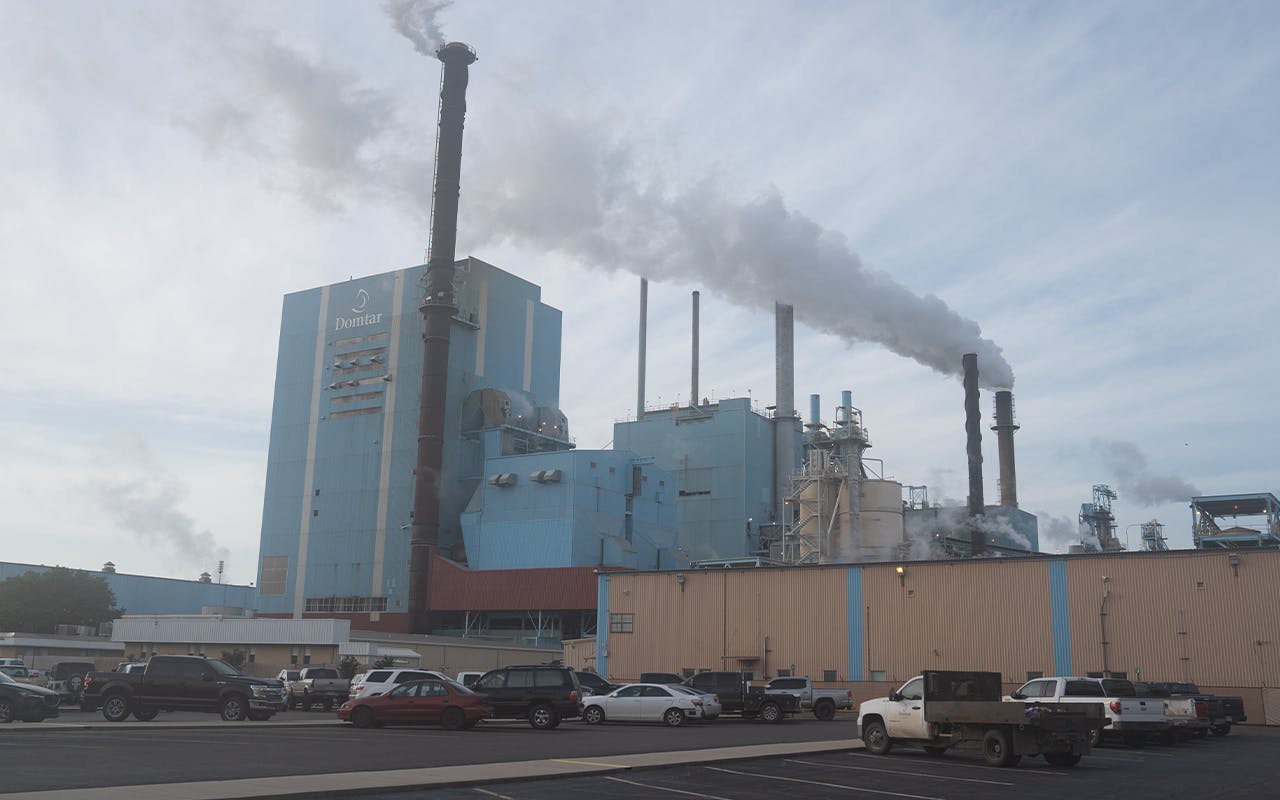
ARKANSAS — One of the nation’s biggest paper pulp mills will install carbon capture and storage targeting up to 1.5 million metric tons of biogenic CO2. Svante Technologies will develop the CCS project at the Ashdown Pulp Mill facility in Arkansas. Ashdown, owned by Domtar-Paper Excellence, produces close to 775,000 air dry metric tons of pulp annually, according to the parent company. The project will help deploy Svante’s carbon capture technology for the pulp and paper industry to generate carbon dioxide removal credits and enhance the sustainability of the industry’s operations. The project has been selected by the U.S. Department of Energy’s Industrial Efficiency and Decarbonization Office for negotiation of a cost-sharing agreement of up to almost $1.5 million. …Claude Letourneau, CEO of Svante said, “Svante’s MOF-based carbon capture technology has the potential to revolutionize how industrial facilities manage their emissions.”

Read More

Microsoft’s Key Role in Growing 35 Million Trees in the US

By Steven Downes
Sustainability Magazine
January 31, 2025
Category: Carbon, Climate & Bioenergy
Region: United States, US East

Microsoft has sealed a long-term agreement with Chestnut Carbon to provide high-quality, nature-based carbon removal from its afforestation, reforestation and revegetation (ARR) project in the Southern US. The deal, one of the largest ARR offtakes in the US, spans 25 years and will deliver over 7 million tons of carbon removal credits. The carbon removal will be derived entirely from Chestnut’s ARR project in the southern United States, including Arkansas, Texas and Louisiana. It is in addition to an initial agreement between Chestnut and Microsoft in December 2023 and involves multiple phases – estimated to restore 60,000 acres of land by planting over 35 million native, biodiverse hardwood and softwood trees… The Chestnut Sustainable Restoration Project stands out because of its focus on creating a long-lasting ecosystem of native forests at scale.

Read More

May conference focuses on expanding markets for wood residuals

By the Department of Natural Resources
State of Michigan
January 30, 2025
Category: Carbon, Climate & Bioenergy
Region: United States, US East

Once logging is done and lumber is sawn, what do you do with the wood chips, bark and sawdust that’s left?What do other manufacturers and mills do with their wood waste? These materials are commonly used for mulch, fuel, composite products and animal bedding. But what if wood residuals could be used for other products and generate more revenue? Innovative uses for wood residuals are the focus of the Green Gold: Wood Residuals Summit May 6-8 in Traverse City. “The management of wood residuals presents an economic and operational challenge that has cascading impacts on the health of our forests and forestry sector,” said Julie Manley, chair of the Michigan Forest Biomaterials Institute, the event host. The Michigan Department of Natural Resources is a sponsor. “New products are proving that sawdust, bark and chips can be used in insulation, adhesives, chemicals and more – with the added climate benefit of embedded carbon.

Read More

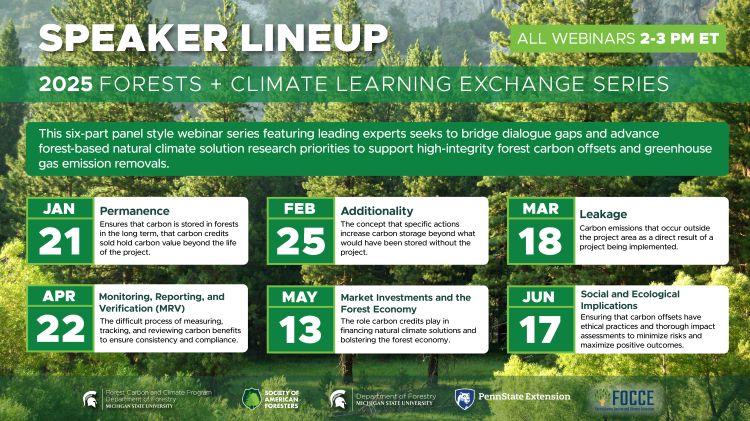
Forests + Climate Learning Exchange Series Announces 2025 Series Focused on High-integrity Forest Carbon Offsets and Programs

Michigan State University
January 27, 2025
Category: Carbon, Climate & Bioenergy
Region: United States, US East

EAST LANSING, Mich. – The Forests + Climate Learning Exchange Series (LES), co-hosted by the Forest Carbon and Climate Program (FCCP), the Society of American Foresters (SAF), and the FOCCE Program at Pennsylvania State University invites academics, practitioners, policymakers, and other experts to present innovative and important research, projects, and strategies relating to forest carbon. The series aims to develop and expand forest stakeholder knowledge and perspectives on forest carbon science, management, and strategy. The 2025 Forests + Climate Learning Exchange Series will feature six webinar panels that will bring together leading experts in forest carbon science, management, and policy to advance dialogues in support of high-integrity forest carbon offsets and credits. Panel conversations will not only identify major questions, barriers and gaps surrounding forests carbon offsets, but work to further the dialogue by identifying current research needs and potential pathways forward to foster the role of forests as natural climate solutions.

Read More

Georgia’s timber industry eyes sustainable aviation fuel to secure its future

By Shanteya Hudson
Public News Service
January 27, 2025
Category: Carbon, Climate & Bioenergy
Region: United States, US East

Georgia is the nation’s top forestry state, grappling with overproduction and the aftermath of severe storms which damaged timber supplies. Industry leaders and policymakers are turning to sustainable aviation fuel to boost the industry, create jobs and reduce carbon emissions. Sen. Larry Walker, R-Perry… said the growing demand for sustainable aviation fuel from companies like Delta Air Lines highlights its potential. However, he emphasized expanding production requires strategic federal policies and research to ensure long-term growth. “To invest in a facility that manufactures SAF, it’s a huge investment. It’s a long-term proposition,” Walker stressed. “We need some certainty out of Washington what the public policy is going to be, what the incentives to create this industry are.” …Walker added state lawmakers plan to introduce bills during the 2025 legislative session to support forestry innovation and expand sustainable aviation fuel production in the state.
Read More

As world grapples with wood pellets’ climate impacts, North Carolina communities contend with dust and noise

By Elizabeth Ouzts
Energy News Network
January 15, 2025
Category: Carbon, Climate & Bioenergy
Region: United States, US East

Jane Thornton tried and failed to stop the wood pellet plant from being built within earshot of her home in Faison, a tiny farming town in eastern North Carolina where she’s lived for over 60 years. Now, some eight years later, she and her neighbors have a smaller but critical aim: getting the facility to better control its dust and the nuisance it creates. A host of advocates, scientists, and data backs up Thornton. Producing pellets, shipping them to Europe and Asia, and burning them in power plants all creates carbon pollution greater than that of burning coal. Too often, pellets are made from whole, hardwood trees that were absorbing carbon dioxide while they were alive. Their replacements, often pines, can’t regrow in time to make up for it.

Read More

USA BioEnergy secures land for $2.8-B Sustainable Aviation Fuel plant in East Texas

Hydrocarbon Processing
January 13, 2025
Category: Carbon, Climate & Bioenergy
Region: United States, US East

USA BioEnergy (USABE) announced it has closed on the acquisition of 1,600+ acres of land in East Texas for its new $2.8-B advanced biorefinery, designed to convert wood waste into sustainable, net-zero aviation fuel (SAF). The landmark SAF facility already secured a 20-year offtake agreement with Southwest Airlines and is at the forefront of advancing ultra-low-carbon fuel, which is much needed in the future of aviation… Once blended with conventional jet fuel, the SAF could produce the equivalent of 2.59 billion gallons of net-zero fuel and avoid 30 million metric tons of CO2 over the offtake agreement term.  According to USABE calculations this will enable approximately 112,000 short (less than three hours) or 7,000 long haul (more than 10 hours) net-zero airline flights per year.

Read More

Amid outcry, solar farm owner says it no longer wants Michigan forest to expand

By Kelly House
Bridge Michigan
January 6, 2025
Category: Carbon, Climate & Bioenergy
Region: United States, US East

A proposal to lease 420 acres of state land near Gaylord for a solar energy development is on shaky ground after attracting criticism from lawmakers, including calls for “mass firings” of state employees involved in the plan… In Michigan, legislation passed last year requiring utilities to achieve 100% clean energy by 2040. To meet that mandate, Michigan may need to devote another 209,000 acres to wind and solar energy… In turn, state officials have been evaluating state land for renewable development… But developing state forests for clean energy comes with climate tradeoffs. Trees are a known carbon sink, and logging them to install solar panels can sometimes cancel out the climate gains… Lawmakers also object to solar farms on state land because they are viewed as more destructive to habitat and public access. “This is going to permanently, for many, many years, destroy that property’s ability to be enjoyed by sportsmen, by wildlife”.

Read More

What’s the dollar value of a forest that you can’t cut down?

Bt David Brooks
Concord Monitor
January 6, 2025
Category: Carbon, Climate & Bioenergy
Region: United States, US East

What is a living forest worth in money? That’s a simple-sounding question which has flummoxed New Hampshire for a long time… New Hampshire Division of Forests & Lands just released a registry of five carbon credit programs in the state. That includes 7,200 acres in and around the Ossipee Mountains mostly owned by Lakes Region Conservation Trust that in 2018… The trust can harvest trees as long as they don’t cut the property back to less than the 2018 baseline. If they cut too much, they have to repay some of the credits. As you might expect, there’s a lot of work involved to ensure the project actually adds to carbon capture – properties already protected by easements aren’t eligible – and to monitor lands to make sure trees aren’t being cut without anybody knowing.

Read More

Rayonier Announces Pore Space Agreement with Reliant Carbon Capture & Storage Covering Approximately 104,000 Acres

Rayonier Inc.
December 23, 2024
Category: Carbon, Climate & Bioenergy
Region: United States, US East

WILDLIGHT, Florida — Rayonier announced that it has entered into an underground pore space easement agreement with an affiliate of Reliant Carbon Capture & Storage covering approximately 104,000 acres in Alabama. Reliant specializes in capturing CO2 emissions from power plants and industrial facilities and safely sequestering this CO2 in subsurface geologic formations.  Along with this significant pore space agreement, Reliant is currently completing a front-end engineering design report for a power generating station in the area. “Carbon capture and storage opportunities represent a key pillar of our land-based solutions strategy,” said Mark McHugh, CEO of Rayonier. …Tom McCarthy, CEO of Reliant, added, “By building this large-scale sequestration hub, coupled with post-combustion carbon capture projects at large-volume emitters, Reliant will provide the key components required to decarbonize industry in this region.”

Read More

How ‘Thirsty’ Trees May Make Forests More Vulnerable to Climate Change

Morning Ag Clips
December 16, 2024
Category: Carbon, Climate & Bioenergy
Region: United States, US East

A new study suggests that increased maple populations may leave forests in western North Carolina more vulnerable to extreme weather conditions like flooding and drought.The southern Appalachian Mountains feature large, intact forests with frequent precipitation. This kind of area would not typically be a place to look for the effects of climate change, but the emergence of more “thirsty” trees like maples shifts that dynamic. Maples are an example of “diffuse-porous” trees, which require more water to grow than “ring-porous” trees like oaks… Previous models did not account for the different water needs of various tree species. This led to a potential underestimation of the threat posed by climate change in areas with increasing diffuse-porous tree populations.

Read More

Finland’s forests now emit more CO2 than they absorb

The Helsinki Times
January 29, 2025
Category: Carbon, Climate & Bioenergy
Region: International

Finland’s forests, once a crucial carbon sink, have become a source of emissions, raising concerns over the country’s climate policy and carbon neutrality targets. According to the latest data from the Natural Resources Institute Finland (LUKE), Finland’s forests emitted 1.12 million tonnes of CO2 equivalent in 2023. This shift began gradually around 2010 and has accelerated since 2018. By 2021, Finland’s forests had transitioned from absorbing carbon to releasing it. The main causes are declining forest growth, increased logging, and rising emissions from forest soil. The land use, land-use change and forestry (LULUCF) sector, which includes forests, emitted a total of 11.8 million tonnes of CO2 equivalent in 2023. This makes it one of Finland’s largest emission sources, surpassing emissions from sectors such as agriculture. LUKE’s report highlights three key reasons behind the decline of Finland’s forest carbon sink.

Read More

Finland stopping logging won’t save global climate, says new climate minister

By Aleksi Teivainen
Helsinki Times
January 27, 2025
Category: Carbon, Climate & Bioenergy
Region: International

Sari Maltala, a 46-year-old third-term Member of Parliament from Uusimaa, has started in her new role as minister of climate and the environment by emphasising the needs of the forest industry. Multala on Friday outlined at a press conference that the climate crisis and biodiversity loss are “fateful questions” for the planet that require “effective solutions”. She acknowledged that measures to strengthen the carbon sink of forests – the cornerstone of the national effort so achieve carbon neutrality by 2035 – are required but declined to specify the nature of such measures. When asked about the need to scale back logging volumes – one of the primary causes of the shrinking carbon sink – she took the opportunity to emphasise the needs of the forest industry. “The world’s climate can’t be saved by stopping logging in Finland,” she retorted.

Read More

UK would need forest ‘twice size of London’ to offset new airport expansion

By Josh Gabbitiss and Verner Viisainen
CarbonBrief.org
January 27, 2025
Category: Carbon, Climate & Bioenergy
Region: International

A forest twice the size of Greater London would need to be planted in the UK to cancel out the extra emissions from the expansion of Heathrow, Gatwick and Luton airports, Carbon Brief analysis reveals. New runaways at these airports surrounding London would result in cumulative emissions of around 92m tonnes of extra carbon dioxide equivalent (CO2e) by 2050, if the number of flights increases in line with their operating company targets. For example, offsetting these emissions would require more than 300,000 hectares of trees to be planted within just a few years. This equates to all the trees planted in the UK since 2000… Reeves has stressed that “sustainable aviation fuels” (SAFs) and electric planes could help to offset these emissions. However, such technologies are still in the early stages of deployment and previous Carbon Brief analysis suggests the role of SAFs in achieving net-zero may be limited.

Read More

Drax is taking positive action to deliver secure clean power and climate goals

By Miguel Veiga-Pestana, Chief Sustainability Officer
Drax Group Inc.
January 23, 2025
Category: Carbon, Climate & Bioenergy
Region: International

Drax divides opinion. Some recognise the critically important role we play in generating renewable power which keeps the lights on for millions. Others argue that we are not ‘green enough’ and need to do more to demonstrate that we are part of the solution to tackling the existential threat of climate change. …Since the Ukrainian conflict and the ongoing uncertainty around investments needed to achieve net zero, energy has overtaken many other sectors in he controversy stakes. We recognise that some people have concerns about our operations. …this year will see us make changes to further integrate sustainability across our operations. We are … taking positive action to provide greater transparency about our plans, processes and operations.  We are developing this new approach in consultation with experts to ensure that we’re on the right path to being climate, nature and people positive.

Read More

The Democratic Republic of Congo to create the Earth’s largest protected tropical forest reserve

World Economic Forum
January 22, 2025
Category: Carbon, Climate & Bioenergy
Region: International

The Congo Basin is home to the largest expanse of intact tropical forest on Earth, covering approximately 3.7 million square kilometres. It retains vast areas of undisturbed forest – like the 108,000 square kilometres in the Democratic Republic of Congo (DRC), an area about the size of Iceland. The Amazon has steadily lost its carbon storage potential, flipping from a sink to a net emitter in 2021. But, the Congo Basin is still functioning effectively as a carbon sink, a crucial planetary buffer limiting greenhouse gases in the atmosphere. The Congo Basin is currently the largest and healthiest tropical forest carbon sink in the world, sequestering 1.5 billion tonnes of CO₂ annually with a peat swamp that stores 29 billion tonnes of carbon – equivalent to about three years’ worth of global greenhouse gas emissions.

Read More

Burning wood for power not necessary for UK’s energy goals, analysis finds

By Fiona Harvey
The Guardian
January 22, 2025
Category: Carbon, Climate & Bioenergy
Region: International

The UK should stop burning wood to generate power because it is not needed to meet the government’s target of decarbonising the electricity sector by 2030, according to analysis. Ed Miliband, the energy security and net zero secretary, is expected to make a decision soon on whether to allow billions of pounds in new public subsidies for biomass burning, despite fierce opposition from green groups. Campaigners have amassed years of evidence of how much destruction burning wood causes to forests and wildlife around the world, and argue that it is not “carbon neutral” because regrowing trees takes decades to make up for the carbon emitted when burned. But ministers were thought to be reluctant to let go of the capacity for baseload power generation that biomass represents. Biomass makes up roughly 4% of the UK’s total electricity generation, and about 8% of “green” power generation, most of it coming from Drax.

See the analysis in E3G: The UK’s clean power mission: Delivering the prize

Read More

South Korea to shrink biomass energy subsidies after criticism over link to deforestation

By Victoria Milko
Associated Press
January 21, 2025
Category: Carbon, Climate & Bioenergy
Region: International

JAKARTA, Indonesia — The South Korean government will reduce subsidies for biomass energy after rising domestic and international criticism of its link to deforestation. Environmental activists generally applauded the reforms but criticized loopholes and slow timelines for phasing out the subsidies. … Biomass power … is growing globally as countries accelerate their transition to use cleaner energy — even though many scientists and environmentalists see it as problematic. In South Korea, it’s the second-largest source of renewable energy. South Korea has subsidized biomass energy with millions of dollars for more than a decade via their renewable energy certificates program. South Korea’s biomass power industry has structured its business model around importing large volumes of wood pellets at lower prices from forest-rich nations. …Experts said South Korea’s policy change could signal a shift in how countries consider and incorporate biomass as part of their own energy transitions.

Read More

Finnish forests were a source of emissions in 2023, show preliminary data

By Aleksi Teivainen
Helsinki Times
January 17, 2025
Category: Carbon, Climate & Bioenergy
Region: International

Forests in Finland were a source of emissions in 2023 because trees did not sequester enough carbon dioxide from the atmosphere to offset emissions from the soil, indicate preliminary data from the greenhouse gas inventory released on Wednesday by Natural Resources Institute Finland (Luke). The data suggest that forests added 1.12 megatonnes of carbon-dioxide equivalents to the atmosphere in 2023, accounting for roughly 10 per cent of net emissions from the land-use sector. Luke estimates based on the latest data that forests became a source of emissions in 2021. The entire land-use sector, meanwhile, turned from a sink into an emitter in 2018 as a result of increasing logging, growing emissions from forested peatlands and contraction of the sink of mineral soil. The carbon sink of the sector had begun to contract in 2010.

Read More

Logged tropical rainforests can still be valuable for biodiversity

University of Oxford
January 10, 2025
Category: Carbon, Climate & Bioenergy
Region: International

A research team led by the University of Oxford has carried out the most comprehensive assessment to date of how logging and conversion to oil palm plantations affect tropical forest ecosystems. The results demonstrate that these have significantly different and cumulative environmental impacts – and that logged forests should not be immediately ‘written off’ for conversion to oil palm plantations. The findings have been published in Science… In general, logging mostly impacted factors associated with forest structure and environment. Since logging in the tropics is generally selective – focusing on trees with particular commercial qualities – even low levels of logging alter the system. Converting these logged forests to oil palm plantations, however, has greater impacts on biodiversity that go beyond those of logging alone.

Read More

New building materials could lock away billions of tons of CO2

By Joshua Shavit
The Brighter Side of News
January 13, 2025
Category: Carbon, Climate & Bioenergy
Region: International

The quest to limit global warming and stabilize Earth’s climate hinges on achieving net-zero emissions of greenhouse gases. This goal requires balancing anthropogenic carbon dioxide emissions with greenhouse gas removal. While traditional carbon capture and storage methods have been proposed, they often involve significant challenges and risks. A promising alternative lies in the materials we already use extensively: building materials such as concrete, asphalt, wood, and bricks. Civil engineers and earth systems scientists from institutions like UC Davis and Stanford University have explored the ability of construction materials to act as carbon sinks. Their findings, published in the journal Science, indicate that these materials could lock away billions of tons of carbon dioxide.

Read More

Shell and Microsoft top list of 10 biggest carbon credit buyers in 2024

By Jim Giles
GreenBiz
January 13, 2025
Category: Carbon, Climate & Bioenergy
Region: International

The two companies at the top of credit leaderboard paid vastly different amounts and backed very different projects to achieve their ranking… Microsoft focused almost exclusively on carbon removal credits. Close to 80 percent of the credits it retired were from projects that generate energy by burning biomass and then capturing and storing the associated emissions. Because the biomass captures carbon dioxide as it grows, the process, known as bioenergy with carbon capture and storage (BECCS), can be carbon negative. Shell focused on projects that avoided greenhouse gas emissions. The company retires credits to offset its emissions and, unlike Microsoft, also helps clients acquire credits. It used more established credit types, retiring 9.4 million forestry and land use credits and 2.4 million renewable energy credits.

Read More

CO2-capturing building material would cut emissions by 16 billion tonnes – study

By Eloise Gibson
Radio New Zealand News
January 10, 2025
Category: Carbon, Climate & Bioenergy
Region: International

A new study by US researchers in Science shows using new, CO2-capturing concrete and other substances instead of traditional building materials could reduce global carbon dioxide emissions by more than 16 billion tonnes. …Alternatives suggested include mixing carbon-sucking substances from the earth, such as dunite, with concrete, using wood-based materials in bricks, and swapping out asphalt bitumen for bio-oil. Experts believe New Zealand has the right raw materials – such as dunite and wood – to switch out its building materials that store CO2. …Diego Elustondo of the Crown-owned wood science company Scion said the premise of the paper was promising but it appeared to favour storing carbon in masonry materials at the expense of wood-based alternatives. He said the comparison should have considered wood-based materials which were at the same stage of development as other future materials mentioned in the paper.

Read More

Climate change: what the latest science is telling us

By Gloria Dickie
Reuters
January 6, 2025
Category: Carbon, Climate & Bioenergy
Region: International
Globally, forests appear to be struggling. Here is some of the latest climate research:
  • Global warming is drying waterways and sapping moisture from forests, creating conditions for bigger and hotter wildfires from the U.S. West and Canada to southern Europe and Russia’s Far East.
  • Between 10% and 47% of Brazil’s Amazon will face combined stresses of heat and drought from climate change, which could push the Amazon past a tipping point, with the jungle no longer able to produce enough moisture to quench its own trees.
  • Forests overall failed to absorb as much carbon dioxide from the atmosphere as in the past, due largely to wildfires in Canada. That means a record amount of CO2 entered the atmosphere.
  • While the vast Arctic tundra has been a carbon sink for thousands of years, rising wildfire emissions mean the tundra is now releasing more carbon than it stores.

Read More

Council for Forest Research and Development sets out recommendations for forest-based biomass in Ireland

Bioenergy Insight Magazine
January 3, 2025
Category: Carbon, Climate & Bioenergy
Region: International

The Irish government’s COFORD Council for Forest Research and Development has published a paper that recommends future policies to support an expanded role of forest-based biomass. The paper, entitled “Forest Based Biomass and Modern Bioenergy, Moving to Net Zero“, complements and rounds out an earlier series of COFORD statements on the role of forests and forest products in climate change mitigation. …It is essential to have an evidence base around supply, costs, sustainability and technical feasibility of bioenergy to inform national policies and the climate action plan processes, added the document. One recommendation was that a national bioenergy strategy be developed to set out the general aims for bioenergy use into the future, and a level of ambition for deployment in the context of climate and energy goals, security of energy supply, sustainability and balanced regional development. 

Read More

Just four fines issued for wood-burning complaints in a year in England

By Helena Horton
The Guardian
December 19, 2024
Category: Carbon, Climate & Bioenergy
Region: International

Only four fines out of 5,600 complaints have been issued for illegal burning of wood in smoke-control areas from September 2023 to August 2024 in England, data has revealed… A recent survey found 22% of the UK public use an open fire and/or wood-burning stove in their home. It also found that 37% of Londoners surveyed said they use an open fire and/or a wood-burning stove in their home, despite the capital being a smoke-control area. In smoke-control areas, which have higher levels of pollution, people can only burn wood and other unauthorised fuels in government-approved stoves and other appliances. This is because the approved appliances have air control mechanisms that improve combustion efficiency and reduce the amount of harmful particles released.

Read More

From ‘tipping points’ to ‘sleeper species’: this year’s known unknowns of the climate crisis

By Ian Shine
World Economic Forum
December 17, 2024
Category: Carbon, Climate & Bioenergy
Region: International

The phrase “carbon footprint” is understood across the world today, but this was not the case when it was first used around the start of the 21st century. The nature and climate crisis has resulted in a raft of vocabulary to explain new phenomena that we all need to learn. But more important than learning the words themselves is developing an understanding of the dynamics behind them, the impacts they could have and – crucially – the way to act now to limit the full scope of their potential future impacts. Here are five phrases that are rising in prominence, the stories behind them and ideas about how to tackle emerging threats.

Read More