
The Government of BC approved a tenure transfer from Weyerhaeuser to Gorman Group—marking a rare bright spot for BC forestry. In related news: BC First Nations gain control of three Clayoquot Sound forest areas; a COFI’s 2026 panel will tackle fibre access and competitiveness; Trump’s logging push faces new forest challenges in Oregon; a Swedish study says managed forests store less carbon; smokeless fuels may be bad for your health; and the winner-and-loser species from the 2021 heat wave.
In other news: Kruger’s hydrogen plan for Kamloops may not be more efficient; LEGO employs mass timber for its office building; and Domtar touts its status as the world’s largest holder of both FSC and SFI management certificates. Meanwhile: perspectives on the Canada-US-Mexico trade negotiations; California recycling labeling law is being challenged; and the paper industry says it’s ready for ‘Made in Europe‘ recycling policy.
Finally, Canada and allies signal willingness to participate in US effort to reopen the Strait of Hormuz.
Kelly McCloskey, Tree Frog News Editor
 The
The 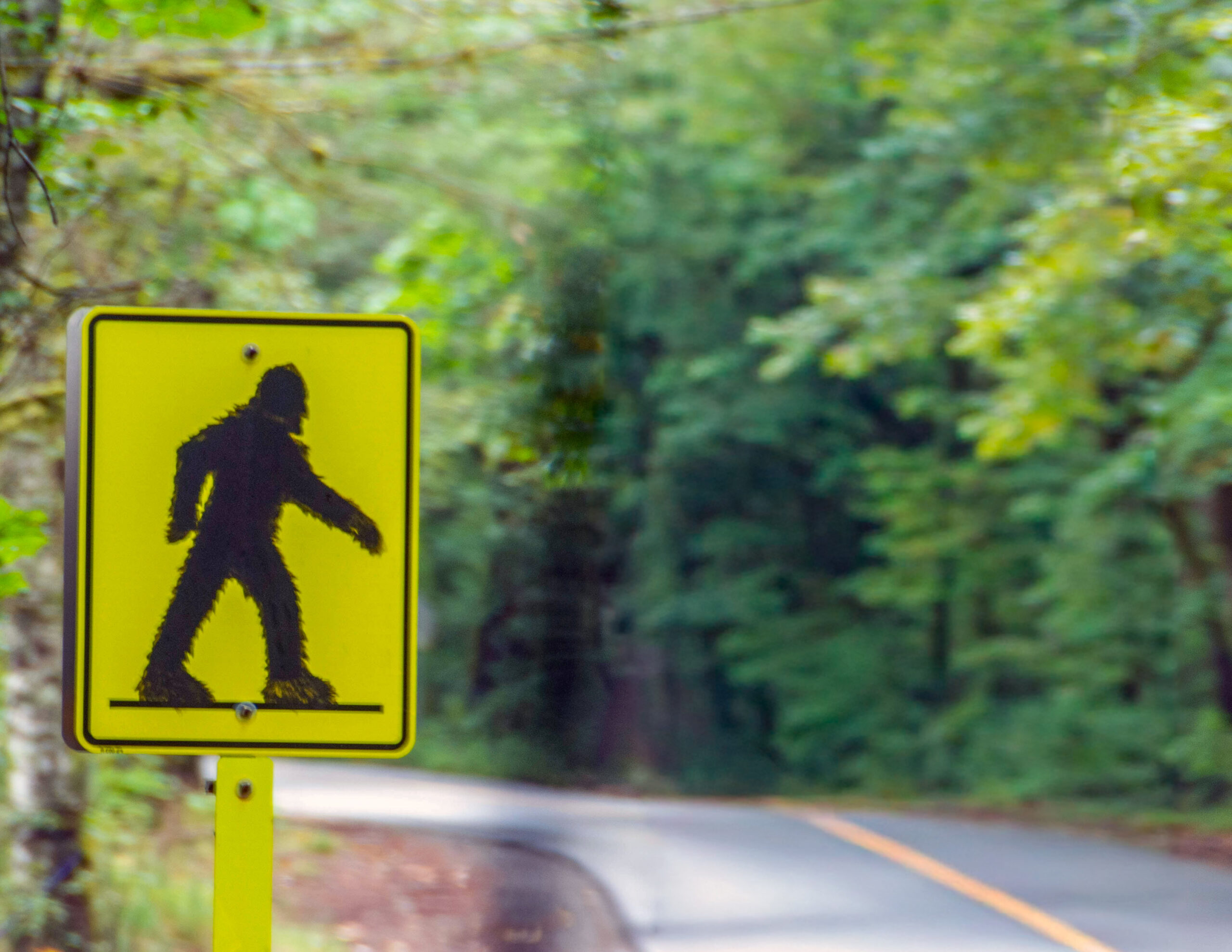 For years, three Greater Victoria men have been locked in the ultimate game of hide-and-seek with its most celebrated player and current reigning champion: Sasquatch. …Inspired by some of North America’s most renowned Sasquatch researchers – including Comox Valley’s John Bindernagel and Canadian journalist John Green – and driven by their own deep-seated fascination, the trio founded the Vancouver Island Sasquatch Society in 2018. Dedicated to rigorous fieldwork and evidence collection, the citizen science group aims to move the Sasquatch conversation from myth toward fact. …Dave Hill and Stephen Gray have both worked for the Canadian Forest Service, experience that helps them assess if a woodland area could realistically support a large, primate-like beast. …Alex Solunac, a senior media analyst at the University of Victoria, has been involved in Sasquatch research since the ’80s. …It was a similar story for gorillas, the threesome notes. The species was widely considered a mythical creature by European explorers until the mid-19th century, when an American named Thomas Savage found gorilla bones in Liberia.
 Kemptville, ON — Under the leadership of Canadian Forest Owners (CFO), the Ontario Woodlot Association (OWA), along with partnering associations nationwide, has appointed BrokerLink as our exclusive insurance broker. This
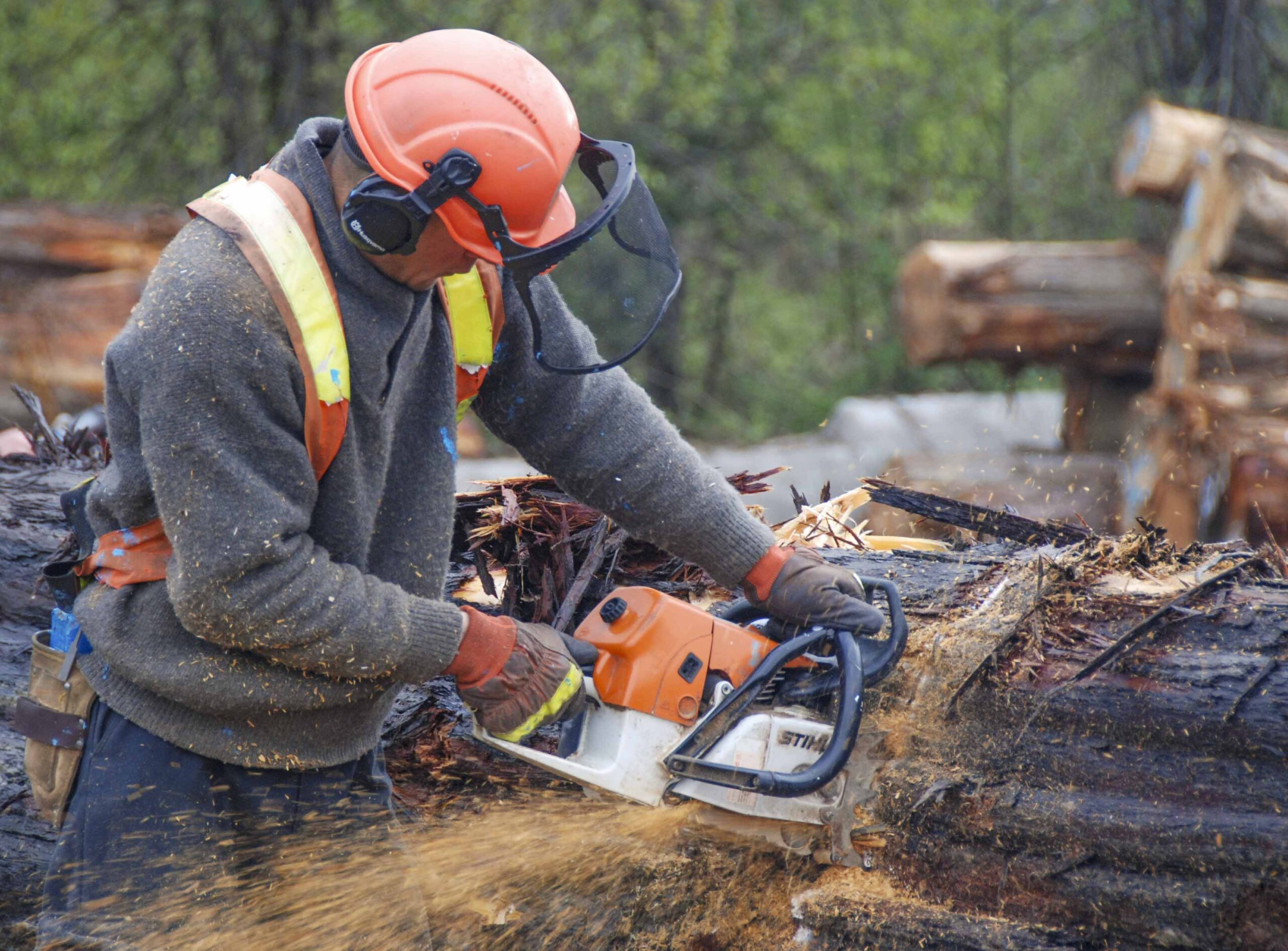 Last year was hard on workers in some industries within B.C.’s resource sector, particularly forestry, and 2026 doesn’t look like it’s starting much better. Statistics Canada’s February labour force survey, the report that tracks overall unemployment, tracked job losses in both the natural resources and manufacturing sectors for both the previous month and for the 12 months since the same month in 2025. Natural resources … had a year-over-year loss of 9,300 jobs from February 2025 to February 2026. The manufacturing classification, which includes lumber production, had a year-over-year loss of 12,200, according to StatCan. StatCan’s … survey of employment and payroll counted at least 1,200 job losses in forestry, which include logging and supporting jobs, and at least 800 job losses in sawmills between December 2024 and December 2025. …“The worst was probably in the fourth quarter (of 2025) when the full bite of the duties hit, and then the (U.S.) tariffs,” said industry consultant Russ Taylor. “That’s when we saw a lot more of the jobs falling off.”

 Northern BC communities know better than most how closely their fortunes are tied to major industry. Mills, mines and power generation facilities are more than workplaces — they’re economic anchors… When an industrial business shuts down, it stops paying most of its share of property taxes. This means …the rest of their community must now share more of the tax burden. That’s why a push to revise or eliminate the closure allowance in the BC Assessment Act deserves strong backing from municipalities across northern BC —
 Alberta — Are you passionate about forestry education and inspiring the next generation? Looking for work that’s anything but a desk job — flexible, dynamic, and always evolving. You just found your next opportunity. Work Wild, a program within the Alberta Forest Products Association, reaches out to people who are making one of the most important choices in their lives — finding a career they love! We are looking for an engaging, people-orientated individual to join our Work Wild team in the role of Southern Alberta Forestry Educator. Reporting to the Program Manager, the Forestry Educator implements Work Wild program objectives, which include educating Albertans on forest sector practices as well as career opportunities in Alberta’s forest industry. The Forestry Educator will spend much of their time traveling to communities throughout southern Alberta engaging middle and high school students, educators, and job seekers about the variety of rewarding opportunities in Alberta’s forest sector.
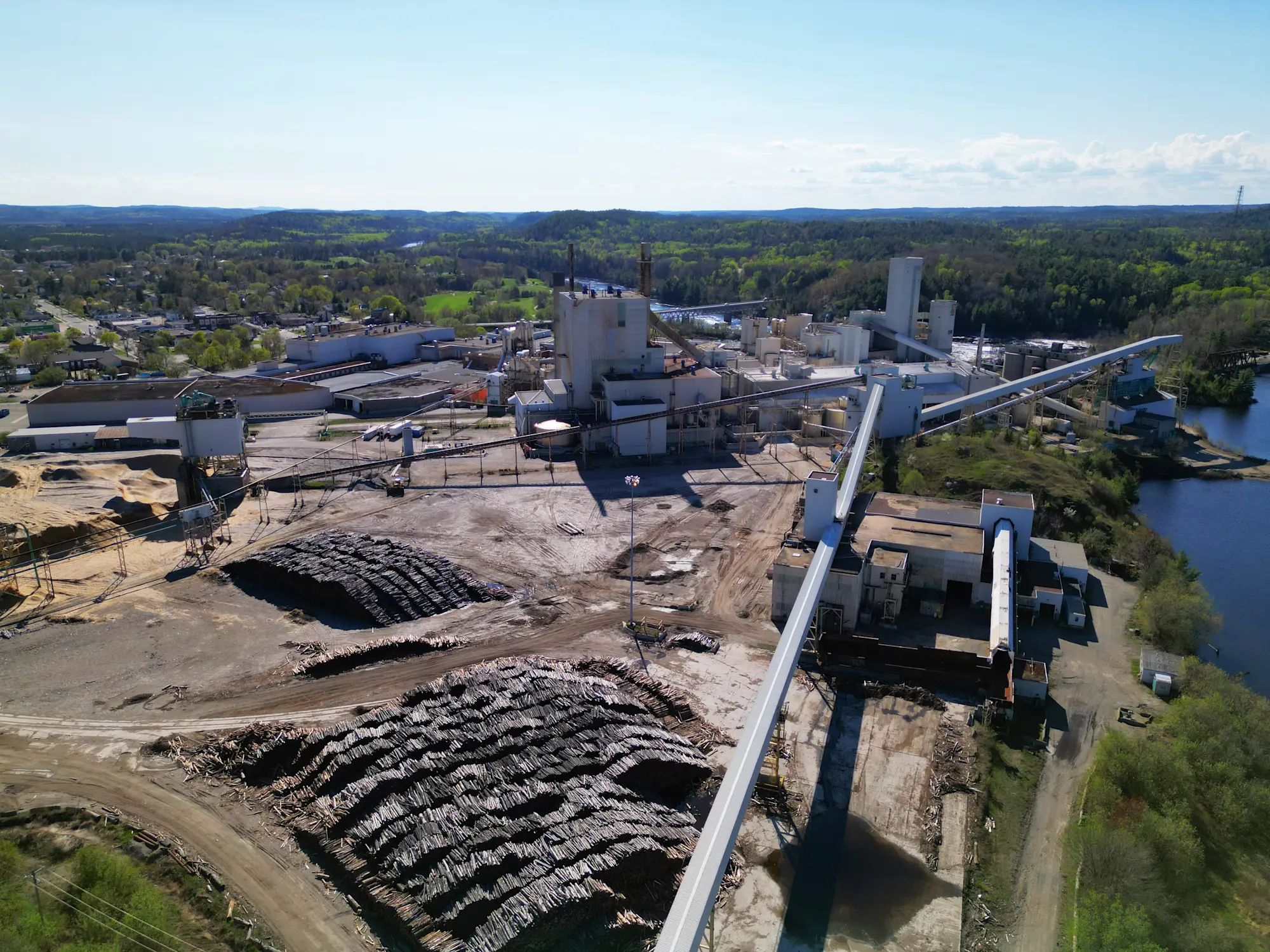


 European laminate flooring manufacturer sales declined 6.50% to 263.4 million m2 in 2025, according to the European Producers of Laminate Flooring (EPLF). The sales decreased from 281.6 million m2 in 2024. EPLF said the trend reflects the broader slowdown observed across construction markets, particularly in new residential builds and renovation activity, which continued to weigh on demand throughout the year. EPLF said the 2025 figures point to a “year of adjustment” for the laminate flooring sector. “While global volumes declined, demand remained comparatively more stable in the core European markets, which continue to represent the majority of EPLF sales,” it said. “Regional differences indicate that market conditions evolved at different speeds rather than following a single global pattern.” Europe accounted for more than 80% of total sales by EPLF member countries, confirming its position as the core market for the laminate flooring.


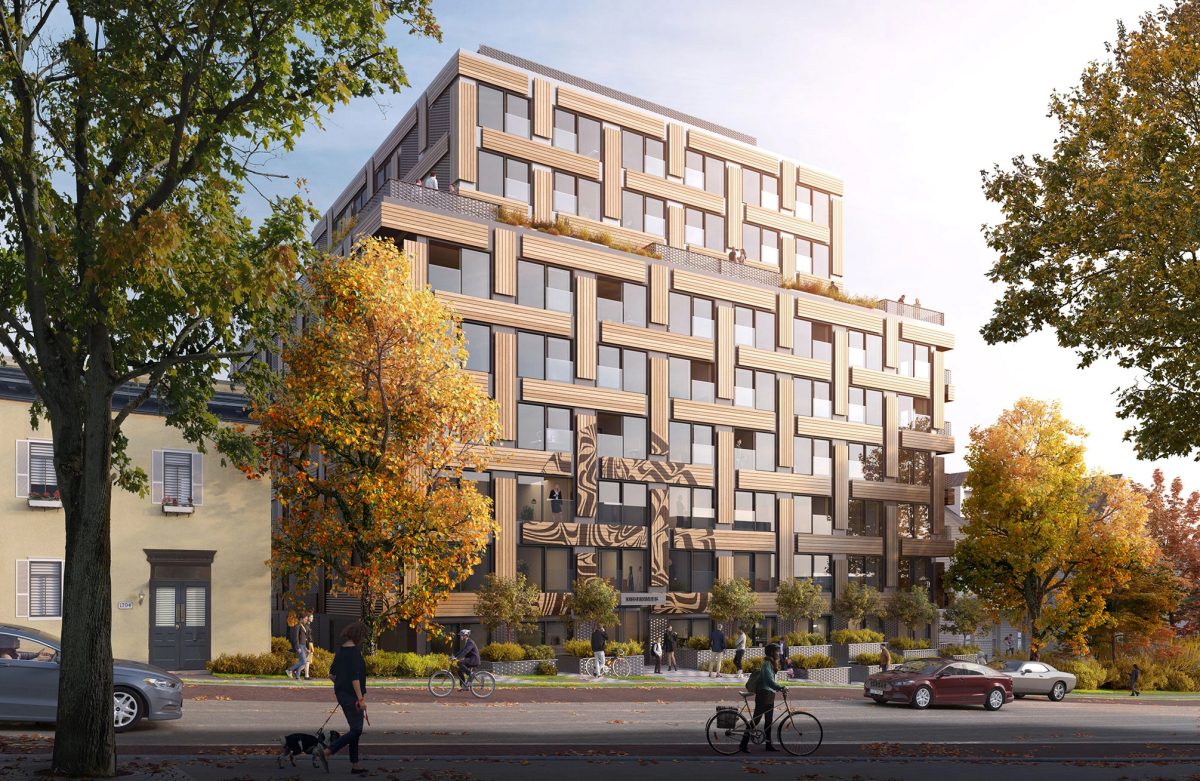
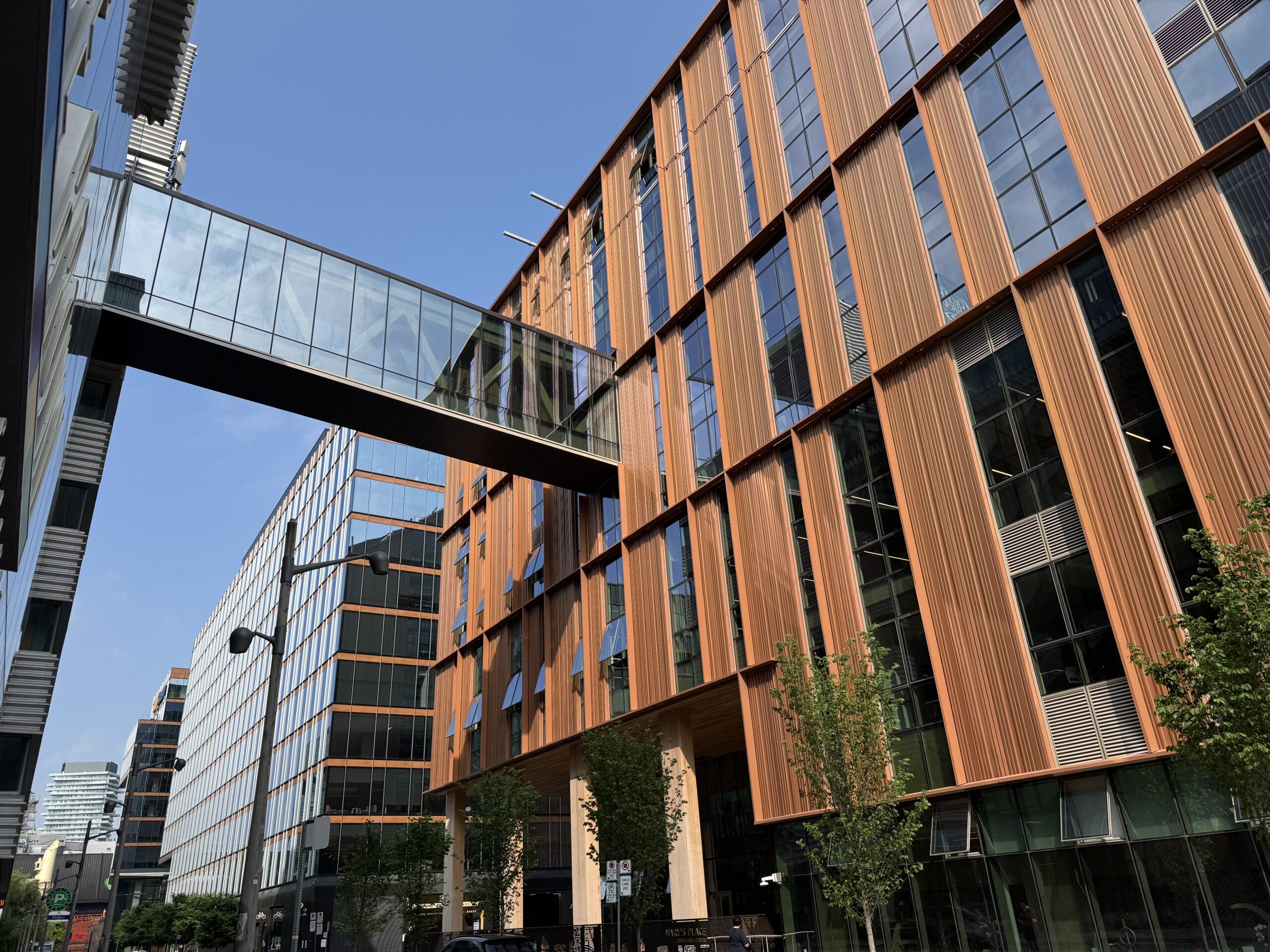 PCL Constructors Canada Inc. (Toronto) earned a pair of awards at the Toronto Construction Association’s (TCA) Best of the Best Awards. Presented at the TCA’s 158th Annual General Meeting, PCL was awarded Project Achievement Awards for the Kingsway College Senior School Phase 2 renovation and George Brown Polytechnic’s Limberlost Place. Creating a new era for George Brown Polytechnic students and faculty, Limberlost Place exemplifies what’s possible through collaboration, out-of-the-box thinking and a shared commitment to building a resilient future. The 10-storey mass timber, net-zero educational facility integrates first-of-its-kind solutions including the cross-laminated timber (CLT) slab band structural system and North America’s largest mass timber columns spanning three storeys. Early engagement from the entire team during the preconstruction phase was crucial to design development and determining constructability.
 A cross-sector group of packaging producers, farmers, restaurants and grocers has filed a class action lawsuit seeking a preliminary injunction to block enforcement of SB 343, California’s controversial recycling labeling law. The coalition argues the legislation imposes unconstitutional restrictions on free speech, ultimately working against recycling participation programs by making it harder for consumers to understand what can and cannot go in the bin. At the heart of the complaint is SB 343’s prohibition on the use of widely recognized recycling symbols and claims, even when those claims are factually accurate, according to the suit. Under the law, producers cannot label packaging as recyclable unless it meets state-defined, “rigid” criteria that allegedly fails to reflect how recycling actually works. …“SB 343 establishes labeling standards that could discourage innovation and limit the ability to provide accurate recycling information to consumers,” the American Forest and Paper Association stated.
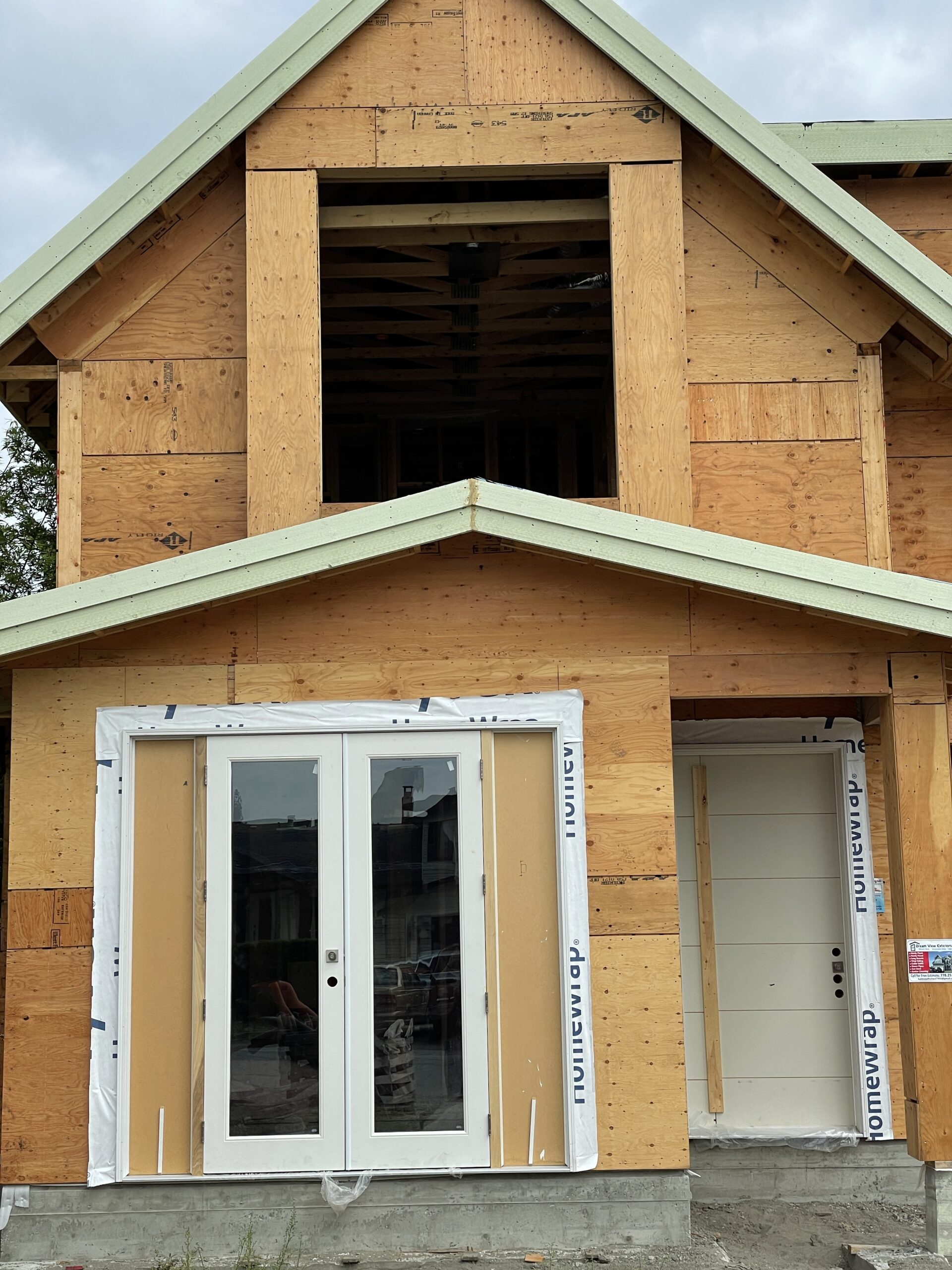 OLYMPIA, WA — A new Washington state law aimed at expanding affordable housing options will make it easier to build small “kit homes” and backyard units across the state. Gov. Bob Ferguson signed Engrossed Substitute Senate Bill 5552 into law, following four years of work by Sen. Jeff Wilson. The measure directs the Washington State Building Code Council to develop rules specifically for kit homes under 800 square feet. Supporters say the legislation is intended to help address Washington’s housing shortage by reducing costs and simplifying the construction process for smaller homes. Wilson said standardized kit-home designs could allow plans to be approved once at the state level rather than requiring separate design reviews for each project. Kit homes typically include precut lumber delivered as a package that can be assembled on site. Modern versions often use prefabricated wall and roof panels to speed construction, and start at less than $10,000.
 The wood industry produces enormous quantities of lignocellulosic by-products, such as sawdust, and their incineration for energy recovery results in substantial carbon emissions and the loss of valuable raw materials. Here, we introduce struvite as a fully recyclable inorganic binder for the consolidation of sawdust into high-performance hybrid materials. The mineral binder is produced in situ by an enzymatically induced solution-mediated phase transformation driven by ureolytic protein bodies extracted from watermelon seeds. The resulting material exhibits excellent fire resistance with a long time to ignition (51 ± 1 s), low peak heat release (118 ± 2 kW m−2), and fast flame self-extinction due to efficient char-layer formation. Moreover, it displays high compressive strength (4.71 ± 0.37 MPa). Crucially for sustainability, the struvite binder can be recovered under mild aqueous conditions without loss of performance, offering a valid path toward a circular materials economy.
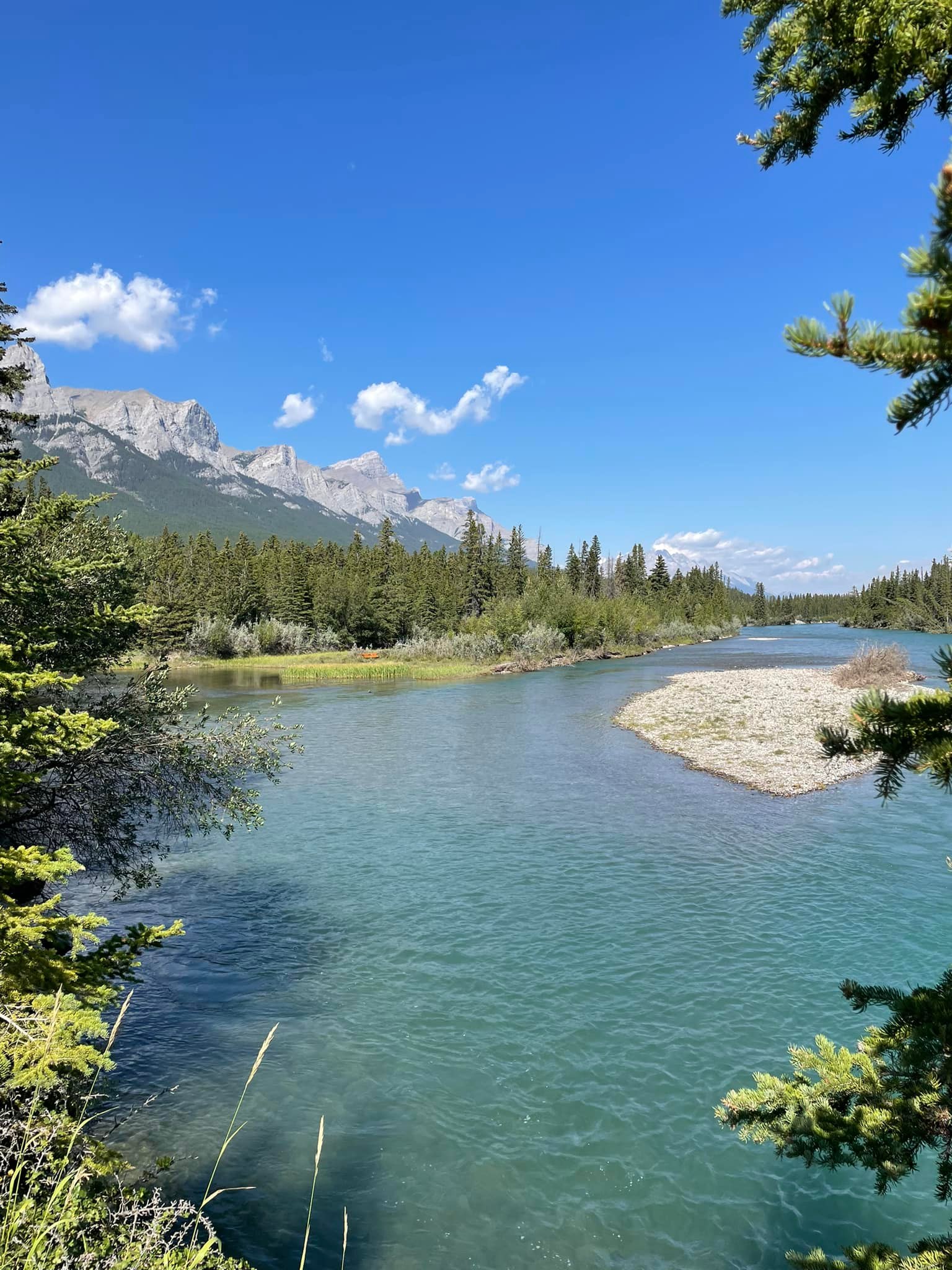 GATINEAU, QC — Today, during Canada Water Week, the Honourable Julie Dabrusin, Minister of the Environment, Climate Change and Nature, is announcing the release of the National Freshwater Science Agenda, which aims to better align freshwater science and research efforts across Canada. The Science Agenda is the result of over two years of engagement efforts led by Environment and Climate Change Canada with input from more than 800 science experts, Knowledge Holders, experts, and science users across governments and sectors, Indigenous organizations, and Canada’s freshwater science community. It is grounded in Western science and Indigenous Knowledge and reflects the diverse scientific needs and perspectives that are relevant to partners and stakeholders across the country. It outlines interconnected themes including bridging, braiding, and weaving Indigenous science and Knowledge; water availability; land‑use stressors and water pollution; ecosystem resilience and biodiversity; socio‑ecological considerations; and economic research.



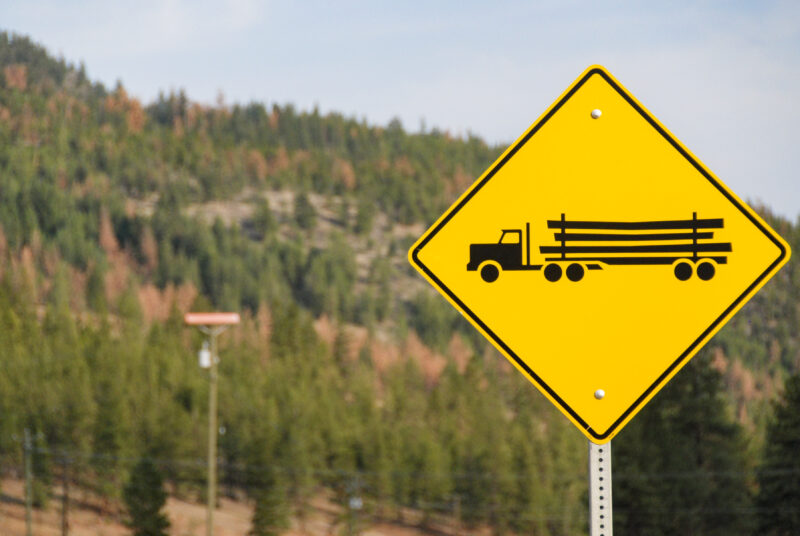 BC Timber Sales is bringing forward an application to establish 17 new cut blocks on Crown land east of Okanagan Falls and Penticton. The application is being brought to the Regional District of Okanagan Similkameen on March 19 for support, as the proposed cut blocks are located within the boundaries of the Okanagan Falls electoral area. The 17 cut blocks total 494.7 hectares, and the proposal would also see road construction and road deactivation. The rehabilitation process for the roads would include tree replanting. The land is in an RDOS-designated resource area, and a staff report says the proposed cutblocks fall within watercourse development permit areas and “important ecosystem areas.” The advisory planning committee for Okanagan Falls gave its support to the application at its March 9 meeting, while requesting that any approval be subject to a full environmental assessment.

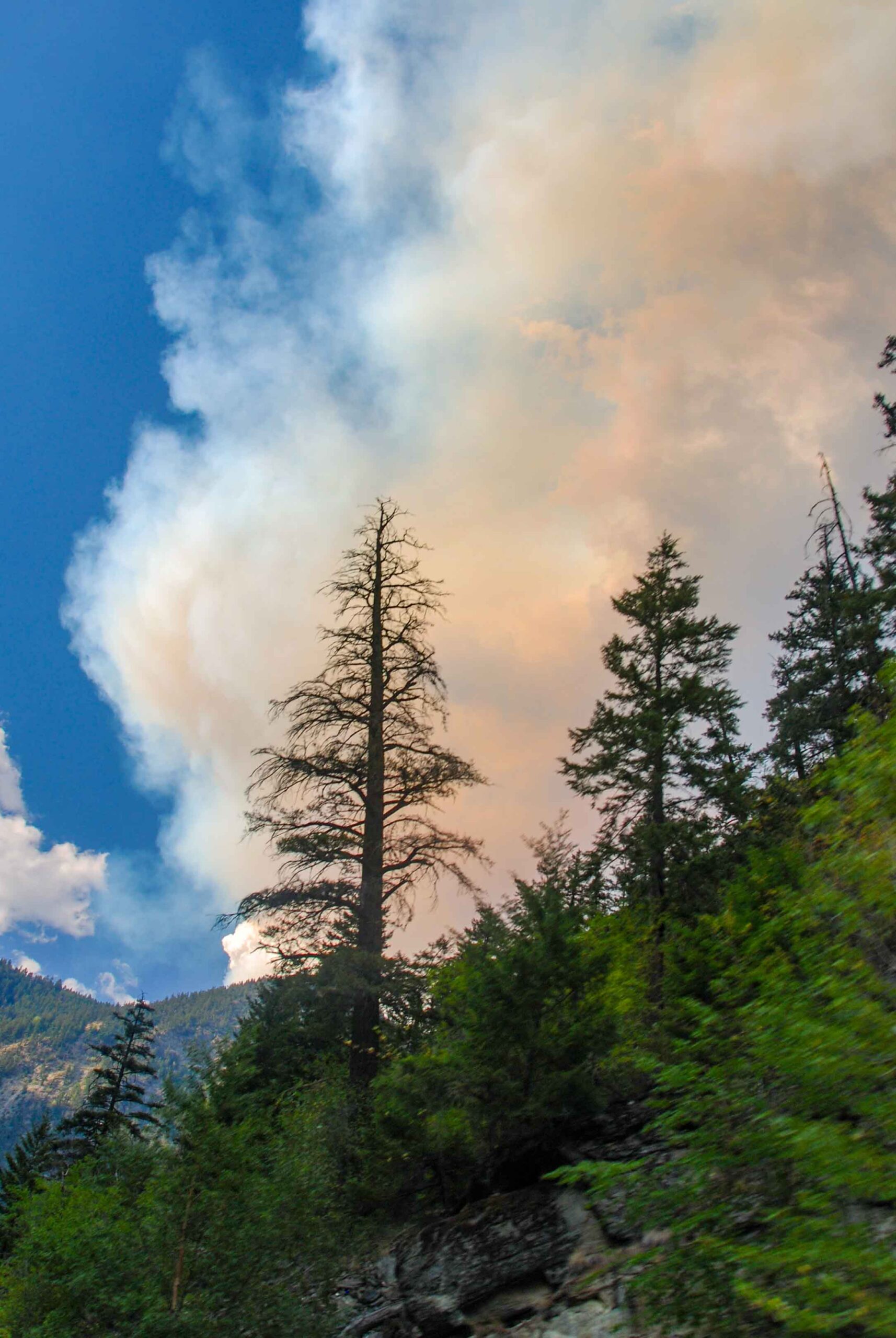 Columbia Basin organizations and residents are benefiting from $3 million in wildfire reduction funding through a partnership between the Province of British Columbia and Columbia Basin Trust, according to a March 17 funding announcement. The projects are guided by FireSmart principles and aim to reduce wildfire risk and strengthen local resilience. The practical projects range from managing wildfire fuels to educating residents. Actions include hiring FireSmart coordinators, preparing fuel-treatment plans, carrying out on-the-ground fuel management and providing FireSmart training. The program is tailored to the Columbia Basin and is part of B.C.’s Community Resiliency Investment Program. The Ministry of Forests, BC Wildfire Service and Columbia Basin Trust are partners in delivering this support.
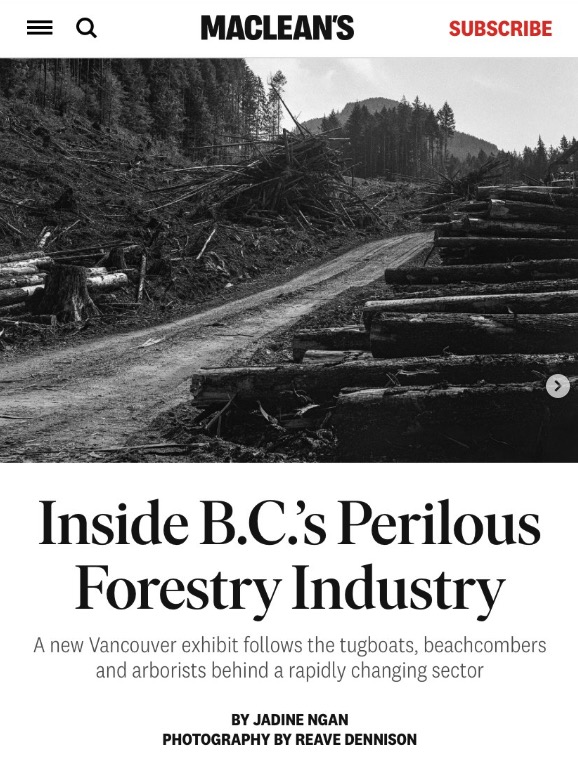 A tree felled in B.C.’s coastal rainforest, is towed by tugboat to lumber mills along waterways like the Fraser River. It’s difficult work. In the cold months, gales tear through inlets and the river ices over; tides and storms can yank logs out of formation all year round. For decades, beachcombers salvaged escaped logs and sold them back into use. But fuel and boat costs are rising, and beachcombers’ ranks are thinning. Reave Dennison is sometimes a tugboat worker, sometimes a beachcomber and sometimes even an arborist, doing maintenance work on trees. …Over the last 10 years, he’s assembled a collection of photographs that document the beauty he sees while toiling in the field. …As part of this year’s Capture Photography Festival in Vancouver, Dennison’s images will be displayed at the Pale Fire art gallery from March 19 to May 9. The exhibit, called Tree Work, folds three of his projects into one.
  District of 100 Mile House Council voted unanimously to write a letter of support, as well as sign a petition related to the Forestry is a Solution initiative. A letter was written to the District Council by Kim Haakstad, the president and CEO of B.C. Council of Forest Industries, which outlined its key priorities: speeding up access to economic wood, improving competitiveness and cost certainty, fixing B.C. Timber Sales and supporting First Nations partnerships. The letter asked council to endorse the campaign, sign a petition and send a letter to their MLA, government officials and the Forests critic. Finally, it asked council to support the District of 100 Mile House staff to share information about the campaign through official communication channels.

 The City of Revelstoke and the Columbia-Shuswap Regional District have passed motions formalizing their intention to push the provincial government to protect an old-growth forest. The proposed Rainbow-Jordan park would stretch 11,000 hectares… Until now, the forest has been spared from logging because the area is difficult to access… But David Brooks-Hill, a Columbia-Shuswap Regional District director said the steep slopes and lack of roads will not protect the rainforest forever. …Brooks-Hill said there is a forest tenure on the Rainbow-Jordan forest, a harvest agreement between a logging company and the B.C. government. …Brooks-Hill brought the motion to protect the area to the regional district after the City of Revelstoke passed its own resolution in February. Next, the city and regional district will present the resolution at the Southern Interior Local Government Association meeting in April. If successful, it will then be presented at the Union of B.C. Municipalities meeting in September.
 Ecologists Rachel Holt and Karen Price, landscape analyst Dave Daust, veteran forester Garry Merkel and economist Lisa Matthaus, members of a former panel the British Columbia government appointed to identify old-growth for potential protection in 2021 now says they’re concerned about continued logging in those same rare and “irreplaceable” forests. In a document sent to Premier David Eby, Forests Minister Ravi Parmar and Resource Stewardship Minister Randene Neill they say the proposed old-growth deferrals were meant to be an interim measure to reduce the risks of logging, allowing time for long-term planning. But the process has not worked as intended says the document provided to The Canadian Press. Instead, the B.C. government continues to approve logging in forests the panel identified, while long-term plans have yet to be finalized, Holt said in an interview.
 Woodland Almanac from the Federation of BC Woodlot Associations is now available, offering a look at the people, programs, and practical tools shaping woodlot management in British Columbia. This issue highlights the Charles Bloom Forestry Program, a hands-on training initiative that introduces high school students to forestry skills and careers while working on a real operating woodlot. The newsletter also features the Executive Director’s report, details on the 2026 Woodlots BC bursary program, and an invitation to attend the Woodlots BC Annual Conference and Workshop in Parksville, October 1–4. Readers will also find updates on value-added opportunities for woodlot licensees and revisions to the Commercial Thinning Guide, along with two “Meet a Woodlotter” profiles featuring the Zemanek Family and Garrett Ranches. Together, the stories showcase the innovation, stewardship, and community connections that continue to define BC’s woodlot sector.
 Alberta’s forestry minister says wildfire preparations have gone smoothly as the season opens, but he is concerned about the lack of precipitation and warm weather in the southern part of the province. Alberta’s wildfire season officially began March 1 with 30 wildfires extinguished already so far this calendar year. Two fires remain active, according to the province’s online wildfire dashboard, and more than 280 hectares have been affected so far. Forestry and Parks Minister Todd Loewen said Wednesday that while parts of the province are in relatively good shape ahead of the key spring weeks still to come, the southwest corner of the province in particular faces a more risky set of conditions. …Loewen said the province’s overall wildfire readiness is in a good state with most staff hiring already completed, but added the weather over the next two months will greatly affect how many fires crews the province will have this summer.
 Fears of a wildfire devastating a drinking water source for up to 80,000 people in the North Okanagan are bringing local Indigenous and non-Indigenous governments together to protect their shared watershed. Last month, leaders of Okanagan Indian Band (OKIB), the District of Lake Country and City of Vernon declared that protecting the crucial North Aberdeen Plateau watershed goes far beyond just preventing or mitigating wildfires. “We can’t let it go back to what it was,” Lake Country Mayor Blair Ireland told fellow members of the Okanagan-Similkameen Collaborative Leadership Table at the Feb. 20 meeting. …In November, a North Aberdeen Plateau Guidance Plan was signed by Ireland, OKIB Chief Dan Wilson, and Vernon Mayor Victor Cumming. The plateau, near Kalamalka Lake in the North Okanagan, includes four smaller watersheds that provide water for homes and farms across Lake Country and the greater Vernon areas.
  Vermonters are weighing the impacts of a federal bill — the
 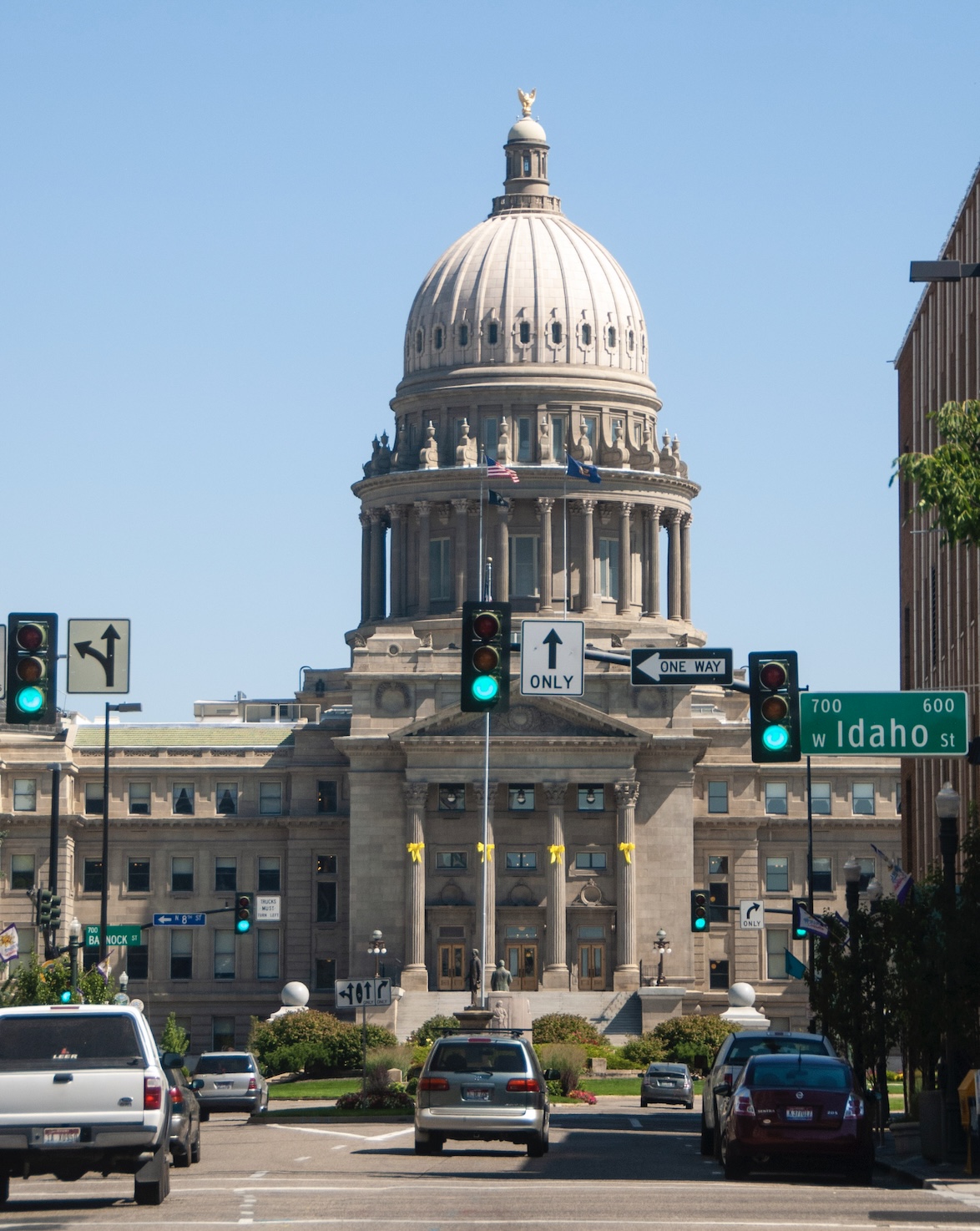 This week, we have yet another reminder that Idaho can’t possibly afford to take over or manage federal lands. A forthcoming study, which will be published Friday, provides the most recent reliable estimates of exactly how much Idaho would lose if it were to take over federal lands. The study, which was commissioned by Backcountry Hunters and Anglers, Idaho Business for the Outdoors, the Idaho Outfitters and Guides Association, and the Idaho Wildlife Federation, was performed by Peterson and Associates, which has long been a go-to source for economic analysis of this type in Idaho. While the full results won’t be released until Friday, the top-line figures are stark. Idaho would lose $837.7 million directly, in the form of spending by the U.S. Forest Service, Bureau of Land Management and other federal agencies, as well as Payment in Lieu of Taxes and Secure Rural Schools payments. That’s nearly 16% of Idaho’s general fund budget.
 Three organizations and an individual are suing the Gardiner District of the Custer Gallatin National Forest — for a plan they say hurts the already-endangered whitebark pine tree while ignoring lynx and grizzly habitat, and relying on unproven studies. The groups say the federal government is ignoring its rules and seems to be disregarding its own maps of protected lynx area in an effort to preserve the rare whitebark pine trees, despite admitting in its own documents that the efforts to preserve the trees could actually harm them. The lawsuit … centers on logging north of Yellowstone National Park. A technique, called “daylight thinning,” which involves removing trees near a whitebark pine, is not backed by scientific research according to the court documents, and the organizations point out that the Forest Service admits that in the process of thinning, it could actually wind up killing some of the whitebark pine trees.
  You have until Monday to provide input on the Trump administration’s plan to dramatically increase logging in western Oregon forests. Last month, the U.S. Bureau of Land Management
  OREGON —
 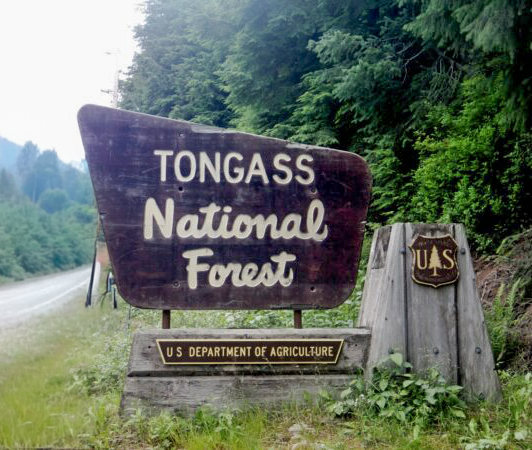 A federal judge in Alaska
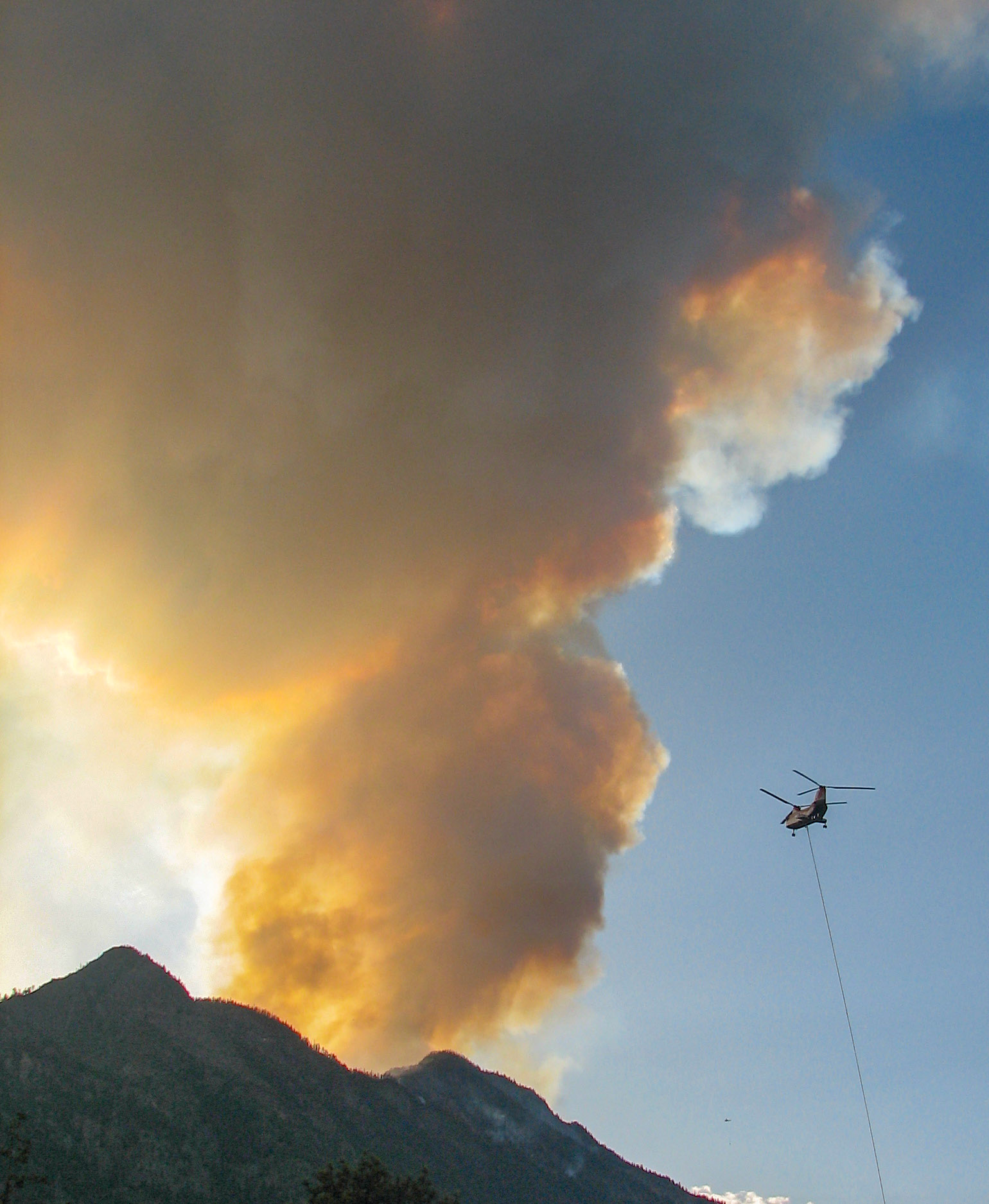 Dismantling environmental protections is in vogue, even those enhancing safety and economic prosperity. But California is bucking the trend and now on the verge of modernizing how its 14 Demonstration State Forests are managed. Cal Fire manages these public lands, which span 85,000 acres and 10 counties. Redwoods and other trees are routinely logged to pay for operations, according to a 1947 law that mandates “maximum sustained yield” – that’s simply a euphemism for removing as much lumber as possible without shrinking the forest. This extractive agribusiness model prioritizes revenues, often contrary to the goals of demonstration, recreation and forward-looking research. …In February, Assemblyman Chris Rogers, a Democrat from Santa Rosa, introduced AB 2494, sponsored by the Environmental Protection Information Center, to modernize and align forestry management with the state’s broader goals. The new science-based approach prioritizes restoration and tribal co-management. It decouples funding from timber operations, financing it instead through an existing lumber tax.
 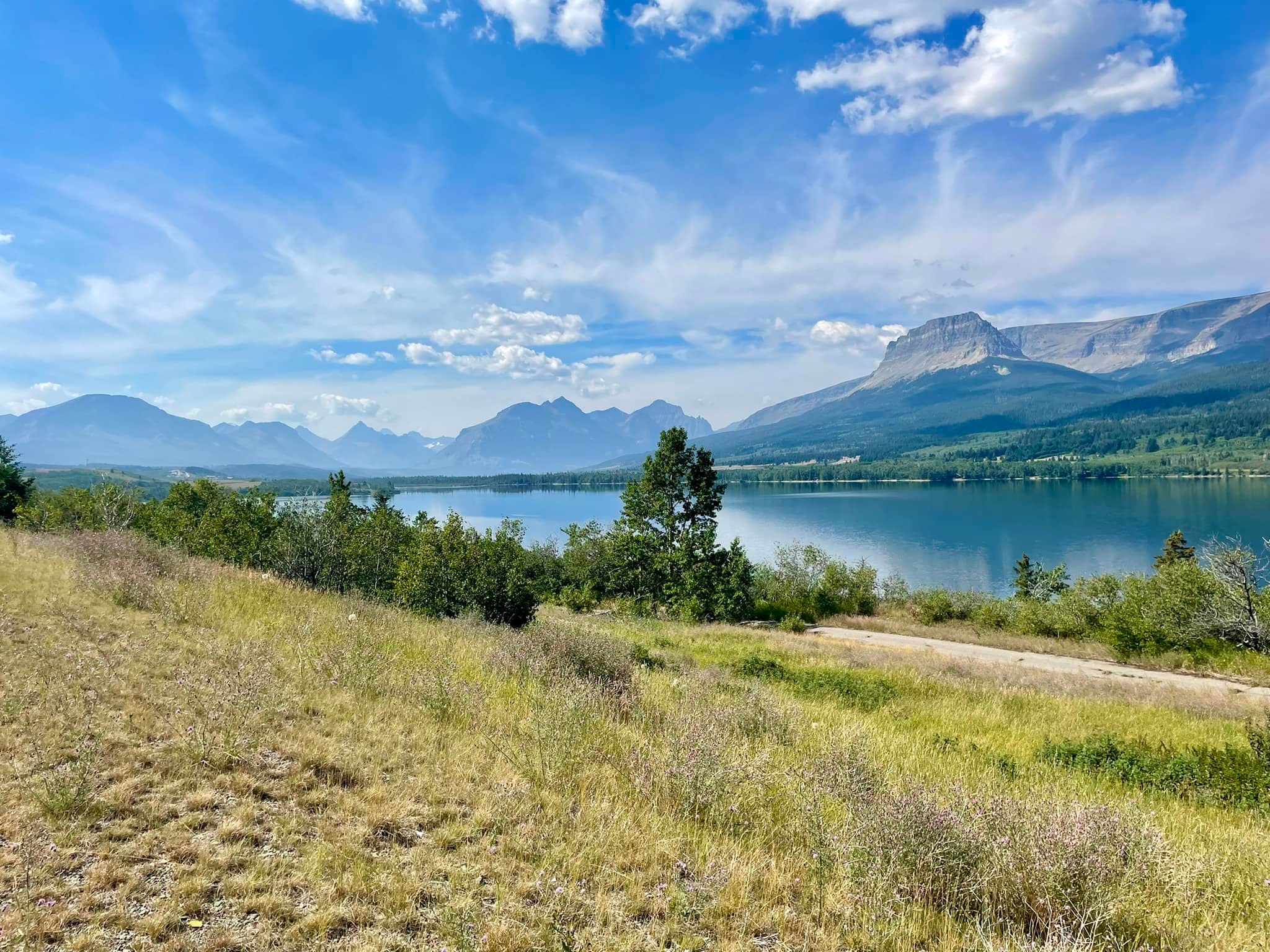 Montana and the U.S. Forest Service announced last week they were moving ahead on a shared agreement between the two to do forestry work in large swathes of the state. Last summer, the state and Forest Service signed an agreement formalizing closer cooperation between federal forest management operations and the state Department of Natural Resources and Conservation. That came about two months after a Trump Administration executive order seeking to increase domestic timber production. On Friday, Gov. Greg Gianforte, DNRC Director Amanda Kaster and U.S. Forest Service Chief Tom Schultz said that two large areas have been selected for state and federal work. The focus of the work will be on approximately 213,910 acres in the Flathead and Kootenai National Forests and 200,000 acres within the Bitterroot National Forest. The project areas were selected due to wildfire risk and how close they are to being implemented.
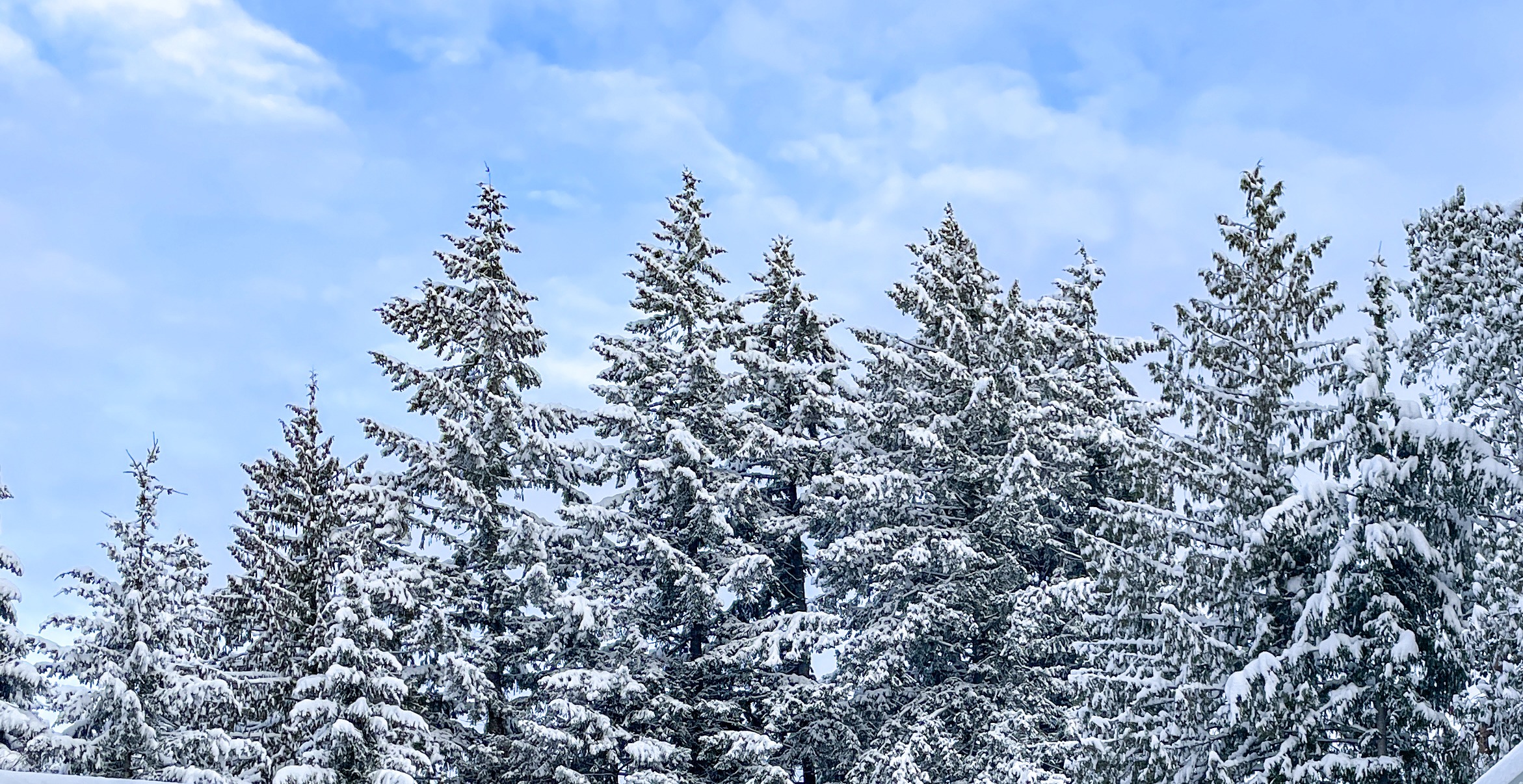 ANCHORAGE, Alaska – A federal judge has dismissed a lawsuit brought by timber industry groups and operators seeking to force increased old-growth logging in the Tongass National Forest, ruling the industry groups had no valid legal claim. U.S. District Judge Sharon L. Gleason granted the U.S. Department of Agriculture and U.S. Forest Service’s motion to dismiss and directed the clerk to enter final judgment for the federal defendants. “This ruling is a big victory for the Tongass’ old-growth forests. I’m relieved the court squarely rejected the logging industry’s rash attempt to force large-scale logging,” said Marlee Goska, Alaska attorney at the Center for Biological Diversity in a statement. “We need to leave the Tongass standing for the sake of wildlife, climate and local communities.” The case centered on how the Forest Service manages timber sales in the Tongass, the nation’s largest national forest and the world’s largest temperate old-growth rainforest.
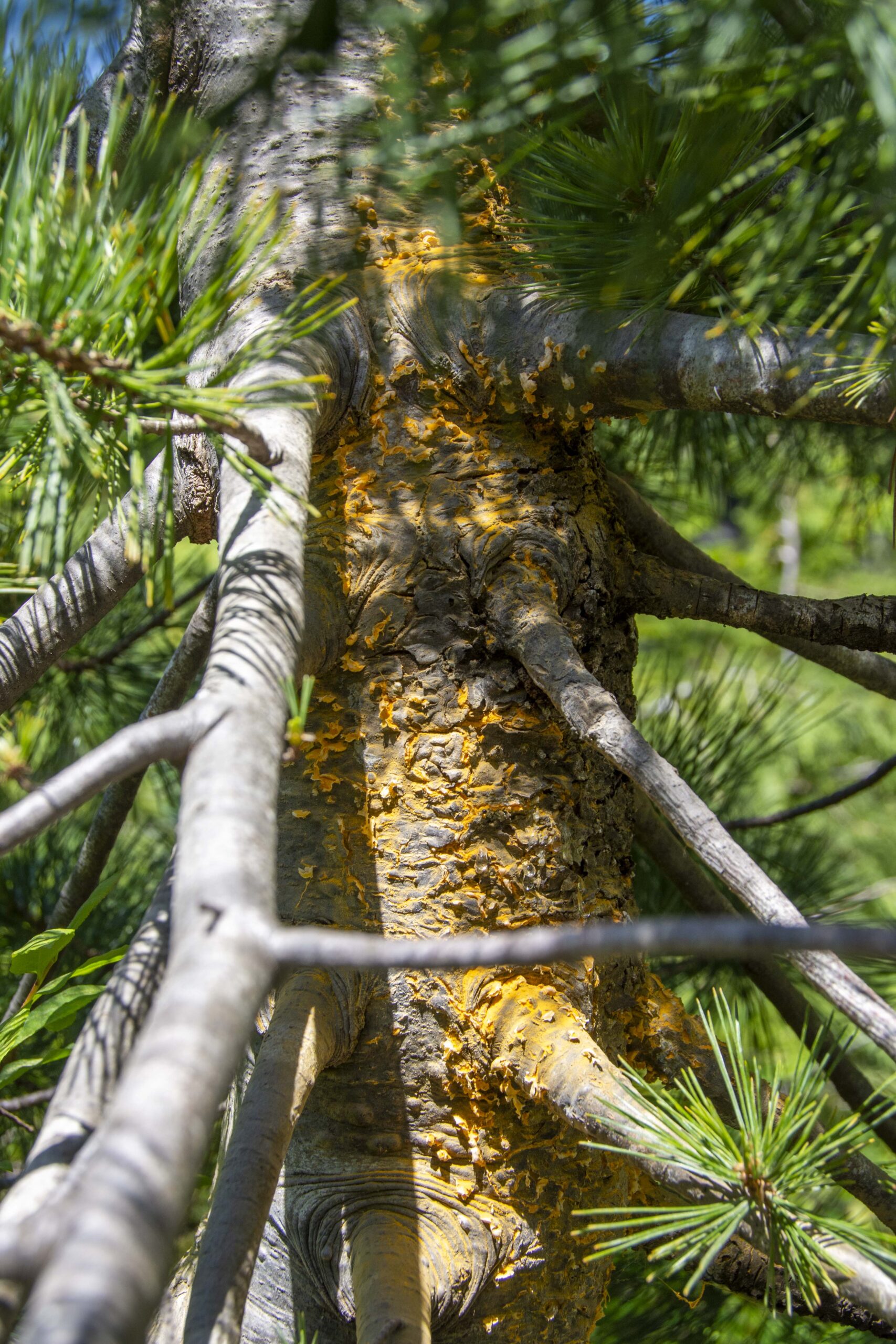 In 2002, Crater Lake National Park ecologist Michael Murray thought the park’s majestic whitebark pine trees were as good as gone. An invasive fungus called white pine blister rust was killing the trees around the crater of the lake. …It was accidentally introduced to the U.S. in a shipment of infected nursery trees from Europe around 1900. Since then, it’s wiped out millions of whitebark pine trees and threatened the survival of the species. But Oregon scientist Richard Sniezko, a geneticist with the U.S. Forest Service, said some whitebark pine trees have natural resistance to the blister rust disease. …Murray took this science with him to his current job as forest pathologist for
  When Hurricane Helene swept through western North Carolina, forestry officials conservatively estimated the storm damaged 822,000 acres of timber. Now satellite imagery showing changes in forest cover suggests the extent of damage was much greater. Nearly 18 months after Helene, forestry officials and the state fire marshal warned legislators Thursday that North Carolina needs to be much better prepared to battle wildfires. Deputy Forester Kevin Harvell with the North Carolina Forest Service said from the air, it’s easy to spot areas where complete stands of trees were flattened, making forest roads and logging roads impassable. …In many counties, N.C. Forest Service staffing consists of just three people – a county ranger, an assistant ranger, and a heavy equipment operator. That means a local county fire department may be the first responder when a brush or woods fire is reported. As in many areas of state government, Hicks says low pay is making it increasingly difficult to keep experienced staff.
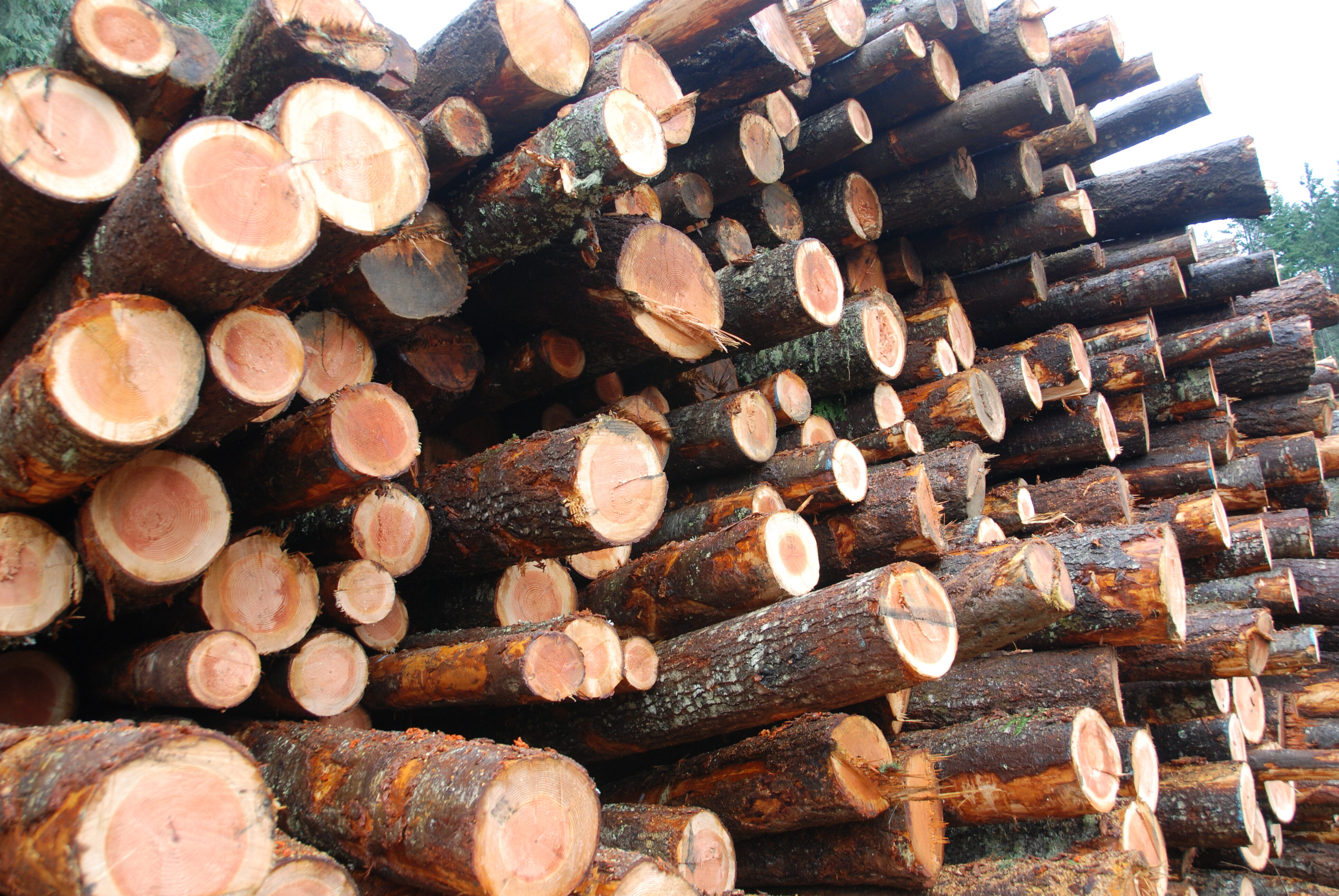 Two of Sweden’s largest forest companies have called on the European Union to revise its bioeconomy strategy to include a stronger commitment to expanding sustainable wood supply, warning that current policy signals risk undermining Europe’s green transition goals. In a joint statement published this week, the chief executives of SCA and Holmen argued that the EU Commission’s updated bioeconomy strategy — released last November — underestimates both the economic weight of the wood-based sector and the primary biomass volumes needed to meet its own ambitions. The two executives estimated that wood-based value chains account for around seven per cent of total EU economic value and support approximately 17 million jobs across the continent — figures they said the strategy fails to capture by focusing narrowly on upstream production. The Commission’s own figure of roughly €240 billion in added value and fewer than three million jobs, they argued, represents less than a quarter of the sector’s true contribution.
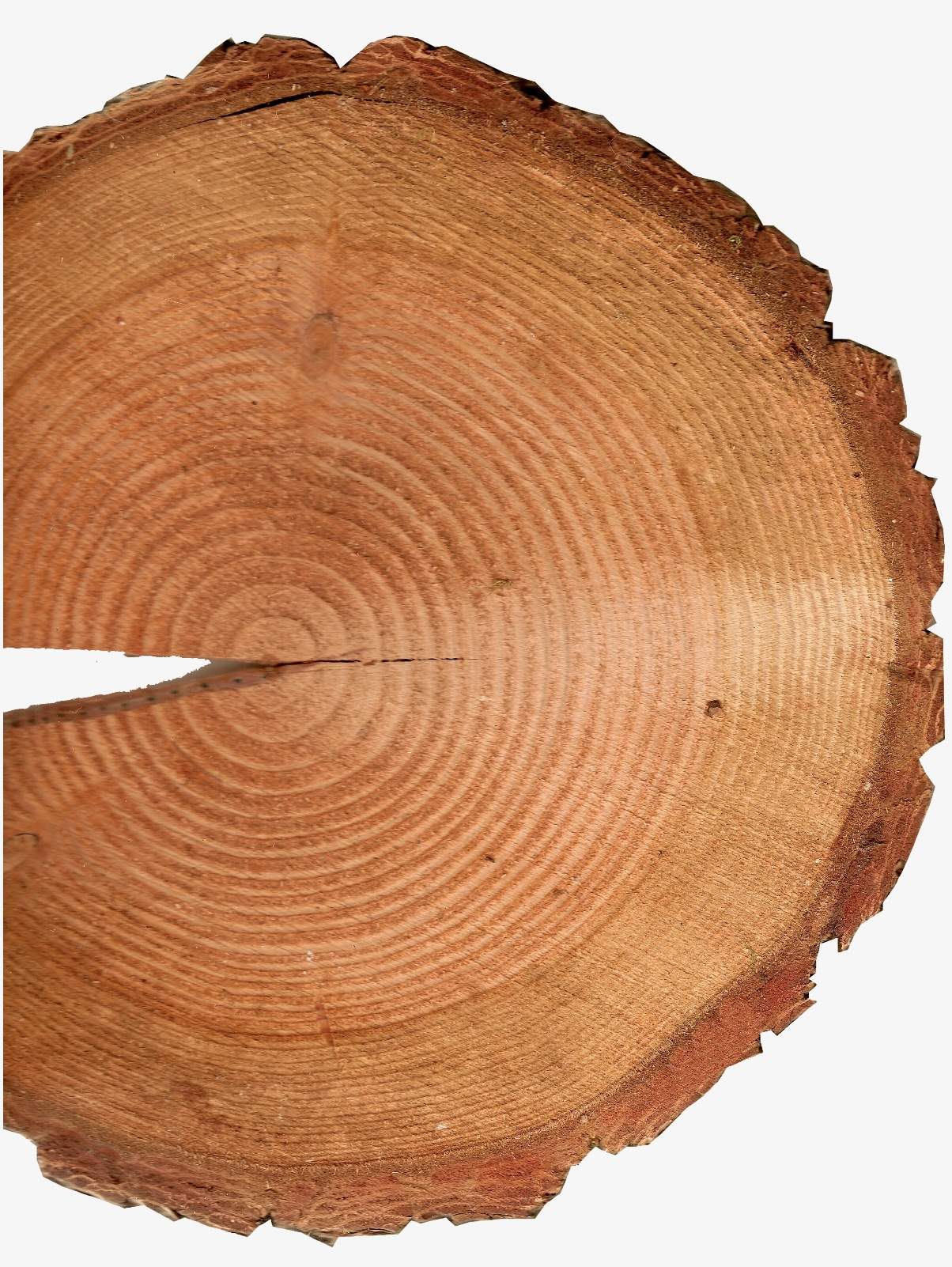 WASHINGTON — The Carbon Business Council announced the launch of the Direct Storage of Biomass (DSB) Coalition, a new industry working group bringing together leading companies to advance understanding, credibility, and responsible deployment of direct biomass storage as a carbon dioxide removal (CDR) pathway. Direct storage of biomass, also referred to as terrestrial storage of biomass, involves durably storing organic material such as waste wood from forests, agricultural residues like corn stover, biochar, or other plant and biological matter. Storing these organic residues allow the carbon previously absorbed by the biomass to be durably locked out of the active carbon cycle. The biomass can be safely buried, stored deep underground in sealed reservoirs, wells or other containers. DSB can deliver durable atmospheric carbon removal while leveraging existing forestry, agricultural, and biomass-handling infrastructure. …The DSB Coalition is part of the Carbon Business Council’s broader initiative to scale carbon removal across air, land, rock, and water.
 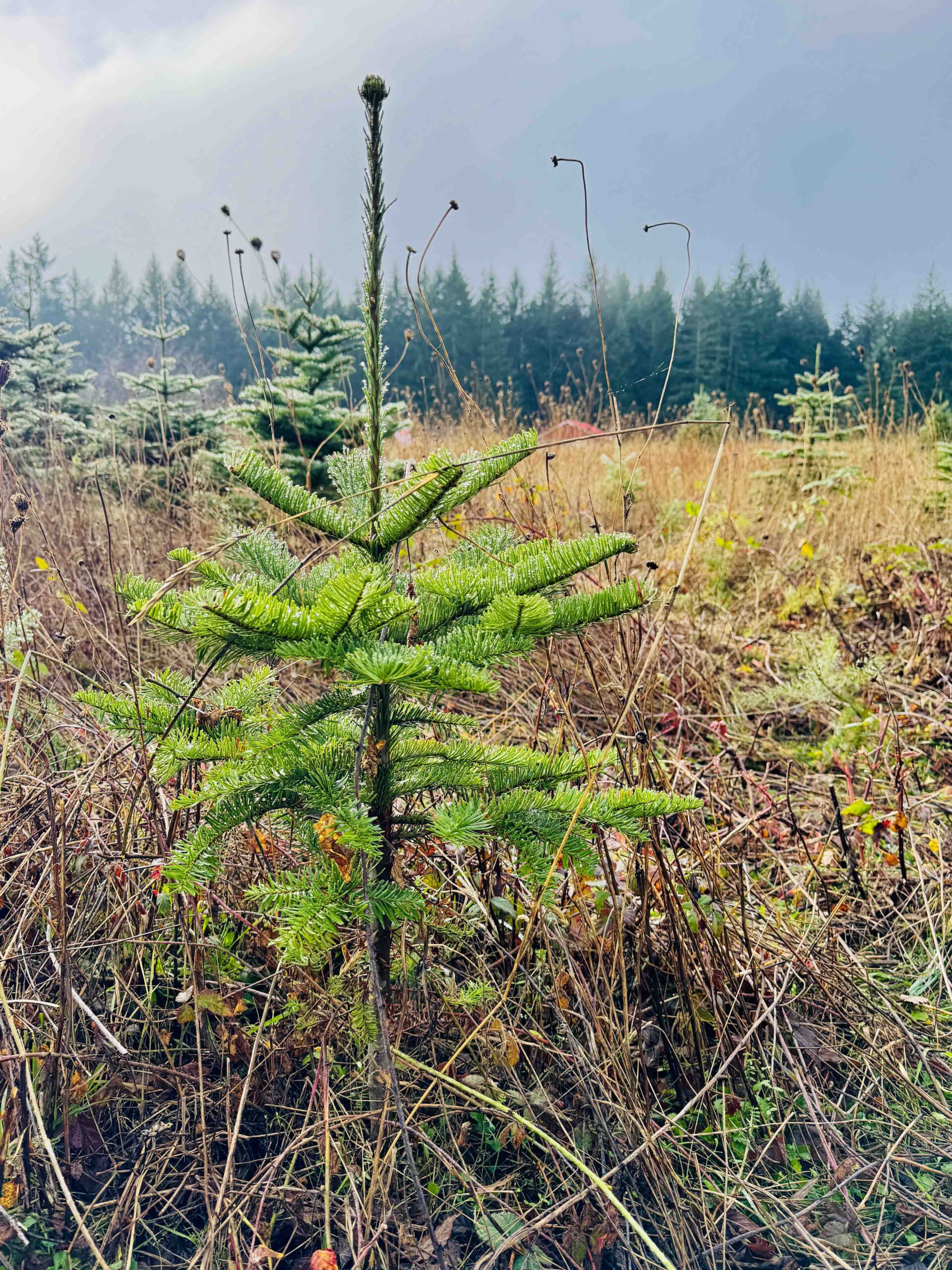 In the fight against the climate crisis, countries are pinning great hope in reforestation projects. In a new study, ETH Zurich researchers show that the location in which reforestation is taking place is usually more important than the number of trees planted. If forests are strategically positioned, the same cooling effect could be achieved using half the area of land. Climate researchers at ETH Zurich show where planting trees makes the most sense with a view to achieving the greatest possible cooling effect on the climate. Reforestation in tropical regions has the greatest cooling effect. Tree planting in the northern hemisphere, on the other hand, reduces the reflection of sunlight and has no effect or even contributes to global warming. The cooling effect on the climate will be a maximum of 0.25°C by 2100. This contribution is important, but it cannot replace the urgently required reduction in greenhouse gas emissions.
 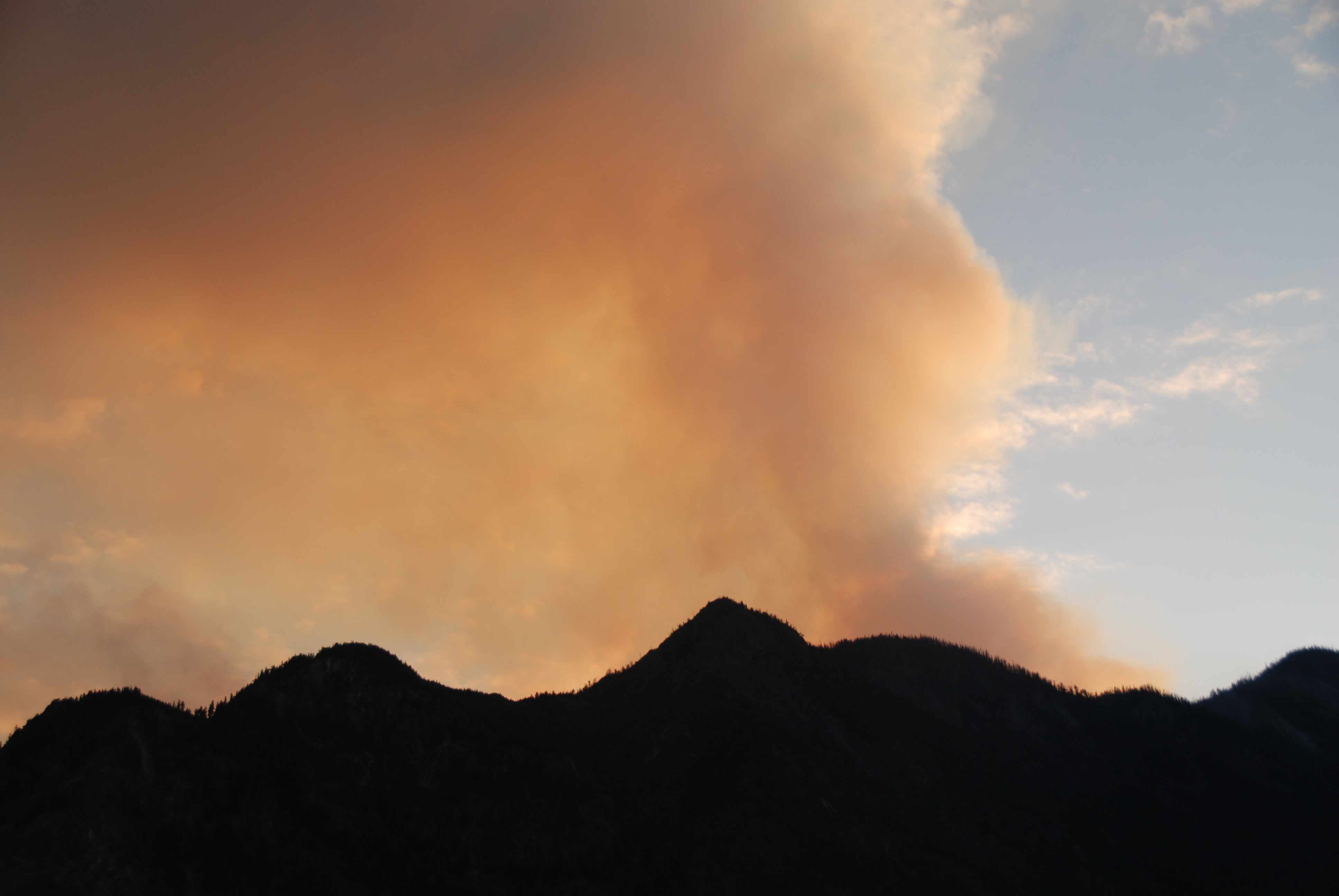 Wildfire smoke is a toxic cocktail of gases, small particles and other ingredients. It’s known to contain hundreds of chemicals. It contains particulate matter, sometimes referred to as soot. …According to an article published by Stanford University, repeated, acute exposure to smoke can shorten firefighters’ life expectancy by about a decade. …Guy Bourgouin, an NDP member of provincial Parliament in Ontario, has demanded breathing protection for wildland firefighters in the province’s legislature. He says the government has been receptive. …Provincial agencies share information and resources through the non-profit Canadian Interagency Forest Fire Centre. It sets standards, including a fitness test used to determine whether a candidate is strong enough to withstand the job’s rigours. But CIFFC has no discernible role in breathing protection and denied an interview request for this story. …The BC Wildfire Service has emerged as Canada’s leader in this quest. Working with the University of Alberta, in 2019 it began studying smoke’s contents and sought to determine whether they were getting into workers’ bodies, with or without N95 masks. [The Globe and Mail is a subscription publication]
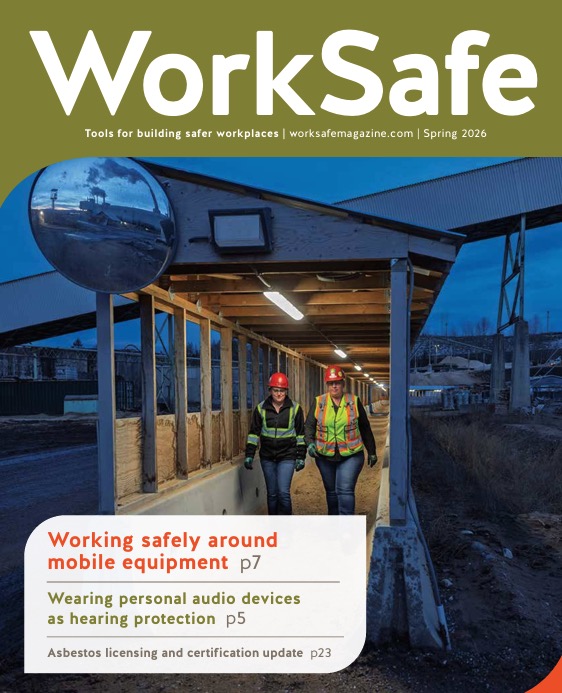 The Tree Frog Forestry News encourages readers to check out the WorkSafeBC Spring 2026 issue of WorkSafe Magazine. The lead story has a strong focus on preventing “struck-by” incidents and improving safety around mobile equipment. It highlights how B.C. forest-product operations are redesigning worksites with engineered controls—such as barriers, walkways, and traffic systems—to better separate workers from moving equipment. Additional features include practical tools to help employers assess and control struck-by risks, along with guidance on roadside work planning and traffic management. The issue also tackles hearing safety, cautioning that personal audio devices are not a substitute for approved hearing protection. WorkSafeBC updates round out the edition, including a refreshed commercial fishing safety guide, clarified rules for reporting tips and gratuities, and progress on asbestos licensing and certification programs. Together, the issue emphasizes proactive planning, clear controls, and shared responsibility as key to safer workplaces across B.C.