David Elstone
On August 25, 2026, Canada announced counter-tariffs of 15%, 25% and 50% on targeted US products in response to the US decision to impose a 50 per cent tariff on $27.6 billion of Canadian goods. Canada’s counter-tariffs will apply to 874 product classifications, covering a matching $27.6 billion in imports from the US, with a focus on steel, dairy, appliances, agricultural equipment, pulp and paper, and electronics. The retaliation marks the start of a full-scale trade war, with Canadian tariffs taking effect on September 8. …The Canadian counter-tariffs will apply to US softwood lumber, plywood, dissolving pulp, paper and packaging products—including toilet paper—kitchen cabinets, upholstered furniture and non-upholstered furniture. AcrossCanada, I estimate these US forest product imports had a value of $3.2 billion in 2025. For US forest products entering BC, I estimate their 2025 import value was $527 million.
It makes sense that paper and packaging products are a clear focus of Canadian countermeasures. Counter-tariffs targeting $2.4 billion of US paper and packaging products will cause concern. …Canada has fired back, but in a trade war, the forest sector still gets caught in the crossfire. Counter-tariffs are retaliation, not a defensive strategy that protects domestic producers from the impacts of tariffs on their export sales. The consequences are already emerging with Rayonier Advanced Materials announcing a temporary mill closure affecting its dissolving pulp production in Temiscaming, Ontario. Also there are reports Nova Scotia’s pine sawmills are facing shutdowns. Unfortunately, this is likely only the beginning.

 The complete index of American products subject to Canadian retaliatory tariffs on September 8 include more than 600 different entries. Searching for patterns can drive you to madness. Butterfly nets will be hit with a 50 percent tariff. So will eye make-up preparations and fish egg incubators. …When asked about the decision-making process, industry minister Mélanie Joly said some goods are meant to hurt Trump-supporting states, though she declined to say which. …States with Republican senators, such as Maine, Ohio, Michigan, Iowa, and Texas, all have substantive trade relationships with Canada—and are considered possible battleground states. Some experts are calling the issue “a political trap for Republicans,” with Democrats already seizing on the matter as a talking point. Here’s a look at some of the red states vulnerable to Canada’s new round of tariffs and the industries that may feel the most hardship.
 One of the world’s closest trading relationships is about to break down at enormous cost to both countries — and for no intelligible reason. …Canadian Prime Minister Carney suggested the US made unacceptable last-minute demands, including measures that would “compromise Canada’s sovereignty or undermine our key industries.” US Trade Representative Greer said Canada inexplicably turned its back on improvements that would’ve made a good deal for both sides even better. That claim was hardly credible. This White House has shown no interest in mutual advantage. …American voters, on the other hand, may be unwilling to bear any burden merely to show Canada who’s boss. …US businesses are puzzled too. Many American companies have supply-chains tightly linking domestic and Canadian operations. …But it isn’t too late to step back. Washington should revert to the terms in play before the talks collapsed. …If the worst happens, who are Americans heading to the polls in November going to blame?
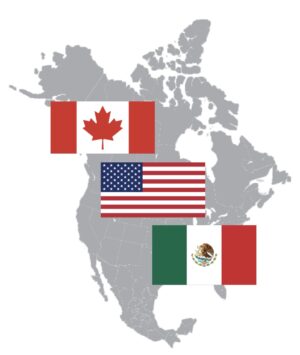 The more the United States undertakes comprehensive efforts to reduce its vulnerability to Chinese economic coercion, the more important it becomes for Canada and Mexico to align their own policies. Misaligned tariff rates across the three countries incentivize the transshipment of Chinese goods to U.S. consumers. …Fundamental differences among the three countries allow for specialization based on what workers and companies in each do best. …Trump’s 2025 and 2026 tariffs pursued too many contradictory objectives. Beijing’s economic coercion clarified the most important task: to quickly create new sources of supply outside China. The ongoing USMCA negotiations present a political opportunity to pursue that objective by better aligning the countries’ tariff policies along three dimensions. …Then, Canada and Mexico need to raise some of their tariffs on China. …The most immediate need is for the Trump administration to stop implementing policies and circulating rhetoric that undermine North American unity.
 More than 20 lumber mills closed across B.C. over the last three years. Billions in wood products affected by U.S. tariffs. Tens of thousands of jobs lost in Canada. …While there are many factors driving the decline, recent U.S. tariffs haven’t helped. But Donald Trump is hardly the first U.S. president whose government has imposed steep duties on Canadian lumber. The tariffs are the latest chapter in a dispute that’s been going on for more than four decades. …It boils down to differences in how much Canadian and American producers have to pay for access to wood, according to
  OTTAWA — The federal government is replacing its counter-tariffs on seafood with 50% levies on a series of other American goods, according to Finance Minister François-Philippe Champagne’s office. …The decision to remove seafood from Canada’s list of counter-tariffs was made in part to avoid giving the appearance of escalation by Canada in the face of a simmering trade conflict with the United States, as the U.S. does not tariff Canadian seafood imports. Newly added to Canada’s list of counter-tariffs include: Wood charcoal; Printed matter, including printed pictures or photographs; Articles of plaster or of compositions based on plaster, including boards, sheets and tiles; Materials used in the conveyance or packing of goods, including bottles, flasks, jars and pots; And copper wire. On Tuesday, the federal government laid out its plan for countermeasures in the ongoing trade war, and announced a $7.5-billion support package for workers and businesses.
 Barton: You know, it was just a week ago, incredibly, that you and your counterpart, Dominic LeBlanc, shook hands outside, seemed pretty confident that there was a deal to be had. From your perspective, what happened that caused the talks to collapse?
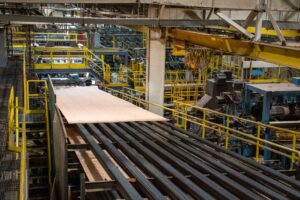 Nanaimo is bracing for the impacts the implementation of the 50% tariffs on billions of dollars in Canadian goods that came into effect on Aug. 22 will have on the local business community. Julie Sperber, the new CEO of the Greater Nanaimo Chamber of Commerce said… it’s clear that many of the region’s forest companies are going to take a big hit. …“Companies like the Harmac Pacific pulp mill won’t be affected as much because much of their products go to Asia, but Coastland Wood Industries are feeling the impacts of US tariffs for the first time.” Secondary-wood products like veneer sheets have been explicitly targeted for the first time. Doug Pauze, president of Coastland, said the company has scaled back production. …Sperber said officials from Western Forest Products and Mosaic Forest Management have planned meetings with government members in Victoria to discuss strategies to deal with the tariffs.
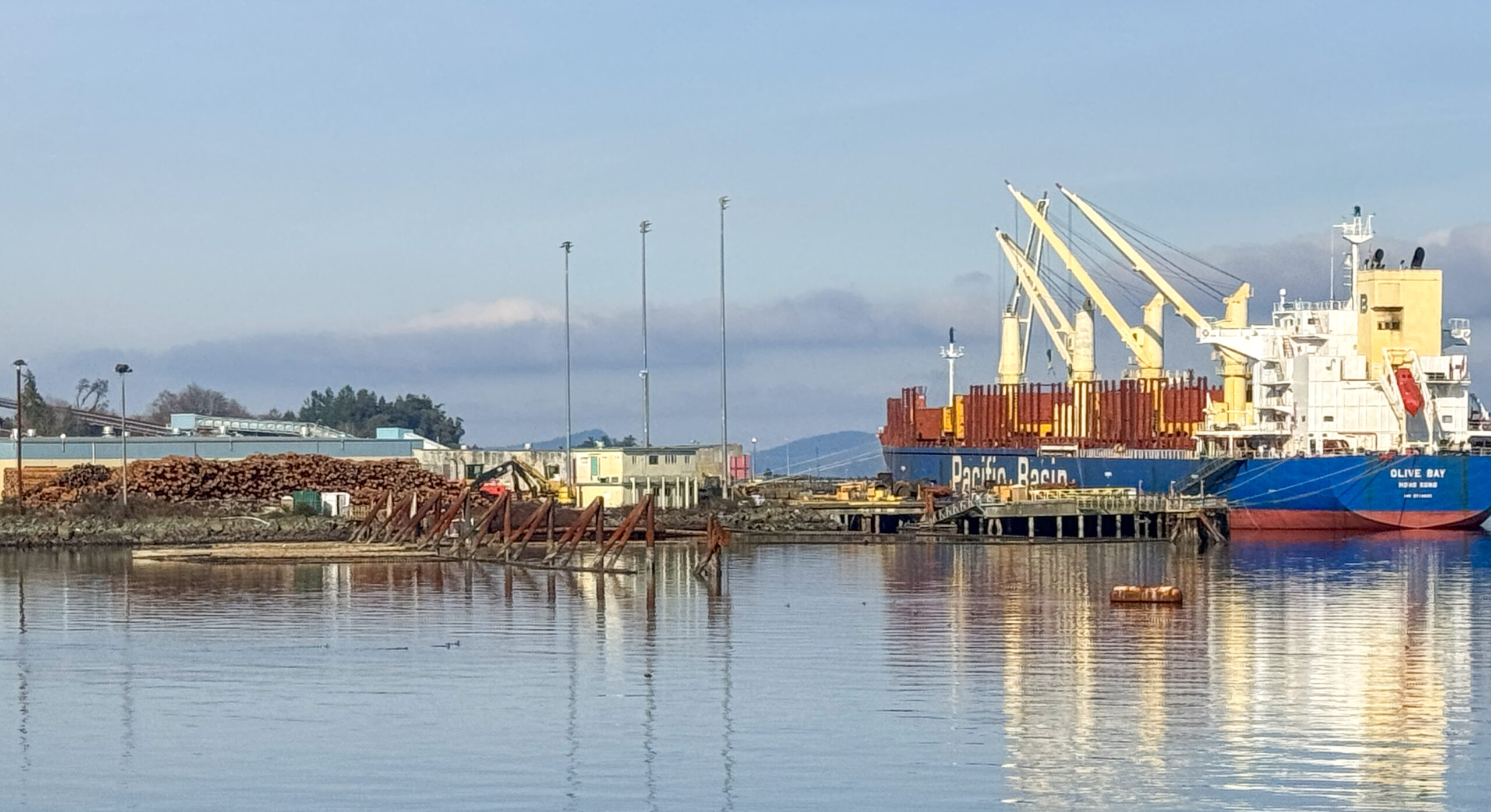 The Member of Parliament for Cowichan-Malahat-Langford is calling on the federal government to explore how it could potentially use the Crofton mill. MP Jeff Kibble is floating the idea of it being used by the Department of National Defense. …On Friday, crews were loading logs onto a ship at its deep sea port. It’s one of the key assets of the property that has the region’s MP calling on Ottawa to consider the property’s purchase. “What I recommended is that the government immediately conduct a feasibility study to see if this is an opportunity to expand the base at Esquimalt. We know that the opportunity to have a deep water industrial site is rare and we also know that the navy is expanding rapidly,” said Kibble. Kibble served in the Royal Canadian Navy for 28 years. …When asked about Kibble’s proposal, Domtar said it’s “exploring a variety of possibilities for the future of the site”.
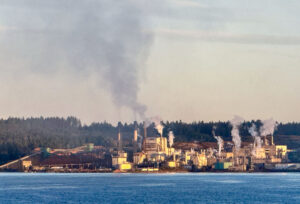 It’s a dynamic moment in time for Nanaimo’s Harmac Pacific pulp mill and the whole coastal forest industry, according to CEO Paul Sandler. Sadler said that the new American 50% tariffs… are not directly impacting Harmac’s operations at this time, but the tariffs’ likely repercussions on the coastal saw and lumber mills… are very worrying. Harmac requires a significant amount of wood chips to produce its high-value kraft pulp that is used globally for tissue, packaging and paper production. …But Sadler said, the biggest news for the forest industry on the B.C. coast recently was the indefinite closure of Domtar’s Howe Sound pulp and paper mill on the Sunshine Coast. …“We need more pulp capacity on the coast to meet the demand than Harmac and the pulp operation in Port Alberni can provide. …Sadler said it’s vitally important that the region’s sawmills get back to operating at full capacity.
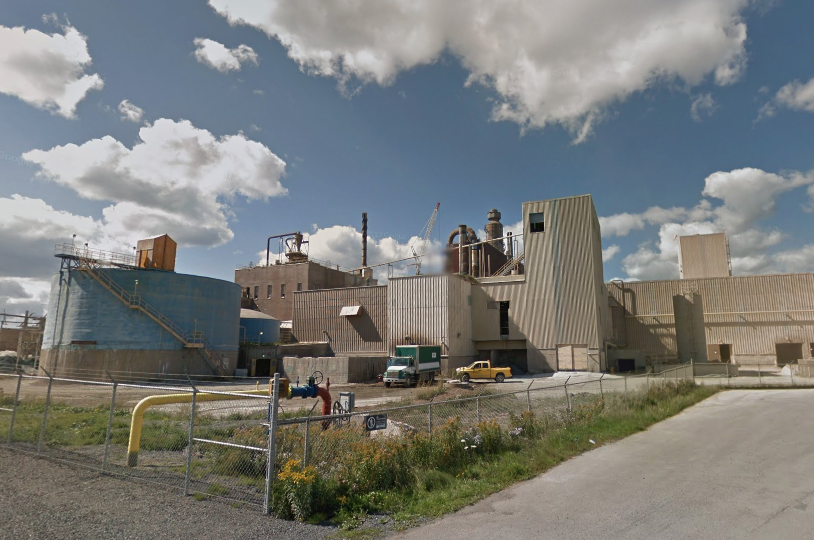

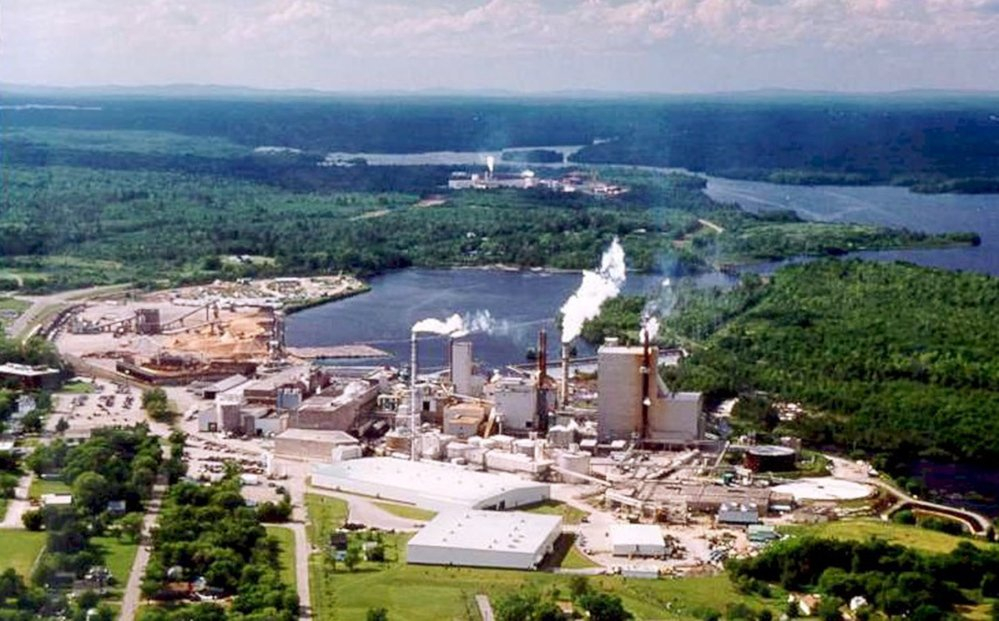
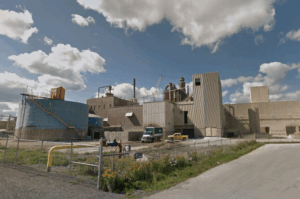 The wrecking ball is readying for the former Northern Pulp mill, a once major player in Nova Scotia’s forestry sector that also came to be recognized as one of the province’s most prominent examples of environmental racism. Environment Minister Tim Halman announced an amended ministerial order on Thursday, clearing the way for the decommissioning, abatement and demolition of buildings and other infrastructure at the site in Abercrombie that sits on the edge of Pictou Harbour. Officials with Northern Timber Nova Scotia, the company that owns the property, expect the work to begin as early as September. …Halman’s amended order says all solid waste, including construction and demolition debris from the mill site, must be disposed of in an approved facility and everything must be removed within 18 months. …An official for Domtar said the work is expected to be complete in the last quarter of 2027,” Brenda Martin said.

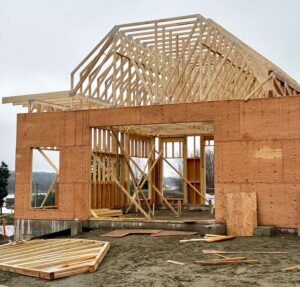 BOISE, Idaho — Tensions between the US and its second-largest trade partner — and Idaho’s top partner — boiled over last month when President Trump lashed out at Canada with a slew of new tariffs. …Canadian officials said last week that they were “targeting” products that would affect certain states as they responded with tariffs of their own. …Idaho exports more goods to its northern neighbor than it does to its next six largest markets — Taiwan, Mexico, Singapore, Japan, China and Malaysia. Agricultural and food products are the state’s top exported goods, and Canada is the biggest market for them. …Wood, paper, pulp and printing products are also on the list of items facing 50% tariffs from both sides. …Idaho imports wood and paper products from Canada more than twice the amount it exports. …Trump’s new round of tariffs is another way to target Canadian wood, which this time affects different types of plywood.
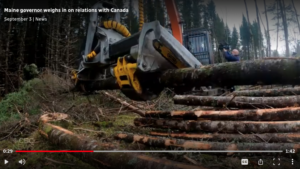 Maine Gov. Janet Mills says tariffs on lumber products have been difficult for the state’s economy to absorb. [CBC video 1.42 min]

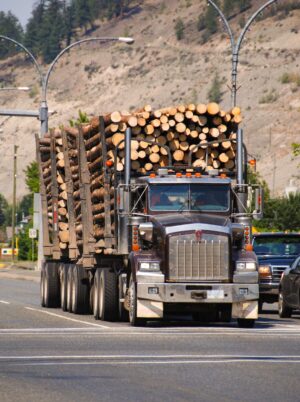 SAVANNAH, Georgia — The South, and Georgia in particular, have borne the brunt of a historic run of pulp and paper-mill closures as recycled boxes, cheap imported pulp and more thrifty packing by e-commerce giants, including Amazon.com, have hit demand. Last year, the US shed roughly 10% of its capacity to produce containerboard. …Demand for pulpwood plummeted. So did demand for wood chips, sawdust and other byproducts. Prices across the South are at the lowest level in nearly 40 years before factoring in inflation. In some parts, there’s essentially no market. Some growers are, for the first time, having to pay to have their pulpwood removed. …A search is on to create new sources of demand. Weyerhaeuser, the South’s largest timberland owner with about 6.6 million acres in 11 states, is spending hundreds of millions of dollars to build facilities in Arkansas and Mississippi to turn pulpwood surpluses into engineered lumber and an alternative to metallurgical coal, respectively. [to access the full story a WSJ subscription is required]
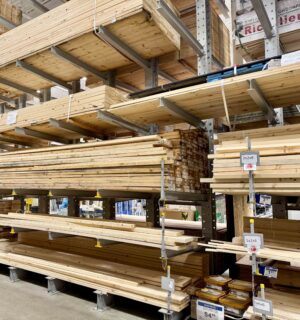 A century-old Philadelphia packaging company is closely watching tariffs and trade negotiations with Canada as it deals with rising costs for materials it uses every day. F. P. Woll & Company, a family business in Northeast Philadelphia, makes packaging for other companies and their products, ranging from cameras to kitchen sinks. Fred Woll runs the company, which has about a dozen employees and a sprawling production operation. …The latest tariffs and trade negotiations with Canada are creating another challenge for the business. One key material the company uses is CDX plywood from Canada. …The company’s concerns extend beyond the materials it needs for its own products. Woll said tariffs on materials used by its customers, including aluminum, can also affect his business if those customers cut production. …Canada is Pennsylvania’s biggest trading partner. Data shows the state sent about $14 billion in goods to Canada last year and imported about $13 billion.
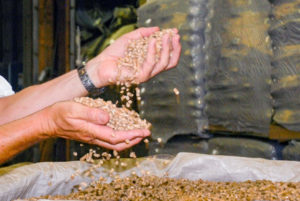 The fight for restitution is on at a fallen green-energy giant, following one of the most disastrous commodity trades of the decade. The ill-fated wood-pellet trades that bankrupted Enviva during the sustainable-investing boom were made by executives hoping to trigger their own bonuses, according to creditors who are seeking more than $2 billion in damages. Instead… the nine-figure trades backfired and bankrupted the company, which once had a nearly $6 billion market value. Five of the company’s top executives concealed the inordinately large and risky trades from its board, according to a lawsuit, suppliers and others with claims. …Enviva said it wasn’t involved in the litigation, and none of the former executives named in the suit are affiliated with the reorganized company, which emerged from bankruptcy in December 2024 with new owners and leadership. …The company was considered one of the winners of the green-energy boom. [to access the full story a WSJ subscription is required]

 Boosting trade with a more diverse array of international partners would only plug part of the hole in Canada’s economy if the U.S. were to withdraw from the North American trade pact, says a new Deloitte Canada report. So Canada must look at measures beyond trade diversification to help make up the difference, such as removing interprovincial trade barriers and fostering new industries, wrote the authors of “
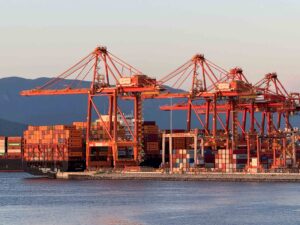 OTTAWA — Canada’s trade surplus narrowed sharply in July as exports of energy and metal products shrank while imports rose, just weeks before Washington’s new 50% tariffs begin to show up in statistics. The trade surplus was C$769 million (US$557 million), compared with a four-year high surplus of C$4.2 billion posted a month ago, Statistics Canada said. Exports dropped 2.3%, while imports increased 2.2%. Amid an escalating trade dispute with U.S. President Donald Trump’s administration, Canada has been seeking to reduce its dependence on its neighbour and largest trading partner. The U.S. accounted for 66.35% of Canada’s total exports in July, down from 69.39% in June and 72.64% a year ago. However, Canada’s import dependence on the U.S. has only narrowed to 59% in the last 12 months compared with 62% in 2024. However, Washington’s latest duties, imposed last month, will provide a tougher test for exporters in the coming months.
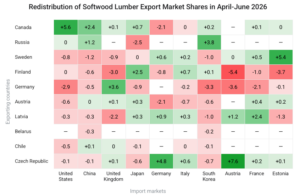 The ten largest softwood lumber import markets imported 16.6 million m3 in April-June 2026. Canada increased its share of U.S. softwood lumber imports by 6 pp, while Germany lost 3 pp of U.S. softwood lumber imports, according to Lesprom Analytics. The ten largest suppliers shipped 15.0 million m3 and held 90% of imports across the ten largest import markets. Canada gained 2 pp of Chinese softwood lumber imports. In the United Kingdom, Germany gained 4 pp and Finland lost 3 pp of U.K. softwood lumber imports. Russia shipped 474 thousand m3 less across the ten largest import markets, followed by Germany at 428 thousand m3 less and Austria at 370 thousand m3 less. In the first half of 2026, the ten largest import markets imported 34.7 million m3. Canada shipped 1.8 million m3 less and Russia shipped 1.2 million m3 less than in the first half of 2025.
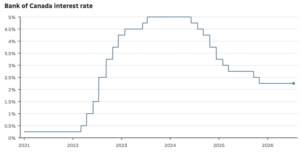 Bank of Canada Governor Tiff Macklem says inflation risk is on the rise, with higher energy costs topping Canada’s incoming dollar-for-dollar tariffs on U.S. goods as the biggest potential driver of rising prices for consumers and businesses. Macklem’s remarks on Wednesday came after Canada’s central bank held its benchmark interest rate steady at 2.25 per cent, as widely expected by economists. The central bank lowered its policy rate to its current level in October of last year. This latest announcement marks seven consecutive times it has left its trend-setting policy rate unchanged. “The counter-tariffs, and indeed the U.S. tariffs … will add costs for some businesses,” Macklem told reporters in Ottawa. “These tariffs are very steep, but they are applied to a relatively narrow base.”The bigger issue, he said, is the war in the Middle East.
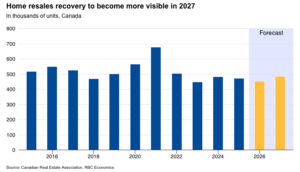 Canadian home resales have been on a winning streak since April, inventory has levelled off, and prices appear to be stabilizing or at least falling more slowly. We see room for further gradual progress ahead as improved affordability and brightening job prospects shore up confidence, increasingly unlocking pent-up demand and slowly draining piled up inventory. But, the path is unlikely to be smooth or uniform across the country. The prolonged market correction in Ontario and BC will take time to heal. And, more resilient regions have little upside left amid stable or rising interest rates and stagnant population growth. …We project home resales and the benchmark price index to fall -3.6% to 453,200 units and -2.3% to $794,200, respectively, this year mainly reflecting weakness this winter and early spring. Recovery will become more visible by 2027 when we forecast transactions to grow 6.7% to 483,600 units, and the benchmark value edges higher by 0.8% to $800,700.
 The Bank of Canada is likely to hold borrowing costs steady, as an escalation in the trade war with the U.S. threatens the economic recovery while adding to inflation risks. Economists and markets expect policymakers led by Governor Tiff Macklem to keep the policy rate at 2.25% on Wednesday. It would be the seventh straight hold — but the mood surrounding the country’s relationship with its top trading partner has changed dramatically since the last one, in July. …“Heightened growth risks from new U.S. tariffs and inflation risks from high oil prices likely created more discomfort for the Bank of Canada since their last meeting in July, but not enough to push them off the sidelines,” Nathan Janzen and Claire Fan, economists at Royal Bank of Canada, wrote. Tariffs will add to inflation while weighing on growth, reviving a dilemma Macklem and his governing council have highlighted throughout the trade war.
 As the dust settles in this tit-for-tat tariff row, what will be affected most on both sides of the border? …Construction materials such as steel, aluminium as well as lumber wood have had tariffs in place before the latest escalation, though Canada has now matched US rates on the metals at 50%. Carney has also imposed import taxes on several US wood products, such as plywood, and even screws used to fix timber together. That means building firms that import such materials will face higher costs and may choose to pass those on through higher prices – pushing up the cost of homes, for example. The Forest Products Association of Canada says tariffs would “raise costs on both sides of the border”, while on the US side, Bill Owens, chairman of the National Association of Home Builders (NAHB) urged Trump to make building materials exempt from his tariff agenda due to an “ongoing housing affordability crisis”.
 New US tariffs on Canadian wood products threaten to raise construction costs for US homebuilders and squeeze supply chains already stretched thin as a potentially long and bruising trade war gets underway. …“Basically, the fact that there’s import tariffs on Canadian shipments to the US and vice versa is going to raise the cost of production for everyone, ultimately through the housebuilder to the consumer,” wood market expert Russ Taylor told Mortgage Professional America. …The full impact on homebuilders could take a few months to become clear but the direction of travel is clear, he said. “The builders either can’t find product or the prices go higher for certain products, and then that starts to influence homebuilders,” he said. “Probably not right away – everyone’s got inventory to sell – but certainly looking ahead a couple of months from now, that’s when some shortages or stockouts could start to occur.”
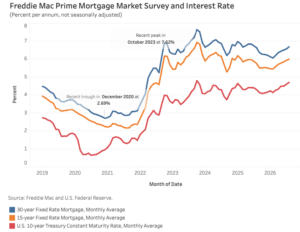 Mortgage rates increased in August as Treasury yields remained elevated amid persistent inflation concerns. According to Freddie Mac, the 30-year fixed-rate mortgage averaged 6.67% in August, up 13 basis points (bps) over July. Since the conflict in the Middle East began, the 30-year mortgage rate has jumped by more than 60 bps. The average 15-year rate averaged 5.98% in July, up 7 bps from July and 55 bps from the end of February. Mortgage rates are now roughly on par with their levels a year ago, with the 30-year rate 6 bps higher and the 15-year rate 24 bps higher. The 10-year Treasury yield, a key benchmark for long-term borrowing, rose 10 bps to an average of 4.68% in August, Yields rose in the later part of the month amid a broader selloff in global government bonds.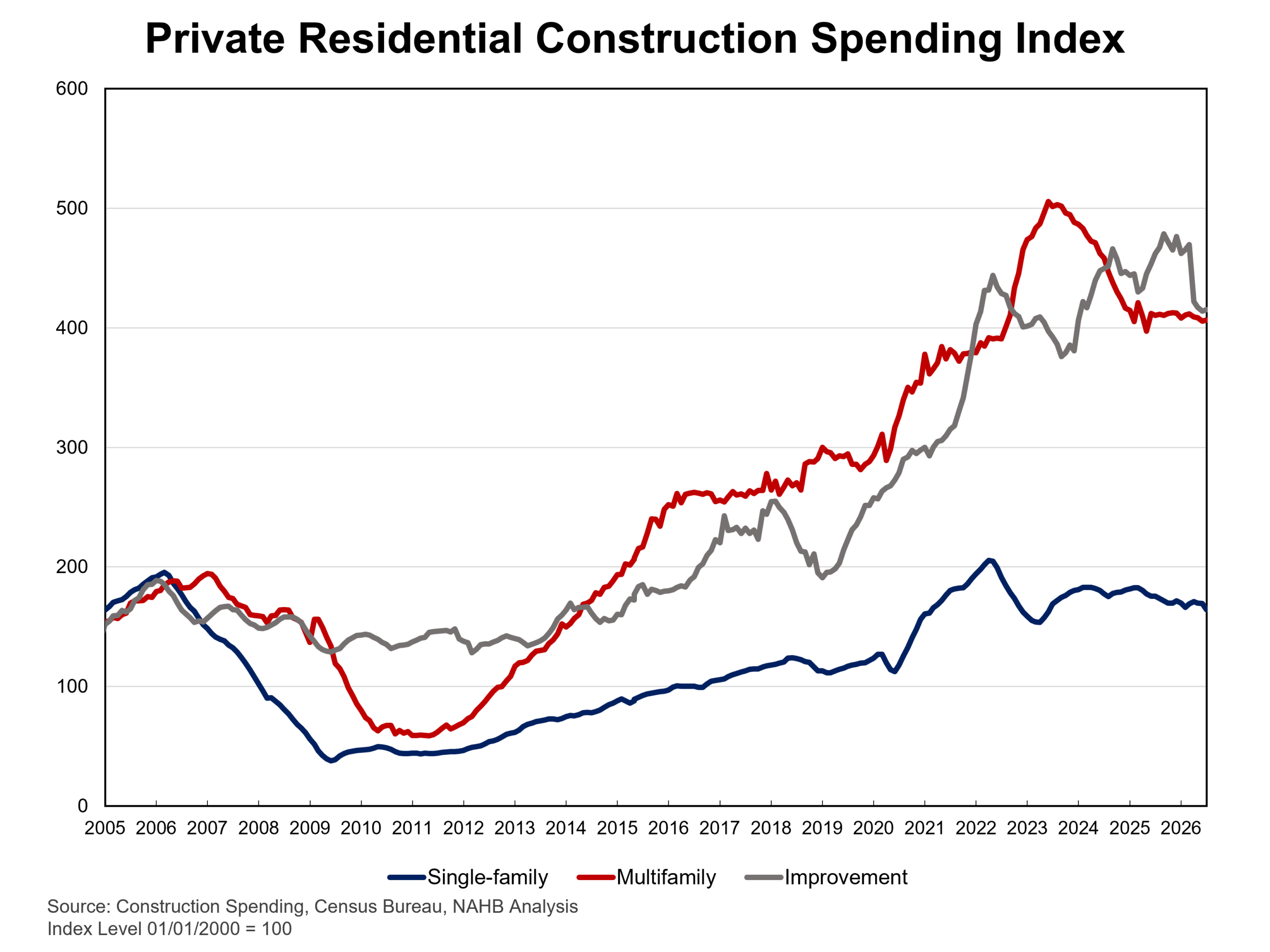
 NEW YORK
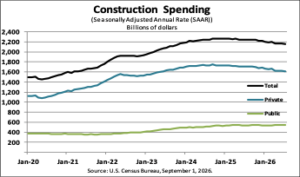 Construction spending during July 2026 was estimated at a seasonally adjusted annual rate of $2,157.6 billion, 0.5 percent below the revised June estimate of $2,167.7 billion. The July figure is 3.8 percent below the July 2025 estimate of $2,242.6 billion. During the first seven months of this year, construction spending amounted to $1,244.6 billion, 3.5 percent below the $1,289.7 billion for the same period in 2025. …Spending on private construction was at a seasonally adjusted annual rate of $1,614.2 billion, 0.5 percent below the revised June estimate of $1,622.9 billion. Residential construction was at a seasonally adjusted annual rate of $859.0 billion in July, 1.3 percent below the revised June estimate of $870.6 billion. Nonresidential construction was at a seasonally adjusted annual rate of $755.2 billion in July, 0.4 percent above the revised June estimate of $752.4 billion.
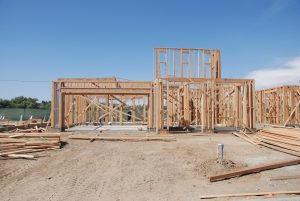 CAPITAL REGION, New York — Starting next week, Canadian retaliatory tariffs are taking effect. The tariffs are up to 50% on American products. The tariffs are projected to impact $20 billion worth of American goods; materials like lumber, steel, and dairy could be the hardest hit. We see data coming out of the Fed that shows that 90% of the costs of tariffs are passed along to, you know, U.S. businesses and consumers,” said Justin Wilcox, of Upstate United. “That’s having an impact on people’s pocketbooks at a time when they can least afford it.” …The National Association of Home Builders predicts a $10,000 to $14,000 increase per home. …According to an April 2026 report from the New York State Comptroller, Canada is the state’s most significant trading partner. In 2025, exports to Canada declined by $3.8 billion due to tariffs.
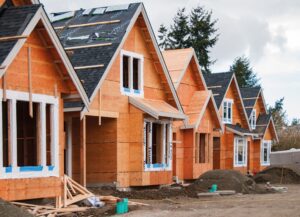
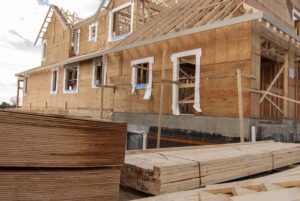 BUFFALO, New York — The changing tariffs policies for the U.S. and Canada are raising cost and supply issues for the home building and remodeling field with possible impact on their customers for planned and future projects… said a contractor and the operator of a lumber and building supplies business. …Domenic Cortese, of Cortese Construction, said “The implications to a new home on the costs of that home are about $10,000 more because of the tariffs. You know you’re probably going to be looking at $2,000 or $3,000 more in lumber costs for a deck just because of the tariffs.” …”The problem is we don’t have the infrastructure in place to ramp up productivity to be able to supply lumber for our needs.” …Lenco’s Stephen Coppola said, “We love the Canadian lumber. Our customers tend to like it quite a bit. But we’ve been very active in trying to find other sources.”
 Japan’s housing starts increased 8.2% year-on-year in July 2026, slowing significantly from an 18.6% surge in the previous month. Still, the latest reading marked the fourth consecutive month of growth, surpassing market expectations of 7.9% growth. Owner-occupied homes rose just 0.4% (vs 15.7% in June), while rental housing growth eased markedly (10.0% vs 24.6%). In the meantime, built-for-sale homes continued to grow solidly (14.6% vs 14.2%). At the same time, starts of two-by-four homes fell further (-8.5% vs -7.4%), while prefabricated housing starts dropped 6.9%, reversing a 13.7% gain in June.
 Canada’s nascent mass timber industry escaped a direct hit from the Trump administration… But steep US levies on the wider Canadian forestry sector still present sizable challenges for manufacturers as they chase a global market for engineered wood forecast to grow to more than US$12 billion by 2035. …Engineered-wood products such as CLT and glulam were left off the latest tariff list. Yet the emerging mass timber industry could feel the “broader hit”. “Mass timber does not become mass timber without the raw wood inputs,” said FPAC’s Derek Nighbor. …Canada Wood knows what it takes to develop a market for Canadian lumber products in China and other Asian nations. But CEO Bruce St. John cautioned that shifting exports to markets other than the US will “take years still” and require more than simply shipping Canadian lumber to overseas buyers. …Canada Wood’s Lance Tao noted, Canada’s opportunity in Asia’s engineered wood market is still less about shipping finished “modules” to the region and more about selling lumber to Chinese mass-timber manufacturers.
 Certain forces affecting the built environment are beyond human control. …At the same time, increasingly stringent fire- and life-safety requirements have raised expectations for structural systems performing under multiple hazard conditions. For decades, steel and concrete have been the default materials for meeting these demands. However, in recent years, timber construction has emerged as a viable engineered system capable of meeting prescribed wind-load criteria and code-required fire-resistance standards, offering construction professionals a viable solution for mitigating risk and protecting both buildings and occupants. …Heavy timber and mass timber can withstand extreme wind and fire through a combination of material properties and engineered design. Timber’s ductility allows it to absorb and distribute wind forces, while high-wind connectors, hold-downs, and continuous load paths help resist uplift and lateral loads during hurricanes. …Code-recognized fire-resistance design, appropriate member sizing, tested assemblies, and protective materials allow timber systems to meet rigorous life-safety requirements.


 With the US imposing new tariffs on select Canadian exports, North Carolina State University experts warn that the escalating trade war could raise the price and reduce the quality of toilet paper and other tissue products. …Canadian NBSK is a critical raw material in global tissue manufacturing, accounting for roughly 15% to 30% of the fiber blend in premium bath tissue products and 50% to 65% in premium paper kitchen towels. Brazilian eucalyptus fiber makes up the remaining share. Gonzalez said the 50% tariff on Canadian NBSK could raise manufacturing costs for premium toilet tissue by 11% to 20%, while costs for premium paper kitchen towels could increase by 31% to 38%. …“If tissue producers choose to switch to Southern Bleached Softwood Kraft, the softness of premium tissue products will be compromised,” Jameel said. On the other hand, Gonzalez said the tariffs could create an opportunity to use more local fibers for tissue manufacturing, though they are less soft than northern softwood.
 Hundreds of trees have been found embedded with metal spikes in Vancouver Island’s upper Walbran Valley, according to a court ruling that extends an injunction against a logging blockade there until early 2028. The BC Supreme Court court ruling says the blockade activity has included vandalism of logging equipment and tree-spiking incidents, in which two fallers had their chainsaws damaged beyond repair when they struck spikes on Aug. 18. Last Friday’s ruling says the loggers weren’t injured, but tree spikes carry “significant risk of injury or death”. Investigations found several hundred trees in Tsawak‑Qin Forestry’s cutblocks had been embedded with spikes, many with their heads cut off and bark placed over the top. …Tsawak‑Qin Forestry’s activities in the upper Walbran Valley have been disrupted by protesters opposed to old-growth logging since August 2025. Justice H. William Veenstra’s ruling says “the new evidence establishes that there continues to be irreparable harm suffered by Tsawak-Qin”.
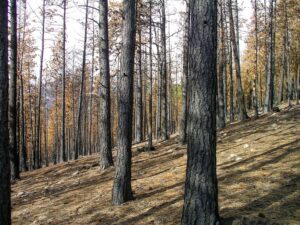 Forestry critic and B.C. Conservative MLA for Kamloops-North Thompson Ward Stamer wants to see the province salvage more wildfire-burned wood faster. He said that only about 5% of burned wood is logged on average in B.C. following a wildfire — a number he’s prefer to see rise to 25%. The former logger said he also wants to see cutting license issued faster, noting most burned trees are useless if not harvested within two years. …Stamer said once a trees dies, it begins deteriorating and each species does so at different rates. He said most burned trees that aren’t harvested within two years may only be good for low value chips, as opposed to other products such as plywood, veneer and saw logs. …Forestry Minister Ravi Parmar said the salvage rate is closer to eight to 10%. Parmar said the province is always trying to increase its salvage rate.
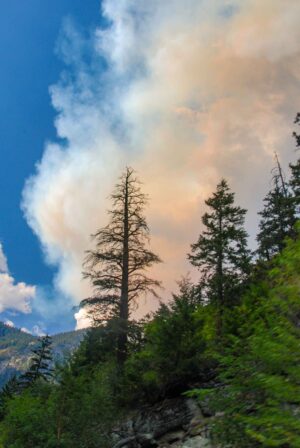 The province has ended its state of provincial emergency. The state of emergency was first declared Aug. 8 following a night of fast-moving fires, including the Bald Range wildfire that led to the evacuation of the District of Summerland. At the time, more than 20,000 people were evacuated from their homes. It was then extended Aug. 21 through to Aug. 29, but the province says the decision to end it early follows advice from emergency management officials. However, the province says the wildfire risk in B.C. remains high. The ending of the state of emergency has no effect on the current evacuation orders, evacuation alerts or local states of emergencies put in place by local governments or First Nations.

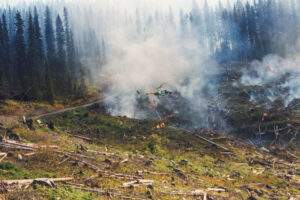 In Oregon’s Tillamook State Forest, a group of incarcerated men gathered around an instructor warning them about the dangers of an over-pressurized firefighting hose. …Such were the risks that these men were willing to take to avoid sleeping in a prison cell. “It’s dangerous, but that’s why we train, and we train hard,” said Jason Russell, a 41-year-old from Salem incarcerated at the South Fork Forest Camp, a state prison. In a few weeks, many of them would be on fire lines alongside thousands of other firefighters battling what would become a record-breaking fire season in Oregon. …But while most firefighters make $25 an hour on the fire line, Oregon’s incarcerated firefighters earn $25 a day. …Inmates earn wildland firefighting certifications and gain experience, which can help with employment opportunities after their prison term ends. Oregon is one of seven states that use prison labor to fight wildfires.
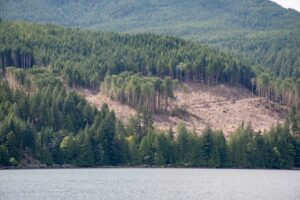 OREGON — The 2021 floods in British Columbia’s Fraser Valley caused upwards of $14 billion in damages. Since then, communities have brought lawsuits against logging companies and the provincial government, blaming them for logging practices that made flooding worse. Over the past 50 years throughout B.C., clear-cut logging has been the primary method of timber extraction across watersheds of all sizes. Floods are happening more often and are becoming more expensive, and unlike the storms that help trigger them, clear cutting and the associated cumulative impacts are something we can manage. When watersheds are assessed for flood risk, the question often asked is a simple one: How much of the watershed has been logged? …
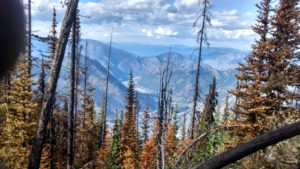 ARIZONA — US Interior Secretary Doug Burgum said that misguided forest management policies played a role in the recent deadly flash floods at the Grand Canyon. Burgum said that a failure to properly manage protected forest areas contributed to the potency of last year’s Dragon Bravo Fire on the North Rim, which in turn increased the risk of flash flooding on the canyon’s floor. “When the forest has been burned through, you get a lot of runoff,” Burgum said. …The Dragon Bravo Fire burned nearly 150,000 acres last summer. …A Dept. of the Interior Burned Area Emergency Response Team conducted a postfire assessment in August 2025. The assessment found that the burn scar would increase the water runoff and debris flow in Bright Angel Creek, but “they are unlikely to significantly impact values-at-risk under normal storm conditions.” Burgum, however, said the Dragon Bravo Fire and Saturday’s Bright Angel Creek flooding are connected.
 OLYMPIA, Washington – The Washington Forest Protection Association (WFPA) and Washington Farm Forestry Association (WFFA) will appeal a Thurston County Superior Court decision upholding the state’s expanded buffer rule for non-fish-bearing (Np) streams. The appeal will ask whether forest-practices rules can be changed without first showing that existing protections are failing to protect fish and water quality. WFPA and WFFA said the state’s own record shows expected downstream benefits to fish are negligible to minor, and Ecology acknowledged the expanded rule may still allow temperature changes in non-fish streams. “This is not a conservation win if the state’s own record shows limited fish benefits, and immense harm to working forests and rural communities,” said Jason Spadaro, Executive Director of WFPA. …Elaine Oneil, Executive Director of WFFA. “If a rule strands harvestable timber or makes a parcel uneconomical to manage, that harm cannot be fixed later.” …The court has ruled, but policy questions remain.
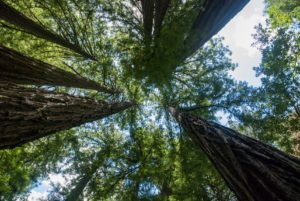 CALIFORNIA — Tall trees are generally associated with high-biomass forests. This is particularly true for forests dominated by Sequoia sempervirens, the world’s tallest tree species. Extreme decay resistance, the ability to survive high-severity fires, shade tolerance and prolific trunk reiteration (resprouting) make the species unique, allowing tall redwood forests to accumulate more biomass and store more aboveground carbon than any other vegetation type. …A new study published in Forest Ecology and Management combined ground-based measurements and repeated (2007–2025) airborne laser scanning (ALS) to inventory the tallest redwoods and quantify forest biomass. …Forest biomass changed substantially over time. Large areas of primary forest gained biomass during the prestorm interval (2007–2022), averaging 10–13 metric tons per hectare annually. …These ALS-derived estimates of biomass change may be somewhat exaggerated. …Nonetheless, the amount of crown damage probably rivaled losses of live-tree biomass to treefall in California’s Redwood National and State Parks.
  A new chapter for FSC in New Zealand is taking shape, with New Zealand-based members unanimously voting to join Australia under a shared Australia and New Zealand’s (FSC ANZ) governance model. This decision marks an important milestone for FSC across the region, solidifying a formal role for New Zealand-based members in FSC Australia and New Zealand’s governance and laying a stronger foundation for expanding FSC’s work, engagement, and impact in New Zealand. …New Zealand-based directors will be added to the FSC ANZ Board at the next Annual General Meeting to strengthen New Zealand’s representation and voice across the organisation’s Environmental, Social and Economic chambers. …FSC ANZ is planning to establish a dedicated presence in New Zealand, adding a new team member based in the country to work closely with members, certificate holders and stakeholders on the ground. …For FSC, New Zealand is a crucial part of the organisation’s future.
 Canadians will have to prepare for a future that’s 5 C hotter, according to a new report summarizing the latest science on climate change. The second edition of
  Mark Carney government is arguing in court that the signature piece of Justin Trudeau’s climate action plan — the Canadian Net-Zero Emissions Accountability Act — is unenforceable. Also, that it’s not the job of the courts to rule on federal climate policy. That may come as a shock to Canadians who remember the Trudeau government crowing when the Supreme Court ruled in 2021 that Trudeau’s carbon pricing law was constitutional, after it was challenged by Ontario, Alberta and Saskatchewan as an intrusion into provincial authority. But that was then, and this is now.
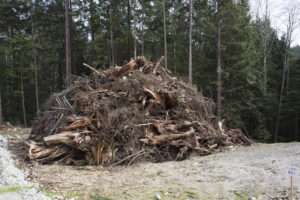 GEORGIA — A peer-reviewed University of Georgia study has found that rural forest landowners in the southeastern United States do not assess wood-based bioenergy or climate change solely through economic considerations. Their views are shaped by political beliefs, cultural values, personal experience, trust in markets and perceptions of local communities, the researchers reported in 2025. The study, published in the journal